
BuddhistCatholicContemplativeEvangelicalGeneral ChristianHinduJewishLatter-day SaintMuslimNew VisionsProgressive Christian
Beliefs
- Buddhist
- Catholic
- Contemplative
- Evangelical
- General Christian
- Hindu
- Jewish
- Latter-day Saint
- More Voices
- Muslim
- New Visions
- Pagan
- Progressive Christian
Topics
- Religion News
- Food and Religion
- Sports and Religion
- Religious Art
- Religious Music and Entertainment
- Religious Events
- History and Religion
- Style and Religion
- Politics and Religion
- Women in Religion
- Recreation Outdoors and Religion
- Business Finance and Religion
- Careers Workplace and Religion
- Education and Religion
- Family Parenting and Religion
- Health Fitness and Religion
- Home and Religion
- Relationships and Religion
- Technology and Religion
- Travel and Religion
Columnists
- Buddhist Columnists
- Business Finance and Religion Columnists
- Careers Workplace and Religion Columnists
- Catholic Columnists
- Contemplative Columnists
- Education and Religion Columnists
- Evangelists Columnists
- Family Parenting and Religion Columnists
- General Christian Columnists
- Health Fitness and Religion Columnists
- Hindu Columnists
- History and Religion Columnists
- Home and Religion Columnists
- Jewish Columnists
- More Voices Columnists
- Latter Day Columnists
- Muslim Columnists
- New Visions Columnists
- Nonreligious Columnists
- Pagan Columnists
- Politics and Religion Columnists
- Progressive Columnists
- Recreation Outdoors and Religion Columnists
- Relationships and Religion Columnists
- Religion News Columnists
- Religious Art Columnists
- Religious Events Columnists
- Religious Music and Entertainment Columnists
- Sports and Religion Columnists
- Style and Religion Columnists
- Technology and Religion Columnists
- Travel and Religion Columnists
- Women in Religion Columnists
Resource Library
- 2026 Calendar
- Library of World Religions
- The 100 Most Holy Places on Earth
- Patheos Answers
- Podcasts
- Videos
- Faith Leaders Database
- Anglican Episcopalian
- Bahai
- Baptist
- Buddhism
- Christianity
- Confucianism
- Eastern Orthodoxy
- Hinduism
- Holiness and Pentecostal
- ISKCON
- Islam
- Judaism
- Lutheran
- Methodist
- The Church of Jesus Christ of Latter-day Saints
- New Age
- Paganism
- Presbytarian and Reformed
- Protestantism
- Religion Behind the Scenes
- Roman Catholic
- Scientology
- Shia Islam
- Sikhism
- Sufism
- Sunni Islam
- Taoism
- Zen
- See all religions
Research Tools
 Ad-Free & Subscriber Log-In Subscription Support
Ad-Free & Subscriber Log-In Subscription Support
Follow Patheos 

- Trending:
- Forgiveness
- |
- Marriage
- |
- Consciousness
- |
- Death Penalty
- |
- Election
- |
- Halloween
 Looking Closer
- Home
- Religious Music & Entertainment
- A Three-Star Rant About Thumbs (or, Why I Won’t “Rate” Movies)
A Three-Star Rant About Thumbs (or, Why I Won’t “Rate” Movies)
Last updated on: October 4, 2012 at 9:14 pm by Jeffrey Overstreet
A Three-Star Rant About Thumbs (or, Why I Won’t “Rate” Movies) 2012-10-04T21:14:27-06:00 Jeffrey Overstreet
Patheos Explore the world's faith through different perspectives on religion and spirituality! Patheos has the views of the prevalent religions and spiritualities of the world.
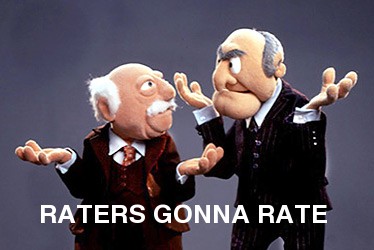 Have you seen the new film-review site called Letterboxd? I like it. A lot. I need a convenient online moviegoing journal, and it provides that.
But most of my colleagues who are chronicling their reviews there are rating movies with stars or “likes.” I just can’t bring myself to start any such thing. So it’s time to say again what I said at Filmwell a few years ago… I think “rating” movies does us all more harm than good.
Here’s how I explained that at Filmwell in April of 2009…
–
I recently said farewell to a coworker who moved on to another job. We weren’t close, but we did chat occasionally about the movies we were seeing. One of his parting comments to me was, “You should sign up on Flixster.”
“Oh, I did,” I said. “For a while. But I don’t know… I got bored with just clicking stars all the time.”
“Ohhhh,” he said with deep disappointment. “You really should stick with it. I like your taste in movies, and when I’m gone, I want to know what you think of new movies, so I can decide what to see.”
I remember thinking, Well… why then would you go to Flixster, which is primarily a place for me to sum up my opinion of a film by clicking on one of five possibilities on a meter?
Fortunately, I didn’t voice my snarky, impulsive answer. After all, some people do post thoughtful reviews on Flixster, right underneath the star-rating they’ve selected for the film. But have you ever taken much time to read those reviews? I confess, I’ve never bothered to read beyond the opening sentence from one of those bazillion star-clicking users.
I’m not criticizing Flixster reviewers. I’ve rated a lot of films there myself. But you won’t learn anything about the films, or my interpretation of them, by scanning those ratings. You’ll be starry-eyed, but uninformed. I burned out on that game a long time ago, even though Netflix continues to hassle me for star-ratings of everything I see through their wonderful service.
That’s because I want to read perspectives and interpretations… not assessments of “I liked it” or “It sucked.” When I was a child watching Siskel and Ebert, the thumbs-up/thumbs-down was a suspenseful gimmick; I couldn’t wait to see the sparks fly when the critics’ thumb-ation of the film put them odds. But it was what they said beyond that, the thought process that inspired the thumb-arization, that affected me. They taught me that people could disagree on a film without one person being Right and the other person being Wrong.

One of the things I like best about writing on cinema for Filmwell, or Image, or Looking Closer, is that I know that nobody’s going to be able to say “Overstreet gave The Last Temptation of Christ four stars.” Of what possible use would such a rating be?
Truth is, when I have been asked to “rate” The Last Temptation of Christ, I’ve consistently given it four stars. Doing so has earned me some snarky responses and even a few blasts of outrage. Some of those disgruntled readers have criticized me for not recognizing that Last Temptation is not as well-crafted as Scorsese’ s greatest works. In fact, I happen to agree. Some have hurled abuse at me for “promoting” a film that represents a flawed understanding of Jesus. In fact, I too happen to have some arguments with the theological ideas of the author whose novel inspired the film.
What was I thinking, giving Last Temptation four stars? Was I telling the world I thought it was a work of surpassing excellence? That’s not what I meant to convey. Was I telling the world that I thought it was a profoundly true depiction of Christ? That isn’t what I meant either.
What did I mean? I’m not sure. We’d need a long walk and probably a stiff drink before I ramble my way through a summation of how the film affected me, and why. It moved me deeply… at times. It made me wrestle with difficult questions… at times. Certain aspects of its creative collaboration dazzled me… at times. I was enthralled with the experience of seeing skeptical artists wrestle with the mystery of the Word Made Flesh. Such complex, revealing encounters with art are rare in my experience. So I certainly wasn’t going to stick Last Temptation with a three-star “ho-hum.” That would put it on par with enjoyable mediocrities like, oh, Die Hard with a Vengeance. Which I liked.
Does four-stars mean I like the movie? I like a lot of mediocre films. Cast your judgments if you must.
Does four-stars mean I consider a film a great work of art? There are a lot of films that I find almost unbearable to sit through, personally, that I also recognize to be great works of art. I admire Citizen Kane and have no argument with critical assessments that weigh it as one of the most influential and important films ever crafted… but I do not enjoy it much. So shoot me. What rating should I give it?
When most people ask me, “Did you like _______?” I tend to think they’re asking “Was it entertaining?” Often, when I begin to describe my experience, their grins fade and they start to slowly back away. They didn’t want more than a one-word answer. And most of the time, trying to wrap up my thoughts about a movie into a few lines is about as easy as folding soup.
When asked what kind of rating I give Brian Dannelly’s Saved!, the comedy about hypocrisy and peer pressure in a Christian high school, my response is this: “For whom am I rating it?” For an audience of Christians, I’d probably give it four stars — I think the film will provoke fruitful discussion for them. For an audience of the general public, I’d only give it three — it’s full of great ideas, but there’s nothing remarkable about the cinematography or the acting or the soundtrack. And the ending is cheap and sentimental. Even so, how can I be sure that either answer would convey any of my thoughts about the film?
I recently reinvented my website and I’m still in the slow, tedious process of restoring all of my film reviews for the archive there. As I do, I’m leaving behind my own rating-system. Granted, it was not a star-rating system… it was more like a school report card. When I eliminated this piece of the archive, it provoked a few complaints from readers. I don’t really care: I want people to care about the reviews, or move on.
Encounters with art cannot be reduced to numbers.
In fact, even a full film review only scratches the surface, giving a sketchy impression of a viewer’s thoughts and feelings at that particular moment. In my experience, feelings and thoughts about a work of art evolve. I might write pages of praise after seeing a film the first time, and then revise my thoughts later when I find that the film doesn’t offer anything more on the second time through, or when I find that the cracks begin to show upon closer examination.
“The truth must dazzle gradually,” wrote Emily Dickinson. How many times have we seen, over the course of a few decades, that a film initially dismissed was, in fact, a work of genius?
How many recognized, upon the release of Blade Runner, that it would stand as one of the most influential and beloved science fiction films in cinema history? We are only just now starting to see that it has a remarkable, lasting quality, and that it speaks not only to the people in the theater, but to generations.
How many of us even remember that Chicago won Best Picture at the Oscars just a few years ago? How many of us look back at A Beautiful Mind, which won Best Picture, and say, “That was truly one of the finest works of filmmaking in this decade?”
In 2004, David Hare asked,
… why does a self-respecting critic agree to a system of grading that renders his or her detailed reaction superfluous? “What did the Guardian think of it ?” “Oh, they gave it two stars.” Why would any critic let their presumably thoughtful work be so diminished?
Similarly, Kim Newman at BBC, in the post that inspired this rambling rant, writes that star ratings are
…a substitute for thought, insight, debate, and even consumer advice…
Newman also says,
I think star ratings are for people too busy to read or stupid to understand the actual review.
Many thanks to the film critics who have drawn me in with thoughtful analysis, with imaginative prose, and with insight that shows they really took the time to think things through. Roger Ebert, Jonathan Rosenbaum, Steven Greydanus, Doug Cummings, Ron Reed, Michael Sicinski, Matt Zoller Seitz, to name just a few, not to mention the contributors here at Filmwell. I’ve learned as much from movie reviewers as I have from filmmakers. I’ve learned about paying attention, about plot and character development and color and commerce. I’ve found new lenses through which to understand films that frustrated or befuddled me. And I’ve had some of my most fundamental convictions about art, life, politics, and even faith challenged by things I’ve read in considerations of artists as varied as Kieslowski, Tarantino, Spielberg, Jarmusch, Ozu, Kubrick, and Miyazaki.
I also greatly appreciate those who write with a humility that suggests their perspective is their own… and thus limited, personal, and inseparable from their own experiences, preferences, and passions. Ater all, despite what you’ll read in many reviews, no one person has the authority to describe a film with words like “Most” or “Best” or “Classic.”
Oh, how critics love superlatives. I think I’m developing an allergy. I look back at certain reviews from the ’90s and I get sick to my stomach at the shows of arrogance — particularly because I wrote those reviews. “The best film of the year so far.” Who has the authority to say such a thing? Who has already seen all of the films this year has to offer? Who ever will see them all, and be able to make such a pronouncement?
Blurb-ready superlatives do more to exalt the critic’s sense of self-importance, I suspect, or their eagerness or attention, than they do to convey anything truly meaningful about the film in question.
I recently invited people to comment at my blog, and to share what it is they appreciated about the film WALL-E, because I found it to be a film full of things to admire and enjoy. Some of those comments failed to convey much at all that was informative. Some merely declared that it was “one of the greatest movies ever made.” This is not helpful, except in convincing me that the person making the comment is enthusiastic… and probably prone to exaggeration.
I have continued to publish lists of my “personal favorites” for each year. I take great pains to explain them as accounts of those titles that have meant a great deal to me for whatever reason. But even so, I worry that I’m suggesting these are the Greatest Works of Art… or the films that I recommend most highly to anybody. Some of the films I treasure are films I wouldn’t recommend to very many people at all. How does one rate an experience like David Lynch’s Inland Empire?
I am writing this more out of regret for things I’ve published in the past than out of annoyance with any particular critic, so please, fellow moviegoers, don’t take this personally. Heck, most of my favorite film critics still use stars or point systems.
But ask yourself: Have you ever seen a rating system that was actually helpful? A system that helped you come to understand and appreciate films more deeply?
If so, do share. Perhaps it will catch on.
(Thanks to Joseph Hollies for the links to Newman and Hare.)
Previous Post

September 29, 2012
This Blog's New Address
Next Post

October 4, 2012 Winners of Auralia's Fifth Anniversary Contest (Correction)
Browse Our Archives
Select a Category Blog Bloggers on "Through a Screen Darkly" Browser Coming Soon Endorsements Fiction Books Film Forum Film Reviews Inspirations Interviews Journal Kindlings Muse Movie buzz Music Reviews Non-Fiction Books radio Reviewers on "Through a Screen Darkly" The Auralia Thread Through a Screen Darkly Through a Screen Darkly - Bonus Materials Top 10 (or 20 or 100) lists Uncategorized
Select a Month June 2015 May 2015 April 2015 March 2015 February 2015 January 2015 December 2014 November 2014 October 2014 September 2014 August 2014 July 2014 June 2014 May 2014 April 2014 March 2014 February 2014 January 2014 December 2013 November 2013 October 2013 September 2013 August 2013 July 2013 June 2013 May 2013 April 2013 March 2013 February 2013 January 2013 December 2012 November 2012 October 2012 September 2012 August 2012 July 2012 June 2012 May 2012 April 2012 March 2012 February 2012 January 2012 December 2011 November 2011 October 2011 September 2011 August 2011 July 2011 June 2011 May 2011 April 2011 March 2011 February 2011 January 2011 December 2010 November 2010 October 2010 September 2010 August 2010 July 2010 June 2010 May 2010 April 2010 March 2010 February 2010 January 2010 December 2009 November 2009 October 2009 September 2009 August 2009 July 2009 June 2009 May 2009 April 2009 March 2009 February 2009 January 2009 December 2008 November 2008 October 2008 September 2008 August 2008 July 2008 June 2008 May 2008 April 2008 March 2008 February 2008 January 2008 December 2007 November 2007 October 2007 September 2007 August 2007 July 2007 June 2007 May 2007 April 2007 March 2007 February 2007 January 2007 December 2006 November 2006 October 2006 September 2006 August 2006 July 2006 June 2006 May 2006 April 2006 March 2006 February 2006 January 2006 December 2005 November 2005 October 2005 September 2005 August 2005 July 2005 June 2005 May 2005 April 2005 March 2005 February 2005 January 2005 December 2004 November 2004 October 2004 September 2004 August 2004 July 2004 June 2004 May 2004 April 2004 July 2003 May 2003 March 2003 September 1999
Follow Us!
TAKE THE
Religious Wisdom Quiz
Who found baby Moses in the river?
Select your answer to see how you score.
Pharaoh’s daughter Miriam Pharaoh himself An Egyptian priest
Related posts from Looking Closer

This Is Not Goodbye. But It is... See...


What Specialists Are Saying About Jurassic World

Torres and the Influence of David Bazan and...
TRENDING AT PATHEOS Religious Music & Entertainment

"Les Diabolique" and Transgression
Alongside something like Arrival, Vertigo, or Charade, Les Diaboliques is a...

"The Plague Dogs" and Mortality
So, flashback to the late 70s, early 80s. Walt Disney Studios is...

With the recent and highly successful release of Christopher Nolan’s epic film,...

"L'avventura" and Human Weakness
Today's piece is going to be a little different for a few...

I first want to apologize for not posting or writing anything. I'm...

I've engaged in the multi-year project of reading through the Church Fathers,...
view all Religious Music & Entertainment blogs
Ad-Free & Subscriber Log-In Subscription Support
- About Us
- 2026 Calendar
- Videos
- Podcasts
- Library of World Religions
- Faith In Media Tracker
- Advertise With Us
- Write for Us
- Privacy Policy
- Terms of Service
- Do Not Sell My Data
- Contact Us
- Radiant Digital
- Manage Newsletter Subscriptions
- Unsubscribe From Notifications
- Sitemap
Copyright 2008-2026, Patheos. All rights reserved.
Subscription Support Ad-Free & Subscriber Log-In
Follow Patheos