
BuddhistCatholicContemplativeEvangelicalGeneral ChristianHinduJewishLatter-day SaintMuslimNew VisionsProgressive Christian
Beliefs
- Buddhist
- Catholic
- Contemplative
- Evangelical
- General Christian
- Hindu
- Jewish
- Latter-day Saint
- More Voices
- Muslim
- New Visions
- Pagan
- Progressive Christian
Topics
- Religion News
- Food and Religion
- Sports and Religion
- Religious Art
- Religious Music and Entertainment
- Religious Events
- History and Religion
- Style and Religion
- Politics and Religion
- Women in Religion
- Recreation Outdoors and Religion
- Business Finance and Religion
- Careers Workplace and Religion
- Education and Religion
- Family Parenting and Religion
- Health Fitness and Religion
- Home and Religion
- Relationships and Religion
- Technology and Religion
- Travel and Religion
Columnists
- Buddhist Columnists
- Business Finance and Religion Columnists
- Careers Workplace and Religion Columnists
- Catholic Columnists
- Contemplative Columnists
- Education and Religion Columnists
- Evangelists Columnists
- Family Parenting and Religion Columnists
- General Christian Columnists
- Health Fitness and Religion Columnists
- Hindu Columnists
- History and Religion Columnists
- Home and Religion Columnists
- Jewish Columnists
- More Voices Columnists
- Latter Day Columnists
- Muslim Columnists
- New Visions Columnists
- Nonreligious Columnists
- Pagan Columnists
- Politics and Religion Columnists
- Progressive Columnists
- Recreation Outdoors and Religion Columnists
- Relationships and Religion Columnists
- Religion News Columnists
- Religious Art Columnists
- Religious Events Columnists
- Religious Music and Entertainment Columnists
- Sports and Religion Columnists
- Style and Religion Columnists
- Technology and Religion Columnists
- Travel and Religion Columnists
- Women in Religion Columnists
Resource Library
- 2026 Calendar
- Library of World Religions
- The 100 Most Holy Places on Earth
- Patheos Answers
- Podcasts
- Videos
- Faith Leaders Database
- Anglican Episcopalian
- Bahai
- Baptist
- Buddhism
- Christianity
- Confucianism
- Eastern Orthodoxy
- Hinduism
- Holiness and Pentecostal
- ISKCON
- Islam
- Judaism
- Lutheran
- Methodist
- The Church of Jesus Christ of Latter-day Saints
- New Age
- Paganism
- Presbytarian and Reformed
- Protestantism
- Religion Behind the Scenes
- Roman Catholic
- Scientology
- Shia Islam
- Sikhism
- Sufism
- Sunni Islam
- Taoism
- Zen
- See all religions
Research Tools
 Ad-Free & Subscriber Log-In Subscription Support
Ad-Free & Subscriber Log-In Subscription Support
Follow Patheos 

- Trending:
- Forgiveness
- |
- Marriage
- |
- Consciousness
- |
- Death Penalty
- |
- Election
- |
- Halloween
 Looking Closer
- Home
- Religious Music & Entertainment
- Man on Fire (2004)
Man on Fire (2004)
Last updated on: August 20, 2012 at 5:53 pm by Jeffrey Overstreet
Man on Fire (2004) 2012-08-20T17:53:46-06:00 Jeffrey Overstreet
Patheos Explore the world's faith through different perspectives on religion and spirituality! Patheos has the views of the prevalent religions and spiritualities of the world.
 2012 Update: The world is just learning of the death of director Tony Scott. Evidence, including his suicide note, points to the possibility that he killed himself by throwing himself off a bridge, leaving behind a wife and two sons. I will not comment on this event, as much is still unknown, except to say the obvious: This is terrible news. Suicide, whenever it happens, is a grievous act and a great loss for humankind. Scott was a husband, a father, a friend of many, an artist.
Regarding his films, Scott was a master craftsman of slick, compelling action cinema. I remember seeing Top Gun many times in the theater during my high school years, and I remember that True Romance and Crimson Tide were both very impressive. I admired his talents, but I often found his movies to be rather hollow. While their storylines sometimes paid lip service to sacrifice and honor, the imagery and the style of the films often indulged in and exalted violence and the kind of frantic action that short-circuits thought. I had always hoped to see him direct more inspiring material. But he seemed to be more focused on visual style than substantial storytelling.
I’ve been restoring the “lost reviews” of this blog one by one, and so today I’m bringing back my review of Man on Fire. Why? I remember when it was released that many evangelical Christian moviegoers were especially enthusiastic about the film, praising the “Christ figure” at its center. I had a very, very different experience with the movie, and as I revisit this review, one particular line in it sticks with me.
Here’s my original review…
–
[This review was originally published at Christianity Today.]
–
Kill Bill, Vol. 1 opened with a quote that movie buffs quickly recognized: “Revenge is a dish best served cold.” It was credited as an “ancient Klingon proverb,” a reference to Star Trek 2: The Wrath of Khan. The quip perfectly set the tone for the movie, announcing that this was a tongue-in-cheek endeavor, an exercise in revenge-genre moviemaking that should not be taken too seriously.
Tony Scott’s new film, Man on Fire, employs the same “Klingon proverb,” but without any humor at all. It’s dead serious about its revelry in eye-for-an-eye killings.
Revenge is the name of the game on the big screen right now. In addition to Tarantino’s two-part flick, there’s The Punisher, which takes place in a world of comic book simplicity, in which bad guys receive spectacularly violent “punishment.” Walking Tall responds to the question of evil with the answer of smackdown courtesy of The Rock.
Man on Fire is the most brutal of them all. It’s also the most troubling, for several reasons.
First and foremost is its insistence on presenting itself as a “spiritual” film. We’re supposed to believe that John Creasy, the brooding bodyguard played by Denzel Washington, has a lot in common with Jesus. There are scars on his hands. He sometimes looks heavenward and wonders why God has forsaken him. Others depend on him for salvation and security. He has God’s Word on his mind and heart. And his initials? Yep … J.C.
The parallels get more and more obvious as the film draws to its close. But where Christ overcomes evil with good, Creasy overcomes evil with heavy artillery.
Secondly, the script by Brian Helgeland (The Order, Mystic River) takes great pains to convince us that this is a real-world drama. Thus its glorification of vigilante justice is hard to excuse. Detailed with ripped-from-the-headlines relevance, the story is set in Mexico City where, we are told, a kidnapping occurs every 60 seconds and 70% of the victims are never seen again. We’re plunged into an environment that feels as nerve-jangling as present-day Iraq, a city wired to explode, saturated with the flammable evils of government corruption and organized crime. When the filmmakers thank Mexico City in the closing credits and call it a “very special place,” you have to wonder if that isn’t sarcasm.
Creasy, a former counter-terrorism agent, crosses the border into Mexico and strides into this volatile neighborhood with troubles of his own. He’s a deeply wounded American who meditates on bullets as much as he does the Bible. Knowing that his drinking problem has slowed his reflexes, he abandons government work and takes a job as a bodyguard for the daughter of wealthy parents. He wants to work, free of emotional attachments. Hired to protect young Pita (Dakota Fanning of Uptown Girls), he refuses to participate in conversation, committing himself to his work so he can collect a check. He’s also a man of faith, but that faith is struggling. “Do you see God in the work that you do?” asks a nun at Pita’s Catholic school. “Not anymore,” he says. But he keeps his Bible close at hand anyway, finding comfort in its pages.
We come to care about Creasy, not because he’s charismatic, but because Pita needs a father figure — and Creasy’s her only hope. She describes Creasy as “a big sad bear,” and there’s something of a schoolgirl crush in her admiring gaze. She’s neglected by her parents — an obvious problem that the film never bothers to address — and thus she’s a sitting duck for predatory kidnappers. With persistent questions and a refusal to be ignored, Pita slowly melts the heart her protector has packed in ice.
As Creasy warms to her company, he takes an interest in her desire to win a swimming competition. The focus on her tiny shape gasping as she crawl-strokes in competition emphasizes her vulnerability. Thus, when the inevitable happens, we’re terrified for her well-being, we feel Creasy’s rage and helplessness, and we become deeply troubled by the way villains can vanish into the backdrop of the city.
Fanning is a gutsy little actress. She gives Pita quick humor and a convincing intelligence that cuts through the duplicity of grownups. Washington’s performance has three phases. In the opening scenes, he’s the strong, silent, morose type. When he relaxes into Pita’s friendship, he becomes … well … a lot like Denzel Washington. And then comes Phase Three, in which he’s as forceful as a tank, crushing the bad guys in his path like so many dandelions. He’s riveting to watch, but does he make Creasy an admirable hero?
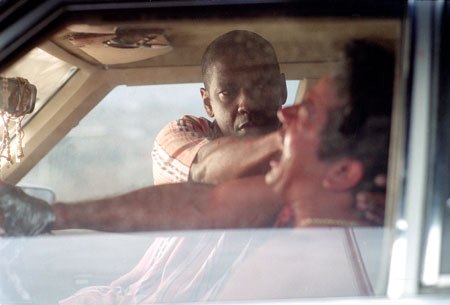
In one scene, he torments a bad guy by cutting off his fingers one by one. In another, he clinically describes what will happen when he places a small explosive in his victim’s hindquarters and then detonates it from a safe distance away. It’s as brutal as anything in Kill Bill, but Creasy’s “roaring rampage of revenge” is offered as profound heroism, goading the audience into cheering for his righteous anger. This knocks the film off balance and sends it down the slippery slope from the high ground of justice to the gutter of vigilante violence.
Newspaper headlines give us a hint as to why these brutal revenge fantasies are so appealing to audiences right now. Here’s an American hero, burdened by grief and moral confusion, entering a foreign environment, warned that there is corruption and devastating power lurking unseen in the shadows. He’s angry that someone he loves has been violated, and he’s determined to find the hiding places of the “terrorists” (in this case, kidnappers), root them out, and destroy them, even if he has to upset the typical rules of law and order in the process. Viewers seem ready to cheer for American heroes who decide to mete out justice on their own terms, outside the view of news cameras, while paying lip service to Christian faith.
Creasy’s Christ-figure qualities are especially dissonant. How are we to feel about a man so deliberately portrayed as a stand-in for Jesus who is more inclined to recommend suicide than repentance?
But it is unlikely that audiences will find much opportunity to reflect on these things while the film roars along. Tony Scott buries any thoughtfulness in his story under layers of editing gimmicks, stylistic flourishes, and an obvious delight in the opulence of the rich. (The interiors of this film’s palatial homes must have cost as much as The Lord of the Rings trilogy.) The whole two-and-a-half hour running ordeal feels like a hyperactive music video, the frantic, jittery, dizzying, rapid-cut, overexposed footage disorienting and distracting us.
For Scott, it is not sufficient to provide subtitles for those speaking in other languages — the text must be entertaining. These subtitles jump, flicker, fade, and slide all over the screen. Worse, they even appear for lines spoken in plain English, emphasizing certain quotes as if the director decided his actors weren’t speaking forcefully enough. It’s the first film to be presented everywhere in a Closed Captioned for the Hearing Impaired format.
Perhaps Scott worried that moviegoers would be bored with anything but explosions, so he stuffed the interludes with an assault of artificial activity. Or perhaps he wants to numb us to any twinge of conscience. He relentlessly reminds us of what the enemy has done, re-playing echoes of Pita’s desperate screams, as if we could ever forget what is driving Creasy’s rage.
It says something about Washington’s gravitas that his performance remains compelling despite the filmmakers’ attention deficit disorder. Also worth noting: Christopher Walken plays Creasy’s old war buddy who gets him the job. Walken makes a strong impression, but then mysteriously vanishes about two-thirds of the way through, probably because he’s forced to say lines like “Creasy’s art is death. He’s about to paint his masterpiece.”
As long as “heroes” like Creasy continue to appear onscreen, it will not be hard to understand why the news is filled with stories of desperate men taking the law into their own hands. We are right to hope for justice when something is done wrong. But sinners like us who have experienced grace should never relish the sight of flawed human beings being spectacularly destroyed. We should attend to the execution of justice with solemn humility, grieved by the evil of which we are all capable, sobered by its consequences.
The only people in the film who dare to question Creasy’s bloodthirsty response are an elderly couple who ask, “Doesn’t the Scripture say we should forgive?” Alas, they are treated as the butt of a joke. Creasy responds: “Forgiveness is between them and God. It’s my job to arrange the meeting.” He then launches a missile out the window toward an oncoming car.
–
Director – Tony Scott; writer – Brian Helgeland; based on the novel by A. J. Quinnell; director of photography – Paul Cameron; editor – Christian Wagner; music – Harry Gregson-Williams; production designers – Benjamin Fernandez and Chris Seagers; producers – Arnon Milchan, Tony Scott and Lucas Foster. Starring – Denzel Washington (Creasy), Dakota Fanning (Pita), Marc Anthony (Samuel), Radha Mitchell (Lisa), Christopher Walken (Rayburn), Giancarlo Giannini (Manzano), Rachel Ticotin (Mariana) and Gero Camilo (Aurelio Sanchez). 20th Century Fox. 142 minutes. Rated R.

Next Post

August 21, 2012 Pontius Pilate... The Movie!
Browse Our Archives
Select a Category Blog Bloggers on "Through a Screen Darkly" Browser Coming Soon Endorsements Fiction Books Film Forum Film Reviews Inspirations Interviews Journal Kindlings Muse Movie buzz Music Reviews Non-Fiction Books radio Reviewers on "Through a Screen Darkly" The Auralia Thread Through a Screen Darkly Through a Screen Darkly - Bonus Materials Top 10 (or 20 or 100) lists Uncategorized
Select a Month June 2015 May 2015 April 2015 March 2015 February 2015 January 2015 December 2014 November 2014 October 2014 September 2014 August 2014 July 2014 June 2014 May 2014 April 2014 March 2014 February 2014 January 2014 December 2013 November 2013 October 2013 September 2013 August 2013 July 2013 June 2013 May 2013 April 2013 March 2013 February 2013 January 2013 December 2012 November 2012 October 2012 September 2012 August 2012 July 2012 June 2012 May 2012 April 2012 March 2012 February 2012 January 2012 December 2011 November 2011 October 2011 September 2011 August 2011 July 2011 June 2011 May 2011 April 2011 March 2011 February 2011 January 2011 December 2010 November 2010 October 2010 September 2010 August 2010 July 2010 June 2010 May 2010 April 2010 March 2010 February 2010 January 2010 December 2009 November 2009 October 2009 September 2009 August 2009 July 2009 June 2009 May 2009 April 2009 March 2009 February 2009 January 2009 December 2008 November 2008 October 2008 September 2008 August 2008 July 2008 June 2008 May 2008 April 2008 March 2008 February 2008 January 2008 December 2007 November 2007 October 2007 September 2007 August 2007 July 2007 June 2007 May 2007 April 2007 March 2007 February 2007 January 2007 December 2006 November 2006 October 2006 September 2006 August 2006 July 2006 June 2006 May 2006 April 2006 March 2006 February 2006 January 2006 December 2005 November 2005 October 2005 September 2005 August 2005 July 2005 June 2005 May 2005 April 2005 March 2005 February 2005 January 2005 December 2004 November 2004 October 2004 September 2004 August 2004 July 2004 June 2004 May 2004 April 2004 July 2003 May 2003 March 2003 September 1999
Follow Us!
TAKE THE
Religious Wisdom Quiz
Who opened the first seal to release the White Horse in Revelation?
Select your answer to see how you score.
The 24 Elders An angel John The Lamb (Jesus)
Related posts from Looking Closer

This Is Not Goodbye. But It is... See...



What Specialists Are Saying About Jurassic World
TRENDING AT PATHEOS Religious Music & Entertainment

"Les Diabolique" and Transgression
Alongside something like Arrival, Vertigo, or Charade, Les Diaboliques is a...

"The Plague Dogs" and Mortality
So, flashback to the late 70s, early 80s. Walt Disney Studios is...

With the recent and highly successful release of Christopher Nolan’s epic film,...

"L'avventura" and Human Weakness
Today's piece is going to be a little different for a few...

I first want to apologize for not posting or writing anything. I'm...

I've engaged in the multi-year project of reading through the Church Fathers,...
view all Religious Music & Entertainment blogs
Ad-Free & Subscriber Log-In Subscription Support
- About Us
- 2026 Calendar
- Videos
- Podcasts
- Library of World Religions
- Faith In Media Tracker
- Advertise With Us
- Write for Us
- Privacy Policy
- Terms of Service
- Do Not Sell My Data
- Contact Us
- Radiant Digital
- Manage Newsletter Subscriptions
- Unsubscribe From Notifications
- Sitemap
Copyright 2008-2026, Patheos. All rights reserved.
Subscription Support Ad-Free & Subscriber Log-In
Follow Patheos