
BuddhistCatholicContemplativeEvangelicalGeneral ChristianHinduJewishLatter-day SaintMuslimNew VisionsProgressive Christian
Beliefs
- Buddhist
- Catholic
- Contemplative
- Evangelical
- General Christian
- Hindu
- Jewish
- Latter-day Saint
- More Voices
- Muslim
- New Visions
- Pagan
- Progressive Christian
Topics
- Religion News
- Food and Religion
- Sports and Religion
- Religious Art
- Religious Music and Entertainment
- Religious Events
- History and Religion
- Style and Religion
- Politics and Religion
- Women in Religion
- Recreation Outdoors and Religion
- Business Finance and Religion
- Careers Workplace and Religion
- Education and Religion
- Family Parenting and Religion
- Health Fitness and Religion
- Home and Religion
- Relationships and Religion
- Technology and Religion
- Travel and Religion
Columnists
- Buddhist Columnists
- Business Finance and Religion Columnists
- Careers Workplace and Religion Columnists
- Catholic Columnists
- Contemplative Columnists
- Education and Religion Columnists
- Evangelists Columnists
- Family Parenting and Religion Columnists
- General Christian Columnists
- Health Fitness and Religion Columnists
- Hindu Columnists
- History and Religion Columnists
- Home and Religion Columnists
- Jewish Columnists
- More Voices Columnists
- Latter Day Columnists
- Muslim Columnists
- New Visions Columnists
- Nonreligious Columnists
- Pagan Columnists
- Politics and Religion Columnists
- Progressive Columnists
- Recreation Outdoors and Religion Columnists
- Relationships and Religion Columnists
- Religion News Columnists
- Religious Art Columnists
- Religious Events Columnists
- Religious Music and Entertainment Columnists
- Sports and Religion Columnists
- Style and Religion Columnists
- Technology and Religion Columnists
- Travel and Religion Columnists
- Women in Religion Columnists
Resource Library
- 2026 Calendar
- Library of World Religions
- The 100 Most Holy Places on Earth
- Patheos Answers
- Podcasts
- Videos
- Faith Leaders Database
- Anglican Episcopalian
- Bahai
- Baptist
- Buddhism
- Christianity
- Confucianism
- Eastern Orthodoxy
- Hinduism
- Holiness and Pentecostal
- ISKCON
- Islam
- Judaism
- Lutheran
- Methodist
- The Church of Jesus Christ of Latter-day Saints
- New Age
- Paganism
- Presbytarian and Reformed
- Protestantism
- Religion Behind the Scenes
- Roman Catholic
- Scientology
- Shia Islam
- Sikhism
- Sufism
- Sunni Islam
- Taoism
- Zen
- See all religions
Research Tools
 Ad-Free & Subscriber Log-In Subscription Support
Ad-Free & Subscriber Log-In Subscription Support
Follow Patheos 

- Trending:
- Forgiveness
- |
- Marriage
- |
- Consciousness
- |
- Death Penalty
- |
- Election
- |
- Halloween
 Looking Closer
- Home
- Religious Music & Entertainment
- In America (2004)
In America (2004)
Last updated on: July 5, 2012 at 12:55 pm by Jeffrey Overstreet
In America (2004) 2012-07-05T12:55:13-06:00 Jeffrey Overstreet
Patheos Explore the world's faith through different perspectives on religion and spirituality! Patheos has the views of the prevalent religions and spiritualities of the world.
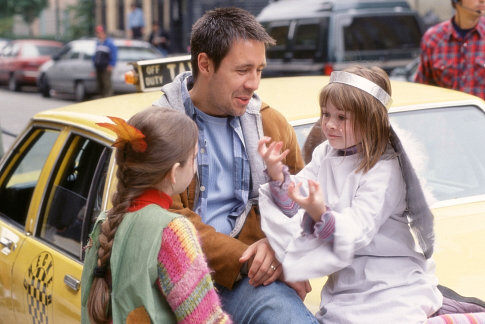
What’s your favorite Fourth of July movie?
If crowds and traffic will keep you away from big fireworks shows — those stressful ordeals turned me away from public places on the Fourth a long time ago — then I recommend you consider spending some time with Jim Sheridan’s 2004 film about a family of Irish immigrants called In America.
You can read an abridged version of my In America review at Paste.
Or, if you want my in-depth look at the film, here’s one from the archives.
•
Jim Sheridan is an Irishman through and through.
Though he moved his family to New York in the ’80s and has lived there ever since, Sheridan remains a storyteller preoccupied with the dilemma of Ireland’s divided soul. All of his films have explored in vivid and memorable ways the chasm between Catholic and Protestant; between wounded Ireland and a possible future.
My Left Foot brought to life the sufferings and inspiring spirit of the painter and poet Christie Brown, and introduced many viewers to the formidable talents of Daniel Day-Lewis. In the Name of the Father delivered more Oscar-worthy performances by Day-Lewis and Pete Postlethwaite in a story about IRA bombings and the wrongfully accused Gerry Conlon. Into the West, which Sheridan wrote and Mike Newell directed, remains a sorely underrated family adventure film, in which two Irish boys discover a mythical horse and run from the pain of a lost parent. The Boxer focuses on the efforts of one man to bring warring factions together in a community endeavor.
Now, he just may have his masterpiece in a semi-autobiographical account of a family who has left Ireland, haunted by the death of a loved one trying to make a new start in the States. While the family members are not directly based on his own family, Sheridan’s characters clearly reflect his firsthand experience with similarly rugged emotional territory.
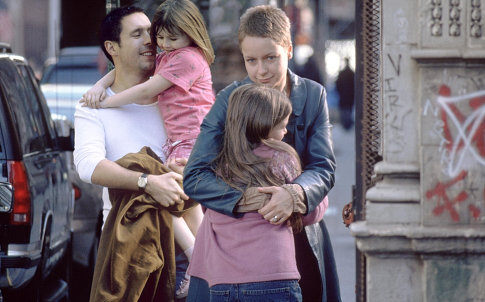
Johnny and Sarah are hard-working parents and hard-loving spouses. (For a change, a movie suggests that love is not about getting something from someone else, but rather about sacrificing for another’s sake.) Their daughters are Christy (Sarah Bolger), a melancholy contemplative, and Ariel (Emma Bolger), a spirited 7-year-old who asks the right questions that her parents need to hear. Bedraggled and broken, they arrive in Manhattan with very few dollars and enormous dreams.
Johnny (Paddy Considine) is an actor, and he quickly goes to work auditioning for a part that will help them pay the bills. Sarah (Samantha Morton) is his consolation; as he tries to steady their rocking boat, she tries to steady his volatile temper. They amuse themselves by trying to dress up a dilapidated apartment in a ghetto building full of junkies and memorable strangers. It is, of course, inevitable that they will have to reckon with the muscular artist who lives behind a door marked KEEP AWAY: Matteo (Djimon Hounsou), whose personal torments earn him the nickname “The Screaming Man.”
Through close attention to detail, Sheridan draws suspense and humor from the emotional journeys of each character.
Johnny grapples with his anger and grief over the loss of a family member, and he does so by obsessing over the family’s practical needs. Considine, who comes across as a formidable talent, makes Johnny a man whose feverish dedication to survival and family is at once endearing and alarming, especially as he becomes increasingly blind to the impact his anger has upon his children.
Sarah is wrestling too, but in a much quieter way, burying her true feelings behind a forced performance of happiness for the sake of her children. Samantha Morton brings the same intensity to the character that she brought to “the pre-cog” in Minority Report and to the lead role in Morvern Callar. Just as she did in Woody Allen’s Sweet and Lowdown, she commands our attention even in a crowd, saying very little, letting us glimpse deep wells of emotion through cracks in her smiling and deceptively giddy veneer.
If Sarah is introspective, her daughter Christy is more so. Christy narrates the film; her perspective is a mix of childlike faith and the intensifying questions of grown-up doubt. We see through her eyes and through her camcorder, which she uses to document many of the family’s important moments, a device that increases the film’s journal-entry qualities. As the story is told through her, it is startling when she steps out from behind her observant pose and suddenly unloads her own feelings, her own frustrations and loss. Eleven-year-old Sarah Bolger gives the quietest performance in the film, but it in hindsight it burns just as intensely. (Keep an eye on this actress. She can act and sing: Her mid-film solo is a moving rendition of a most unlikely cover.)
Through it all, Christy’s younger sister Ariel, played by Sarah’s younger sister Emma, skips like a guardian angel, her innocence humbling her parents and neighbors, her questions naïve and yet profound, her spirit undimmed by loss. Emma Bolger’s performance is the most astonishing by a young girl since the brilliant turn by Victoire Thivisol in Ponette. The two sisters play and interact so convincingly, they keep the film buoyant and engaging in spite of its heavy load of angst and anger. When they set out trick-or-treating on their very first Halloween experience, they create a deliciously suspenseful and rewarding scene.
As Matteo, the solitary artist, Djimon Hounsou comes to the family like a threat. But the miracle of the girls’ presence in his life brings about a change that ends up affecting all of them deeply. As a castoff from his own family due to the nature of his torment, he becomes a sort of surrogate son, in spite of the fact that he towers over them.

Before things get better, though, they get worse. Two debilitating crises require medical attention, events that reopen recent wounds and throw fuel on the flames of their fears. There are financial problems that make us cringe. One character makes a troubling confession of lost faith, a problem that remains rather unresolved at the end of the film (which I’m sure will disappoint those religious press critics who want every film to end with the resolution of all doubt). Nothing becomes predictable, though. Nothing feels implausible. For a few moments, I feared that the movie was headed for a suspenseful scene of theatre auditions, in which Dad has to act his heart out and win the big role in order to save his family from financial and physical ruin. But Sheridan is far too smart and ambitious to trivialize the film in that way.
The film ends on a note that lacks resolution. We can see the beginnings of healing, but there is also an honesty about doubt. At one point, Christy admits her own frustrations with God by admitting that her private prayer-like conversations with the lost family member ended when, as she puts it, “I realized I was talking to myself.” In America does not end with an exhortation that “His eye is on the sparrow” or that “All things work together for good.”
However, it does suggest that there might be a Higher Power ready to offer grace and healing, if only we will own up to our grief and anger. Only by releasing our unspoken frustrations can our lungs find air to breathe again. It also indicates that by embracing, with fearless and childlike faith, those who are unfamiliar, we create a larger space for love and grace to do a work that blesses us all.
Where both of the year’s most highly celebrated dramas, Mystic River and 21 Grams, are filmed in murky, bland, even fungal color schemes to emphasize their grim attitudes, cinematographer Declan Quinn—who filmed Mira Nair’s wondrous Monsoon Wedding, Mike Figgis’s Leaving Las Vegas, and gave us close-up access to the actors in Louis Malle’s *Vanya on 42nd Street—*has an eye for beauty. The film’s intimate nature is enhanced by poetic imagery. Quinn and Sheridan do here for Manhattan what Stephen Frears and Chris Menges did for London in Dirty Pretty Things; they avoid familiar and distracting postcard images and immerse us instead in a particular neighborhood.
In America also presents us with a true cinematic rarity: a married couple whose relationship is convincingly complicated, passionate, intellectual, and sexual. You may be hard-pressed to think of another recent film that demonstrates family life in such an honest and yet appealing manner.
Dare I add September 11 to the mix? While it does not directly relate to the events of the World Trade Center bombings, the film’s focus on loss in the heart of New York makes the film resonant and relevant to the city’s wounded state. In Sheridan’s narrative about lost loved ones, lost security, lost faith, and lost identity, we have a vital story of spiritual healing and renewal in Manhattan’s broken heart.
In a time when “drama” on the big screen has begun to feel like a game of one-upmanship—a contest in angst, anger, and bleak determinism—Jim Sheridan has made a movie that stares the scary questions in the face, admits that it cannot answer all of them, and yet offers glimmers of hope and a generous helping of humor. Whereas the other acclaimed year-end dramas of 2003 – let their emotional burdens bury any hope for humor and warmth, In America is alive with laughter and uplift, all of it well earned.
Go see In America. Laugh, cry, and savor it … a few times, if you can.
Directed by Jim Sheridan; written by Mr. Sheridan, Naomi Sheridan and Kirsten Sheridan; director of photography, Declan Quinn; edited by Naomi Geraghty; music by Gavin Friday and Maurice Seezer; production designer, Mark Geraghty; produced by Mr. Sheridan and Arthur Lappin; released by Fox Searchlight Pictures. Starring – Samantha Morton (Sarah), Paddy Considine (Johnny), Djimon Hounsou (Mateo), Sarah Bolger (Christy) and Emma Bolder (Ariel). 103 minutes. Rated PG-13.
Previous Post
July 4, 2012
Truffin and Morefield on Chariots of Fire: Does God care who wins?
Next Post

July 5, 2012 Spider-man 2 (2004)
Browse Our Archives
Select a Category Blog Bloggers on "Through a Screen Darkly" Browser Coming Soon Endorsements Fiction Books Film Forum Film Reviews Inspirations Interviews Journal Kindlings Muse Movie buzz Music Reviews Non-Fiction Books radio Reviewers on "Through a Screen Darkly" The Auralia Thread Through a Screen Darkly Through a Screen Darkly - Bonus Materials Top 10 (or 20 or 100) lists Uncategorized
Select a Month June 2015 May 2015 April 2015 March 2015 February 2015 January 2015 December 2014 November 2014 October 2014 September 2014 August 2014 July 2014 June 2014 May 2014 April 2014 March 2014 February 2014 January 2014 December 2013 November 2013 October 2013 September 2013 August 2013 July 2013 June 2013 May 2013 April 2013 March 2013 February 2013 January 2013 December 2012 November 2012 October 2012 September 2012 August 2012 July 2012 June 2012 May 2012 April 2012 March 2012 February 2012 January 2012 December 2011 November 2011 October 2011 September 2011 August 2011 July 2011 June 2011 May 2011 April 2011 March 2011 February 2011 January 2011 December 2010 November 2010 October 2010 September 2010 August 2010 July 2010 June 2010 May 2010 April 2010 March 2010 February 2010 January 2010 December 2009 November 2009 October 2009 September 2009 August 2009 July 2009 June 2009 May 2009 April 2009 March 2009 February 2009 January 2009 December 2008 November 2008 October 2008 September 2008 August 2008 July 2008 June 2008 May 2008 April 2008 March 2008 February 2008 January 2008 December 2007 November 2007 October 2007 September 2007 August 2007 July 2007 June 2007 May 2007 April 2007 March 2007 February 2007 January 2007 December 2006 November 2006 October 2006 September 2006 August 2006 July 2006 June 2006 May 2006 April 2006 March 2006 February 2006 January 2006 December 2005 November 2005 October 2005 September 2005 August 2005 July 2005 June 2005 May 2005 April 2005 March 2005 February 2005 January 2005 December 2004 November 2004 October 2004 September 2004 August 2004 July 2004 June 2004 May 2004 April 2004 July 2003 May 2003 March 2003 September 1999
Follow Us!
TAKE THE
Religious Wisdom Quiz
What does the name "Jesus" mean?
Select your answer to see how you score.
The Lord saves God is with us Teacher Prince of peace
Related posts from Looking Closer

This Is Not Goodbye. But It is... See...



What Specialists Are Saying About Jurassic World
TRENDING AT PATHEOS Religious Music & Entertainment

"Les Diabolique" and Transgression
Alongside something like Arrival, Vertigo, or Charade, Les Diaboliques is a...

"The Plague Dogs" and Mortality
So, flashback to the late 70s, early 80s. Walt Disney Studios is...

With the recent and highly successful release of Christopher Nolan’s epic film,...

"L'avventura" and Human Weakness
Today's piece is going to be a little different for a few...

I first want to apologize for not posting or writing anything. I'm...

I've engaged in the multi-year project of reading through the Church Fathers,...
view all Religious Music & Entertainment blogs
Ad-Free & Subscriber Log-In Subscription Support
- About Us
- 2026 Calendar
- Videos
- Podcasts
- Library of World Religions
- Faith In Media Tracker
- Advertise With Us
- Write for Us
- Privacy Policy
- Terms of Service
- Do Not Sell My Data
- Contact Us
- Radiant Digital
- Manage Newsletter Subscriptions
- Unsubscribe From Notifications
- Sitemap
Copyright 2008-2026, Patheos. All rights reserved.
Subscription Support Ad-Free & Subscriber Log-In
Follow Patheos