
BuddhistCatholicContemplativeEvangelicalGeneral ChristianHinduJewishLatter-day SaintMuslimNew VisionsProgressive Christian
Beliefs
- Buddhist
- Catholic
- Contemplative
- Evangelical
- General Christian
- Hindu
- Jewish
- Latter-day Saint
- More Voices
- Muslim
- New Visions
- Pagan
- Progressive Christian
Topics
- Religion News
- Food and Religion
- Sports and Religion
- Religious Art
- Religious Music and Entertainment
- Religious Events
- History and Religion
- Style and Religion
- Politics and Religion
- Women in Religion
- Recreation Outdoors and Religion
- Business Finance and Religion
- Careers Workplace and Religion
- Education and Religion
- Family Parenting and Religion
- Health Fitness and Religion
- Home and Religion
- Relationships and Religion
- Technology and Religion
- Travel and Religion
Columnists
- Buddhist Columnists
- Business Finance and Religion Columnists
- Careers Workplace and Religion Columnists
- Catholic Columnists
- Contemplative Columnists
- Education and Religion Columnists
- Evangelists Columnists
- Family Parenting and Religion Columnists
- General Christian Columnists
- Health Fitness and Religion Columnists
- Hindu Columnists
- History and Religion Columnists
- Home and Religion Columnists
- Jewish Columnists
- More Voices Columnists
- Latter Day Columnists
- Muslim Columnists
- New Visions Columnists
- Nonreligious Columnists
- Pagan Columnists
- Politics and Religion Columnists
- Progressive Columnists
- Recreation Outdoors and Religion Columnists
- Relationships and Religion Columnists
- Religion News Columnists
- Religious Art Columnists
- Religious Events Columnists
- Religious Music and Entertainment Columnists
- Sports and Religion Columnists
- Style and Religion Columnists
- Technology and Religion Columnists
- Travel and Religion Columnists
- Women in Religion Columnists
Resource Library
- 2026 Calendar
- Library of World Religions
- The 100 Most Holy Places on Earth
- Patheos Answers
- Podcasts
- Videos
- Faith Leaders Database
- Anglican Episcopalian
- Bahai
- Baptist
- Buddhism
- Christianity
- Confucianism
- Eastern Orthodoxy
- Hinduism
- Holiness and Pentecostal
- ISKCON
- Islam
- Judaism
- Lutheran
- Methodist
- The Church of Jesus Christ of Latter-day Saints
- New Age
- Paganism
- Presbytarian and Reformed
- Protestantism
- Religion Behind the Scenes
- Roman Catholic
- Scientology
- Shia Islam
- Sikhism
- Sufism
- Sunni Islam
- Taoism
- Zen
- See all religions
Research Tools
 Ad-Free & Subscriber Log-In Subscription Support
Ad-Free & Subscriber Log-In Subscription Support
Follow Patheos 

- Trending:
- Forgiveness
- |
- Marriage
- |
- Consciousness
- |
- Death Penalty
- |
- Election
- |
- Halloween
 Looking Closer
- Home
- Religious Music & Entertainment
- Lourdes (2009)
Lourdes (2009)
Last updated on: September 28, 2012 at 5:13 pm by Jeffrey Overstreet
Lourdes (2009) 2012-09-28T17:13:11-06:00 Jeffrey Overstreet
Patheos Explore the world's faith through different perspectives on religion and spirituality! Patheos has the views of the prevalent religions and spiritualities of the world.
[This review was originally published at Good Letters, the blog hosted by Image.]
Caution: Lourdes is a movie that may complicate your prayers. And prayer is complicated enough already, isn’t it?
You’re probably familiar with scriptures that advise us how to pray. I’m embarrassed to admit it, but I sometimes read those passages as if they were the troubleshooting page of a user’s manual, hoping I might find I’ve overlooked a step, a secret, a keystroke that would provoke God’s response.
“Is it me?” I ask myself. “Is there a loose connection in my prayer wiring that will spark if I poke at it? Will good behavior improve my chances? Do I need to ask for this enough times that God knows I really mean it? If I remember to express gratitude for God’s blessings, will that put him in a generous mood?”
Childish questions, I know, but I suspect I’m not the only one who’s stumbled into them during God’s long silences.
Lourdes complicates matters by asking us if we’re really serious. It asks us if we’ve considered the possible consequences. It asks us how we’ll recognize an answer from the Lord.
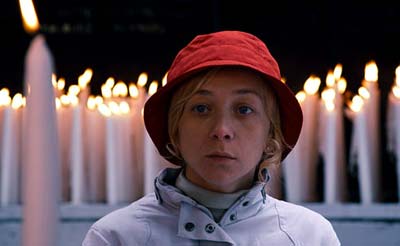
In this 2009 feature directed by Jessica Hausner, Sylvie Testud plays Christine, a wheelchair-bound woman who, nearly paralyzed by multiple sclerosis for years, has good reason to pray. She embarks on one “prayer pilgrimage” after another to destinations where healings are said to have occurred.
Will God touch her if she is bathed in the right water? If she stands on the right holy ground? If the right priest or nun prays over her? If the right prayer is said? If she lays awake, listening?
Christine may say very little out loud, but her face is as eloquent in prayer as any I’ve seen since The Passion of Joan of Arc. Her longing, her fears, her doubts—she brings them all on a tour of Lourdes, a small French town where many have testified that the Virgin Mary healed them.
Organized by the Order of Malta—an ancient Catholic order devoted to serving the elderly, disabled, homeless, and terminally ill—the visit is overseen by a nurse named Cécile, a weary servant who seems more concerned with order and propriety than the possibility of grace. The best advice she can muster for a desperate pilgrim is to “accept your fate with humility.” Then she adds, “The suffering you bear can have a deep meaning.”
Elina Löwensohn, best known for comical turns in Hal Hartley’s films, powerfully conveys Cécile’s spiritual turmoil—the deep disillusionment that sometimes flares into rage.
One of Cécile’s most fickle helpers, young Maria, is in charge of caring for Christine on this trip. But Maria (the new French “It Girl,” Léa Seydoux of Midnight in Paris and Mission Impossible: Ghost Protocol) is so distracted by the effect of her own beauty on handsome ambulance officers that she often fails to meet Christine’s needs, which are taxing and sometimes messy.
So it often falls to Christine’s roommate, an elderly woman with afflictions of her own, to offer faithful friendship and tenderness. One of the old woman’s afflictions might be naïveté—she seems to be the ideal customer for the exploitative Lourdes marketplace. She buys cheap Virgin Mary statues, and even kneels at the one with the neon halo that stands outside a tacky souvenir shop. Her pilgrimage name-tag might as well say “Holy Fool.”
Hausner’s imaginative images sharpen her film’s questions. She frequently composes pictures in which our view is cut off by a wall, a pillar, or another pilgrim. We lean, trying to see the full picture of the scene, but like God’s silence, these obstructions remain impenetrable, unmoving.
If this were a “Christian movie” about an afflicted woman who devoted herself to years of prayer, we’d have no reason to suspect anything more than a miracle followed by rejoicing and the promise that her testimony would bring others to faith. Thank God—Hausner’s film gives us something more truthful, stubbornly refusing to deliver the feel-good conclusions that we’ve come to expect from “miracle stories.”
Some of these pilgrims experience wondrous things at Lourdes… events that confound doctors, priests, and pilgrims alike. And yet, Hausner’s observant movie reveals more than the shock of the miraculous. It takes us beyond this, into the hard questions that a genuine miracle would raise.
What happens when a seeker finds? How much is actually resolved? Do doubts dissolve? Can a blessing, once granted, be withdrawn? Is it conditional? And what happens when a seeker, having received the blessing, becomes the object of other seekers’ attention? What if a miracle for one sends many spiraling downward in jealous resentment?
Lourdes may cause viewers to see miracle stories of the ancient past or the skeptical present in a whole new light. It may make us more reluctant to ask for miracles, or at least more aware of what we might be inviting.
And it’s likely to send most moviegoers away more frustrated than pleased. Film critic Michael Leary nailed it when he called Lourdes “a theological Chinese finger trap.” (He meant it as a compliment.)
Hausner reminds us how little we understand about the ways, thoughts, and purposes of God. Her film stands as a caution: Be careful what you ask for.
It also reminds us that even miracles cannot resolve the challenge of faith. Remember how quickly the fickle, self-centered masses turned against the same teacher who astonished them with wonders. A Gospel that sells itself on the promise that God answers prayers is no Gospel at all.
As I watch Lourdes again, it isn’t the wonder of pilgrims transformed—by miracle or chance—that moves me. Sure, it’s exciting to see incurable diseases cured, but that isn’t this movie’s strongest evidence of some great grace at work in the world.
Rather, I’m stunned by the sight of Frau Hartl, weary and unloved, praying in the glow of a cheap Virgin Mary lamp, and then selflessly bearing Christine’s burdens when others fail her, asking nothing in return, even as the silence goes on swallowing her prayers.
–
Writer, director – Jessica Hausner; director of photography – Martin Gschlacht; editor – Karina Ressler; production designer – Katharina Wöppermann; producer by Martin Gschlacht, Philippe Bober and Susanne Marian. Starring Sylvie Testud (Christine), Bruno Todeschini (Kuno), Elina Löwensohn (Cécile), Gerhard Liebmann (Pater Nigl), Gilette Barbier (Mme. Hartl), Hubsi Kramer (Herr Olivetti) and Léa Seydoux (Maria). Palisades Tartan. In French, with English subtitles. 1 hour 39 minutes. This film is not rated.
–
[This review was originally published at Good Letters, the blog hosted by Image.]
Previous Post

April 27, 2012
My Sixpence None the Richer wish is coming true...
Next Post
May 3, 2012 The Avengers (2012)
Browse Our Archives
Select a Category Blog Bloggers on "Through a Screen Darkly" Browser Coming Soon Endorsements Fiction Books Film Forum Film Reviews Inspirations Interviews Journal Kindlings Muse Movie buzz Music Reviews Non-Fiction Books radio Reviewers on "Through a Screen Darkly" The Auralia Thread Through a Screen Darkly Through a Screen Darkly - Bonus Materials Top 10 (or 20 or 100) lists Uncategorized
Select a Month June 2015 May 2015 April 2015 March 2015 February 2015 January 2015 December 2014 November 2014 October 2014 September 2014 August 2014 July 2014 June 2014 May 2014 April 2014 March 2014 February 2014 January 2014 December 2013 November 2013 October 2013 September 2013 August 2013 July 2013 June 2013 May 2013 April 2013 March 2013 February 2013 January 2013 December 2012 November 2012 October 2012 September 2012 August 2012 July 2012 June 2012 May 2012 April 2012 March 2012 February 2012 January 2012 December 2011 November 2011 October 2011 September 2011 August 2011 July 2011 June 2011 May 2011 April 2011 March 2011 February 2011 January 2011 December 2010 November 2010 October 2010 September 2010 August 2010 July 2010 June 2010 May 2010 April 2010 March 2010 February 2010 January 2010 December 2009 November 2009 October 2009 September 2009 August 2009 July 2009 June 2009 May 2009 April 2009 March 2009 February 2009 January 2009 December 2008 November 2008 October 2008 September 2008 August 2008 July 2008 June 2008 May 2008 April 2008 March 2008 February 2008 January 2008 December 2007 November 2007 October 2007 September 2007 August 2007 July 2007 June 2007 May 2007 April 2007 March 2007 February 2007 January 2007 December 2006 November 2006 October 2006 September 2006 August 2006 July 2006 June 2006 May 2006 April 2006 March 2006 February 2006 January 2006 December 2005 November 2005 October 2005 September 2005 August 2005 July 2005 June 2005 May 2005 April 2005 March 2005 February 2005 January 2005 December 2004 November 2004 October 2004 September 2004 August 2004 July 2004 June 2004 May 2004 April 2004 July 2003 May 2003 March 2003 September 1999
Follow Us!
TAKE THE
Religious Wisdom Quiz
What were the first man and woman’s names in the Bible?
Select your answer to see how you score.
Joseph and Mary Jacob and Rachel Samson and Delilah Adam and Eve
Related posts from Looking Closer



Tomorrowland? Or Tomorrow-bland?

TRENDING AT PATHEOS Religious Music & Entertainment

"Les Diabolique" and Transgression
Alongside something like Arrival, Vertigo, or Charade, Les Diaboliques is a...

"The Plague Dogs" and Mortality
So, flashback to the late 70s, early 80s. Walt Disney Studios is...

With the recent and highly successful release of Christopher Nolan’s epic film,...

"L'avventura" and Human Weakness
Today's piece is going to be a little different for a few...

I first want to apologize for not posting or writing anything. I'm...

I've engaged in the multi-year project of reading through the Church Fathers,...
view all Religious Music & Entertainment blogs
Ad-Free & Subscriber Log-In Subscription Support
- About Us
- 2026 Calendar
- Videos
- Podcasts
- Library of World Religions
- Faith In Media Tracker
- Advertise With Us
- Write for Us
- Privacy Policy
- Terms of Service
- Do Not Sell My Data
- Contact Us
- Radiant Digital
- Manage Newsletter Subscriptions
- Unsubscribe From Notifications
- Sitemap
Copyright 2008-2026, Patheos. All rights reserved.
Subscription Support Ad-Free & Subscriber Log-In
Follow Patheos