
BuddhistCatholicContemplativeEvangelicalGeneral ChristianHinduJewishLatter-day SaintMuslimNew VisionsProgressive Christian
Beliefs
- Buddhist
- Catholic
- Contemplative
- Evangelical
- General Christian
- Hindu
- Jewish
- Latter-day Saint
- More Voices
- Muslim
- New Visions
- Pagan
- Progressive Christian
Topics
- Religion News
- Food and Religion
- Sports and Religion
- Religious Art
- Religious Music and Entertainment
- Religious Events
- History and Religion
- Style and Religion
- Politics and Religion
- Women in Religion
- Recreation Outdoors and Religion
- Business Finance and Religion
- Careers Workplace and Religion
- Education and Religion
- Family Parenting and Religion
- Health Fitness and Religion
- Home and Religion
- Relationships and Religion
- Technology and Religion
- Travel and Religion
Columnists
- Buddhist Columnists
- Business Finance and Religion Columnists
- Careers Workplace and Religion Columnists
- Catholic Columnists
- Contemplative Columnists
- Education and Religion Columnists
- Evangelists Columnists
- Family Parenting and Religion Columnists
- General Christian Columnists
- Health Fitness and Religion Columnists
- Hindu Columnists
- History and Religion Columnists
- Home and Religion Columnists
- Jewish Columnists
- More Voices Columnists
- Latter Day Columnists
- Muslim Columnists
- New Visions Columnists
- Nonreligious Columnists
- Pagan Columnists
- Politics and Religion Columnists
- Progressive Columnists
- Recreation Outdoors and Religion Columnists
- Relationships and Religion Columnists
- Religion News Columnists
- Religious Art Columnists
- Religious Events Columnists
- Religious Music and Entertainment Columnists
- Sports and Religion Columnists
- Style and Religion Columnists
- Technology and Religion Columnists
- Travel and Religion Columnists
- Women in Religion Columnists
Resource Library
- 2026 Calendar
- Library of World Religions
- The 100 Most Holy Places on Earth
- Patheos Answers
- Podcasts
- Videos
- Faith Leaders Database
- Anglican Episcopalian
- Bahai
- Baptist
- Buddhism
- Christianity
- Confucianism
- Eastern Orthodoxy
- Hinduism
- Holiness and Pentecostal
- ISKCON
- Islam
- Judaism
- Lutheran
- Methodist
- The Church of Jesus Christ of Latter-day Saints
- New Age
- Paganism
- Presbytarian and Reformed
- Protestantism
- Religion Behind the Scenes
- Roman Catholic
- Scientology
- Shia Islam
- Sikhism
- Sufism
- Sunni Islam
- Taoism
- Zen
- See all religions
Research Tools
 Ad-Free & Subscriber Log-In Subscription Support
Ad-Free & Subscriber Log-In Subscription Support
Follow Patheos 

- Trending:
- Forgiveness
- |
- Marriage
- |
- Consciousness
- |
- Death Penalty
- |
- Election
- |
- Halloween
 Looking Closer
- Home
- Religious Music & Entertainment
- Waste Land (2010)
Waste Land (2010)
Last updated on: June 23, 2014 at 2:05 pm by Jeffrey Overstreet
Waste Land (2010) 2014-06-23T14:05:14-06:00 Jeffrey Overstreet
Patheos Explore the world's faith through different perspectives on religion and spirituality! Patheos has the views of the prevalent religions and spiritualities of the world.
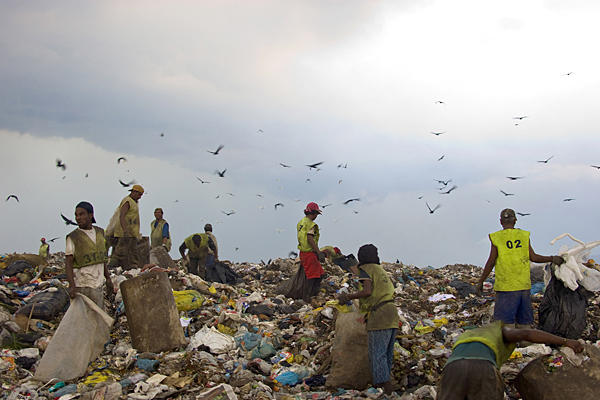 This review was originally published at Good Letters, the blog hosted by Image, in December 2010.
•
In Rio de Janiero, there’s a saying that even Jesus turns his back on the poor.
In a way it’s true. Early in Lucy Walker’s documentary Waste Land, a helicopter carries us around Christ the Redeemer, a white statue towering over Rio, arms outstretched embracing the wealthy of Copacabana, Ipanema, and Leblon. Behind it, we descend into the world’s largest landfill—Jardim Gramacho.
Thousands live on that refuse heap. They’re the catadores—Portuguese for “garbage pickers”—struggling to survive in favelas ruled by drug-dealers, earning money by sorting through the 7,000 tons that are delivered daily in dump trucks.
We might see the living Christ more clearly in the efforts of the few who reach out to the catadores.
Our guide is Vik Muniz, an artist world-renowned for making pictures with unlikely materials like dirt, sugar, string, and chocolate syrup. The Brazil-born artist, now based in Brooklyn, says he’s taking time off from the fine arts world. “It’s a very exclusive, restrictive place to be. What I really want to do is be able to change the lives of a group of people with the same material they deal with every day.”
That is to say, he’s ready to work with garbage.
So Muniz goes “behind Jesus’ back,” remembering his childhood in a poor Brazilian neighborhood where the spreading patches of mold on his bedroom ceiling first inspired him to make art. Studying aerial views of this “garbage world,” he points to the bridge, the landfill’s gateway. “This is where everything not good goes. Including the people… individuals who are, within Brazilian society, not different than garbage itself.”
You may find yourself bracing for a pious documentary, the rich exploiting the poor so they can “perform” goodwill for the cameras. Muniz’s message is rather obvious: “Garbage… is everything that nobody wants, and when it disappears from everyone’s lives, rich or poor, it doesn’t disappear at all, it appears here, like a conjuring trick gone wrong.”
You can see the big philanthropic finale coming: The artist hovers with a camera more than 70 feet above warehouse floor, while catadores arrange four tons of trash across massive portraits of themselves. Muniz directs these collaborative projects, readying images for auction that may bring help to the needy.
But this conversion of garbage into humanitarian aid is just the beginning. Practical charity (or “agape” love) gives way to life-changing intimacy (something closer to “eros”). Both artist and subject are changed by the occasion of an inquisitive gaze.
As Muniz tells his subjects that their pictures will end up in museums, he comically mimics museum-goers. He leans forward, squinting at an imaginary painting. Then he leans back, steps away. “Have you seen this? Everyone does it. Are they drunk?”
Swaying, he does it again. “Imagine it’s a beautiful landscape with a lake and a man fishing. They look and they see the man fishing. Then they lean in and everything vanishes…and becomes paint. They see the material. Then they move away… and see the image.”
The chosen catadores nod. They get it.
“The moment when one thing turns into another is the most beautiful moment,” says Muniz. “A combination of sounds transforms into music. And that applies to everything. That moment is really magical.”
From a distance, catadores looked like ants. Now we’re leaning in, discovering exquisite personalities and radiant smiles in the thick of putrid smells, scars, trash, death. Any high-minded political agenda blurs. I won’t soon forget the people I met through the gazes of Walker and Muniz.
Tiaõ, a “picker” since age 11, is the catadores’ charismatic leader, organizing a co-operative so they can declare their rights with a unified voice.
Isis, cast aside by a married man who made false promises, feels like a piece of the trash heap she calls home.
Irma feeds her coworkers, cooking the freshest, edible trash.
Zumbi has built a lending library from books he’s found in the trash. He’s absorbed all that he’s read—especially Nietzsche. I find myself hoping he’ll discover translations of Lewis or Chesterton.
Eighteen year-old Suelem, who started scavenging when she was seven, has two small children dependent on her.
Magna may be beautiful, but her fellow bus-riders cringe at the putrid cloud that follows her home from work. She clings to a common refrain among catadore women: At least she’s not a Copacabana prostitute.
In a recent Good Letters post, Laura Bramon Good talked about the hard but redemptive work of confessing our weaknesses in community. Similarly, Vik Muniz and his colleagues are bringing all that we’ve buried out into the light to reveal its value. Plastic bottles. Expired electronics. Boxes. High-heeled shoes. Reels of old film. Body parts. Human beings.
The trash that the people rejected has become the cornerstone for something beautiful and redeeming. Why does that sound so familiar?
Walker says, “Just as Vik wants the portraits to serve as a mirror in which the catadores may see themselves, so I hope the movie serves as a means for us…to zoom all the way in to caring about someone who was previously as far away as it’s possible to be.”
Waste Land achieves this. It also reminds us to back up for a God’s-eye-view, a picture of the whole of our lives. Someday, in the twinkling of an eye, one thing will turn into another. Love’s design will be revealed, made of “recyclable material.”
Seeing himself in a portrait, Tiaõ gasps. “I never imagined I’d become a work of art.”
Irma’s grandchildren gaze upon her portrait made from trash, while she reflects on thirty years in the garbage. “My life began there, thank God.” In the reverent hush of the children’s gaze, Irma’s portrait becomes an icon.
Would that we could see each other’s faces—family, friends, and strangers—in such a frame. Leaning in. Stepping back. Leaning in again.
Previous Post

January 30, 2011
A Boxer and Some Briefs
Next Post
January 31, 2011 Ongoing Lies and Distortions from Movieguide
Browse Our Archives
Select a Category Blog Bloggers on "Through a Screen Darkly" Browser Coming Soon Endorsements Fiction Books Film Forum Film Reviews Inspirations Interviews Journal Kindlings Muse Movie buzz Music Reviews Non-Fiction Books radio Reviewers on "Through a Screen Darkly" The Auralia Thread Through a Screen Darkly Through a Screen Darkly - Bonus Materials Top 10 (or 20 or 100) lists Uncategorized
Select a Month June 2015 May 2015 April 2015 March 2015 February 2015 January 2015 December 2014 November 2014 October 2014 September 2014 August 2014 July 2014 June 2014 May 2014 April 2014 March 2014 February 2014 January 2014 December 2013 November 2013 October 2013 September 2013 August 2013 July 2013 June 2013 May 2013 April 2013 March 2013 February 2013 January 2013 December 2012 November 2012 October 2012 September 2012 August 2012 July 2012 June 2012 May 2012 April 2012 March 2012 February 2012 January 2012 December 2011 November 2011 October 2011 September 2011 August 2011 July 2011 June 2011 May 2011 April 2011 March 2011 February 2011 January 2011 December 2010 November 2010 October 2010 September 2010 August 2010 July 2010 June 2010 May 2010 April 2010 March 2010 February 2010 January 2010 December 2009 November 2009 October 2009 September 2009 August 2009 July 2009 June 2009 May 2009 April 2009 March 2009 February 2009 January 2009 December 2008 November 2008 October 2008 September 2008 August 2008 July 2008 June 2008 May 2008 April 2008 March 2008 February 2008 January 2008 December 2007 November 2007 October 2007 September 2007 August 2007 July 2007 June 2007 May 2007 April 2007 March 2007 February 2007 January 2007 December 2006 November 2006 October 2006 September 2006 August 2006 July 2006 June 2006 May 2006 April 2006 March 2006 February 2006 January 2006 December 2005 November 2005 October 2005 September 2005 August 2005 July 2005 June 2005 May 2005 April 2005 March 2005 February 2005 January 2005 December 2004 November 2004 October 2004 September 2004 August 2004 July 2004 June 2004 May 2004 April 2004 July 2003 May 2003 March 2003 September 1999
Follow Us!
TAKE THE
Religious Wisdom Quiz
I wanted a vineyard so badly that my wife arranged the owner's death through false witnesses. Who am I?
Select your answer to see how you score.
Jezebel David Ahab Naboth
Related posts from Looking Closer



Tomorrowland? Or Tomorrow-bland?

TRENDING AT PATHEOS Religious Music & Entertainment

"Les Diabolique" and Transgression
Alongside something like Arrival, Vertigo, or Charade, Les Diaboliques is a...

"The Plague Dogs" and Mortality
So, flashback to the late 70s, early 80s. Walt Disney Studios is...

With the recent and highly successful release of Christopher Nolan’s epic film,...

"L'avventura" and Human Weakness
Today's piece is going to be a little different for a few...

I first want to apologize for not posting or writing anything. I'm...

I've engaged in the multi-year project of reading through the Church Fathers,...
view all Religious Music & Entertainment blogs
Ad-Free & Subscriber Log-In Subscription Support
- About Us
- 2026 Calendar
- Videos
- Podcasts
- Library of World Religions
- Faith In Media Tracker
- Advertise With Us
- Write for Us
- Privacy Policy
- Terms of Service
- Do Not Sell My Data
- Contact Us
- Radiant Digital
- Manage Newsletter Subscriptions
- Unsubscribe From Notifications
- Sitemap
Copyright 2008-2026, Patheos. All rights reserved.
Subscription Support Ad-Free & Subscriber Log-In
Follow Patheos