
BuddhistCatholicContemplativeEvangelicalGeneral ChristianHinduJewishLatter-day SaintMuslimNew VisionsProgressive Christian
Beliefs
- Buddhist
- Catholic
- Contemplative
- Evangelical
- General Christian
- Hindu
- Jewish
- Latter-day Saint
- More Voices
- Muslim
- New Visions
- Pagan
- Progressive Christian
Topics
- Religion News
- Food and Religion
- Sports and Religion
- Religious Art
- Religious Music and Entertainment
- Religious Events
- History and Religion
- Style and Religion
- Politics and Religion
- Women in Religion
- Recreation Outdoors and Religion
- Business Finance and Religion
- Careers Workplace and Religion
- Education and Religion
- Family Parenting and Religion
- Health Fitness and Religion
- Home and Religion
- Relationships and Religion
- Technology and Religion
- Travel and Religion
Columnists
- Buddhist Columnists
- Business Finance and Religion Columnists
- Careers Workplace and Religion Columnists
- Catholic Columnists
- Contemplative Columnists
- Education and Religion Columnists
- Evangelists Columnists
- Family Parenting and Religion Columnists
- General Christian Columnists
- Health Fitness and Religion Columnists
- Hindu Columnists
- History and Religion Columnists
- Home and Religion Columnists
- Jewish Columnists
- More Voices Columnists
- Latter Day Columnists
- Muslim Columnists
- New Visions Columnists
- Nonreligious Columnists
- Pagan Columnists
- Politics and Religion Columnists
- Progressive Columnists
- Recreation Outdoors and Religion Columnists
- Relationships and Religion Columnists
- Religion News Columnists
- Religious Art Columnists
- Religious Events Columnists
- Religious Music and Entertainment Columnists
- Sports and Religion Columnists
- Style and Religion Columnists
- Technology and Religion Columnists
- Travel and Religion Columnists
- Women in Religion Columnists
Resource Library
- 2026 Calendar
- Library of World Religions
- The 100 Most Holy Places on Earth
- Patheos Answers
- Podcasts
- Videos
- Faith Leaders Database
- Anglican Episcopalian
- Bahai
- Baptist
- Buddhism
- Christianity
- Confucianism
- Eastern Orthodoxy
- Hinduism
- Holiness and Pentecostal
- ISKCON
- Islam
- Judaism
- Lutheran
- Methodist
- The Church of Jesus Christ of Latter-day Saints
- New Age
- Paganism
- Presbytarian and Reformed
- Protestantism
- Religion Behind the Scenes
- Roman Catholic
- Scientology
- Shia Islam
- Sikhism
- Sufism
- Sunni Islam
- Taoism
- Zen
- See all religions
Research Tools
 Ad-Free & Subscriber Log-In Subscription Support
Ad-Free & Subscriber Log-In Subscription Support
Follow Patheos 

- Trending:
- Forgiveness
- |
- Marriage
- |
- Consciousness
- |
- Death Penalty
- |
- Election
- |
- Halloween
 Looking Closer
- Home
- Religious Music & Entertainment
- Black Swan (2010)
Black Swan (2010)
Last updated on: October 3, 2012 at 5:09 pm by Jeffrey Overstreet
Black Swan (2010) 2012-10-03T17:09:29-06:00 Jeffrey Overstreet
Patheos Explore the world's faith through different perspectives on religion and spirituality! Patheos has the views of the prevalent religions and spiritualities of the world.
[This review was originally published at Filmwell.]
By now we know that the words “A Darren Aronofsky Film” promise us a fever dream, an intense psychological thriller, a discomforting but enthralling experience.
We also know that we’re likely to see very good actors deliver performances so maniacal that veins will bulge and pulse across their temples and throats, as if they’re androids plugged into more voltage than they can survive. And we’ll be confounded by surreal visions — a man digging through the flesh of his own head, Ellen Burstyn fighting a haunted refrigerator, Hugh Jackman transforming into a tree, or the magnificent ruin of Mickey Rourke’s face.
And we’ll see characters who go to extremes to get what they want, even if it ruins them in the end. But oh, the glory of that ruin.
Black Swan — Aronofsky’s new film about an uptight, obsessive ballet dancer who is determined to score the leading role in “Swan Lake” — is definitely a rush. Aronofsky fans will get what they expect.
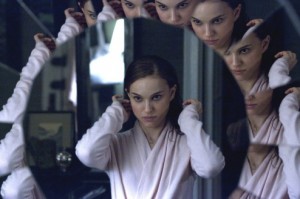
As the young and tormented Nina, Natalie Portman makes a riveting show of dedication and desperation on the dance floor. Nina is possessed by an almost demonic drive to become and eclipse Beth, the dance company’s famous starlet, played with frightening conviction by Winona Ryder. To achieve her ambitions, Nina will have to impress a tough and exploitative director (Vincent Cassel), which may require some private performances in his penthouse apartment. She’ll have to cope with her mercurial and manipulative mother (Barbara Hershey), who fuels Nina’s selfish ambitions even as she snarls with vicious jealousy.
It’s the most demanding performance of Portman’s career, and she hits all of her marks perfectly.
But the script doesn’t give her what could have made a good performance great. Her lines, like those of the Wicked Director, the Fearsome Mother, and the Snippy Girls all around her, sound like placeholders for the real dialogue… which they must have run out of time or money to compose. The Wrestler, whether you enjoyed it or not (I didn’t), was at least a movie about characters — detailed characters with distinct personalities, time-worn voices, people who seemed to be living on the other side of town. Black Swan, by contrast, lacks lifelike human beings. Instead, it gives us simple outlines of characters. It has archetypes. Primal forces. Mythic figures.
And that should be fine. You might just say “It’s a fairy tale. These figures are simplistic for a reason.” The story of Black Swan adheres closely to the beloved myth of “Swan Lake.” These are supposed to be exaggerated characters, big as Greek gods, titans clashing in a storm of power and emotion. That’s certainly the picture that Tchaikovsky’s sonorous music paints, and Aronofsky wants to live up to that.
Moreover, we’re viewing the world through Nina’s warped psyche. Her attention is so narrowly focused on inheriting Beth’s crown that she’s made herself a nervous wreck. Everyone around her is either an advantage or an obstacle, someone to seduce or to shove out of the way. She’s wound herself so tight in the cords of her own ambition that her skin is splitting open.
And insofar as Black Swan brings the myth to life through dance, it is an exhilarating success — that is, if you find a story of innocence lost in a bloody calamity exhilarating. With the impressive camerawork of Matthew Libatique (as usual), Aronofsky draws us into the dance until we’re breathless with the fluid motion of the dancers, the whirling lights. Hurricane-force waves of music crash from the movie into the audience until we’re either dizzy with the thrill or seasick from the chaos.
The colors and textures of the elaborate costumes — costumes that morph into frightful new forms as dark forces take hold of Nina’s imagination — are a fantastic spectacle. And when the black-feathered phantom of the title is fully unveiled, striking a triumphant pose mid-stage, well… what can we do but surrender? Aronofsky is one of the few American directors capable of painting indelible images, and that’s one for the ages.
These strengths do make Black Swan quite a memorable experience, and one I wish I could recommend without Capital “D” Disclaimers.
But I cannot.
Aronofsky’s weakness is that, in his roaring confidence, he lets his giddy enthusiasm for intensity get the better of him, and he fails to give enough attention to story.
What little suspension of disbelief I could sustain through the film’s first half was disrupted by three things.
First: The mockery of Beth as a has-been seems specifically designed to make us think of Winona Ryder herself, and how she once held a Portman-like place on the big screen. That set off a wave of laughter in the audience, making it clear that we were all thinking about the stars instead of the characters.
Second: The film takes an unfortunate turn down Mulholland Drive. As Nina feels threatened by a newcomer, a graceful dancer named Lily (Mila Kunis), she becomes obsessed with out-performing her. The two actresses are evenly matched in their commanding screen presence. But they’re both so attractive that the director gives in to the temptation for some soft-core girl-on-girl action.
“Oh, but that’s about Nina’s self-worship, her desire to turn a girl who might be a threat into someone who will serve her completely.”
Yeah, yeah. Sure. There are a dozen ways to explain why the movie contrives sex scenes between the two. I’m not objecting out of any prudish aversion to sex scenes. But this particular twist has been done too many times before — most notably in films like Bound and Mulholland Drive — and it leaves a stain on the movie that lingers as its most talked-about flourish. Instead of enhancing the viewer’s imaginative involvement, it becomes The Scene that everyone will talk about, The Scene that might break the Internet, The Scene that distracts us from characters and makes us suddenly very aware of The Actresses. Few moviegoers are likely to remain focused on Lily and Nina during this tangent; instead they’ll be thinking, “OMG, Natalie Portman and Mila Kunis are both smoking hot and really going for it.”
But that’s not the biggest disruption. The movie’s most arresting presence is also what spoils the mythic splendor. And I’m not talking about Natalie Portman. Sure, she’ll win her Oscar. And deservedly so, for committing so completely to such a tormented character. But no, Nina is not the heart of the movie.
This movie belongs to Mila Kunis.
Kunis, dazzling those of us who thought she brought a spark of genius to the sitcom That 70’s Show, proves to be a far more formidable big-screen presence than even her admirers would have guessed. She dances effortlessly into the film and steals it right out from under Portman. She makes Lily a living, breathing, dangerous human being, seeming capable of warmth, compassion, and humor, even as we suspect (with Nina) that she’s plotting a betrayal behind the scenes. “Look!” Aronofsky practically shouts from off-camera. “Don’t you see how capable she is of being both the White Swan and the Black?”
Next to Lily, Nina seems all the more pathetic and ridiculous. And there’s the problem. Even though Kunis is voicing the same trite, predictable, on-the-nose dialogue that all the other actors barely manage to recite without embarrassment, she brings us into the “real world,” the world in which The Wrestler took place, a far different world than the wicked wonderland of Nina’s psyche. Around her, everyone else looks like a bunch of soap opera characters.
Thus, when the film pulled away from its most interesting character and headed into its apocalyptic dénouement, I started checking my watch. Aronofsky seemed to run out of storytelling ideas, piling on the horror-movie jolts and laughably flamboyant spectacles of Nina’s fractured psyche. Nina’s madness sweeps us up and carries us away, far from the land of storytelling, and drowning us in a current of melodrama. (Or is it meant to be comedy?) Its most striking images, including a slow-turning music-box ballerina figure that recalls Inception‘s spinning top, end up seeming like light, sound, and fury signifying nothing at all or whatever you want them to be.
I never really cared about Nina. I haven’t been enchanted into elevating Portman to “goddess” status as so many have. To me, Nina seems like a petulant, whining, bitching overachiever, like certain girls I encountered in high school whose vain, competitive, backstabbing behavior made me eager to escape their company. Villainous though Lily might be, I wanted to follow her character and leave the rest — including Nina — to implode in their own self-absorption.
Is there anything more to take from a story like this than the obvious conclusion that self-destructive behavior can lead to, yes, self-destruction?
Myths like “Swan Lake” can serve as warnings. They question the widespread American ethic of “Just Do It” — follow your passion, no matter the cost. If we pursue all of our dreams and pay any price, but have not love, we are just clashing cymbals. Black Swan could have been that sort of cautionary tale.
But I don’t think it is. If it’s a cautionary tale, why does it feel so triumphant and celebratory in the end? “Look at Nina,” Aronofsky is singing. “Isn’t her misery grand? Isn’t this disintegration glorious?” The film seems to suggest that it’s better to rise above by embracing both the light and the dark side, even if it means you burn out like a supernova.
Aronofsky’s last two films have changed my mind about the movie that announced his arrival — Requiem for a Dream. Many people thought it was too over-the-top. I was among those who defended it as a “cautionary tale,” saying that the wild intensity of its drug sequences and violent stretches were there to represent the dangerous power of addiction.
But now I feel differently. I think Aronofsky has the talents of a great artist, but he’s also an adrenalin junkie, and that keeps his films short of greatness. When, in the end credits, he splashes “Directed by Darren Aronofsky” and “A Film by Darren Aronosfky” across the screen, as if wanting to make sure we get the point, well… the point has been made. He aims to impress. And in his eagerness, he goes for violent energy over poetry, shock over suggestion, emotion over intelligence.
If and when that ever changes, he’ll become a powerful director indeed.
•
Director – Darren Aronofsky; writers – Mark Heyman, Andrés Heinz and John McLaughlin;based on a story by Mr. Heinz; director of photography – Matthew Libatique; editor – Andrew Weisblum; music – Clint Mansell; ballet choreography – Benjamin Millepied; production design – Thérèse DePrez; costumes – Amy Westcott; ballet costumes – Kate and Laura Mulleavy of Rodarte; produced – Mike Medavoy, Arnold W. Messer, Brian Oliver and Scott Franklin. Starring – Natalie Portman (Nina Sayers/the Swan Queen), Vincent Cassel (Thomas Leroy/the Gentleman), Mila Kunis (Lily/the Black Swan), Barbara Hershey (Erica Sayers/the Queen) and Winona Ryder (Beth Macintyre/the Dying Swan). Fox Searchlight Pictures. 1 hour 50 minutes.
•
[This review was originally published at Filmwell.]
Previous Post

December 9, 2010
Greydanus Reviews "Voyage of the Dawn Treader"
Next Post
December 10, 2010 I Survived "Black Swan"
Browse Our Archives
Select a Category Blog Bloggers on "Through a Screen Darkly" Browser Coming Soon Endorsements Fiction Books Film Forum Film Reviews Inspirations Interviews Journal Kindlings Muse Movie buzz Music Reviews Non-Fiction Books radio Reviewers on "Through a Screen Darkly" The Auralia Thread Through a Screen Darkly Through a Screen Darkly - Bonus Materials Top 10 (or 20 or 100) lists Uncategorized
Select a Month June 2015 May 2015 April 2015 March 2015 February 2015 January 2015 December 2014 November 2014 October 2014 September 2014 August 2014 July 2014 June 2014 May 2014 April 2014 March 2014 February 2014 January 2014 December 2013 November 2013 October 2013 September 2013 August 2013 July 2013 June 2013 May 2013 April 2013 March 2013 February 2013 January 2013 December 2012 November 2012 October 2012 September 2012 August 2012 July 2012 June 2012 May 2012 April 2012 March 2012 February 2012 January 2012 December 2011 November 2011 October 2011 September 2011 August 2011 July 2011 June 2011 May 2011 April 2011 March 2011 February 2011 January 2011 December 2010 November 2010 October 2010 September 2010 August 2010 July 2010 June 2010 May 2010 April 2010 March 2010 February 2010 January 2010 December 2009 November 2009 October 2009 September 2009 August 2009 July 2009 June 2009 May 2009 April 2009 March 2009 February 2009 January 2009 December 2008 November 2008 October 2008 September 2008 August 2008 July 2008 June 2008 May 2008 April 2008 March 2008 February 2008 January 2008 December 2007 November 2007 October 2007 September 2007 August 2007 July 2007 June 2007 May 2007 April 2007 March 2007 February 2007 January 2007 December 2006 November 2006 October 2006 September 2006 August 2006 July 2006 June 2006 May 2006 April 2006 March 2006 February 2006 January 2006 December 2005 November 2005 October 2005 September 2005 August 2005 July 2005 June 2005 May 2005 April 2005 March 2005 February 2005 January 2005 December 2004 November 2004 October 2004 September 2004 August 2004 July 2004 June 2004 May 2004 April 2004 July 2003 May 2003 March 2003 September 1999
Follow Us!
TAKE THE
Religious Wisdom Quiz
What spice was brought by the wise men to Jesus?
Select your answer to see how you score.
Myrrh Cinnamon Pepper Mint
Related posts from Looking Closer

This Is Not Goodbye. But It is... See...



What Specialists Are Saying About Jurassic World
TRENDING AT PATHEOS Religious Music & Entertainment

"Les Diabolique" and Transgression
Alongside something like Arrival, Vertigo, or Charade, Les Diaboliques is a...

"The Plague Dogs" and Mortality
So, flashback to the late 70s, early 80s. Walt Disney Studios is...

With the recent and highly successful release of Christopher Nolan’s epic film,...

"L'avventura" and Human Weakness
Today's piece is going to be a little different for a few...

I first want to apologize for not posting or writing anything. I'm...

I've engaged in the multi-year project of reading through the Church Fathers,...
view all Religious Music & Entertainment blogs
Ad-Free & Subscriber Log-In Subscription Support
- About Us
- 2026 Calendar
- Videos
- Podcasts
- Library of World Religions
- Faith In Media Tracker
- Advertise With Us
- Write for Us
- Privacy Policy
- Terms of Service
- Do Not Sell My Data
- Contact Us
- Radiant Digital
- Manage Newsletter Subscriptions
- Unsubscribe From Notifications
- Sitemap
Copyright 2008-2026, Patheos. All rights reserved.
Subscription Support Ad-Free & Subscriber Log-In
Follow Patheos