
BuddhistCatholicContemplativeEvangelicalGeneral ChristianHinduJewishLatter-day SaintMuslimNew VisionsProgressive Christian
Beliefs
- Buddhist
- Catholic
- Contemplative
- Evangelical
- General Christian
- Hindu
- Jewish
- Latter-day Saint
- More Voices
- Muslim
- New Visions
- Pagan
- Progressive Christian
Topics
- Religion News
- Food and Religion
- Sports and Religion
- Religious Art
- Religious Music and Entertainment
- Religious Events
- History and Religion
- Style and Religion
- Politics and Religion
- Women in Religion
- Recreation Outdoors and Religion
- Business Finance and Religion
- Careers Workplace and Religion
- Education and Religion
- Family Parenting and Religion
- Health Fitness and Religion
- Home and Religion
- Relationships and Religion
- Technology and Religion
- Travel and Religion
Columnists
- Buddhist Columnists
- Business Finance and Religion Columnists
- Careers Workplace and Religion Columnists
- Catholic Columnists
- Contemplative Columnists
- Education and Religion Columnists
- Evangelists Columnists
- Family Parenting and Religion Columnists
- General Christian Columnists
- Health Fitness and Religion Columnists
- Hindu Columnists
- History and Religion Columnists
- Home and Religion Columnists
- Jewish Columnists
- More Voices Columnists
- Latter Day Columnists
- Muslim Columnists
- New Visions Columnists
- Nonreligious Columnists
- Pagan Columnists
- Politics and Religion Columnists
- Progressive Columnists
- Recreation Outdoors and Religion Columnists
- Relationships and Religion Columnists
- Religion News Columnists
- Religious Art Columnists
- Religious Events Columnists
- Religious Music and Entertainment Columnists
- Sports and Religion Columnists
- Style and Religion Columnists
- Technology and Religion Columnists
- Travel and Religion Columnists
- Women in Religion Columnists
Resource Library
- 2026 Calendar
- Library of World Religions
- The 100 Most Holy Places on Earth
- Patheos Answers
- Podcasts
- Videos
- Faith Leaders Database
- Anglican Episcopalian
- Bahai
- Baptist
- Buddhism
- Christianity
- Confucianism
- Eastern Orthodoxy
- Hinduism
- Holiness and Pentecostal
- ISKCON
- Islam
- Judaism
- Lutheran
- Methodist
- The Church of Jesus Christ of Latter-day Saints
- New Age
- Paganism
- Presbytarian and Reformed
- Protestantism
- Religion Behind the Scenes
- Roman Catholic
- Scientology
- Shia Islam
- Sikhism
- Sufism
- Sunni Islam
- Taoism
- Zen
- See all religions
Research Tools
 Ad-Free & Subscriber Log-In Subscription Support
Ad-Free & Subscriber Log-In Subscription Support
Follow Patheos 

- Trending:
- Forgiveness
- |
- Marriage
- |
- Consciousness
- |
- Death Penalty
- |
- Election
- |
- Halloween
 Looking Closer
- Home
- Religious Music & Entertainment
- Where the Wild Things Are (2009)
Where the Wild Things Are (2009)
Last updated on: April 2, 2013 at 9:43 pm by Jeffrey Overstreet
Where the Wild Things Are (2009) 2013-04-02T21:43:48-06:00 Jeffrey Overstreet
Patheos Explore the world's faith through different perspectives on religion and spirituality! Patheos has the views of the prevalent religions and spiritualities of the world.
 This review was originally published at the Image blog, Good Letters.
–
By the time Max shouted “Let the wild rumpus start!” on opening day ofWhere the Wild Things Are, a rumpus was already raging among the film’s critics.
Reviewers have been roaring and beating their chests in debate. Were director Spike Jonze and screenwriter Dave Eggers faithful enough to author Maurice Sendak’s lavishly illustrated pages? Should they be treated like kings? Or sent to their rooms without dinner?
I’m not too concerned. Debating Peter Jackson’s fidelity to J.R.R. Tolkien’s The Lord of the Rings makes some sense, as Tolkien gave the filmmakers an encyclopedia of detail. But Sendak’s Where the Wild Things Are contains—count them—ten sentences in forty eight pages. How could the movie be anything but an extravagant embellishment?
Do the filmmakers show respect for Sendak’s work?
Enough, I think. What is more—they avoid the pitfalls of so many storybook adaptations.
Wild Things might have been just another crass cartoon, the blanks filled in with relentless snark, fart jokes, and unnecessarily frantic tangents. Most mainstream filmmakers would have made the monsters’ wild rumpus the film’s raison d’être.
Instead, Jonze and Eggers have crafted a thoughtful, poetic, personal interpretation.
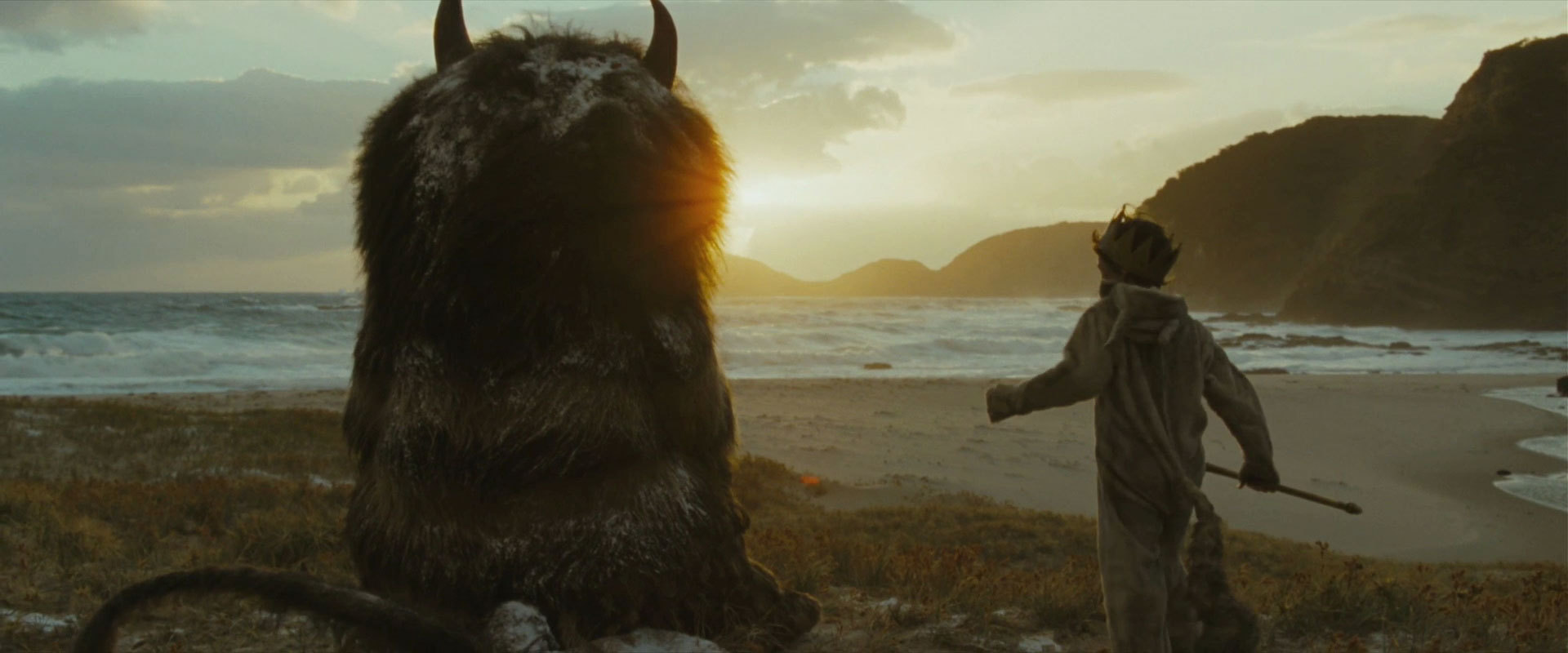
And while I’m disappointed that they skipped my favorite images—the transformation of Max’s bedroom, the Sea Monster, the Wild Things swinging from branch to branch — I’m impressed with the film’s approximation of Sendak’s artwork. The set designs and costumes have fantastic textures. Fabric, fur, and glue give the creatures a convincing weight that no digital code could equal.
Nevertheless, the film’s most marvelous wild thing is Max. The actor, nine-year-old Max Records, reminds me of Kelly Reno who played Alec in The Black Stallion — there’s a similarly genuine awe in his face as he tames a magnificent mystery. He makes Max a big-screen rarity: a complicated, surprising, real-world kid.
It helps that Eggers has read between the lines, filling in what Sendak’s prose didn’t say. He’s wrapped his screenplay around its most significant mystery, a question some readers never consider — the absence of Max’s father. Due to the film’s fleeting mention of Dad, the film canbe “read” as a poetic meditation on childhood in the aftermath of divorce.
And why not? Max’s unruly behavior, his powerful compulsion to escape into a world where he’s in charge, his imagination’s monsters — these have always suggested that Max is more than a little upset about something.
The father’s absence casts a shadow over the film. It explains why Max’s mood darkens with every perceived abandonment. When Claire runs off with friends, he’s ruined. When his mother divides her attention between a job and a boyfriend, he riots.
It makes sense that Max would protest, run away, and sail into the storm of his subconscious. Like Ofelia in Pan’s Labyrinth, he plunges into a dark wood where monsters present him with challenges relevant to his “real world” trouble.
The Wild Things—marvelously animated by the Jim Henson Company’s master puppeteers — are as big and fuzzy as the furry critters of Hayao Miyazaki’s My Neighbor Totoro. But they’re not the quiet, comforting helpers of Miyazaki’s world. As in Sendak’s storybook, they’re menacing and miserable.
And in Eggers’ interpretation, these bad animals are prone to betrayals, cliquishness, and smashing up their own homes. That is to say, they’re not just manifestations of Max’s rowdy spirit. They’re revealing his experience of the “big kids” and grownups back home.
The first phase of Max’s fantasy—in which Wild Things submit to his will—is typical of kids who want their own way, who want to dominate their superiors. But like most artists, Max reaches a point where his invention takes on a life of its own. Succumbing to selfishness, prejudice, and disloyalty, the Wild Things disappoint him, reflecting how bigger folks have let him down.
The burly beast called Carol becomes like Max’s ideal Dad, a rowdy giant who obeys his whims. But Carol eventually reveals jealousy, prejudice, and an explosive temper. His contentious relationship with KW, the most maternal of Wild Things, is revealing. Their disputes hint at what Max might have heard before his father left.
When he tries to resolve such conflicts, his subjects answer with his own brash retorts. Exasperated, he repeats his mother’s scolding: “You’re out of control!”
But we see more than Max’s troubles. His longings burn bright as well, illustrated most powerfully when the Wild Things collapse after a “rumpus,” sleeping happily in “a big pile,” suggesting a harmony that Max is missing. Putting the Wild Things to work on a utopian fortress, he shows his desire for creative collaboration.
Wild Things isn’t Spike Jonze’s first exploration of these themes. Being John Malkovich was about adults living out their self-serving fantasies, controlling and manipulating others to satisfy beastly desires. That story ended without any hint of grace, its characters burning in a hell of their own making.
Malkovich is definitely not an all-ages film, but I think Wild Things is a fine, challenging film for young moviegoers. It will challenge its adult viewers too—especially parents and teachers. Children often feel powerless in the turmoil we unleash. If we tell them they’ll just “have to adjust” to the consequences of our selfishness, they might do more than invent wild things. They might become them. I’m surprised that the end credits didn’t employ David Bowie’s classic song “Changes.” He sings:
And these children that you spit on
As they try to change their worlds,
They are immune to your consultations,
They’re quite aware of what they’re going through.
I’m grateful for the glimmer of hope in his take on Wild Things, just as I’m grateful for Sendak’s enlightening take on The Prodigal Son. I, too, visit my imagination’s “wild things” through storytelling. The beast-men I encounter there take on lives of their own, often reflecting my own failures and sins back to me, sending me home sobered, humbled, grateful for the “hot soup” of grace.
Previous Post

November 6, 2009
Moviegoers Who Stare at So-So Comedies
Next Post
November 10, 2009 Hoop Dreams: Why the Academy Snubbed It
Browse Our Archives
Select a Category Blog Bloggers on "Through a Screen Darkly" Browser Coming Soon Endorsements Fiction Books Film Forum Film Reviews Inspirations Interviews Journal Kindlings Muse Movie buzz Music Reviews Non-Fiction Books radio Reviewers on "Through a Screen Darkly" The Auralia Thread Through a Screen Darkly Through a Screen Darkly - Bonus Materials Top 10 (or 20 or 100) lists Uncategorized
Select a Month June 2015 May 2015 April 2015 March 2015 February 2015 January 2015 December 2014 November 2014 October 2014 September 2014 August 2014 July 2014 June 2014 May 2014 April 2014 March 2014 February 2014 January 2014 December 2013 November 2013 October 2013 September 2013 August 2013 July 2013 June 2013 May 2013 April 2013 March 2013 February 2013 January 2013 December 2012 November 2012 October 2012 September 2012 August 2012 July 2012 June 2012 May 2012 April 2012 March 2012 February 2012 January 2012 December 2011 November 2011 October 2011 September 2011 August 2011 July 2011 June 2011 May 2011 April 2011 March 2011 February 2011 January 2011 December 2010 November 2010 October 2010 September 2010 August 2010 July 2010 June 2010 May 2010 April 2010 March 2010 February 2010 January 2010 December 2009 November 2009 October 2009 September 2009 August 2009 July 2009 June 2009 May 2009 April 2009 March 2009 February 2009 January 2009 December 2008 November 2008 October 2008 September 2008 August 2008 July 2008 June 2008 May 2008 April 2008 March 2008 February 2008 January 2008 December 2007 November 2007 October 2007 September 2007 August 2007 July 2007 June 2007 May 2007 April 2007 March 2007 February 2007 January 2007 December 2006 November 2006 October 2006 September 2006 August 2006 July 2006 June 2006 May 2006 April 2006 March 2006 February 2006 January 2006 December 2005 November 2005 October 2005 September 2005 August 2005 July 2005 June 2005 May 2005 April 2005 March 2005 February 2005 January 2005 December 2004 November 2004 October 2004 September 2004 August 2004 July 2004 June 2004 May 2004 April 2004 July 2003 May 2003 March 2003 September 1999
Follow Us!
TAKE THE
Religious Wisdom Quiz
What does "Ebenezer" mean, as in the stone Samuel set up?
Select your answer to see how you score.
Stone of help Stone of Law Stone of God Stone of David
Related posts from Looking Closer

This Is Not Goodbye. But It is... See...



What Specialists Are Saying About Jurassic World
TRENDING AT PATHEOS Religious Music & Entertainment

"Les Diabolique" and Transgression
Alongside something like Arrival, Vertigo, or Charade, Les Diaboliques is a...

"The Plague Dogs" and Mortality
So, flashback to the late 70s, early 80s. Walt Disney Studios is...

With the recent and highly successful release of Christopher Nolan’s epic film,...

"L'avventura" and Human Weakness
Today's piece is going to be a little different for a few...

I first want to apologize for not posting or writing anything. I'm...

I've engaged in the multi-year project of reading through the Church Fathers,...
view all Religious Music & Entertainment blogs
Ad-Free & Subscriber Log-In Subscription Support
- About Us
- 2026 Calendar
- Videos
- Podcasts
- Library of World Religions
- Faith In Media Tracker
- Advertise With Us
- Write for Us
- Privacy Policy
- Terms of Service
- Do Not Sell My Data
- Contact Us
- Radiant Digital
- Manage Newsletter Subscriptions
- Unsubscribe From Notifications
- Sitemap
Copyright 2008-2026, Patheos. All rights reserved.
Subscription Support Ad-Free & Subscriber Log-In
Follow Patheos