
BuddhistCatholicContemplativeEvangelicalGeneral ChristianHinduJewishLatter-day SaintMuslimNew VisionsProgressive Christian
Beliefs
- Buddhist
- Catholic
- Contemplative
- Evangelical
- General Christian
- Hindu
- Jewish
- Latter-day Saint
- More Voices
- Muslim
- New Visions
- Pagan
- Progressive Christian
Topics
- Religion News
- Food and Religion
- Sports and Religion
- Religious Art
- Religious Music and Entertainment
- Religious Events
- History and Religion
- Style and Religion
- Politics and Religion
- Women in Religion
- Recreation Outdoors and Religion
- Business Finance and Religion
- Careers Workplace and Religion
- Education and Religion
- Family Parenting and Religion
- Health Fitness and Religion
- Home and Religion
- Relationships and Religion
- Technology and Religion
- Travel and Religion
Columnists
- Buddhist Columnists
- Business Finance and Religion Columnists
- Careers Workplace and Religion Columnists
- Catholic Columnists
- Contemplative Columnists
- Education and Religion Columnists
- Evangelists Columnists
- Family Parenting and Religion Columnists
- General Christian Columnists
- Health Fitness and Religion Columnists
- Hindu Columnists
- History and Religion Columnists
- Home and Religion Columnists
- Jewish Columnists
- More Voices Columnists
- Latter Day Columnists
- Muslim Columnists
- New Visions Columnists
- Nonreligious Columnists
- Pagan Columnists
- Politics and Religion Columnists
- Progressive Columnists
- Recreation Outdoors and Religion Columnists
- Relationships and Religion Columnists
- Religion News Columnists
- Religious Art Columnists
- Religious Events Columnists
- Religious Music and Entertainment Columnists
- Sports and Religion Columnists
- Style and Religion Columnists
- Technology and Religion Columnists
- Travel and Religion Columnists
- Women in Religion Columnists
Resource Library
- 2026 Calendar
- Library of World Religions
- The 100 Most Holy Places on Earth
- Patheos Answers
- Podcasts
- Videos
- Faith Leaders Database
- Anglican Episcopalian
- Bahai
- Baptist
- Buddhism
- Christianity
- Confucianism
- Eastern Orthodoxy
- Hinduism
- Holiness and Pentecostal
- ISKCON
- Islam
- Judaism
- Lutheran
- Methodist
- The Church of Jesus Christ of Latter-day Saints
- New Age
- Paganism
- Presbytarian and Reformed
- Protestantism
- Religion Behind the Scenes
- Roman Catholic
- Scientology
- Shia Islam
- Sikhism
- Sufism
- Sunni Islam
- Taoism
- Zen
- See all religions
Research Tools
 Ad-Free & Subscriber Log-In Subscription Support
Ad-Free & Subscriber Log-In Subscription Support
Follow Patheos 

- Trending:
- Forgiveness
- |
- Marriage
- |
- Consciousness
- |
- Death Penalty
- |
- Election
- |
- Halloween
 Looking Closer
- Home
- Religious Music & Entertainment
- Still Life (2006) and Up the Yangtze (2007)
Still Life (2006) and Up the Yangtze (2007)
Last updated on: July 6, 2014 at 2:44 pm by Jeffrey Overstreet
Still Life (2006) and Up the Yangtze (2007) 2014-07-06T14:44:52-06:00 Jeffrey Overstreet
Patheos Explore the world's faith through different perspectives on religion and spirituality! Patheos has the views of the prevalent religions and spiritualities of the world.
 [These reviews of Still Life and Up the Yangtze were originally published in the “Through a Screen Darkly” column at Christianity Today.]
–
Nothing here along the Yangtze River is what it seems.
If we just look at the mountains, we’ll be fine. They’re breathtaking, looming green and formidable over the river’s winding silver path. They flow into and out of one another like waves, shrouded in an eerie mist as if the ghosts have gathered here to rest. If we watch cruise ships drifting quietly through these gorgeous gorges, we might be moved to make travel plans.
But two films—new on DVD—will give us pause. Both shine a bright light on these landscapes and reveal a story that Chinese tour guides would rather cover up.
The deep water is the result of China’s massive Three Gorges Dam project. In the works for almost a century, this concrete superstructure, nearly a mile and a half wide, was built in the middle of the Xiling Gorge to help control the Yangtze, which floods from time to time. But it will eventually accomplish much more: When the dam, Earth’s largest hydroelectric power station, starts humming in 2011, it will provide clean electricity for more than 400 million people.
But as a dam, it will also change the Yangtze’s flow. And since 2006, the waters have risen steadily across many miles. As a result, thousands of years of Chinese history, its ancient agrarian culture, and the homes and livelihoods of more than 1.2 million Chinese commoners have been displaced. It’s Atlantis all over again—only this time humankind is to blame.
Think about that number: 1.2 million people, many of them poor, compelled to climb to higher ground, watch their world drown, and start life over again. What China is doing to its own vulnerable people seems unconscionable. As its new economy flourishes, energized by a swell of capitalism, the future is a tidal wave crashing over the past, and the people of “Old China” are forced to adapt or fight the current and drown.
Take your own tour of this “progress” in Still Life, a dramatic feature by China’s celebrated filmmaker Jia Zhang-ke which won the Golden Lion at the Venice Film Festival in 2006. You can get a closer view in Up the Yangtze, a documentary by Yung Chang.
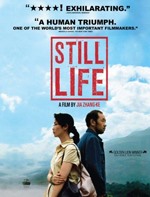 After the Flood: Still Life
Missing persons have driven the plots of a thousand movies. But how many searchers have gone looking for a missing neighborhood?
For Still Life, a drama, filmmaker Zhang-ke carried his cameras around the disintegrating area of Fengjie while the Yangtze rose nearby. In the midst of breathtaking scenery and bizarre scenes of demolition and desperation, he follows a man and a woman on troubling quests to find their lost loved ones. While Sanming and Shen Hong seek their significant others, Jia himself is looking for a lost world and searching for glimmers of hope.
Sanming (Han Sanming), a coal miner, has left Shanxi to return to Fengjie in hopes of finding his wife and teen daughter, perhaps to make amends for abandoning them sixteen years earlier.
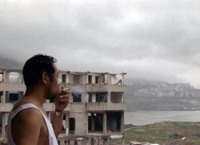
But he can’t find them in the old familiar places because those places no longer exist. Asking directions to a particular address, he is pointed to the river. He drifts along on ferry boats, wanders through what looks like a bombed-out ghost town, and knocks on the doors of old acquaintances who populate ruins soon to be submerged.
Forlorn, Sanming is diagnosed by a friend as being a “nostalgist,” and thus unfit for this rapidly changing world. Then, in a moment that illustrates this collision of old and new, they play their cell phone ringtones for one another. Sanming’s is an old, old Chinese melody, while his friend’s is a dreamy pop song about a very different river than the Yangtze—a river of love.
It’s a complicated exchange. Is Sanming showing incapacity to move forward? Will the richness of past traditions be reduced to trite digital blips? Or is this a sign that Sanming is already finding ways to integrate his past and future?
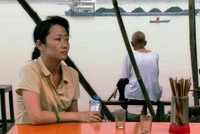
 Meanwhile, a woman named Shen Hong (Zhao Tao) is looking for her husband. He’s been so busy making money that he hasn’t bothered to check in on her for two years. Business is booming so loudly that its champions are deaf to the cries of those left behind.
Old and new are colliding in bizarre juxtapositions. Meandering children wander through the rubble singing ancient songs, while young men form gangs to rule among the ruins. A communist employer is confronted by an ever more assertive work force. A magician turns paper into money—one kind of currency, then another—which suggests another aspect of the people’s bewilderment as the world changes. How can they possibly understand what is happening to them?
In an American film, Sanming and Shen Hong would probably meet, commiserate, and fall in love. Nothing of the sort happens here. Jia isn’t writing to fulfill the wishes of the audience. He’s writing to testify of a people who have no power to see their own wishes fulfilled. The film’s Chinese title, Sanxia haoren, translates “The Good People of Three Gorges.”
 Filming in high-definition video, cinematographer Yu Lik Wai seems awestruck by the environment. It looks like one of the most elaborate sci-fi wastelands ever filmed, but what makes Still Life so compelling is that all of this—the hollowed-out tenement structures that look like the smashed remains of wasps’ nests, the collapsing towers, the masked and uniformed workers who stalk through the debris like alien invaders—is real.
Well, almost all of it. To give us a stronger sense of his characters’ sense of alienation, Jia includes a few startling, whimsical flourishes. A skyscraper might just lift off like a rocketship and disappear, or a UFO might cruise across the landscape. Why not? To these common Chinese laborers, the world around them is turning into something like the Twilight Zone.
Viewers conditioned to expect fast action and rapid-cut editing may grow impatient with his slow, patient progress. More patient viewers will be rewarded with an experience unlike anything they’ve seen before. This film isn’t about the thrill of What Happens Next. It’s about spending time in one of the world’s most extraordinary places. Jia takes it slow so we can comprehend the effects of calamitous change on the environment, on people, on history.
But the film is not entirely without hope. The last thing we see is a tightrope walker—a human being suspended in space on a line, somehow making progress one shaky step at a time.
 A Sobering Cruise: Up the Yangtze
Exploring the same context, documentarian Yung Chang crafts a vision that is equally surreal. Up the Yangtze is full of surprises.
Yung’s journey home, to visit the fishing villages along the Yangtze’s banks where his grandparents grew up, was not a happy one. It’s painfully clear, as he follows a cruise liner from the “New Hong Kong” into Asia’s longest river, that his family’s past is being wiped from the landscape.
Rather than dwell on his own story, he takes us into the lives of an impoverished family who have fished along the river for generations. While their ramshackle home is about to be submerged, they’re scrambling for survival on the edge of starvation.
Their 16-year-old daughter Yu Shui dreams of going to high school, but her parents reject the idea. Weeping for shame, they explain that their survival depends on whatever money she can make.
So Yu Shui goes to work for Victoria Cruises on one of the “Farewell Tours” ships. These luxury cruises give Western tourists a chance to marvel at the wonder of China’s progress.
It’s a humiliating job, but Yu Shui’s coworkers are competitive as they pander to Westerners’ wishes. They’re fighting to keep their jobs, get ahead, and find a place in an uncertain future. Their supervisor pep-talks them with English clichés: “You should have confidence in yourself. Where there is a will, there’s a way. Rome was not built in a day.” Yu Shui, homesick and lonely, can hardly contain her despair.
 Her coworker Chen Bo Yu, three years older and far more ambitious, is a slick representative for a new generation of zealous Chinese youth. He speaks scornfully of those who have not been blessed with his urban middle-class advantages. While he already earns more than his whole family, his heartlessness is shocking.
While Chang’s cameras capture the grandeur of the place, the film leaves us with a feeling of claustrophobia, as if we’re sailing toward some forbidding future. In the closing shot, a boat seems to be sailing through the gates of hell. It left me gasping for air.
Up the Yangtze opens with this saying from Confucius:
By three methods we may learn wisdom:
First, by reflection, which is noblest;
Second, by imitation, which is easiest;
And third, by experience, which is the bitterest.
Reflection, imitation, and experience. Yung’s marvelous movie gives us all an opportunity for reflection. His filmmaking is a work of conscience and artistry, worthy of imitation. And the experience he offers, while at times embittering, shows us how artists can defend the defenseless and speak out for the poor. It also reveals what will happen to the human heart when we seek survival instead of grace, “progress” instead of love.
Next Post

April 29, 2009 Casting Call: Two Satans, Two Adams, Two Eves...
Browse Our Archives
Select a Category Blog Bloggers on "Through a Screen Darkly" Browser Coming Soon Endorsements Fiction Books Film Forum Film Reviews Inspirations Interviews Journal Kindlings Muse Movie buzz Music Reviews Non-Fiction Books radio Reviewers on "Through a Screen Darkly" The Auralia Thread Through a Screen Darkly Through a Screen Darkly - Bonus Materials Top 10 (or 20 or 100) lists Uncategorized
Select a Month June 2015 May 2015 April 2015 March 2015 February 2015 January 2015 December 2014 November 2014 October 2014 September 2014 August 2014 July 2014 June 2014 May 2014 April 2014 March 2014 February 2014 January 2014 December 2013 November 2013 October 2013 September 2013 August 2013 July 2013 June 2013 May 2013 April 2013 March 2013 February 2013 January 2013 December 2012 November 2012 October 2012 September 2012 August 2012 July 2012 June 2012 May 2012 April 2012 March 2012 February 2012 January 2012 December 2011 November 2011 October 2011 September 2011 August 2011 July 2011 June 2011 May 2011 April 2011 March 2011 February 2011 January 2011 December 2010 November 2010 October 2010 September 2010 August 2010 July 2010 June 2010 May 2010 April 2010 March 2010 February 2010 January 2010 December 2009 November 2009 October 2009 September 2009 August 2009 July 2009 June 2009 May 2009 April 2009 March 2009 February 2009 January 2009 December 2008 November 2008 October 2008 September 2008 August 2008 July 2008 June 2008 May 2008 April 2008 March 2008 February 2008 January 2008 December 2007 November 2007 October 2007 September 2007 August 2007 July 2007 June 2007 May 2007 April 2007 March 2007 February 2007 January 2007 December 2006 November 2006 October 2006 September 2006 August 2006 July 2006 June 2006 May 2006 April 2006 March 2006 February 2006 January 2006 December 2005 November 2005 October 2005 September 2005 August 2005 July 2005 June 2005 May 2005 April 2005 March 2005 February 2005 January 2005 December 2004 November 2004 October 2004 September 2004 August 2004 July 2004 June 2004 May 2004 April 2004 July 2003 May 2003 March 2003 September 1999
Follow Us!
TAKE THE
Religious Wisdom Quiz
How did Jesus die?
Select your answer to see how you score.
Spearing Hanging Stoning Crucifixion
Related posts from Looking Closer

This Is Not Goodbye. But It is... See...



What Specialists Are Saying About Jurassic World
TRENDING AT PATHEOS Religious Music & Entertainment

"Les Diabolique" and Transgression
Alongside something like Arrival, Vertigo, or Charade, Les Diaboliques is a...

"The Plague Dogs" and Mortality
So, flashback to the late 70s, early 80s. Walt Disney Studios is...

With the recent and highly successful release of Christopher Nolan’s epic film,...

"L'avventura" and Human Weakness
Today's piece is going to be a little different for a few...

I first want to apologize for not posting or writing anything. I'm...

I've engaged in the multi-year project of reading through the Church Fathers,...
view all Religious Music & Entertainment blogs
Ad-Free & Subscriber Log-In Subscription Support
- About Us
- 2026 Calendar
- Videos
- Podcasts
- Library of World Religions
- Faith In Media Tracker
- Advertise With Us
- Write for Us
- Privacy Policy
- Terms of Service
- Do Not Sell My Data
- Contact Us
- Radiant Digital
- Manage Newsletter Subscriptions
- Unsubscribe From Notifications
- Sitemap
Copyright 2008-2026, Patheos. All rights reserved.
Subscription Support Ad-Free & Subscriber Log-In
Follow Patheos