
BuddhistCatholicContemplativeEvangelicalGeneral ChristianHinduJewishLatter-day SaintMuslimNew VisionsProgressive Christian
Beliefs
- Buddhist
- Catholic
- Contemplative
- Evangelical
- General Christian
- Hindu
- Jewish
- Latter-day Saint
- More Voices
- Muslim
- New Visions
- Pagan
- Progressive Christian
Topics
- Religion News
- Food and Religion
- Sports and Religion
- Religious Art
- Religious Music and Entertainment
- Religious Events
- History and Religion
- Style and Religion
- Politics and Religion
- Women in Religion
- Recreation Outdoors and Religion
- Business Finance and Religion
- Careers Workplace and Religion
- Education and Religion
- Family Parenting and Religion
- Health Fitness and Religion
- Home and Religion
- Relationships and Religion
- Technology and Religion
- Travel and Religion
Columnists
- Buddhist Columnists
- Business Finance and Religion Columnists
- Careers Workplace and Religion Columnists
- Catholic Columnists
- Contemplative Columnists
- Education and Religion Columnists
- Evangelists Columnists
- Family Parenting and Religion Columnists
- General Christian Columnists
- Health Fitness and Religion Columnists
- Hindu Columnists
- History and Religion Columnists
- Home and Religion Columnists
- Jewish Columnists
- More Voices Columnists
- Latter Day Columnists
- Muslim Columnists
- New Visions Columnists
- Nonreligious Columnists
- Pagan Columnists
- Politics and Religion Columnists
- Progressive Columnists
- Recreation Outdoors and Religion Columnists
- Relationships and Religion Columnists
- Religion News Columnists
- Religious Art Columnists
- Religious Events Columnists
- Religious Music and Entertainment Columnists
- Sports and Religion Columnists
- Style and Religion Columnists
- Technology and Religion Columnists
- Travel and Religion Columnists
- Women in Religion Columnists
Resource Library
- 2026 Calendar
- Library of World Religions
- The 100 Most Holy Places on Earth
- Patheos Answers
- Podcasts
- Videos
- Faith Leaders Database
- Anglican Episcopalian
- Bahai
- Baptist
- Buddhism
- Christianity
- Confucianism
- Eastern Orthodoxy
- Hinduism
- Holiness and Pentecostal
- ISKCON
- Islam
- Judaism
- Lutheran
- Methodist
- The Church of Jesus Christ of Latter-day Saints
- New Age
- Paganism
- Presbytarian and Reformed
- Protestantism
- Religion Behind the Scenes
- Roman Catholic
- Scientology
- Shia Islam
- Sikhism
- Sufism
- Sunni Islam
- Taoism
- Zen
- See all religions
Research Tools
 Ad-Free & Subscriber Log-In Subscription Support
Ad-Free & Subscriber Log-In Subscription Support
Follow Patheos 

- Trending:
- Forgiveness
- |
- Marriage
- |
- Consciousness
- |
- Death Penalty
- |
- Election
- |
- Halloween
 Looking Closer
- Home
- Religious Music & Entertainment
- To Be and To Have (2002) and The Class (2008)
To Be and To Have (2002) and The Class (2008)
Last updated on: July 10, 2014 at 5:27 pm by Jeffrey Overstreet
To Be and To Have (2002) and The Class (2008) 2014-07-10T17:27:46-06:00 Jeffrey Overstreet
Patheos Explore the world's faith through different perspectives on religion and spirituality! Patheos has the views of the prevalent religions and spiritualities of the world.

“To Be and to Have”
This two-part review of The Class and To Be and To Have was originally published at Christianity Today.
–
“Carpe Diem.”
Remember that? That’s what Professor Keating (Robin Williams) told his class of troubled youngsters in Dead Poets Society.
“Seize the days, boys. Make your lives extraordinary.”
In The Class, “Seize the day” might be the worst thing the teacher could say to his students. This multi-ethnic group of troublemakers, cynics, and egoists have already seized the classroom, and if he’s not careful they will seize his career and throw it out the window.
The Class, an extraordinarily gripping feature by the great French director Laurent Cantet, is a must-see for college students and teachers alike, and absolutely essential viewing for anyone who feels the urge to make a career in education.
It is, for me, a fascinating film, as my parents, my aunt and uncle, and my grandmother were all teachers, so I’ve grown up in and around classrooms, teachers’ lounges, and parent-teacher conferences. The Class feels more authentic, thoughtful, and inspiring than any other school-related film I’ve seen, including To Sir With Love, Mr. Holland’s Opus, Dangerous Minds, and the aforementioned Dead Poets Society. The jury at the 2008 Cannes Film Festival gave the movie their highest award—the Palme d’Or.
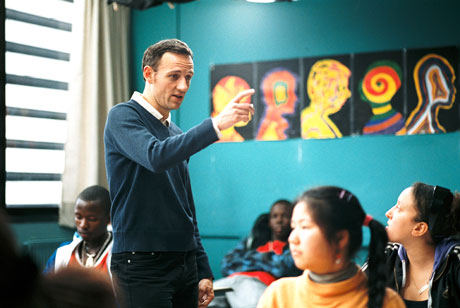 But don’t be scared off by the fact that it’s subtitled, or that it’s bound to one classroom for most of its running time. The Class is as intense as The Bourne Ultimatum, offers more fodder for discussion about modern multi-ethnic societies than Crash, and is enlivened by performances so convincing you may suspect that this is “Reality Big-Screen.”
It is almost, but not quite, a documentary. The French title—Entre les Murs—comes from the book that inspired it, an account by François Bégaudeau of his experiences teaching Parisian middle schoolers. Part of the film’s remarkably persuasive authenticity comes from the fact that Bégaudeau does, in fact, play the part of the teacher—Mr. Marin. It’s a territory he clearly understands. He and the young actors improvised a great deal of the dialogue, “playing classroom” while Cantet’s cameras caught wonderful moments of spontaneity and revealing subtleties.
“The Enlightenment will be tough for them,” Marin laments to a colleague. And yet, we know that students like these once studied the Enlightenment and understood it. It’s difficult to diagnose the students’ apathy and anti-intellectual inclinations. Is it due to troubles at home? Increasing distractions? Lack of common experiences? The culture of “instant gratification”? Christian moviegoers may respond, “They need Jesus.” And of course they do, but how will they ever come to appreciate him if no one is living as an imitation of Christ for them?
Whatever the case, it seems the definition of “teacher” has changed. Mr. Marin’s job description has more in common with wrestlers than schoolteachers as I remember them.
Clearly, these students are suffering in the microcosm of France’s contemporary melting pot, trying to cope with complex tensions—racial, ethnic, and economic. Their behavior is about defining and protecting their identities and egos; to stand up for their rights, they defend themselves with brash attitude. They mock Marin for his use of simple English names in chalkboard sentences. “What’s with the Bills?” one asks, and then the students gang up to suggest better examples: “Aïssata! Fatou!”
And it’s more than just a tension between European and African. Watch how an off-the-cuff reference to sports can spark a debate between two African students that exposes deeply rooted prejudice between their cultures.
Still, the many things that divide the students are trumped by the universal divide between the young and the old. Watch how the students gang up on Marin, like sharks when there’s blood in the water, when he makes a careless mistake. Just as Coleman Silk in Robert Benton’s The Human Stain sparked a scandal when he used the word “spooks” to describe students in absentia, so Marin’s use of “skanky” sets events in motion that just might cost him his job. A young Muslim man from Mali called Souleymane, who guards himself with steely stares and stony silences, eventually challenges Marin by asking him if he’s gay. Marin, to his credit, manages to turn the question into a fruitful exchange about propriety and privacy.
While these students test Marin’s patience—and ours—the beauty of their personalities and intelligence is, at times, breathtaking. You’ll probably have your favorites. I was particularly delighted by the young black woman named Khoumba (Rachel Régulier). While fiercely moody and brashly disrespectful, she is also smart, surprising, and beautifully expressive.
American moviegoers have been conditioned to expect certain things from classroom movies, and The Class turns those expectations upside down. It’s refreshing in its realistic unpredictability. No standing up on the desks in tribute to the teacher. No sacrificial acts or bold stands before the school board to save a troubled student. No climactic success story. The teacher doesn’t feign any kind of cool to win their respect (and that’s good, because real-world students have powerful radar for condescension and fakery). This isn’t Mr. Marin’s Opus.
Instead, we realize that somewhere in these daily sparring matches, someone is escaping notice. Someone isn’t learning a thing.
This isn’t a story crafted to please the audience; it’s crafted to show us a picture of the world we live in, whether we’re in Paris or Seattle. The film’s depictions of communication breakdowns frequently reminded me of Michael Haneke’s masterpiece—*Code Unknown—*a film about schisms between sexes, ages, classes, and races that preceded, and remains vastly superior to, the American equivalent—the Oscar-winning Crash. It breaks down the idea that a teacher can, in the course of a few weeks, tame, unify, and transform a mob of unruly, suspicious, resentful youngsters into model citizens.
That’s not to say it never happens, but such an experience is extremely rare. I grew up in a small school, where all of the students knew each other, where most lived fairly comfortably, and where Christian faith was shared by the administration, teachers, students, and their families. This set the stage for greater unity and deeper relationships. I’m still in close touch with many more than twenty from my graduating class, and some of my former teachers are now my best friends. I watch The Class, and it breaks my heart that the blessings I received are so rare.
–
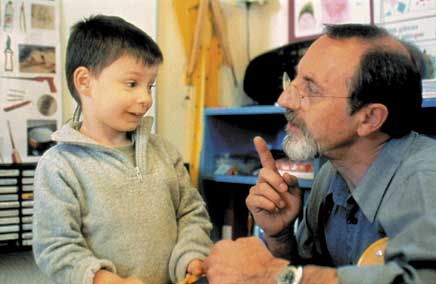 By contrast, To Be and To Have, the other essential “classroom movie” of the last decade, is a quieter film. It may remind you as much of Into Great Silence as any other movie.
This 2002 documentary was filmed by Nicolas Philibert over the course of a year in a one-room schoolhouse, and it’s every bit as inspiring asThe Class—perhaps more so. After all, the students in Mr. George Lopez’s class are younger, ranging from age 3 to 11. They’re not so brash or full of themselves. They’re still malleable and full of wonder. Whether their innocence and potential has anything to do with their remote location—a farming community in central France—the film leaves up to the viewers to decide.
To Be and To Have has become one of those films I turn to during stressful periods, to “get out of town” and visit a beautiful area in rural France. It’s impressive to meet the monk-like Mr. Lopez, who has been teaching for more than thirty years. He is so masterfully gentle, so effectively firm, that you may end up thinking back to your favorite elementary school teacher—or else wish you had one so observant, tender, and conscientious.
Watching it again so soon after seeing The Class, I marveled again at how these children do not seem to have any trouble respecting authority, even if they do struggle to craft the numeral “7.” They work, they color, they listen, they read, they draw, they count, they write, and they go sledding.
Lopez plays the Good Shepherd. Many seem distracted, like they’d rather be elsewhere. One lives in a silent world of her own. Lopez wins their trust. When two of the older boys fight, one of them, Guillaume, sits down and, instead of a curt reprimand or a threat, he takes a different approach. “I want us to talk about your argument and that fight at playtime to try and see what it means.” Later, when it’s time to dream about the future, one wants to be a veterinarian and, tellingly, two want to be teachers.
You’ll be charmed by the children. Little “Jojo” is often the audience favorite—he has a little trouble concentrating, but his inquisitive sensibility is a joy to behold. Nathalie looks too young to be speaking, but she’s one of the sharpest and most observant in the group.
With a few poetic sequences that show us the cattle-herding that goes on around the schoolhouse, and how a snowblown winter gives way to a glistening spring, the filmmakers give quiet testimony to the dignity to be found in tending to the simple things, and the hope we have that the seeds that have been planted will endure hard times and burst into glory someday.
Either film is well worth your time—alone or with a group from school or church. Watch them both, and you’ll find intriguing connections between them, in spite of their differing contexts, backgrounds, vocabularies, and the students’ age span.
In both films, parents come in for tense exchanges with the teacher. And in both, students suffer bodily injuries among their peers, prompting swift disciplinary action, but the two incidents could not be more different. One is a documentary that plays well as a character study; the other is a character study authentic enough to be a documentary.
I suspect you’ll learn a good deal about yourself by who inspires your sympathy, who inspires your criticism, and whether these films make you feel hopeful or dismayed. And if you’re interested in teaching, these films will help you consider the challenges ahead.
Maybe some will be inspired to contact their former teachers and thank them for all that they suffered while investing in us. Even if we didn’t learn much in the turmoil of our classes, perhaps it’s not too late to learn something from the teachers’ courageous, faithful, daily stand in front of so many “dangerous minds.” Write your teacher. Seize the day.
Previous Post

March 16, 2009
Auralia geekery
Next Post
March 17, 2009 U2 Medium, Rare + Lillywhite!
Browse Our Archives
Select a Category Blog Bloggers on "Through a Screen Darkly" Browser Coming Soon Endorsements Fiction Books Film Forum Film Reviews Inspirations Interviews Journal Kindlings Muse Movie buzz Music Reviews Non-Fiction Books radio Reviewers on "Through a Screen Darkly" The Auralia Thread Through a Screen Darkly Through a Screen Darkly - Bonus Materials Top 10 (or 20 or 100) lists Uncategorized
Select a Month June 2015 May 2015 April 2015 March 2015 February 2015 January 2015 December 2014 November 2014 October 2014 September 2014 August 2014 July 2014 June 2014 May 2014 April 2014 March 2014 February 2014 January 2014 December 2013 November 2013 October 2013 September 2013 August 2013 July 2013 June 2013 May 2013 April 2013 March 2013 February 2013 January 2013 December 2012 November 2012 October 2012 September 2012 August 2012 July 2012 June 2012 May 2012 April 2012 March 2012 February 2012 January 2012 December 2011 November 2011 October 2011 September 2011 August 2011 July 2011 June 2011 May 2011 April 2011 March 2011 February 2011 January 2011 December 2010 November 2010 October 2010 September 2010 August 2010 July 2010 June 2010 May 2010 April 2010 March 2010 February 2010 January 2010 December 2009 November 2009 October 2009 September 2009 August 2009 July 2009 June 2009 May 2009 April 2009 March 2009 February 2009 January 2009 December 2008 November 2008 October 2008 September 2008 August 2008 July 2008 June 2008 May 2008 April 2008 March 2008 February 2008 January 2008 December 2007 November 2007 October 2007 September 2007 August 2007 July 2007 June 2007 May 2007 April 2007 March 2007 February 2007 January 2007 December 2006 November 2006 October 2006 September 2006 August 2006 July 2006 June 2006 May 2006 April 2006 March 2006 February 2006 January 2006 December 2005 November 2005 October 2005 September 2005 August 2005 July 2005 June 2005 May 2005 April 2005 March 2005 February 2005 January 2005 December 2004 November 2004 October 2004 September 2004 August 2004 July 2004 June 2004 May 2004 April 2004 July 2003 May 2003 March 2003 September 1999
Follow Us!
TAKE THE
Religious Wisdom Quiz
Who walked on water with Jesus before losing faith and sinking?
Select your answer to see how you score.
James Peter Philip Thomas
Related posts from Looking Closer

This Is Not Goodbye. But It is... See...



What Specialists Are Saying About Jurassic World
TRENDING AT PATHEOS Religious Music & Entertainment

"Les Diabolique" and Transgression
Alongside something like Arrival, Vertigo, or Charade, Les Diaboliques is a...

"The Plague Dogs" and Mortality
So, flashback to the late 70s, early 80s. Walt Disney Studios is...

With the recent and highly successful release of Christopher Nolan’s epic film,...

"L'avventura" and Human Weakness
Today's piece is going to be a little different for a few...

I first want to apologize for not posting or writing anything. I'm...

I've engaged in the multi-year project of reading through the Church Fathers,...
view all Religious Music & Entertainment blogs
Ad-Free & Subscriber Log-In Subscription Support
- About Us
- 2026 Calendar
- Videos
- Podcasts
- Library of World Religions
- Faith In Media Tracker
- Advertise With Us
- Write for Us
- Privacy Policy
- Terms of Service
- Do Not Sell My Data
- Contact Us
- Radiant Digital
- Manage Newsletter Subscriptions
- Unsubscribe From Notifications
- Sitemap
Copyright 2008-2026, Patheos. All rights reserved.
Subscription Support Ad-Free & Subscriber Log-In
Follow Patheos