
BuddhistCatholicContemplativeEvangelicalGeneral ChristianHinduJewishLatter-day SaintMuslimNew VisionsProgressive Christian
Beliefs
- Buddhist
- Catholic
- Contemplative
- Evangelical
- General Christian
- Hindu
- Jewish
- Latter-day Saint
- More Voices
- Muslim
- New Visions
- Pagan
- Progressive Christian
Topics
- Religion News
- Food and Religion
- Sports and Religion
- Religious Art
- Religious Music and Entertainment
- Religious Events
- History and Religion
- Style and Religion
- Politics and Religion
- Women in Religion
- Recreation Outdoors and Religion
- Business Finance and Religion
- Careers Workplace and Religion
- Education and Religion
- Family Parenting and Religion
- Health Fitness and Religion
- Home and Religion
- Relationships and Religion
- Technology and Religion
- Travel and Religion
Columnists
- Buddhist Columnists
- Business Finance and Religion Columnists
- Careers Workplace and Religion Columnists
- Catholic Columnists
- Contemplative Columnists
- Education and Religion Columnists
- Evangelists Columnists
- Family Parenting and Religion Columnists
- General Christian Columnists
- Health Fitness and Religion Columnists
- Hindu Columnists
- History and Religion Columnists
- Home and Religion Columnists
- Jewish Columnists
- More Voices Columnists
- Latter Day Columnists
- Muslim Columnists
- New Visions Columnists
- Nonreligious Columnists
- Pagan Columnists
- Politics and Religion Columnists
- Progressive Columnists
- Recreation Outdoors and Religion Columnists
- Relationships and Religion Columnists
- Religion News Columnists
- Religious Art Columnists
- Religious Events Columnists
- Religious Music and Entertainment Columnists
- Sports and Religion Columnists
- Style and Religion Columnists
- Technology and Religion Columnists
- Travel and Religion Columnists
- Women in Religion Columnists
Resource Library
- 2026 Calendar
- Library of World Religions
- The 100 Most Holy Places on Earth
- Patheos Answers
- Podcasts
- Videos
- Faith Leaders Database
- Anglican Episcopalian
- Bahai
- Baptist
- Buddhism
- Christianity
- Confucianism
- Eastern Orthodoxy
- Hinduism
- Holiness and Pentecostal
- ISKCON
- Islam
- Judaism
- Lutheran
- Methodist
- The Church of Jesus Christ of Latter-day Saints
- New Age
- Paganism
- Presbytarian and Reformed
- Protestantism
- Religion Behind the Scenes
- Roman Catholic
- Scientology
- Shia Islam
- Sikhism
- Sufism
- Sunni Islam
- Taoism
- Zen
- See all religions
Research Tools
 Ad-Free & Subscriber Log-In Subscription Support
Ad-Free & Subscriber Log-In Subscription Support
Follow Patheos 

- Trending:
- Forgiveness
- |
- Marriage
- |
- Consciousness
- |
- Death Penalty
- |
- Election
- |
- Halloween
 Looking Closer
- Home
- Religious Music & Entertainment
- Harry Potter and the Prisoner of Azkaban (2004)
Harry Potter and the Prisoner of Azkaban (2004)
Last updated on: April 14, 2013 at 2:16 pm by Jeffrey Overstreet
Harry Potter and the Prisoner of Azkaban (2004) 2013-04-14T14:16:36-06:00 Jeffrey Overstreet
Patheos Explore the world's faith through different perspectives on religion and spirituality! Patheos has the views of the prevalent religions and spiritualities of the world.
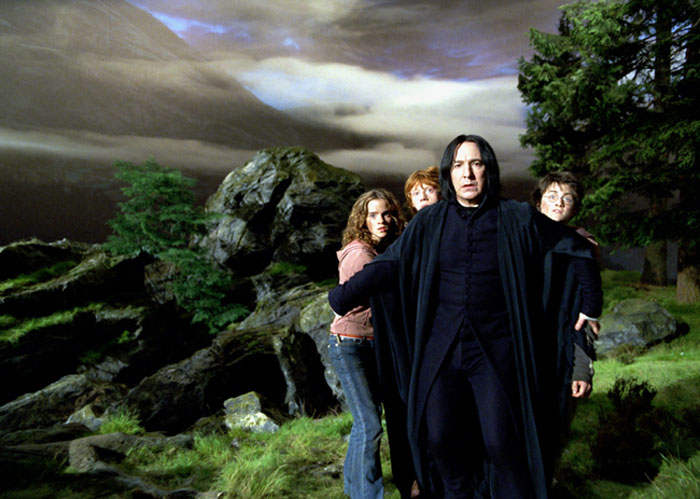 Thanks to director Alfonso Cuarón and his dream-team of British actors, Harry Potter and the Prisoner of Azkaban may mark the first time that the third film in a trilogy has been the best. But thanks to storyteller J.K. Rowling, the derivative plot lacks depth and suspense.
Cuarón is clearly a great choice for the film, bringing with him the talent that made his 1995 film A Little Princess one of the best fairy tales ever filmed. He’s got a knack for fantasy. Contrary to the typical Disney sanitization, he allows for the possibility of things to go very wrong, and he’s not afraid to let mysteries remain mysterious or dark possibilities remain threatening. Thus, his Potter film is more resonant than the cartoonish, methodical quality of the first two.
Azkaban is richer, more complex, with better performances from its leads. It boasts John Williams’ best musical contribution to the franchise. It’s also loaded with dazzling special effects that will make the first two films look like cheap made-for-TV affairs.
Most impressively, it features a cast more dazzling than any we’re likely to see for a while. Cuarón brings back the spunky Emma Watson as Hermione Granger, of course. And while her presence helps make up for Daniel Radcliffe’s unmemorable Harry and Rupert Gint’s tiresomely oafish Ron, her increasing ability to steal scenes and enchant the audience may eventually become a real problem for this series. If the Potter franchise is remembered for launching any big stars, I have little doubt that she’s the one who will shine brightest in the long term.
Cuarón is also fortunate to have Michael Gambon (Gosford Park, The Insider) step into the shoes of Richard Harris’s Albus Dumbledore. Thus, Dumbledore’s a rougher, gruffer, more interesting mentor for the children. There’s also Alan Rickman as the sour-tempered Snape and Maggie Smith as Professor McGonagall.
But then, Cuarón reveals the new Defense Against the Dark Arts teacher. Replacing the flamboyant Kenneth Branagh in the job is-could it be?-David Thewlis as Professor Lupin! Thewlis, who set fire to the screen with his galvanizing performance in Mike Leigh’s Naked, is an inspired choice. He seems more at ease in this environment than any of the cast so far. He doesn’t make Lupin a cartoon or a caricature — he’s funny, likeable, mysterious, and unpredictable. Lupin starts out training the young wizards to overcome their fears. Later, he gives them reason to fear him. Lupin’s complexity makes him the most interesting character in the franchise thus far.
But wait, there’s more. How about Emma Thompson as Professor of Divination Sibyll Trelawney, with glasses that magnify her eyes so they no longer fit her head, and a near-sightedness that messes with her visions of the future? Fantastic. Musing over tea leaves with tremulous melodrama, she’s a supernatural flibbertigibbet.
Then, as if showing off, Cuarón pulls off a greater trick. He pulls the long-missing Gary Oldman out of a hat, playing the shadowy figure of the title-an escaped prisoner called Sirius Black. Black has troubling connections to the murder of Harry Potter’s parents, and now he seems to have his deadly arts aimed at Harry. When Oldman finally surfaces (disappointingly late in the show), he’s not at all what his ‘WANTED’ poster has led us to expect. He’s, well, Gary Oldman-which means he’s a character we’ve never seen before: complicated, emotional, and full of surprises.
There will be few screen pleasures this year as delightful as seeing Rickman, Thewlis, and Oldman onscreen at the same time, suddenly joined by yet another superlative British talent-Timothy Spall. It’s enough to make one wonder if Mike Leigh didn’t serve as the film’s casting agent. In fact, it makes one a bit sad that it had to be this film that united them. Perhaps seeing three of his former cast members together will inspire Leigh, or someone, to reunite them for something substantial.
Like Leigh’s brilliant line of dusty, gritty British films, Cuarón’s trip to Rowling’s world feels distinctly English. Cinematographer Michael Seresin achieves a naturalism that was lacking in the first two, making Harry’s world much more “lived-in” and convincing. The costumes look lived-in as well, thanks to designer Jany Temime. Stuart Craig’s brilliant production design gives shadows and history to Hogwarts halls. His gallery of moving paintings becomes something awe-inspiring instead of merely clever. Tim Burke and Roger Guyett’s visual effects are masterful, making the Hippogriff-an eagle/horse hybrid-an enchanting and lifelike achievement. It strikes me as rather sad that CGI animation is so frequently used to create the stuff of our nightmares, and so rarely used to invent something beautiful. The Hippogriff soars, buoyed by John Williams’ score, a restrained and evocative composition more along the lines of his Catch Me If You Can score than the trademark Williams fanfare of the first two.
You’ll notice I’m not saying much about the plot. That’s because it’s the least interesting aspect of the film. Cuarón has everything he needs for a spectacularly entertaining and exciting fantasy except a suspenseful story. He scares up some goosebumps with a nasty variation on Tolkien’s Black Riders, floating black phantoms called Dementors. But otherwise, this is the same plot that carried us through the first two.
Once again, Steve Kloves’ failing is not to invest Rowling’s story with more heart, more worth caring about. Sure, if he strayed far from her plot, he’d incur the wrath of a zillion fans. But alas, he’s thus bound to repeating an unsensational story. The series is thus becoming redundant, predictable, and formulaic.
Here’s the formula: Harry begins at the Dursleys, abusing his powers at their expense, for his own amusement. (Ahh, what a role model. Nothing like humiliating a relative to show your budding skills for leadership.) He goes to school, defies authority again and breaks even more rules, gets bullied by other students who also break rules (albeit with a sneer), discovers that his teachers are clueless (again), breaks more rules in order to take care of things on his own, comes face to face with the latest enemy, discovers that he was completely wrong about the enemy’s identity, and then humbles everyone by exposing the truth for all to see. What a moral: Crime pays.
Worse, Rowling’s story collapses in the last act, spoiling the spooky mood of the film’s first 90 minutes by trying to pull the rug out from under us. Just as in the first two films, there must be a last-minute revelation in which exposition is poured over our heads to explain what is really going on. This doesn’t seem fair to the audience. The film gave us no indication that we should be looking for clues to solve a mystery, and yet the conclusion behaves as if it has accomplished a brilliant bait-and-switch.
But the thing that bothers me most about this episode in the Potter series is the way that it continues to drain any kind of suspense from Harry’s adventures by giving the magicians every variety of spell that they need just when they need it, even though those spells have never been mentioned before.
I groaned aloud when Hermione, who once again proves the smartest and most interesting of the young personalities, pulled a trick out of her hat in the last chapter–a trick that could save the day. Why didn’t any of the wizards ever propose using this trick before? Had they considered it in the previous two films, they could have prevented a world of trouble for many of the characters. In fact, if they would use the trick even now, at the end of episode three, they could clean up a great deal of the distress and disorder going on at Hogwarts.
Plot problems like this will continue to make Potter chapters as expendable as episodes of most sci-fi television shows. When trials come up, there will always be a technological tool, or a magic trick, that will save everyone at the last minute. Magic is thus robbed of its symbolic potential and becomes merely a toolbox of technological devices.
With all of its recurring focus on young boys having trouble with their wands, and with the slightly changing dynamic in the relationship between Ron and Hermione, the story is a not-so-subtle drama about coming of age. But it finds nothing interesting to suggest about growing up, except that we must face our fears, blah blah blah. It’s far too distracted with tricks and overcrowded with characters who must each make at least one appearance or risk offending the fans. Potentially powerful characters like Professor Snape are reduced to a few scowling cameos. Poor Maggie Smith gets all dressed up and has not but a line or two. When all is said and done, The Prisoner of Azkaban is at heart most concerned about distracting us with red herrings until the arrival a finale that’s only surprising because it is arbitrary.
Themes? Acts of sacrifice? Love? No. Potter and Company operate on the principle that all authority is naïve, and that if you want something, you make it happen your own way, no matter how many rules you have to break to get it done. No need to appeal to the wisdom of your elders. Just charge ahead blindly, trusting in your own immature understanding, and the Good Witch Rowling will be there to toss you another trick when you need it.
The next episode will be directed by Mike Newell, who proven his own brilliance with fairy tales in the Irish adventure Into the West. Perhaps he can cast a spell that transforms more than style and technique, elevating story as well.
•
Directed by Alfonso Cuarón; written by Steve Kloves, based on the novel by J. K. Rowling; director of photography, Michael Seresin; edited by Steven Weisberg; music by John Williams; production designer, Stuart Craig; produced by David Heyman, Chris Columbus and Mark Radcliffe. Starring – Daniel Radcliffe (Harry Potter), Rupert Grint (Ron Weasley), Emma Watson (Hermione Granger), Robbie Coltrane (Rubeus Hagrid), Michael Gambon (Albus Dumbledore), Richard Griffiths (Uncle Vernon), Gary Oldman (Sirius Black), Alan Rickman (Professor Snape), Fiona Shaw (Aunt Petunia), Maggie Smith (Professor McGonagall), Timothy Spall (Peter Pettigrew), David Thewlis (Professor Lupin), Emma Thompson (Professor Trelawney) and Tom Felton (Draco Malfoy). Warner Brothers Pictures. 136 minutes.
Harry Potter and the Prisoner of Azkaban
Previous Post
November 25, 2008
Harry Potter and the Order of the Phoenix (2007)
Next Post

November 25, 2008 The Lord of the Rings: The Two Towers (2002)
Browse Our Archives
Select a Category Blog Bloggers on "Through a Screen Darkly" Browser Coming Soon Endorsements Fiction Books Film Forum Film Reviews Inspirations Interviews Journal Kindlings Muse Movie buzz Music Reviews Non-Fiction Books radio Reviewers on "Through a Screen Darkly" The Auralia Thread Through a Screen Darkly Through a Screen Darkly - Bonus Materials Top 10 (or 20 or 100) lists Uncategorized
Select a Month June 2015 May 2015 April 2015 March 2015 February 2015 January 2015 December 2014 November 2014 October 2014 September 2014 August 2014 July 2014 June 2014 May 2014 April 2014 March 2014 February 2014 January 2014 December 2013 November 2013 October 2013 September 2013 August 2013 July 2013 June 2013 May 2013 April 2013 March 2013 February 2013 January 2013 December 2012 November 2012 October 2012 September 2012 August 2012 July 2012 June 2012 May 2012 April 2012 March 2012 February 2012 January 2012 December 2011 November 2011 October 2011 September 2011 August 2011 July 2011 June 2011 May 2011 April 2011 March 2011 February 2011 January 2011 December 2010 November 2010 October 2010 September 2010 August 2010 July 2010 June 2010 May 2010 April 2010 March 2010 February 2010 January 2010 December 2009 November 2009 October 2009 September 2009 August 2009 July 2009 June 2009 May 2009 April 2009 March 2009 February 2009 January 2009 December 2008 November 2008 October 2008 September 2008 August 2008 July 2008 June 2008 May 2008 April 2008 March 2008 February 2008 January 2008 December 2007 November 2007 October 2007 September 2007 August 2007 July 2007 June 2007 May 2007 April 2007 March 2007 February 2007 January 2007 December 2006 November 2006 October 2006 September 2006 August 2006 July 2006 June 2006 May 2006 April 2006 March 2006 February 2006 January 2006 December 2005 November 2005 October 2005 September 2005 August 2005 July 2005 June 2005 May 2005 April 2005 March 2005 February 2005 January 2005 December 2004 November 2004 October 2004 September 2004 August 2004 July 2004 June 2004 May 2004 April 2004 July 2003 May 2003 March 2003 September 1999
Follow Us!
TAKE THE
Religious Wisdom Quiz
What does Paul say about weakness in 2 Corinthians 12?
Select your answer to see how you score.
"Avoid all weakness." "Weakness leads to destruction." "The weak shall perish." "God’s power is made perfect in weakness."
Related posts from Looking Closer

This Is Not Goodbye. But It is... See...



What Specialists Are Saying About Jurassic World
TRENDING AT PATHEOS Religious Music & Entertainment

"Les Diabolique" and Transgression
Alongside something like Arrival, Vertigo, or Charade, Les Diaboliques is a...

"The Plague Dogs" and Mortality
So, flashback to the late 70s, early 80s. Walt Disney Studios is...

With the recent and highly successful release of Christopher Nolan’s epic film,...

"L'avventura" and Human Weakness
Today's piece is going to be a little different for a few...

I first want to apologize for not posting or writing anything. I'm...

I've engaged in the multi-year project of reading through the Church Fathers,...
view all Religious Music & Entertainment blogs
Ad-Free & Subscriber Log-In Subscription Support
- About Us
- 2026 Calendar
- Videos
- Podcasts
- Library of World Religions
- Faith In Media Tracker
- Advertise With Us
- Write for Us
- Privacy Policy
- Terms of Service
- Do Not Sell My Data
- Contact Us
- Radiant Digital
- Manage Newsletter Subscriptions
- Unsubscribe From Notifications
- Sitemap
Copyright 2008-2026, Patheos. All rights reserved.
Subscription Support Ad-Free & Subscriber Log-In
Follow Patheos