
BuddhistCatholicContemplativeEvangelicalGeneral ChristianHinduJewishLatter-day SaintMuslimNew VisionsProgressive Christian
Beliefs
- Buddhist
- Catholic
- Contemplative
- Evangelical
- General Christian
- Hindu
- Jewish
- Latter-day Saint
- More Voices
- Muslim
- New Visions
- Pagan
- Progressive Christian
Topics
- Religion News
- Food and Religion
- Sports and Religion
- Religious Art
- Religious Music and Entertainment
- Religious Events
- History and Religion
- Style and Religion
- Politics and Religion
- Women in Religion
- Recreation Outdoors and Religion
- Business Finance and Religion
- Careers Workplace and Religion
- Education and Religion
- Family Parenting and Religion
- Health Fitness and Religion
- Home and Religion
- Relationships and Religion
- Technology and Religion
- Travel and Religion
Columnists
- Buddhist Columnists
- Business Finance and Religion Columnists
- Careers Workplace and Religion Columnists
- Catholic Columnists
- Contemplative Columnists
- Education and Religion Columnists
- Evangelists Columnists
- Family Parenting and Religion Columnists
- General Christian Columnists
- Health Fitness and Religion Columnists
- Hindu Columnists
- History and Religion Columnists
- Home and Religion Columnists
- Jewish Columnists
- More Voices Columnists
- Latter Day Columnists
- Muslim Columnists
- New Visions Columnists
- Nonreligious Columnists
- Pagan Columnists
- Politics and Religion Columnists
- Progressive Columnists
- Recreation Outdoors and Religion Columnists
- Relationships and Religion Columnists
- Religion News Columnists
- Religious Art Columnists
- Religious Events Columnists
- Religious Music and Entertainment Columnists
- Sports and Religion Columnists
- Style and Religion Columnists
- Technology and Religion Columnists
- Travel and Religion Columnists
- Women in Religion Columnists
Resource Library
- 2026 Calendar
- Library of World Religions
- The 100 Most Holy Places on Earth
- Patheos Answers
- Podcasts
- Videos
- Faith Leaders Database
- Anglican Episcopalian
- Bahai
- Baptist
- Buddhism
- Christianity
- Confucianism
- Eastern Orthodoxy
- Hinduism
- Holiness and Pentecostal
- ISKCON
- Islam
- Judaism
- Lutheran
- Methodist
- The Church of Jesus Christ of Latter-day Saints
- New Age
- Paganism
- Presbytarian and Reformed
- Protestantism
- Religion Behind the Scenes
- Roman Catholic
- Scientology
- Shia Islam
- Sikhism
- Sufism
- Sunni Islam
- Taoism
- Zen
- See all religions
Research Tools
 Ad-Free & Subscriber Log-In Subscription Support
Ad-Free & Subscriber Log-In Subscription Support
Follow Patheos 

- Trending:
- Forgiveness
- |
- Marriage
- |
- Consciousness
- |
- Death Penalty
- |
- Election
- |
- Halloween
 Looking Closer
- Home
- Religious Music & Entertainment
- WALL·E (2008) – A Review and a Conversation with Andrew Stanton
WALL·E (2008) – A Review and a Conversation with Andrew Stanton
Last updated on: July 1, 2014 at 10:29 am by Jeffrey Overstreet
WALL·E (2008) – A Review and a Conversation with Andrew Stanton 2014-07-01T10:29:35-06:00 Jeffrey Overstreet
Patheos Explore the world's faith through different perspectives on religion and spirituality! Patheos has the views of the prevalent religions and spiritualities of the world.
 This review and interview were originally published in the online edition of Response, a magazine published by Seattle Pacific University.
–
Who would have believed that a mechanical trash compactor on wheels would become the most lovable big-screen personality of the year?
It’s happening. The moviemaking wizards at Pixar Animation Studio are winning raves from kids and critics alike with WALL·E, thanks to the help of a little robot with a big heart. Yes, it’s business as usual for the storytellers and animators who have given moviegoers memorable, awe-inspiring scenes for more than a decade.
With 1995’s Toy Story, they introduced us to a new era in feature-length, digitally animated movies. But they weren’t just showing off. They were concerned about storytelling, developed memorable characters, and gave us a delightful, nostalgic celebration of childlike imagination. In the 1999 sequel, Toy Story 2, Buzz Lightyear and Woody took digital animation to new heights, and the tale found poignant moments that captured the bittersweet struggle to maintain childlike faith as we mature.
In Finding Nemo (2003), they took us snorkeling for 90 minutes in an environment of such colorful, dreamy imagery that moviegoers felt hypnotized. The film’s “focus on the family” thrilled kids and brought tears to the eyes of many parents as well. The Incredibles (2004) reaffirmed Pixar’s commitment to telling stories that celebrate family relationships, and it was celebrated by superhero fans as one of the best superhero movies ever made.
Others — A Bug’s Life; Monsters, Inc.; and Cars — have won praise from kids and critics alike, and Pixar’s desk-lamp logo has become a stamp of quality and delight for moviegoers of all ages.
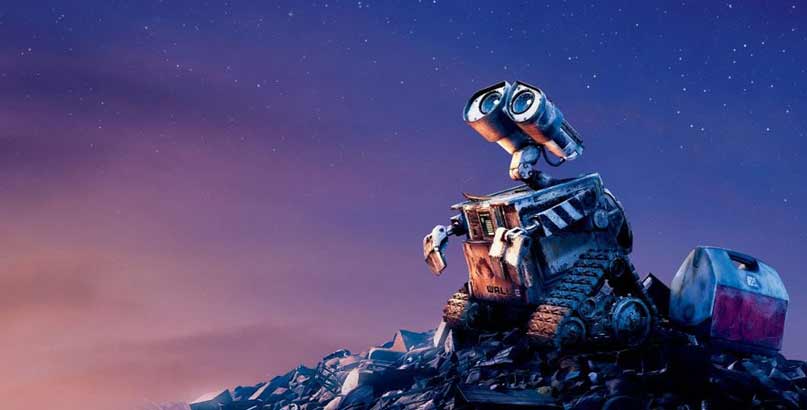
With the release of WALL·E, Pixar’s most ambitious and controversial feature, many are wondering if the studio can maintain its “perfect record.” The overwhelming consensus among critics is a hearty “Yes, they can!” WALL·E is a science fiction fable about the last robot on earth, a lonely little trash compactor who putters through grand canyons of trash, slowly cleaning up an uninhabited world, which humanity polluted and abandoned 700 years earlier. (“WALL·E” stands for “Waste Allocation Load Lifter Earth-Class.”)
WALL·E speaks in a vocabulary of blips provided by sound effects master Ben Burtt, the man who gave R2D2 a voice more than 30 years ago. And yet, while WALL·E’s not speaking English, it’s easy to translate his lonely thoughts. And he doesn’t just smash stuff. He pauses first to ponder the purpose (and sometimes, the absurdity) of every product on this planet-sized landfill. From “sporks” to Rubik’s cubes to lighters to diamond rings, he experiments with his discoveries, providing some of the most delightfully comical entertainment this side of Charlie Chaplin.
In the little trailer he calls home, WALL·E watches battered old VHS tapes of Gene Kelly musicals and savors the spark of human creativity that remains in the rubble. And when two lovers hold hands in Hello Dolly!, something in the robot’s heart lights up like E.T.’s did more than 20 years ago. Despite the desperate practicality of his design, there is a longing in WALL·E that tells him he’s meant for something greater. The poor little droid — a cross between Short Circuit’s “Number Five” and the Energizer Bunny — is desperately lonely, having only a perky cockroach as a friend. When you’ve sunk so low, where can you look but up?
With WALL·E, Pixar has expanded the range of its power impressively. The film is full of clever nods to Star Wars, E.T. The Extra-Terrestrial, 2001: A Space Odyssey, and even Blade Runner. Nevertheless, WALL·E is anything but derivative. This is original, groundbreaking science fiction, and a satire with edges so sharp they’d impress Jonathan Swift.
Don’t let reviews spoil the details, but WALL·E may find his chance at true love. He’s also drawn into an adventure that resembles the story of Noah’s Ark, as he learns what became of humankind, and as he marvels at the grace of a dovelike robot called EVE. Just as there is hope for that lonely, rusty droid to find salvation from his trash-strewn existence, so there is hope for that lonely, polluted planet — that sad little sphere puttering along its orbit, groaning for all that it has become, and all that it was meant to be.
It’s almost enough to make a moviegoer think that the storyteller, Andrew Stanton (who also wrote Finding Nemo), has Christian convictions of his own. And rightly so. Recently interviewed for Christianity Today by Mark Moring, Stanton spoke openly about his faith.
Stanton spoke for this interview about writing stories that can make a difference. (And, much to this interviewer’s astonishment, he revealed that he had read my book Through a Screen Darkly as he was working on WAL·E.) Stanton also took time to address some concerns that critics have raised about the film’s satirical turns. Some have complained that the film mocks consumer culture, and that its portrayal of humanity’s “evolution” into a race of infantile, obese couch potatoes is grossly cynical.
But Stanton doesn’t feel that way at all. For him, it was a story that grew in the telling, as J.R.R. Tolkien once said of The Hobbit… a story that began with a very lonely character.
A Chat With Andrew Stanton
 Overstreet: I know I’m not the only one who’s been charmed by the teasers and trailers for WALL·E. But I was not prepared for this film. It caught me by surprise. You really took the audience out of the Pixar “comfort zone,” so to speak, and into some new territory — a vision of the future that was saddening and bleak.
Stanton: Well … it’s sci-fi. I don’t know any great sci-fi movies that aren’t bleak in their backdrop. The initial conceit that I had in 1994 was “the last robot on earth” — just that sentence — and there’s just nothing optimistic about that sentence.
And yet, in a weird way, I think that backdrop of bleakness is a major factor in why you like WALL·E. He’s this light that shines in the middle of all this sort of gloom.
Overstreet: To tell that kind of story on a platform the size of Pixar’s seems risky. As a storyteller, you’re looking for what will reach our minds and hearts. But most movie producers, on the other hand, are focused on the bottom line. This movie was more thoughtful and grim than most summer entertainment. It was a gamble. Did anybody push back, or get uncomfortable, at any point along the way, when they saw where you wanted that little robot to lead us?
Stanton: I am so proud to say, Nope! That’s what’s wonderful about Pixar. It’s an artist who runs the studio, and Steve Jobs is practically an artist himself in a CEO’s clothing. They completely saw how great of a film this could be if done right. And the only question was, Can we pull it off? Do we have enough chops and enough know-how after all these years to do something that would be more challenging to execute? Nobody was put off by it. They were all engaged by it.
Overstreet: There’s some debate online as to whether Wall·E is one giant contradiction … whether it’s fair for Disney, the great empire of merchandising, to put out a movie that asks if we’ve gone too far in answering our consumer impulses.
Stanton: I do think it’s a cautionary tale about taking anything too far. I wasn’t necessarily pushing “anti-consumerism,” I was just pushing against something that has gone to an extreme. It’s fine if it brings a little bit of conscience to a large corporation, even if it’s us.
I know that [people at Disney] have tried to be a little bit more “green-friendly,” and it’s made them more conscientious in the making of a lot of this stuff over the duration of it. But again, I’m not wagging fingers. To be honest, I reverse-engineered the whole idea. My first idea was, like I said before, “the last robot on earth.” I knew I wanted him to be a trash robot because that would allow him to be able to go through the evidence of humanity, and be able to convey that without having to use dialogue. Trash is very visual. I was raised in the ’70s, where I was told not to litter every 10 minutes on TV. So I went backwards from that and I had to go “OK, I still can’t talk about it. I still have to just get it in the first 15 minutes going through this movie, so how would you explain so much stuff?” And I decided, “Well, we just bought too much.” So I reverse-engineered it. It wasn’t that I had an agenda of any sort.
Overstreet: Entertainment and storytelling — and I’m thinking especially of entertainment crafted for kids these days — seems to be so frantic, so desperate to hold our attention.
Stanton: Yeah, I think they completely underestimate kids all the time.
Overstreet: One of the things that I admire about Pixar, and also the films of Hayao Miyazaki (which Disney also distributes to American audiences), is that willingness to allow for quiet, meditative moments in the middle of all the action. Is it hard for you as a storyteller when you know that the expectation now is for nonstop stimulation?
Stanton: No, because that’s an outside expectation. That may be true for other entities, but I’ve never felt that in-house. It’s a philosophy we’ve never agreed with. Fortunately, I’m surrounded by other filmmakers who look at the world the same way I do. We just are still very in tune with ourselves as kids and what kind of movies we loved, and they’re the kinds of movies we’re making.
Overstreet: How do you approach the challenge of being meaningful in entertainment without preaching?
Stanton: I knew I was playing with fire by having elements that could [make people] accuse me of preaching, but frankly I figured that if I was always doing it from an honest place, that I was only using things in order to make the story clear and make the love story and the theme of the movie as rock-solid as I could, then the smart people would get it. So … that’s my only defense. I hate going to a movie and being preached to. If it emotionally gets to somebody, then I’ll take credit for it, because I was trying to go for as much emotional punch as possible.
Overstreet: If you were going to address a conference of storytellers about making great family entertainment, what habits would you encourage them to develop, or to break?
Stanton: I think it’s much easier to go to an honest place and make the kind of movie you want to see yourself. Listen to the audience member in yourself. What is it that you want to see? What is it that you’re not getting? Then go and make that the best film you can. Then, it’s much easier to weed through it, or to refine it, if you find that there are things missing or there are things that might be offensive. But the minute you go backwards from that and you start trying to second-guess what everybody wants or should do, then you’re guaranteeing and ensuring that you’re going to make something that’s inferior.
Previous Post

July 25, 2008
Browser, 7/24: The Balcony is Closed; Tron 2?; Wolverine;
Next Post
July 28, 2008 Occasional blogging this week: I'm relaxing and writing in Santa Fe.
Browse Our Archives
Select a Category Blog Bloggers on "Through a Screen Darkly" Browser Coming Soon Endorsements Fiction Books Film Forum Film Reviews Inspirations Interviews Journal Kindlings Muse Movie buzz Music Reviews Non-Fiction Books radio Reviewers on "Through a Screen Darkly" The Auralia Thread Through a Screen Darkly Through a Screen Darkly - Bonus Materials Top 10 (or 20 or 100) lists Uncategorized
Select a Month June 2015 May 2015 April 2015 March 2015 February 2015 January 2015 December 2014 November 2014 October 2014 September 2014 August 2014 July 2014 June 2014 May 2014 April 2014 March 2014 February 2014 January 2014 December 2013 November 2013 October 2013 September 2013 August 2013 July 2013 June 2013 May 2013 April 2013 March 2013 February 2013 January 2013 December 2012 November 2012 October 2012 September 2012 August 2012 July 2012 June 2012 May 2012 April 2012 March 2012 February 2012 January 2012 December 2011 November 2011 October 2011 September 2011 August 2011 July 2011 June 2011 May 2011 April 2011 March 2011 February 2011 January 2011 December 2010 November 2010 October 2010 September 2010 August 2010 July 2010 June 2010 May 2010 April 2010 March 2010 February 2010 January 2010 December 2009 November 2009 October 2009 September 2009 August 2009 July 2009 June 2009 May 2009 April 2009 March 2009 February 2009 January 2009 December 2008 November 2008 October 2008 September 2008 August 2008 July 2008 June 2008 May 2008 April 2008 March 2008 February 2008 January 2008 December 2007 November 2007 October 2007 September 2007 August 2007 July 2007 June 2007 May 2007 April 2007 March 2007 February 2007 January 2007 December 2006 November 2006 October 2006 September 2006 August 2006 July 2006 June 2006 May 2006 April 2006 March 2006 February 2006 January 2006 December 2005 November 2005 October 2005 September 2005 August 2005 July 2005 June 2005 May 2005 April 2005 March 2005 February 2005 January 2005 December 2004 November 2004 October 2004 September 2004 August 2004 July 2004 June 2004 May 2004 April 2004 July 2003 May 2003 March 2003 September 1999
Follow Us!
TAKE THE
Religious Wisdom Quiz
Who anointed David as king as a boy?
Select your answer to see how you score.
Moses Saul Nathan Samuel
Related posts from Looking Closer

This Is Not Goodbye. But It is... See...



What Specialists Are Saying About Jurassic World
TRENDING AT PATHEOS Religious Music & Entertainment

"Les Diabolique" and Transgression
Alongside something like Arrival, Vertigo, or Charade, Les Diaboliques is a...

"The Plague Dogs" and Mortality
So, flashback to the late 70s, early 80s. Walt Disney Studios is...

With the recent and highly successful release of Christopher Nolan’s epic film,...

"L'avventura" and Human Weakness
Today's piece is going to be a little different for a few...

I first want to apologize for not posting or writing anything. I'm...

I've engaged in the multi-year project of reading through the Church Fathers,...
view all Religious Music & Entertainment blogs
Ad-Free & Subscriber Log-In Subscription Support
- About Us
- 2026 Calendar
- Videos
- Podcasts
- Library of World Religions
- Faith In Media Tracker
- Advertise With Us
- Write for Us
- Privacy Policy
- Terms of Service
- Do Not Sell My Data
- Contact Us
- Radiant Digital
- Manage Newsletter Subscriptions
- Unsubscribe From Notifications
- Sitemap
Copyright 2008-2026, Patheos. All rights reserved.
Subscription Support Ad-Free & Subscriber Log-In
Follow Patheos