
BuddhistCatholicContemplativeEvangelicalGeneral ChristianHinduJewishLatter-day SaintMuslimNew VisionsProgressive Christian
Beliefs
- Buddhist
- Catholic
- Contemplative
- Evangelical
- General Christian
- Hindu
- Jewish
- Latter-day Saint
- More Voices
- Muslim
- New Visions
- Pagan
- Progressive Christian
Topics
- Religion News
- Food and Religion
- Sports and Religion
- Religious Art
- Religious Music and Entertainment
- Religious Events
- History and Religion
- Style and Religion
- Politics and Religion
- Women in Religion
- Recreation Outdoors and Religion
- Business Finance and Religion
- Careers Workplace and Religion
- Education and Religion
- Family Parenting and Religion
- Health Fitness and Religion
- Home and Religion
- Relationships and Religion
- Technology and Religion
- Travel and Religion
Columnists
- Buddhist Columnists
- Business Finance and Religion Columnists
- Careers Workplace and Religion Columnists
- Catholic Columnists
- Contemplative Columnists
- Education and Religion Columnists
- Evangelists Columnists
- Family Parenting and Religion Columnists
- General Christian Columnists
- Health Fitness and Religion Columnists
- Hindu Columnists
- History and Religion Columnists
- Home and Religion Columnists
- Jewish Columnists
- More Voices Columnists
- Latter Day Columnists
- Muslim Columnists
- New Visions Columnists
- Nonreligious Columnists
- Pagan Columnists
- Politics and Religion Columnists
- Progressive Columnists
- Recreation Outdoors and Religion Columnists
- Relationships and Religion Columnists
- Religion News Columnists
- Religious Art Columnists
- Religious Events Columnists
- Religious Music and Entertainment Columnists
- Sports and Religion Columnists
- Style and Religion Columnists
- Technology and Religion Columnists
- Travel and Religion Columnists
- Women in Religion Columnists
Resource Library
- 2026 Calendar
- Library of World Religions
- The 100 Most Holy Places on Earth
- Patheos Answers
- Podcasts
- Videos
- Faith Leaders Database
- Anglican Episcopalian
- Bahai
- Baptist
- Buddhism
- Christianity
- Confucianism
- Eastern Orthodoxy
- Hinduism
- Holiness and Pentecostal
- ISKCON
- Islam
- Judaism
- Lutheran
- Methodist
- The Church of Jesus Christ of Latter-day Saints
- New Age
- Paganism
- Presbytarian and Reformed
- Protestantism
- Religion Behind the Scenes
- Roman Catholic
- Scientology
- Shia Islam
- Sikhism
- Sufism
- Sunni Islam
- Taoism
- Zen
- See all religions
Research Tools
 Ad-Free & Subscriber Log-In Subscription Support
Ad-Free & Subscriber Log-In Subscription Support
Follow Patheos 

- Trending:
- Forgiveness
- |
- Marriage
- |
- Consciousness
- |
- Death Penalty
- |
- Election
- |
- Halloween
 Looking Closer
- Home
- Religious Music & Entertainment
- Shrek (2001)
Shrek (2001)
Last updated on: April 8, 2013 at 5:14 pm by Jeffrey Overstreet
Shrek (2001) 2013-04-08T17:14:18-06:00 Jeffrey Overstreet
Patheos Explore the world's faith through different perspectives on religion and spirituality! Patheos has the views of the prevalent religions and spiritualities of the world.
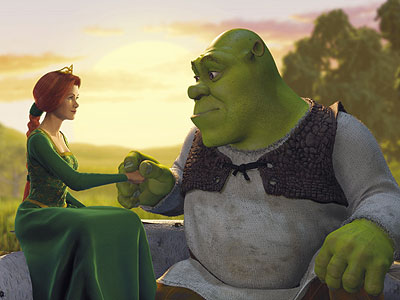 Anthony Lane at The New Yorker and Eric Metaxas at Books and Culture — these men are admirable and thoughtful critics. And both of them are upset about Dreamworks’ new animated movie. They think Shrek is trying to teach us that we don’t need fairy tales.
With all due respect to writers whose work I have admired, I’m a little surprised that they’re missing the actual target of Shrek’s snarky and irreverent story.
Let’s start at the beginning: Shrek is a somewhat subversive fairy tale about a reclusive swamp-dwelling ogre who strikes a bargain with an egotistical, power-mad overlord.
The disgruntled ogre’s swamp has become crowded with fairy tale characters cast out of the castle where the wicked ruler Lord Farquand routinely tortures and abuses them. Shrek, demanding to be left alone in his unhappy existence, marches in to the castle and makes a deal: In exchange for a little peace and quiet back home, he agrees to rescue an imprisoned princess from a fire-breathing dragon so the conniving Farquand can marry her and become king. With sidekick Donkey in tow, Shrek ventures off on a journey that will teach him that the world does not have the right to call him ugly. Beauty… surprise surprise… is more then skin deep.
Even as it embraces a familiar fairy tale structure, Shrek pokes fun at the biggest Fairy Tale Dismemberment machine of all, Walt Disney Studios. The movie exuberantly and sarcastically skewers the clichés that have become Disney’s bread and butter, even as it pulls off some heart-warming and surprisingly meaningful storytelling of its own.
It’s also the flashiest animated feature yet from DreamWorks, the studio led by former Disney exec Jeffrey Katzenberg. With enthusiastic vocal performances by Mike Meyers (Shrek), Eddie Murphy (jabbermouth Donkey), Cameron Diaz (Princess Fiona), and John Lithgow (the moo-ha-ha menace Farquand), the movie never applies the brakes, plunging headlong through action, machine-gunning jokes, and innumerable pop culture references. It has an advantage in its devil-may-care attitude, which gives it a fresh and unique energy; but that same advantage dates the movie, shortening its shelf-life… and it makes the film off-puttingly cocky and arrogant. This doesn’t kill the fun, but it does unfortunately taint it with unnecessary flaws.
Still, while the film has an attitude problem, its primary observations are sound.
Shrek doesn’t want us to shrug off the beloved fairy tales of ages past… or even to critique them. No, this movie is dependent on the very fairy tale models that it lampoons. Rather than condemning traditional stories, I think Shrek is slamming what Disney has done to those stories by sterilizing them.
Disney studios and animators, with films like The Little Mermaid and Pocahontas enforces for children that only a certain Barbie-esque look is “beauty.” They also perpetuate a sort of pop culture paralysis, hammering into our heads the necessity of Diva-delivered pop anthems at any emotional turn in the story.
Worst of all, Disney force-feeds us contrived happy endings, contrary to the original fairy tales that aspire to tougher truths. Some of our best fairy tales soemtimes deliver tragedy and horror as well. (Read any Brothers Grimm lately?) Disney’s relentless happy-ending hysteria sets kids up for disappointment, and puts pressure on them to live up to superficial and materialistic standards of excellence. Better to take the long, hard road to a Joyful Ending — a substantial vision of hope — than to sell young imaginations a happy ending full of artificial sweeteners that eventually cause cancer.
[Update: Plenty of readers are answering Eric Metaxas’s critique in Books and Culture with objections.]
I will agree with many critics that Shrek is too reckless in its humor. Sex jokes and double-entendres are inappropriate in movies for children. And surely storytellers working with such vast resources could find something more inventive than the fart-jokes that fill what passes for “all-ages entertainment” in this country. But to some extent I agree with David Ansen at Newsweek, who asks, exasperated, “Why can’t scripts this smart and economical be written for flesh-and-blood actors?” He calls recent CGI movies like Shrek and Toy Story “throwbacks to the classical style of Hollywood filmmaking, where the story came first, the stars knew their place, and the movies were made to please the widest possible audience without stooping to the lowest common denominator.” While I do register a complaint about some unnecessary jokes in Shrek, I still agree with him.
But I also sympathize with Salon.com’s Stephanie Zacharek and The New Yorker‘s Anthony Lane, who express dismay at the film’s state-of-the-art animation. Lane summed up the complaint: “I don’t recall firing off indignant letters to Warner Bros. to complain about Wile E. Coyote and his insufficiently detailed snout. All I ever required of Road Runner was a drastic simplicity … and I still want the same thing.” Yes, digital animation can do marvelous things for movies. (Check out the effects in Moulin Rouge!) But must we waste resources and energy so we can pridefully show off our technical prowess in a kids’ cartoon? Toy Story‘s animation seems a good balance of skill and simplicity. Shrek, with its swirling 3-D Donkey fur, is perhaps taking things a touch too far. Don’t distract us from the storytelling with the latest technological flourish; use it only if it serves to enrich the storytelling.
Still, Shrek‘s pros outweigh its cons, making this overall a delightful and fun entertainment with a refreshingly honest message. You don’t have to look like Cameron Diaz to be beautiful. Beauty is a deeper thing. And plastic surgery is a waste of money. It is part of society’s downfall that we embrace the Princess Fionas when they’re glamorous rather than real.
While we owe many thanks to Disney studios for some of animation’s highest achievements, they have been asking for a rebuke like this for a while. Early on in the movie, when one of the characters prepares to break into a platitude-heavy pop song, the grouchy ogre furiously tells him to shut up, and the story marches on. Kids and grownups alike laughed and applauded appreciatively. That moment made the point brilliantly. For those of us weary of Disney formulas, DreamWorks’ Antz and Shrek are evidence of animation’s exciting future. Disney is like pop music for the masses, clean, cheesy and dreamy; DreamWorks is rock ‘n’ roll, rebellious, rowdy and real. Let’s hope Disney is paying attention. And let’s hope Katzenberg has worked out his grudge, and can now go on to stronger storytelling, leaving cheap shots and in-jokes behind.
•
Directors – Andrew Adamson and Vicky Jenson; writer – Ted Elliott, Terry Rossio, Joe Stillman and Roger S. H. Schulman, based on the book by William Steig; editor – Sim Evan-Jones; music – Harry Gregson-Williams and John Powell; production designer – James Hegedus; producers – Aron Warner, John H. Williams and Jeffrey Katzenberg. PG. With the voice talents of – Mike Myers (Shrek), Eddie Murphy (Donkey), Cameron Diaz (Princess Fiona), John Lithgow (Lord Farquaad) and Vincent Cassel (Monsieur Hood). DreamWorks Pictures. 89 minutes. This film is rated
Previous Post

May 25, 2008
A Report from Over the Rhine's "Ohio" Concert
Next Post
May 26, 2008 Has Terry Gilliam Found His Don Quixote?
Browse Our Archives
Select a Category Blog Bloggers on "Through a Screen Darkly" Browser Coming Soon Endorsements Fiction Books Film Forum Film Reviews Inspirations Interviews Journal Kindlings Muse Movie buzz Music Reviews Non-Fiction Books radio Reviewers on "Through a Screen Darkly" The Auralia Thread Through a Screen Darkly Through a Screen Darkly - Bonus Materials Top 10 (or 20 or 100) lists Uncategorized
Select a Month June 2015 May 2015 April 2015 March 2015 February 2015 January 2015 December 2014 November 2014 October 2014 September 2014 August 2014 July 2014 June 2014 May 2014 April 2014 March 2014 February 2014 January 2014 December 2013 November 2013 October 2013 September 2013 August 2013 July 2013 June 2013 May 2013 April 2013 March 2013 February 2013 January 2013 December 2012 November 2012 October 2012 September 2012 August 2012 July 2012 June 2012 May 2012 April 2012 March 2012 February 2012 January 2012 December 2011 November 2011 October 2011 September 2011 August 2011 July 2011 June 2011 May 2011 April 2011 March 2011 February 2011 January 2011 December 2010 November 2010 October 2010 September 2010 August 2010 July 2010 June 2010 May 2010 April 2010 March 2010 February 2010 January 2010 December 2009 November 2009 October 2009 September 2009 August 2009 July 2009 June 2009 May 2009 April 2009 March 2009 February 2009 January 2009 December 2008 November 2008 October 2008 September 2008 August 2008 July 2008 June 2008 May 2008 April 2008 March 2008 February 2008 January 2008 December 2007 November 2007 October 2007 September 2007 August 2007 July 2007 June 2007 May 2007 April 2007 March 2007 February 2007 January 2007 December 2006 November 2006 October 2006 September 2006 August 2006 July 2006 June 2006 May 2006 April 2006 March 2006 February 2006 January 2006 December 2005 November 2005 October 2005 September 2005 August 2005 July 2005 June 2005 May 2005 April 2005 March 2005 February 2005 January 2005 December 2004 November 2004 October 2004 September 2004 August 2004 July 2004 June 2004 May 2004 April 2004 July 2003 May 2003 March 2003 September 1999
Follow Us!
TAKE THE
Religious Wisdom Quiz
Who was the first king of Israel?
Select your answer to see how you score.
Saul Samuel Solomon David
Related posts from Looking Closer

This Is Not Goodbye. But It is... See...


What Specialists Are Saying About Jurassic World

Torres and the Influence of David Bazan and...
TRENDING AT PATHEOS Religious Music & Entertainment

"Les Diabolique" and Transgression
Alongside something like Arrival, Vertigo, or Charade, Les Diaboliques is a...

"The Plague Dogs" and Mortality
So, flashback to the late 70s, early 80s. Walt Disney Studios is...

With the recent and highly successful release of Christopher Nolan’s epic film,...

"L'avventura" and Human Weakness
Today's piece is going to be a little different for a few...

I first want to apologize for not posting or writing anything. I'm...

I've engaged in the multi-year project of reading through the Church Fathers,...
view all Religious Music & Entertainment blogs
Ad-Free & Subscriber Log-In Subscription Support
- About Us
- 2026 Calendar
- Videos
- Podcasts
- Library of World Religions
- Faith In Media Tracker
- Advertise With Us
- Write for Us
- Privacy Policy
- Terms of Service
- Do Not Sell My Data
- Contact Us
- Radiant Digital
- Manage Newsletter Subscriptions
- Unsubscribe From Notifications
- Sitemap
Copyright 2008-2026, Patheos. All rights reserved.
Subscription Support Ad-Free & Subscriber Log-In
Follow Patheos