
BuddhistCatholicContemplativeEvangelicalGeneral ChristianHinduJewishLatter-day SaintMuslimNew VisionsProgressive Christian
Beliefs
- Buddhist
- Catholic
- Contemplative
- Evangelical
- General Christian
- Hindu
- Jewish
- Latter-day Saint
- More Voices
- Muslim
- New Visions
- Pagan
- Progressive Christian
Topics
- Religion News
- Food and Religion
- Sports and Religion
- Religious Art
- Religious Music and Entertainment
- Religious Events
- History and Religion
- Style and Religion
- Politics and Religion
- Women in Religion
- Recreation Outdoors and Religion
- Business Finance and Religion
- Careers Workplace and Religion
- Education and Religion
- Family Parenting and Religion
- Health Fitness and Religion
- Home and Religion
- Relationships and Religion
- Technology and Religion
- Travel and Religion
Columnists
- Buddhist Columnists
- Business Finance and Religion Columnists
- Careers Workplace and Religion Columnists
- Catholic Columnists
- Contemplative Columnists
- Education and Religion Columnists
- Evangelists Columnists
- Family Parenting and Religion Columnists
- General Christian Columnists
- Health Fitness and Religion Columnists
- Hindu Columnists
- History and Religion Columnists
- Home and Religion Columnists
- Jewish Columnists
- More Voices Columnists
- Latter Day Columnists
- Muslim Columnists
- New Visions Columnists
- Nonreligious Columnists
- Pagan Columnists
- Politics and Religion Columnists
- Progressive Columnists
- Recreation Outdoors and Religion Columnists
- Relationships and Religion Columnists
- Religion News Columnists
- Religious Art Columnists
- Religious Events Columnists
- Religious Music and Entertainment Columnists
- Sports and Religion Columnists
- Style and Religion Columnists
- Technology and Religion Columnists
- Travel and Religion Columnists
- Women in Religion Columnists
Resource Library
- 2026 Calendar
- Library of World Religions
- The 100 Most Holy Places on Earth
- Patheos Answers
- Podcasts
- Videos
- Faith Leaders Database
- Anglican Episcopalian
- Bahai
- Baptist
- Buddhism
- Christianity
- Confucianism
- Eastern Orthodoxy
- Hinduism
- Holiness and Pentecostal
- ISKCON
- Islam
- Judaism
- Lutheran
- Methodist
- The Church of Jesus Christ of Latter-day Saints
- New Age
- Paganism
- Presbytarian and Reformed
- Protestantism
- Religion Behind the Scenes
- Roman Catholic
- Scientology
- Shia Islam
- Sikhism
- Sufism
- Sunni Islam
- Taoism
- Zen
- See all religions
Research Tools
 Ad-Free & Subscriber Log-In Subscription Support
Ad-Free & Subscriber Log-In Subscription Support
Follow Patheos 

- Trending:
- Forgiveness
- |
- Marriage
- |
- Consciousness
- |
- Death Penalty
- |
- Election
- |
- Halloween
 Looking Closer
- Home
- Religious Music & Entertainment
- Star Wars, Episode Three – Revenge of the Sith (2005)
Star Wars, Episode Three – Revenge of the Sith (2005)
Last updated on: July 11, 2014 at 3:46 pm by Jeffrey Overstreet
Star Wars, Episode Three – Revenge of the Sith (2005) 2014-07-11T15:46:22-06:00 Jeffrey Overstreet
Patheos Explore the world's faith through different perspectives on religion and spirituality! Patheos has the views of the prevalent religions and spiritualities of the world.
 [This review was originally published at Christianity Today.]
•
To steal a phrase from a certain dark lord, “This will be a day long remembered.”
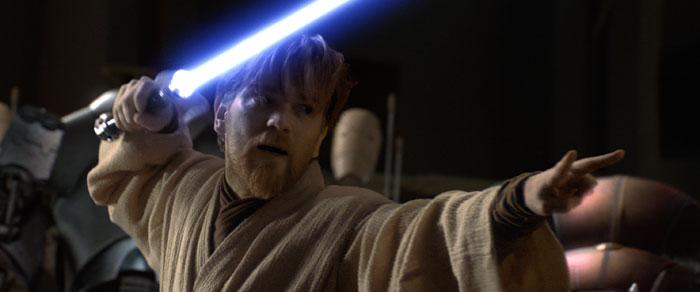
Star Wars, Episode Three: Revenge of the Sith, the fastest Star Wars film ever built, packs in more action than its two predecessors — The Phantom Menace and Attack of the Clones — combined. The opening crawl begins with the word “War!” and, quicker than you can say “Into the garbage chute, flyboy!”, two things become clear:
- This is not going to be another episode in which action only occasionally interrupts people standing around and discussing politics. The prequels have suffered heavy laser blasts from both critics and fans for lacking the snappy dialogue and the high-stakes action of Episodes Four, Five, and Six. While Sith is still sorely lacking, it’s a big improvement on its two predecessors.
- Lucas was right to warn us that Sith wouldn’t be kid-friendly. Beheadings, severed hands, third-degree burns … if there’s a bright center to the universe, you’re in the movie that it’s farthest from. Is this gratuitous violence? No. These sometimes gruesome scenes are necessary to portray the temporary triumph of evil while “good guys” suffer the wages of their sins.
ACTION!
It’s not all doom and gloom, though. Strap yourselves in! Sith jumps into lightspeed action from the get-go. In the opening shot (an obvious nod to A New Hope), we’re plunged headlong into a chaotic combat zone. The Separatist Alliance wickedly assaults Republic ships in the skies over Coruscant, the Republic’s failing heart. Early manifestations of X-Wings, TIE fighters, and Star Destroyers pyromaniacally careen and collide in the biggest “star war” adrenalin-rush since the Death Star battle of ’77, marred only by its robbery of cockpit banter from previous films. (Han Solo should sue.)
 In the thick of things, young Anakin Skywalker (Hayden Christensen) and his Jedi mentor Obi-Wan (Ewan McGregor) strive to rescue Chancellor Palpatine (Ian McDiarmid), who has been kidnapped by a warlord called General Grievous. Part-monster, part machine, Grievous looks like a junkyard Transformer, sounds like a Russian war veteran with smoker’s lung, and wields several lightsabers at once. He also has a tendency to turn tail and run when he meets a real threat… like Skywalker.
Anakin, despite his new unruly hairdo, has become more mature and responsible since Attack of the Clones. Obi-Wan, who’s “not brave enough for politics,” grins like a proud uncle and lets Anakin go his own way to become a Jedi “poster boy” amongst Republic Senators. But away from the spotlight, Anakin seeks covert liaisons with his secret, and pregnant, wife Padmé (Natalie Portman). “Our baby is a blessing,” says Padmé, and Anakin agrees that the news is “the happiest moment of my life.”
Dark dreams disrupt Anakin’s bliss, convincing him that Padmé is in danger. Yoda, who does double-duty here as a Jedi therapist and a sweatsuit-wearing action hero, warns Anakin: “The fear of loss is a path to the Dark Side. Attachment leads to jealousy — the shadow of greed this is.” He exhorts Anakin to surrender anything he fears to lose, declaring that “Death is a natural part of life.”
But Anakin’s battle against fear, jealousy, and greed is — as we all know — a losing one. His loyalties are divided. The Jedi distrust him, lecture him, and show little concern for his dark premonitions, while Palpatine showers Anakin with flattery. The stage is set for the last temptation of Skywalker. Determined to protect Padmé, he makes a Faustian bargain.
Meanwhile, Darth Sidious is baiting the democratic Republic to vote for its own destruction. Jedi Master Mace Windu (Samuel L. Jackson) smells trouble brewing, but he’s never heard of “Order 66,” the satanic-sounding trap that will spring upon the Jedi. All that remains is for the nefarious Count Dooku (Christopher Lee) to enable Anakin’s ascent to power at the right hand of a Sith lord.
CULMINATION!
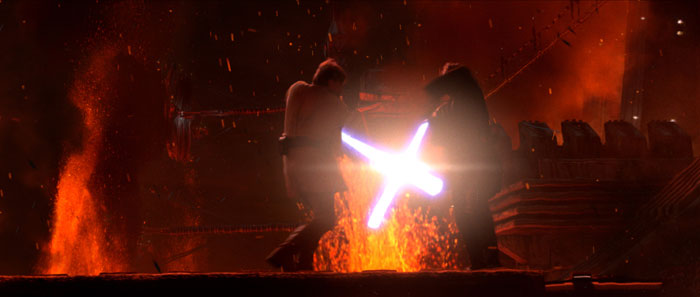
You can feel the Republic’s infrastructure crumbling. Lucas takes a note from The Godfather in a montage of Jedi knights falling victim to traps (a sequence that would have carried much more weight if only viewers had come to know these Jedi, see them in their full glory, and comprehend the pain of their downfall). Despite another exhibition of Yoda’s “Forcibility” against his foes, there will be no one to stop them this time. As in The Return of the King, the drama descends into a volcanic abyss for the culminating struggle of Teacher versus Mentor. Call it the saga’s “Darth nadir.”
Lucas’s greatest success in Revenge of the Sith is this: We can’t help but sympathize with Anakin as he surrenders to the Dark Side. Lo and behold, Darth Vader did not strive to be a heartless villain. He became one by trying to protect the one he loved, going blind to the greater good in the process. The stakes are finally high enough to earn gasps, and the ensuing tragedy is almost Shakespearean. Three intensely emotional lightsaber showdowns — two of which invert the famous Luke/Vader/Emperor face-off of Return of the Jedi, and another that severs bonds of friendship — stir up some of the operatic drama we remember from duels in Empire and Jedi. We’re drawn, at last, to the edges of our seats.
Simultaneously, Lucas discovers what actors are for… acting! He throws a switch, and suddenly Christensen, Portman, and McGregor come alive, emoting as if things really matter.

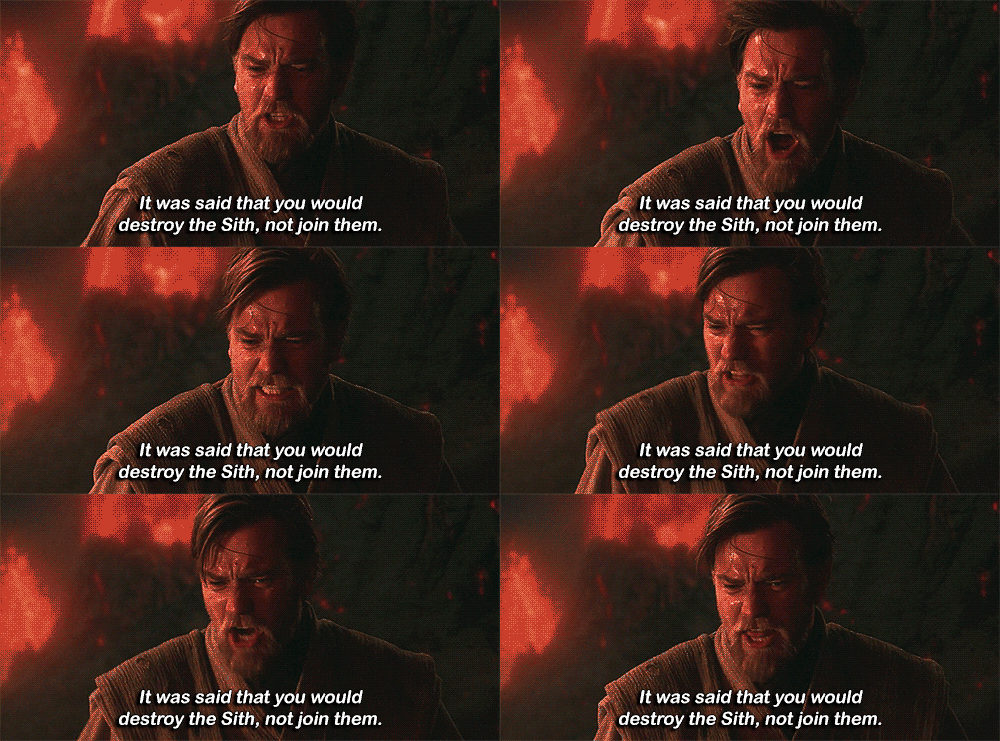
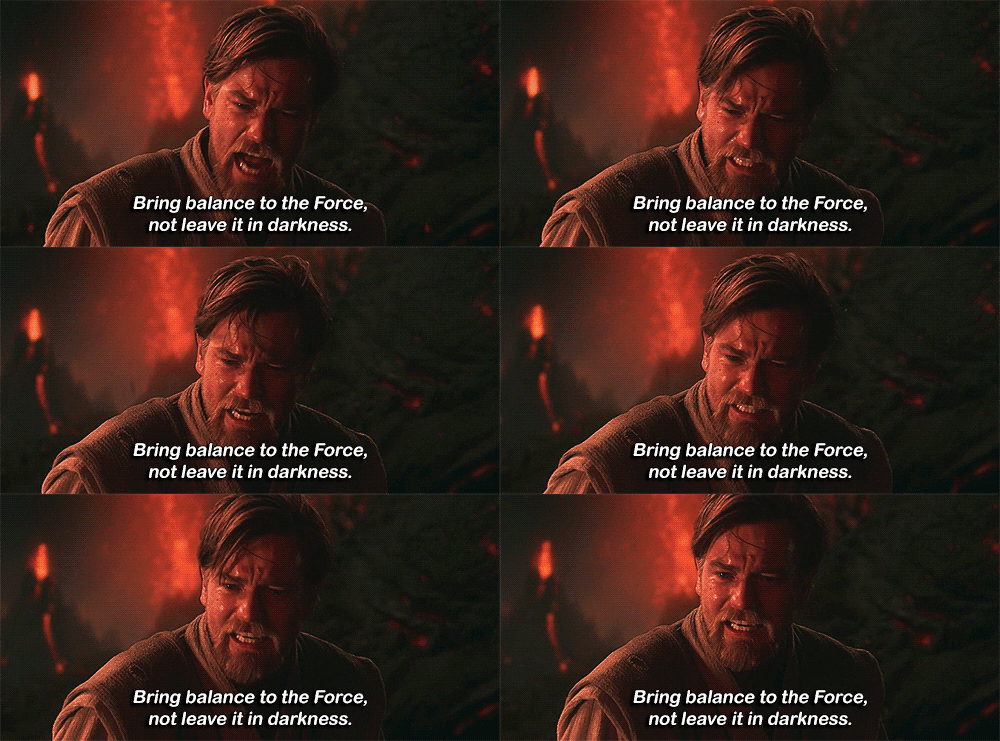
Lucas choreographs them through a virtuosic sequence culminating in the descent of a devil who resembles specters that lurked in The Seventh Seal, The Fellowship of the Ring, and The Passion of the Christ. As Sidious endeavors to build a better monster, we’re suddenly in the territory of Frankenstein. Intercut with these culminating visions of darkness and deformity are images of grief, despair, and finally, a glimmer of hope. With all of the dark drama of Titanic sinking, Darth Vader rises. The power of myth surges through the veins of the saga again just as it did in the glory days.
We’re sent off in a rush of increasingly familiar characters (Tarkin!), corridors (the blockade runner!), and other surprises. Thus, the circle is now complete, and our questions — most of them, anyway — are finally answered.
But new questions are sure to linger in moviegoers’ minds….
QUESTIONS!
Did Lucas intend Sith to be a commentary on contemporary politics? He denies it, but you’ll wonder. Padmé watches the Republic crumble, and remarks, “So this is how liberty ends — to thunderous applause.” Dooku and Grievous resemble a recently overthrown warlord and a smash-and-run terrorist, both hunted by an elected leader armed with emergency executive powers. Something’s familiar when Anakin shouts, “If you’re not for me, then you’re my enemy!”
Beyond the politics, there’s a powerfully provocative spiritual subtext. Few tales of pride have led to harder falls. But Anakin isn’t just arrogant; he’s suffering from alienation caused by the insensitivity and neglect of his Jedi “fathers.” Like Gladiator’s villain, he strikes because he’s been treated with contempt and denied the love he desires. And like The Godfather’s Michael Corleone, he’s sold his soul to gain power and ensure his family’s safety. Lucas vividly illustrates that a violent man convinced of his own righteousness is dangerous indeed. But does he realize that his precious Jedi illustrate the cost of callous leadership?
Deciding that desirable ends justify sinister means, Anakin writes off the Jedi as “evil.” Obi-Wan answers, “Only a Sith deals in absolutes!” Does Obi-Wan mean that there are no absolutes? If so, then why does he absolutely disagree with Anakin’s perspective? Or perhaps he means that it’s dangerous to make oversimplifications. If so, that’s a lesson Kenobi forgets in later episodes. Luke must defy Obi-Wan in Return of the Jedi to prove that Vader is not “absolutely” evil.
And what about the Force? It’s increasingly hard to believe that this invisible power actually “binds the galaxy together” in the end. For years, Christian moviegoers have debated whether “the Force” might be a good metaphor for God. This film seals the deal — the Force is not good enough to save the universe. It remains, in the end, something that both the Jedi and the Sith treat as a commodity, something we should get and learn to manipulate for our own purposes, good or evil.
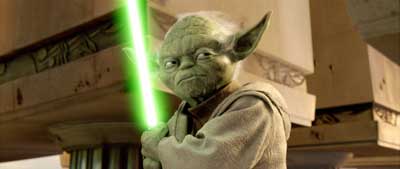 Episode Two’s references to “the will of the Force” suggest that this power is sentient, but nobody ever stops to wonder what that “will” might be. In The Lord of the Rings and Raiders of the Lost Ark, there was “another will at work,” an Authority to serve, a Higher Being intervening to redeem a mess made by well-intentioned but insufficient heroes. In Star Wars, no one asks any Higher Power for help. Thus, the galaxy seems pretty much doomed, because — Jedi and Sith alike — they’re all corrupt. There’s apparently no Higher Power they believe can save them — not even in the afterlife. They’re on their own.
Moreover, it’s bewildering to hear Yoda nonchalantly claim that a Jedi should reject “attachments.” Doesn’t Luke save the galaxy in Episodes Five and Six by rejecting that philosophy and serving his “attachment” to Han, Leia, and ultimately his father? Even worse, Yoda declares that “death is natural” and that we should not let it trouble us. Why, then, is he distraught over the corpses of murdered colleagues? Death is unnatural . . . it was not a part of God’s plan for creation. It’s a natural part of a fallen world, yes, but we recoil from it and grieve over it because it is a flaw, not an ideal. It’s evidence that the world needs of a bold, benevolent redeemer, not an insensitive, dispassionate savior.
AGGRAVATION!
You’re unlikely to hear much discussion of these things. Star Wars fans are sticklers for detail, and it’s not wise to upset a fanboy. Sith gives them plenty to complain about.
Disgruntled fans will target the bland screenwriting. For every brilliant action scene, there’s a spectacularly lame punchline that any moviegoer on the planet could improve upon. Jedi may be masters of stuffy diplomacy, but Han Solo and Princess Leia could teach them about smart, sarcastic comebacks. Anakin and Padme’s “romantic” exchanges are the stuff of cheap teen romance novels. It’s painful to hear Yoda, so eloquently mysterious in The Empire Strikes Back, respond to the Emperor’s threats by quipping, “Not if anything to say about it I have!” No wonder the Republic collapsed.
Continuity problems will drive perfectionists to distraction: “In Episode Six, Princess Leia said she could remember her mother. How could that be?” “Why doesn’t Obi-Wan recognize Threepio and R2D2 in A New Hope?” “Vader could sense that Luke was his son, but not that Leia was his daughter?” Those who care about such things seem to have been made to suffer.
A special edition with severe revisions may be necessary to improve some serious errors in judgment. Obi-Wan’s poorly animated reptilian steed should never have escaped the animator’s computer. Whoever taught Wookies to impersonate Tarzan… terminate him, immediately. Darth Vader’s arrival onscreen is a mix of brilliance and lunacy — the helmet is reverently introduced, but Vader’s first steps are awkward and embarrassing.
 Perhaps the most distressing development is the way in which constant revelations of implausible interconnections keep shrinking this galaxy into something resembling Mr. Lucas’s Neighborhood. Darth is Luke’s father, Leia is Luke’s sister, Boba Fett’s papa was the original stormtrooper, and that jittery protocol droid was Vader’s childhood project. Now we learn that another popular hero, whose appearance here is entirely gratuitous, has been Yoda’s buddy all along. What will the upcoming Star Wars television series reveal? That Han Solo was Aunt Beru’s illegitimate son? That a young Jabba crawled out of Jar-Jar’s nose?
Dwelling on these details, you can dismantle the whole saga, just as Luke Skywalker wiped out the Death Star by bulls-eyeing a vulnerable spot. But we shouldn’t condemn the whole enterprise for a few loose screws. While it falls short of Four and Five, Episode Three is easily as compelling as the climactic Return of the Jedi, and it’s definitely the most visually enthralling installment. It’s not as good as I hoped it would be, but it’s far better than I expected.
APPRECIATION!
Some gratitude is in order. Through Star Wars, Lucas revolutionized many aspects of filmmaking. He wove mythologies, religions, cliffhangers, and Akira Kurosawa films together into a fascinating hybrid. He emphasized that spiritual realities are as important as material realities. A parade of popular directors — James Cameron, Michael Bay, the Wachowskis, Peter Jackson — have built careers out of resources he invented. And Star Wars lingo has influenced language from the playground to the White House. For fans and everyone else, these movies have altered the world, usually for the better.
So, is this truly the end of Star Wars? “Difficult to see. Always in motion the future is.” Until we know, let’s be thankful for an unforgettable journey and a story that, like any great myth, gives us glimpses “through a glass darkly” of things essential and true. Virtue, courage, patience, peace, self-control, love … the Good Side are they. To borrow a line from Obi-Wan, “We’ve taken our first steps into a larger world.”
Previous Post

April 23, 2008
Superman Returns (2006)
Next Post
April 23, 2008 Wolfgang Petersen Quits Playing "Ender's Game"
Browse Our Archives
Select a Category Blog Bloggers on "Through a Screen Darkly" Browser Coming Soon Endorsements Fiction Books Film Forum Film Reviews Inspirations Interviews Journal Kindlings Muse Movie buzz Music Reviews Non-Fiction Books radio Reviewers on "Through a Screen Darkly" The Auralia Thread Through a Screen Darkly Through a Screen Darkly - Bonus Materials Top 10 (or 20 or 100) lists Uncategorized
Select a Month June 2015 May 2015 April 2015 March 2015 February 2015 January 2015 December 2014 November 2014 October 2014 September 2014 August 2014 July 2014 June 2014 May 2014 April 2014 March 2014 February 2014 January 2014 December 2013 November 2013 October 2013 September 2013 August 2013 July 2013 June 2013 May 2013 April 2013 March 2013 February 2013 January 2013 December 2012 November 2012 October 2012 September 2012 August 2012 July 2012 June 2012 May 2012 April 2012 March 2012 February 2012 January 2012 December 2011 November 2011 October 2011 September 2011 August 2011 July 2011 June 2011 May 2011 April 2011 March 2011 February 2011 January 2011 December 2010 November 2010 October 2010 September 2010 August 2010 July 2010 June 2010 May 2010 April 2010 March 2010 February 2010 January 2010 December 2009 November 2009 October 2009 September 2009 August 2009 July 2009 June 2009 May 2009 April 2009 March 2009 February 2009 January 2009 December 2008 November 2008 October 2008 September 2008 August 2008 July 2008 June 2008 May 2008 April 2008 March 2008 February 2008 January 2008 December 2007 November 2007 October 2007 September 2007 August 2007 July 2007 June 2007 May 2007 April 2007 March 2007 February 2007 January 2007 December 2006 November 2006 October 2006 September 2006 August 2006 July 2006 June 2006 May 2006 April 2006 March 2006 February 2006 January 2006 December 2005 November 2005 October 2005 September 2005 August 2005 July 2005 June 2005 May 2005 April 2005 March 2005 February 2005 January 2005 December 2004 November 2004 October 2004 September 2004 August 2004 July 2004 June 2004 May 2004 April 2004 July 2003 May 2003 March 2003 September 1999
Follow Us!
TAKE THE
Religious Wisdom Quiz
Who interpreted Pharaoh's dreams in Egypt?
Select your answer to see how you score.
Aaron David Moses Joseph
Related posts from Looking Closer



Tomorrowland? Or Tomorrow-bland?

TRENDING AT PATHEOS Religious Music & Entertainment

"Les Diabolique" and Transgression
Alongside something like Arrival, Vertigo, or Charade, Les Diaboliques is a...

"The Plague Dogs" and Mortality
So, flashback to the late 70s, early 80s. Walt Disney Studios is...

With the recent and highly successful release of Christopher Nolan’s epic film,...

"L'avventura" and Human Weakness
Today's piece is going to be a little different for a few...

I first want to apologize for not posting or writing anything. I'm...

I've engaged in the multi-year project of reading through the Church Fathers,...
view all Religious Music & Entertainment blogs
Ad-Free & Subscriber Log-In Subscription Support
- About Us
- 2026 Calendar
- Videos
- Podcasts
- Library of World Religions
- Faith In Media Tracker
- Advertise With Us
- Write for Us
- Privacy Policy
- Terms of Service
- Do Not Sell My Data
- Contact Us
- Radiant Digital
- Manage Newsletter Subscriptions
- Unsubscribe From Notifications
- Sitemap
Copyright 2008-2026, Patheos. All rights reserved.
Subscription Support Ad-Free & Subscriber Log-In
Follow Patheos