
BuddhistCatholicContemplativeEvangelicalGeneral ChristianHinduJewishLatter-day SaintMuslimNew VisionsProgressive Christian
Beliefs
- Buddhist
- Catholic
- Contemplative
- Evangelical
- General Christian
- Hindu
- Jewish
- Latter-day Saint
- More Voices
- Muslim
- New Visions
- Pagan
- Progressive Christian
Topics
- Religion News
- Food and Religion
- Sports and Religion
- Religious Art
- Religious Music and Entertainment
- Religious Events
- History and Religion
- Style and Religion
- Politics and Religion
- Women in Religion
- Recreation Outdoors and Religion
- Business Finance and Religion
- Careers Workplace and Religion
- Education and Religion
- Family Parenting and Religion
- Health Fitness and Religion
- Home and Religion
- Relationships and Religion
- Technology and Religion
- Travel and Religion
Columnists
- Buddhist Columnists
- Business Finance and Religion Columnists
- Careers Workplace and Religion Columnists
- Catholic Columnists
- Contemplative Columnists
- Education and Religion Columnists
- Evangelists Columnists
- Family Parenting and Religion Columnists
- General Christian Columnists
- Health Fitness and Religion Columnists
- Hindu Columnists
- History and Religion Columnists
- Home and Religion Columnists
- Jewish Columnists
- More Voices Columnists
- Latter Day Columnists
- Muslim Columnists
- New Visions Columnists
- Nonreligious Columnists
- Pagan Columnists
- Politics and Religion Columnists
- Progressive Columnists
- Recreation Outdoors and Religion Columnists
- Relationships and Religion Columnists
- Religion News Columnists
- Religious Art Columnists
- Religious Events Columnists
- Religious Music and Entertainment Columnists
- Sports and Religion Columnists
- Style and Religion Columnists
- Technology and Religion Columnists
- Travel and Religion Columnists
- Women in Religion Columnists
Resource Library
- 2026 Calendar
- Library of World Religions
- The 100 Most Holy Places on Earth
- Patheos Answers
- Podcasts
- Videos
- Faith Leaders Database
- Anglican Episcopalian
- Bahai
- Baptist
- Buddhism
- Christianity
- Confucianism
- Eastern Orthodoxy
- Hinduism
- Holiness and Pentecostal
- ISKCON
- Islam
- Judaism
- Lutheran
- Methodist
- The Church of Jesus Christ of Latter-day Saints
- New Age
- Paganism
- Presbytarian and Reformed
- Protestantism
- Religion Behind the Scenes
- Roman Catholic
- Scientology
- Shia Islam
- Sikhism
- Sufism
- Sunni Islam
- Taoism
- Zen
- See all religions
Research Tools
 Ad-Free & Subscriber Log-In Subscription Support
Ad-Free & Subscriber Log-In Subscription Support
Follow Patheos 

- Trending:
- Forgiveness
- |
- Marriage
- |
- Consciousness
- |
- Death Penalty
- |
- Election
- |
- Halloween
 Looking Closer
- Home
- Religious Music & Entertainment
- Flight of the Red Balloon (2007)
Flight of the Red Balloon (2007)
Last updated on: April 11, 2013 at 1:06 pm by Jeffrey Overstreet
Flight of the Red Balloon (2007) 2013-04-11T13:06:26-06:00 Jeffrey Overstreet
Patheos Explore the world's faith through different perspectives on religion and spirituality! Patheos has the views of the prevalent religions and spiritualities of the world.
 An abridged version of this review was published today at Christianity Today Movies.
–
How is childhood like a red balloon?
Watching Hou Hsiao-Hsien’s new film Flight of the Red Balloon, there are many possible answers to that question.
We watch seven-year-old Simon meander along Paris sidewalks, and his progress is as lazy and jaunty as the path of that red balloon above him. His lackadaisical stride stands in stark contrast to the crisscrossing streets and tracks that bind the city; he’s not yet imprisoned by the grid-like adult world of hurry and hustle. Under his mop of touseled red hair, his eyes cartoon-wide, this kid has sails open to catch a whim. He’ll even shout up at the balloon to come down and play with him.
The actor, Simon Iteanu, is a joy to watch. Like Jonathan Chang in Edward Yang’s Yi yi, and unlike so many American child actors, Iteanu is one of those rare kids who is utterly convincing and seemingly oblivious to the camera, content to be quiet and thoughtful. He’s the opposite of Dakota Fanning. He captures something essential about a child’s private, emotional, everyday experience.
We know that the weightlessness of Simon’s existence, the whimsy in his wonder, will soon end. It’s already ending. We sense it when he refuses to welcome the balloon as it finally descends. We see it in how he’s drawn to flashy, mechanized activity, like his sister’s PlayStation back home.
Flight’s bittersweet tone comes from its focus on childhood, and even a quality of childhood that the harsh city life might soon burst like a balloon. You could call it The Unbearable Lightness of Being, but that title’s taken.
And speaking of Unbearable Lightness…
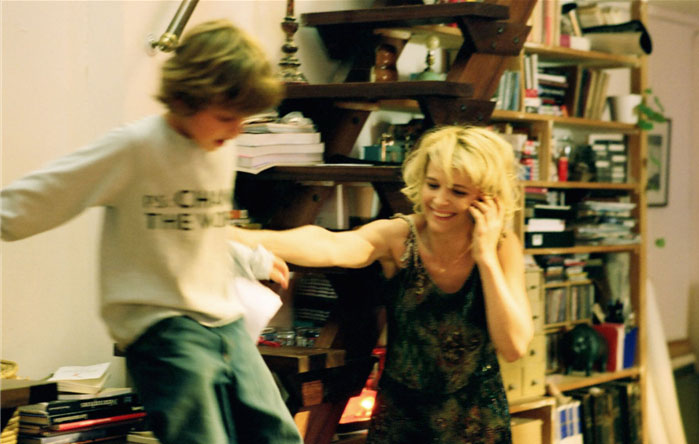
In a visceral, spirited performance that rates among her very best, Juliette Binoche plays Simon’s frazzled, single mother, Suzanne. With her energy manifested in an electrified blonde hairdo that has to be seen to be believed, Suzanne is too busy to know whether she’s coming or going. In an unforgettable and surprising reveal, we learn that Suzanne works as an actress in a puppet theater. Like Hou himself, she’s translating timeless Chinese art for present-day Parisians, and the work unleashes a playful expressiveness that makes her irresistible.
But between rehearsals, Suzanne careens from one activity to another — like a pinball batted about in a machine. She’s trying to cope with intrusive downstairs tenants, the loneliness of missing her absent husband and faraway daughter, and the details of welcoming Simon’s new nanny. Coming home, she gets updates from Simon about his day. “You play pinball these days?” she quips, and the line is loaded. Yes, his life is going on without her. Yes, he’s being drawn into the machine.
We enter into Suzanne’s crazy world through the quiet observance of the new nanny, a Chinese film student named Song (Song Fang). Song’s peaceful acceptance of Suzanne’s crazy world makes her most appealing. We watch and learn with her. Song’s Chinese background, her interest in film, her everpresent digital camera which she uses to film Simon’s everyday experiences, make her the calm at the center of this family’s storm. She’s making a short film about red balloons in tribute to the classic 1956 French short film, The Red Balloon, just as Hou made Flight as an homage to its Albert Lamorisse.
Hou’s cinematography imitates the casual curiosity of a child. His gaze wanders up and down the street, up and down the buildings. But don’t be fooled — every one of his long, patient takes is carefully composed.
If you watch carefully, you’ll catch visual jokes and wonder if they’re intentional. For example, in the opening shot of a balloon floating away on a cut string, we see a subway sign advertising the film Severance. If that isn’t funny enough, the title is bisected by a lamp post! Later, after we’ve realized that the film is about a vulnerable child overlooked by the busy modern world, a bus passes with a bold poster for the film Children of Men, with Clive Owen’s mug staring straight at us*.* Accident? If so, a very happy one.
Hou’s curiosity gives his imagery a hypnotic quality. The modern city, which inspires cynicism in many artists, is a playground for Hou as he seizes possibilities. Looking through a train window at a beautiful cloudscape, we suddenly notice that the same scene has beamed through the window, struck something behind the camera, and bounced back to be projected like a small-screen movie on that very same window. We’re watching the “real” sunset and a reproduction of it in the same frame. It’s a dazzling moment. Krzysztof Kieslowksi would have loved it.
But they’re not just pretty pictures. Hou’s images are rich with meaning for the discerning viewer. In many shots, reflections suggest that we consider the past, present, and future. Some shots show passing traffic, but reflections in windows and doors let us see vehicles approach, and after they pass, we catch distorted views of their continuing journey. (How he manages to keep the camera out of reflections is a special effect indeed.) Hou is constantly, quietly reminding us that the past and future are active in the present, and that should provoke questions about what we value, and how we inhabit a moment.
The story’s most obvious theme is the elusiveness of the joys and wonders we associate with childhood. Suzanne and Simon are both saddened by a longing for younger, more innocent days. They miss Simon’s father and sister—he’s away in Montreal, she’s with her grandfather. In a heartbreaking moment, Suzanne pleads with her daughter to return home. She reveres home movies of her children, and the most precious gift she can give is an old postcard from her scrapbook.
In a beautiful scene, Simon wanders into a video arcade. Song stays outside, filming his progress through the window. Hou’s camera turns to zoom in on Simon, wide-eyed at a pinball machine. (How odd that he’s drawn to pinball—a small sphere, making progress through a series of hard-hitting obstacles.) We watch Simon through the glass, and notice that Song has gone inside to join him, her camera still running. It’s like Hou is suggesting that, through the gift of pictures, postcards, and film, we can transcend the clamor of our lives and recapture some of our childlike wonder again. Song bridges the gap, quietly savoring the world around her. Camera in hand, she manages to maintain a sense of childlike wonder.
While the force that threatens Simon’s innocence is adulthood, Hou is careful not to villianize adults. In fact, the most “villainous” characters are Suzanne’s downstairs tenants who refuse to grow up and take responsibility for rent bills. Suzanne, crazymaking as she is, is still endearing for the passionate love she has for her son. That love is mirrored in her fairy-tale puppet show; the hero declares, “I will boil the ocean dry to find and rescue my beloved.”
Following Song, Suzanne, and Simon, Hou invites viewers along for a dreamy stroll through a day in their lives with a “you are there” immediacy. Hou allowed his actors to improvise, without rehearsals, and as a result the film has a delightful spontaneity. Binoche even wore clothes from her own closet. (And it must be said—she has a very nice closet.)
Nevertheless, Flight has already inspired some impatient critics to complain that “nothing happens” in this film. To borrow a line from James Cameron’s The Abyss — they “need to look with better eyes than that.”
Flight is not plot-driven. It is not about drawing us to the edge of our seat or teasing us with what happens next. It’s meant to be observed the way you might study art in a museum, or the way you might wander down a street in one of the world’s great cities just to watch people and light.
Sound boring? Give it a try. Find out why Hou is one of the world’s most celebrated filmmakers, and what Americans have been missing. The fact that his films aren’t “marketable” in the U.S. reflects poorly on us, not Hou.
Whether it’s a haunting period piece (Flowers of Shanghai), a vigorous plunge into pop culture (Millennium Mambo), or a story that emphasizes generation gaps (Café Lumiere), Hou is always exploring the passage of time through long, exquisitely choreographed takes that reveal the influences of his mentors — especialy Yasujiro Ozu. Curious moviegoers might find last year’s film Three Times a great place to start, as it includes three short stories set in different eras, stories with intertwining themes.
Flight will probably stand as his most playful work. The red balloon is an evocative icon that appeals to all ages. It’s the suggestion that the simple joy of childhood can be lost so easily. It’s also the gravity of that idea — that there’s a lonely but buoyant spirit wandering above us, watching over us, waiting for us to reach up. The balloon’s as mysterious and benevolent a character as Winnie the Pooh or Hayao Miyazake’s Totoro. After we watch it a while, we start to notice bright red spheres and circles everywhere — in decals on bus windows, bright red stop lights, traffic signs, and the taillights of the car in front of Suzanne’s while she drives through a tunnel.
In one moment, the balloon descends the side of a building and passes a painting of a red balloon, and suddenly it brushes against the painting as if kissing a stranger in the Parisian way, or finding a kindred spirit. It’s a moment that can make a theater full of enthralled viewers gasp.
Hou’s film is the first in a program financed by the Musée d’Orsay. The film features a scene inside the museum where children consider a painting of, yes, a red balloon. Hou’s film has set the standard for the series. We can only hope the rest of the participating filmmakers dare to reach so high.
–
In French, with English subtitles. Director – Hou Hsiao-hsien; writer – Hou Hsiao-hsien and François Margolin. Inspired by the film “The Red Balloon” by Albert Lamorisse; director of photography – Mark Lee Ping Bing; editors – Liao Ching Sung and Jean-Christophe Hym; producers – ; produced by François Margolin and Kristina Larsen. Starring – Juliette Binoche (Suzanne), Simon Iteanu (Simon), Song Fang (Song), Hippolyte Girardot (Marc) and Louise Margolin (Louise). IFC First Take. 1 hour 53 minutes.
Previous Post

April 2, 2008
Sam Phillips' "Don't Do Anything" Does Not Disappoint
Next Post
April 5, 2008 At the Death House Door (2008) - A Guest Review by Kenneth R. Morefield
Browse Our Archives
Select a Category Blog Bloggers on "Through a Screen Darkly" Browser Coming Soon Endorsements Fiction Books Film Forum Film Reviews Inspirations Interviews Journal Kindlings Muse Movie buzz Music Reviews Non-Fiction Books radio Reviewers on "Through a Screen Darkly" The Auralia Thread Through a Screen Darkly Through a Screen Darkly - Bonus Materials Top 10 (or 20 or 100) lists Uncategorized
Select a Month June 2015 May 2015 April 2015 March 2015 February 2015 January 2015 December 2014 November 2014 October 2014 September 2014 August 2014 July 2014 June 2014 May 2014 April 2014 March 2014 February 2014 January 2014 December 2013 November 2013 October 2013 September 2013 August 2013 July 2013 June 2013 May 2013 April 2013 March 2013 February 2013 January 2013 December 2012 November 2012 October 2012 September 2012 August 2012 July 2012 June 2012 May 2012 April 2012 March 2012 February 2012 January 2012 December 2011 November 2011 October 2011 September 2011 August 2011 July 2011 June 2011 May 2011 April 2011 March 2011 February 2011 January 2011 December 2010 November 2010 October 2010 September 2010 August 2010 July 2010 June 2010 May 2010 April 2010 March 2010 February 2010 January 2010 December 2009 November 2009 October 2009 September 2009 August 2009 July 2009 June 2009 May 2009 April 2009 March 2009 February 2009 January 2009 December 2008 November 2008 October 2008 September 2008 August 2008 July 2008 June 2008 May 2008 April 2008 March 2008 February 2008 January 2008 December 2007 November 2007 October 2007 September 2007 August 2007 July 2007 June 2007 May 2007 April 2007 March 2007 February 2007 January 2007 December 2006 November 2006 October 2006 September 2006 August 2006 July 2006 June 2006 May 2006 April 2006 March 2006 February 2006 January 2006 December 2005 November 2005 October 2005 September 2005 August 2005 July 2005 June 2005 May 2005 April 2005 March 2005 February 2005 January 2005 December 2004 November 2004 October 2004 September 2004 August 2004 July 2004 June 2004 May 2004 April 2004 July 2003 May 2003 March 2003 September 1999
Follow Us!
TAKE THE
Religious Wisdom Quiz
Which Christian symbol looks like a fish and spells "ichthys" in Greek?
Select your answer to see how you score.
The Jesus Fish The dove The anchor The triangle
Related posts from Looking Closer

This Is Not Goodbye. But It is... See...



What Specialists Are Saying About Jurassic World
TRENDING AT PATHEOS Religious Music & Entertainment

"Les Diabolique" and Transgression
Alongside something like Arrival, Vertigo, or Charade, Les Diaboliques is a...

"The Plague Dogs" and Mortality
So, flashback to the late 70s, early 80s. Walt Disney Studios is...

With the recent and highly successful release of Christopher Nolan’s epic film,...

"L'avventura" and Human Weakness
Today's piece is going to be a little different for a few...

I first want to apologize for not posting or writing anything. I'm...

I've engaged in the multi-year project of reading through the Church Fathers,...
view all Religious Music & Entertainment blogs
Ad-Free & Subscriber Log-In Subscription Support
- About Us
- 2026 Calendar
- Videos
- Podcasts
- Library of World Religions
- Faith In Media Tracker
- Advertise With Us
- Write for Us
- Privacy Policy
- Terms of Service
- Do Not Sell My Data
- Contact Us
- Radiant Digital
- Manage Newsletter Subscriptions
- Unsubscribe From Notifications
- Sitemap
Copyright 2008-2026, Patheos. All rights reserved.
Subscription Support Ad-Free & Subscriber Log-In
Follow Patheos