
BuddhistCatholicContemplativeEvangelicalGeneral ChristianHinduJewishLatter-day SaintMuslimNew VisionsProgressive Christian
Beliefs
- Buddhist
- Catholic
- Contemplative
- Evangelical
- General Christian
- Hindu
- Jewish
- Latter-day Saint
- More Voices
- Muslim
- New Visions
- Pagan
- Progressive Christian
Topics
- Religion News
- Food and Religion
- Sports and Religion
- Religious Art
- Religious Music and Entertainment
- Religious Events
- History and Religion
- Style and Religion
- Politics and Religion
- Women in Religion
- Recreation Outdoors and Religion
- Business Finance and Religion
- Careers Workplace and Religion
- Education and Religion
- Family Parenting and Religion
- Health Fitness and Religion
- Home and Religion
- Relationships and Religion
- Technology and Religion
- Travel and Religion
Columnists
- Buddhist Columnists
- Business Finance and Religion Columnists
- Careers Workplace and Religion Columnists
- Catholic Columnists
- Contemplative Columnists
- Education and Religion Columnists
- Evangelists Columnists
- Family Parenting and Religion Columnists
- General Christian Columnists
- Health Fitness and Religion Columnists
- Hindu Columnists
- History and Religion Columnists
- Home and Religion Columnists
- Jewish Columnists
- More Voices Columnists
- Latter Day Columnists
- Muslim Columnists
- New Visions Columnists
- Nonreligious Columnists
- Pagan Columnists
- Politics and Religion Columnists
- Progressive Columnists
- Recreation Outdoors and Religion Columnists
- Relationships and Religion Columnists
- Religion News Columnists
- Religious Art Columnists
- Religious Events Columnists
- Religious Music and Entertainment Columnists
- Sports and Religion Columnists
- Style and Religion Columnists
- Technology and Religion Columnists
- Travel and Religion Columnists
- Women in Religion Columnists
Resource Library
- 2026 Calendar
- Library of World Religions
- The 100 Most Holy Places on Earth
- Patheos Answers
- Podcasts
- Videos
- Faith Leaders Database
- Anglican Episcopalian
- Bahai
- Baptist
- Buddhism
- Christianity
- Confucianism
- Eastern Orthodoxy
- Hinduism
- Holiness and Pentecostal
- ISKCON
- Islam
- Judaism
- Lutheran
- Methodist
- The Church of Jesus Christ of Latter-day Saints
- New Age
- Paganism
- Presbytarian and Reformed
- Protestantism
- Religion Behind the Scenes
- Roman Catholic
- Scientology
- Shia Islam
- Sikhism
- Sufism
- Sunni Islam
- Taoism
- Zen
- See all religions
Research Tools
 Ad-Free & Subscriber Log-In Subscription Support
Ad-Free & Subscriber Log-In Subscription Support
Follow Patheos 

- Trending:
- Forgiveness
- |
- Marriage
- |
- Consciousness
- |
- Death Penalty
- |
- Election
- |
- Halloween
 Looking Closer
- Home
- Religious Music & Entertainment
- Review flashback: “Watership Down”
Review flashback: “Watership Down”
Last updated on: June 25, 2014 at 3:20 pm by Jeffrey Overstreet
Review flashback: “Watership Down” 2014-06-25T15:20:15-06:00 Jeffrey Overstreet
Patheos Explore the world's faith through different perspectives on religion and spirituality! Patheos has the views of the prevalent religions and spiritualities of the world.
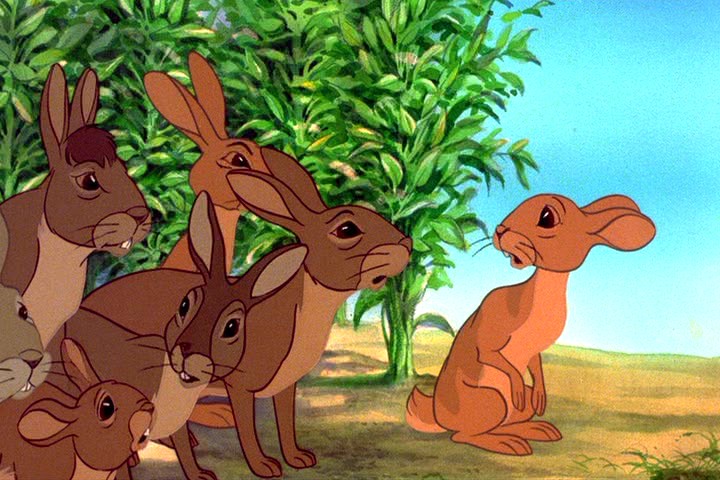 2014 Update: Oh how I wish someone would re-release Watership Down on Region 1 blu-ray in a format that captures the vivid beauty of the theatrical release. The current American DVDs show that they were produced from a worn and faded print. Attention, lords of the Criterion Collection! Save this timeless, exemplary work!
–
Before you choose Martin Rosen’s animated feature Watership Down as a movie-time babysitter for your kids, please note: This is not Finding Nemo.
No, you should sit yourself down for this one. Don’t listen to anybody who writes it off as a “cartoon about bunnies.” Watership Down is distinct among animated films because it is an exemplary adaptation of a massive, complex literary work into an 92-minute feature. The film fuses stunning beauty, smart scripting, a splendid original score, unforgettable characters with excellent voice casting, and an approach that refuses to dumb down the material for moviegoers. This is a serious film for serious moviegoers. It’s also heartbreaking, suspenseful, and unflinchingly realistic in its depiction of animal behavior… violence and all.
Those bright white teeth you see on the poster? That snare you see throttling the rabbit in the grass? That’s a fair representation of the film’s stark realism. It’s not for small children. As in the real world, death can strike these small animals in alarming, arbitrary, unanticipated ways. And when it comes, there is blood. Sometimes, a lot of blood. (It’s been reported that Richard Adams’ novel was a way in which he described some of his experiences during the Battle of Oosterbeek in the Netherlands in 1944.)
Having said that, I would not shield young teens from the film. In fact, it might be more meaningful for them than any of the Disney cartoons, if only for its uncompromising attention to real-world tensions and challenges. I first saw the film when I was ten years old. It scared me, no doubt about it, with grisly violence beyond anything I’d seen on the screen before. But it also fascinated me, and I returned to the film again and again with a sense that it wasn’t just entertainment — rather, it was relevant. It seemed to engage with the world that I saw represented on the news.
As a result, I eagerly read the book. And there I learned that the movie was just a sampling of Richard Adams’ richly rewarding work. Adams’ book is beloved by young and old readers around the world, probably because it has all the magic and excitement of the best fairy tales, while it also draws us into a natural world that’s as detailed, surprising, and dangerous as… well… the natural world. Readers come to believe in the rabbits and that crazy seagull who helps them. As a young reader, I learned to appreciate the value and beauty of creation by concentrating on the plight and peril of these poor creatures in their vast and perilous environment. These were not sentimentalized furballs cavorting about and singing songs. They made no pop culture references, and they didn’t incessantly jabber as if desperate to keep my interest. No… these were characters with the weight of King Arthur and his Knights of the Round Table. And this book deserves to stand on bookshelves alongside The Lord of the Rings, The Once and Future King, Dune, and other works of fantasy that qualify as classic literature.
Watch Watership Down with attentive friends, and you’ll end up discussing many of the book’s themes: humankind’s relationship with the environment; the role of the poet and the prophet in culture; the “necessary evils” of war; the effects of oppression and slavey. The film and its source material are a treasure trove of ideas and excellence. Visually it may not live up to the CGI splendor that we take for granted today, but if you consider that each frame of this film was lovingly handcrafted, you’ll realize how special it really is.
It’s a simple tale, in a way: In a warren of contented, fat, and happy rabbits, a thoughful and conscientious fellow named Hazel (voiced with dignity by John Hurt) finds himself compelled to persuade his friends and neighbors to leave home and set out to start a new warren. He’s drawn to this desperate quest by his friend, the weakling called Fiver who suffers horrific visions that the rabbits’ community will be destroyed by humankind. With the help of a brusque and burly soldier rabbit named Bigwig, Hazel and Fiver persuade a group of their neighbors, and together they flee their warren, leaving behind them most of the community skeptical and laughing at them.
On the road, they encounter a world of dangers, perhaps none more fearsome than other rabbits who have different customs. Hazel, who becomes a reluctant but admirable leader, must face the doubts of his companions, division, and devastating loss. They stumble into one particular warren on the edges of a farm where the rabbits seem happy, but strange. Their food is delivered to them in abundance by a farmer, which seems too good to be true. This spooks a few of Hazel’s gang, and when their suspicions prove true, it is a terrifying revelation indeed.
And that’s only the first half of the journey.
The second half becomes a tense, suspenseful quest to add females to their group, so they can start a new home when they settle into their destination. The only way available to them, it seems, is to steal them from another warren. And fortunately (or perhaps unfortunately) for them, there are some females nearby who desperately need to relocate. Before long, one of them must infiltrate a cruel, military-state warren called Efrafa, and outwit its murderous oppressor, General Woundwort, a villain as memorable and ferocious as Darth Vader. Eventually, the two warrens are at war, Hazel and Bigwig fighting to survive the strength and brutality of Woundwort and his cronies.
As a child, I identified with the vulnerable heroes as they sought to find their place in the world. As a grownup, I am drawn into the mythology that Richard Adams created, the poetry of his language, his appreciation of the power of myth, the compelling dramas that echo historical conflicts in fascist states, and the uncanny knack he has for suspense. A lot of this is effectively preserved in the film, as our heroes attempt to free the enslaved, oppressed females from the regimented society called Efrafa.
The movie suffers only from its own ambition, but any feature-length adaptation of a work this large and complex is bound to fall short. Watership Down is a lengthy novel, and to include everything would make for a cumbersome film. The writers have adapted the book admirably, trimming here and there while maintaining the integrity of the story. As a result, there are some abrupt transitions between chapters, but only fans of the book will notice the bumps. Thankfully, the characters in the film are strong representations of the characters in the novel, and they remain surprisingly distinct and engaging, considering how many of them have big feet and large ears.
In spite of its compression of the narrative, Rosen’s film is exceptional in that it stays relatively true to the strengths and spirit of the novel. It simply tells a story, and tells it beautifully, engagingly, and creatively. It does not compromise, oversimplify, or sentimentalize anything for the sake of “accessibility.” That gives it the advantage over Disney’s entire animated catalogue, in my book. And while it portrays the struggle for survival in rather bleak terms, it also acknowledges that there is more to this world than meets the eye. The film’s contains several sequences of haunting spiritual power, and its closing scene brings me to tears every time.
The animation is strikingly realistic and detailed. I don’t mean photo-realistic, but rather these handpainted images are convincing in that they give us a true sense of rabbit behavior and the nature of the world they inhabit. And in its respect for the grace, color, and natural behavior of the countryside and of rabbits, it is clear the animators knew their subject. This is entirely appropriate. Adams himself was fascinated by the creatures, and wrote an introduction to a book called The Private Life of the Rabbit (a book that my ten-year-old self promptly sought out at the public library after reading Watership Down for the first time).
Angela Morley’s music is a little-known treasure, a compelling adventure soundtrack with memorable themes and a melodic quality that makes it an outstanding work in its own right, more elegant even than the romantic themes of John Williams. Art Garfunkel’s song “Bright Eyes” was recorded for this film, and it provides a stirring accompaniment to Fiver’s meditations on death. (That’s why I get choked up even when I hear it playing in a grocery store.)
And the voices are well chosen. From John Hurt to Deholm Elliot to Zero Mostel, they suit the characters perfectly. Mostel is especially good, bringing attitude and energy to the crucial character of the injured gull, Keehar, who helps the rabbits navigate.
So give your family something meatier than the paper-thin cartoon fare they’re used to. Watership Down is a story that they’ll want to see again — and better, read — for so many reasons.
–
Director, writer, producer – Martin Rosen. Music – Angela Morley, Mike Batt, Malcolm Williamson Starring the voices of John Hurt, Richard Briers, Ralph Richardson, Roy Kinnear, Denholm Elliott, Zero Mostel, Harry Andrews, Michael Hordern. 101 minutes. Rated PG for violence.
Previous Post

January 10, 2007
Hobbit Trouble Continues
Next Post
January 12, 2007 New Innocence Mission Album Details
Browse Our Archives
Select a Category Blog Bloggers on "Through a Screen Darkly" Browser Coming Soon Endorsements Fiction Books Film Forum Film Reviews Inspirations Interviews Journal Kindlings Muse Movie buzz Music Reviews Non-Fiction Books radio Reviewers on "Through a Screen Darkly" The Auralia Thread Through a Screen Darkly Through a Screen Darkly - Bonus Materials Top 10 (or 20 or 100) lists Uncategorized
Select a Month June 2015 May 2015 April 2015 March 2015 February 2015 January 2015 December 2014 November 2014 October 2014 September 2014 August 2014 July 2014 June 2014 May 2014 April 2014 March 2014 February 2014 January 2014 December 2013 November 2013 October 2013 September 2013 August 2013 July 2013 June 2013 May 2013 April 2013 March 2013 February 2013 January 2013 December 2012 November 2012 October 2012 September 2012 August 2012 July 2012 June 2012 May 2012 April 2012 March 2012 February 2012 January 2012 December 2011 November 2011 October 2011 September 2011 August 2011 July 2011 June 2011 May 2011 April 2011 March 2011 February 2011 January 2011 December 2010 November 2010 October 2010 September 2010 August 2010 July 2010 June 2010 May 2010 April 2010 March 2010 February 2010 January 2010 December 2009 November 2009 October 2009 September 2009 August 2009 July 2009 June 2009 May 2009 April 2009 March 2009 February 2009 January 2009 December 2008 November 2008 October 2008 September 2008 August 2008 July 2008 June 2008 May 2008 April 2008 March 2008 February 2008 January 2008 December 2007 November 2007 October 2007 September 2007 August 2007 July 2007 June 2007 May 2007 April 2007 March 2007 February 2007 January 2007 December 2006 November 2006 October 2006 September 2006 August 2006 July 2006 June 2006 May 2006 April 2006 March 2006 February 2006 January 2006 December 2005 November 2005 October 2005 September 2005 August 2005 July 2005 June 2005 May 2005 April 2005 March 2005 February 2005 January 2005 December 2004 November 2004 October 2004 September 2004 August 2004 July 2004 June 2004 May 2004 April 2004 July 2003 May 2003 March 2003 September 1999
Follow Us!
TAKE THE
Religious Wisdom Quiz
Who said, "For me to live is Christ, and to die is gain"?
Select your answer to see how you score.
Paul James John Peter
Related posts from Looking Closer

This Is Not Goodbye. But It is... See...



What Specialists Are Saying About Jurassic World
TRENDING AT PATHEOS Religious Music & Entertainment

"Les Diabolique" and Transgression
Alongside something like Arrival, Vertigo, or Charade, Les Diaboliques is a...

"The Plague Dogs" and Mortality
So, flashback to the late 70s, early 80s. Walt Disney Studios is...

With the recent and highly successful release of Christopher Nolan’s epic film,...

"L'avventura" and Human Weakness
Today's piece is going to be a little different for a few...

I first want to apologize for not posting or writing anything. I'm...

I've engaged in the multi-year project of reading through the Church Fathers,...
view all Religious Music & Entertainment blogs
Ad-Free & Subscriber Log-In Subscription Support
- About Us
- 2026 Calendar
- Videos
- Podcasts
- Library of World Religions
- Faith In Media Tracker
- Advertise With Us
- Write for Us
- Privacy Policy
- Terms of Service
- Do Not Sell My Data
- Contact Us
- Radiant Digital
- Manage Newsletter Subscriptions
- Unsubscribe From Notifications
- Sitemap
Copyright 2008-2026, Patheos. All rights reserved.
Subscription Support Ad-Free & Subscriber Log-In
Follow Patheos