
BuddhistCatholicContemplativeEvangelicalGeneral ChristianHinduJewishLatter-day SaintMuslimNew VisionsProgressive Christian
Beliefs
- Buddhist
- Catholic
- Contemplative
- Evangelical
- General Christian
- Hindu
- Jewish
- Latter-day Saint
- More Voices
- Muslim
- New Visions
- Pagan
- Progressive Christian
Topics
- Religion News
- Food and Religion
- Sports and Religion
- Religious Art
- Religious Music and Entertainment
- Religious Events
- History and Religion
- Style and Religion
- Politics and Religion
- Women in Religion
- Recreation Outdoors and Religion
- Business Finance and Religion
- Careers Workplace and Religion
- Education and Religion
- Family Parenting and Religion
- Health Fitness and Religion
- Home and Religion
- Relationships and Religion
- Technology and Religion
- Travel and Religion
Columnists
- Buddhist Columnists
- Business Finance and Religion Columnists
- Careers Workplace and Religion Columnists
- Catholic Columnists
- Contemplative Columnists
- Education and Religion Columnists
- Evangelists Columnists
- Family Parenting and Religion Columnists
- General Christian Columnists
- Health Fitness and Religion Columnists
- Hindu Columnists
- History and Religion Columnists
- Home and Religion Columnists
- Jewish Columnists
- More Voices Columnists
- Latter Day Columnists
- Muslim Columnists
- New Visions Columnists
- Nonreligious Columnists
- Pagan Columnists
- Politics and Religion Columnists
- Progressive Columnists
- Recreation Outdoors and Religion Columnists
- Relationships and Religion Columnists
- Religion News Columnists
- Religious Art Columnists
- Religious Events Columnists
- Religious Music and Entertainment Columnists
- Sports and Religion Columnists
- Style and Religion Columnists
- Technology and Religion Columnists
- Travel and Religion Columnists
- Women in Religion Columnists
Resource Library
- 2026 Calendar
- Library of World Religions
- The 100 Most Holy Places on Earth
- Patheos Answers
- Podcasts
- Videos
- Faith Leaders Database
- Anglican Episcopalian
- Bahai
- Baptist
- Buddhism
- Christianity
- Confucianism
- Eastern Orthodoxy
- Hinduism
- Holiness and Pentecostal
- ISKCON
- Islam
- Judaism
- Lutheran
- Methodist
- The Church of Jesus Christ of Latter-day Saints
- New Age
- Paganism
- Presbytarian and Reformed
- Protestantism
- Religion Behind the Scenes
- Roman Catholic
- Scientology
- Shia Islam
- Sikhism
- Sufism
- Sunni Islam
- Taoism
- Zen
- See all religions
Research Tools
 Ad-Free & Subscriber Log-In Subscription Support
Ad-Free & Subscriber Log-In Subscription Support
Follow Patheos 

- Trending:
- Forgiveness
- |
- Marriage
- |
- Consciousness
- |
- Death Penalty
- |
- Election
- |
- Halloween
 Looking Closer
- Home
- Religious Music & Entertainment
- A Scanner Darkly (2006)
A Scanner Darkly (2006)
Last updated on: July 20, 2014 at 12:40 pm by Jeffrey Overstreet
A Scanner Darkly (2006) 2014-07-20T12:40:49-06:00 Jeffrey Overstreet
Patheos Explore the world's faith through different perspectives on religion and spirituality! Patheos has the views of the prevalent religions and spiritualities of the world.
 [A severely abridged version of this review was previously published at Christianity Today, and it did not end up representing the perspective I presented in my original draft. Here is the original, unabridged review.]
•
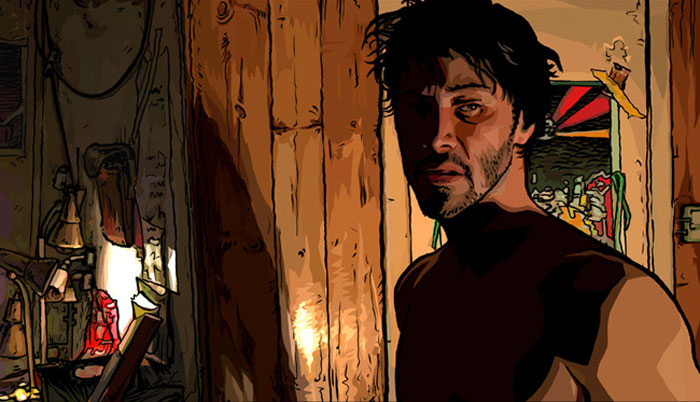
In Richard Linklater’s A Scanner Darkly, Keanu Reeves plays “Agent Fred,” an undercover officer in America’s war on drugs. He’s so deeply undercover that he’s become a drug addict himself, losing touch with reality. So the irony is painful when Agent Fred is ordered to focus his investigation on one junkie in particular … himself.
Sound a bit familiar? Like Ridley Scott’s Blade Runner and Steven Spielberg’s Minority Report, A Scanner Darkly is based on the science fiction of Philip K. Dick. All three introduce us to law enforcement officers who begin by tracking criminals and end up running from the law, dismayed at what they’re learning about themselves.
But where Blade Runner and Minority Report borrowed the main ideas and added all kinds of violence and thrills, Linklater’s movie is actually faithful to Dick’s novel. A Scanner Darkly is true to Dick’s disillusioned, drug-addled, deadbeat characters. It’s a much more thoughtful film — challenging, meditative, and sad, just the way Dick intended it.
Scanner focuses on the small Anaheim community in which Agent Fred pretends to be a dealer. His “friends” are mopey slackers, tormented by the distortions brought on by a cruel, enslaving drug called “Substance D.” (The “D” may stand for death, disintegration, or despair.) “You’re either on it,” says addict James Barris, “or you haven’t tried it.”
As his brain reels with foolish fantasies, Barris (Robert Downey Jr.) lectures others on things he knows nothing about — guns, the chemistry of narcotics, and government conspiracies. He has a captive audience. Wide-eyed and paranoid, Ernie Luckman (Woody Harrelson) is a typical southern California stoner, prone to freaking out. But Luckman is stable compared to Charles Freck (Rory Cochrane). Freck is a wreck who resembles The Lord of the Rings’ Gollum in his fits of twitching and terror. In the opening scene, he obsessively scrubs himself and his dog, convinced that they’re both besieged by giant aphids.
The guys are attracted to Donna Hawthorne, the sexy girlfriend of their house-mate Bob Arctor. But Donna (Winona Ryder, in a welcome return to intelligent moviemaking) responds to Substance D by loathing the thought of physical intimacy. This drives Bob crazy. Unable to consummate his relationship with Donna, he uses drugs to buy sex with someone else, which leads to even nastier surprises.
What the group doesn’t know is that their friend Bob is actually Agent Fred. Behind their backs, Fred is documenting their crimes with elaborate surveillance equipment.
But the drugs are tearing Fred’s endeavors apart. The two hemispheres of his brain are fighting with each other, troubling his sense of identity. Is he really a cop pretending to be a dealer? Or is he a dealer who excuses his habit by posing as a cop?
To give audiences a palpable sense of Fred’s delusion, Linklater uses the same style of animation that made his earlier film Waking Life so hypnotic. Animators “paint” over footage of the actors’ performances, using an innovative computer process called “rotoscoping.” In this way, these cartoon characters become hauntingly lifelike, preserving real movements, gestures, expressions, even scenery. Their outlines are unstable, and so is their environment, keeping us caught in a constant state of questioning the film’s “reality,” just as its characters do. It’s like living in a Kafka nightmare — a person chatting in your living room might suddenly transform into a cockroach.
The animators’ greatest accomplishment is the realization of the “scramble suits” — the agent’s full-body disguises. Made from an electrical fabric, conglomerations of human features mix and match on their surface, disguising the wearer with a random collage of races, ages, hairstyles, and outfits. This gives the agents anonymity at the office, protecting their operations. The scramble suits made Dick’s novel unfilmable for decades. Through Linklater’s technique, they’re astonishing.
And they’re more than just a special effect. The suits make us think about ways in which people are pressured to meet society’s shifting expectations, or how they lose their individuality by conforming to “the system.” And they suggest that any agent of authority may conceal secret agendas within the “costume” of duty.
Truly scrambled, Agent Fred becomes increasingly suspicious of his employers. Could it be that the government actually benefits from this epidemic of addiction? After all, it’s easy to manipulate a nation of apathetic zombies.
Published in 1977, reflecting the drug culture of his day, Dick’s book is remarkably relevant to current events. He imagined a futuristic 1994, and many of his predictions were close to the mark. Newspapers report that governments are using powers of surveillance to monitor their own people. And drugs — prescription medication and illegal imports — continue to wreak havoc on young minds. Media, the Internet, and a proliferation of technological distractions are cultivating generations of naïve, isolated, self-indulgent, and easily manipulated individuals. And it’s increasingly difficult to sort out which politicians, leaders, and news sources can be trusted. Meanwhile, we’re bombarded by those who compete to sell us the latest salve for our frustrations.
Thus, Scanner works as a relevant and timely parable.
And yet, it’s rather difficult to sit through. As in the novel, Barris, Luckman, Freck, Hawthorne, and Arctor’s meandering conversations occasionally amuse. One hilarious sequence involves an argument over whether a bicycle has eight or twelve speeds. Viewers may find themselves growing weary of these verbose, dysfunctional fools.
As a result, this reviewer ended up “double-minded” about Linklater’s film:
Voice 1: “Nobody makes better movies about slackers and the search for meaning.”
Voice 2: “Well, yes, Linklater’s a fine director when he has an engaging subject, like a romance between charismatic characters (Before Sunrise, Before Sunset), or a hilarious comedy (The School of Rock, Dazed and Confused). But Scanner’s characters are somnambulistic and maddening. It’s a bore.”
Voice 1: “But the animation is fantastic! And this is Keanu Reeves’ best role since, well, the first time he played a delusional stoner — Bill and Ted’s Excellent Adventure.”
Voice 2: “Still, the story just isn’t suspenseful. Stories about cops don’t have to be action-adventure, but I feel like a good premise gets squandered here. ”
Voice 1: “Scanner isn’t supposed to be a thriller. It’s a eulogy for Dick’s despairing generation. It’s a desperate search for mercy and hope.”
Voice 2: “Sure, it meant a lot to him. But to us? These guys are miserable company!”
As I argued with myself, I realized that my frustrations were not entirely the fault of the film. In part, I was hoping to be dazzled by summertime thrills. Thus, I became impatient with such a truthful portrayal of human frailty and folly.
Linklater admirably honors Dick’s convictions, giving us a sense of the author’s broken heart. Dick struggled with drugs himself. He knew his own weakness, and thus he had a deep sympathy for his friends who were worse off. This is a movie that may help despairing people see themselves in the mirror, and draw back from the abyss. It may caution people about the dangers of drugs. And it may sensitize others to the suffering and emptiness that turns lost souls into junkies.
And if I’m honest, I must admit that I can relate to these characters. I’ve never experimented with drugs, I know what it’s like to become frustrated with the world and with myself. I’ve been a double-minded man. I’ve done my share of blaming society for my own mistakes. It’s much easier to drown my woes in shallow distractions than it is show discipline and dedicate myself to making a difference.
Gradually, Agent Fred sees the limitations of government surveillance. And he fears that no human being can see things clearly enough to save them from themselves, much less save the world.
“What does a scanner see?” he asks. “Does a scanner see into me — into us — clearly or darkly? I hope it [sees clearly] … because I can’t any longer these days see into myself.” And he concludes, “If the scanner sees only darkly, the way I myself do, then we are cursed … and we’ll wind up dead this way, knowing very little and getting that little fragment wrong too.”
These lines contain a deliberate and revealing reference to 1 Corinthians 13:12: We currently see “through a glass darkly,” and our own faulty understanding fails us. Our hopes lie not in our capacity to solve these mysteries, thank God, but in the grace of the Maker who sees all things clearly, who loves even drug addicts unconditionally, and who promises to raise us up out of our ruined state.
•
Director – Richard Linklater; writer – Linklater; based on the novel by Philip K. Dick; director of photography – Shane F. Kelly; editor – Sandra Adair; music – Graham Reynolds; production designer – Bruce Curtis; producers – Anne Walker-McBay, Tommy Pallotta, Palmer West, Jonah Smith and Erwin Stoff. Starring – Keanu Reeves (Bob Arctor), Robert Downey Jr. (Jim Barris), Woody Harrelson (Ernie Luckman), Winona Ryder (Donna Hawthorne) and Rory Cochrane (Charles Freck).Warner Independent Pictures. Rated R.
Previous Post

October 16, 2006
Specials: FoxFaith, Leibowitz, and Bono
Next Post
October 23, 2006 "Qu'ils mangent de la brioche."
Browse Our Archives
Select a Category Blog Bloggers on "Through a Screen Darkly" Browser Coming Soon Endorsements Fiction Books Film Forum Film Reviews Inspirations Interviews Journal Kindlings Muse Movie buzz Music Reviews Non-Fiction Books radio Reviewers on "Through a Screen Darkly" The Auralia Thread Through a Screen Darkly Through a Screen Darkly - Bonus Materials Top 10 (or 20 or 100) lists Uncategorized
Select a Month June 2015 May 2015 April 2015 March 2015 February 2015 January 2015 December 2014 November 2014 October 2014 September 2014 August 2014 July 2014 June 2014 May 2014 April 2014 March 2014 February 2014 January 2014 December 2013 November 2013 October 2013 September 2013 August 2013 July 2013 June 2013 May 2013 April 2013 March 2013 February 2013 January 2013 December 2012 November 2012 October 2012 September 2012 August 2012 July 2012 June 2012 May 2012 April 2012 March 2012 February 2012 January 2012 December 2011 November 2011 October 2011 September 2011 August 2011 July 2011 June 2011 May 2011 April 2011 March 2011 February 2011 January 2011 December 2010 November 2010 October 2010 September 2010 August 2010 July 2010 June 2010 May 2010 April 2010 March 2010 February 2010 January 2010 December 2009 November 2009 October 2009 September 2009 August 2009 July 2009 June 2009 May 2009 April 2009 March 2009 February 2009 January 2009 December 2008 November 2008 October 2008 September 2008 August 2008 July 2008 June 2008 May 2008 April 2008 March 2008 February 2008 January 2008 December 2007 November 2007 October 2007 September 2007 August 2007 July 2007 June 2007 May 2007 April 2007 March 2007 February 2007 January 2007 December 2006 November 2006 October 2006 September 2006 August 2006 July 2006 June 2006 May 2006 April 2006 March 2006 February 2006 January 2006 December 2005 November 2005 October 2005 September 2005 August 2005 July 2005 June 2005 May 2005 April 2005 March 2005 February 2005 January 2005 December 2004 November 2004 October 2004 September 2004 August 2004 July 2004 June 2004 May 2004 April 2004 July 2003 May 2003 March 2003 September 1999
Follow Us!
TAKE THE
Religious Wisdom Quiz
Who said, “Let there be light”?
Select your answer to see how you score.
Moses Paul God Noah
Related posts from Looking Closer



Tomorrowland? Or Tomorrow-bland?

TRENDING AT PATHEOS Religious Music & Entertainment

"Les Diabolique" and Transgression
Alongside something like Arrival, Vertigo, or Charade, Les Diaboliques is a...

"The Plague Dogs" and Mortality
So, flashback to the late 70s, early 80s. Walt Disney Studios is...

With the recent and highly successful release of Christopher Nolan’s epic film,...

"L'avventura" and Human Weakness
Today's piece is going to be a little different for a few...

I first want to apologize for not posting or writing anything. I'm...

I've engaged in the multi-year project of reading through the Church Fathers,...
view all Religious Music & Entertainment blogs
Ad-Free & Subscriber Log-In Subscription Support
- About Us
- 2026 Calendar
- Videos
- Podcasts
- Library of World Religions
- Faith In Media Tracker
- Advertise With Us
- Write for Us
- Privacy Policy
- Terms of Service
- Do Not Sell My Data
- Contact Us
- Radiant Digital
- Manage Newsletter Subscriptions
- Unsubscribe From Notifications
- Sitemap
Copyright 2008-2026, Patheos. All rights reserved.
Subscription Support Ad-Free & Subscriber Log-In
Follow Patheos