
BuddhistCatholicContemplativeEvangelicalGeneral ChristianHinduJewishLatter-day SaintMuslimNew VisionsProgressive Christian
Beliefs
- Buddhist
- Catholic
- Contemplative
- Evangelical
- General Christian
- Hindu
- Jewish
- Latter-day Saint
- More Voices
- Muslim
- New Visions
- Pagan
- Progressive Christian
Topics
- Religion News
- Food and Religion
- Sports and Religion
- Religious Art
- Religious Music and Entertainment
- Religious Events
- History and Religion
- Style and Religion
- Politics and Religion
- Women in Religion
- Recreation Outdoors and Religion
- Business Finance and Religion
- Careers Workplace and Religion
- Education and Religion
- Family Parenting and Religion
- Health Fitness and Religion
- Home and Religion
- Relationships and Religion
- Technology and Religion
- Travel and Religion
Columnists
- Buddhist Columnists
- Business Finance and Religion Columnists
- Careers Workplace and Religion Columnists
- Catholic Columnists
- Contemplative Columnists
- Education and Religion Columnists
- Evangelists Columnists
- Family Parenting and Religion Columnists
- General Christian Columnists
- Health Fitness and Religion Columnists
- Hindu Columnists
- History and Religion Columnists
- Home and Religion Columnists
- Jewish Columnists
- More Voices Columnists
- Latter Day Columnists
- Muslim Columnists
- New Visions Columnists
- Nonreligious Columnists
- Pagan Columnists
- Politics and Religion Columnists
- Progressive Columnists
- Recreation Outdoors and Religion Columnists
- Relationships and Religion Columnists
- Religion News Columnists
- Religious Art Columnists
- Religious Events Columnists
- Religious Music and Entertainment Columnists
- Sports and Religion Columnists
- Style and Religion Columnists
- Technology and Religion Columnists
- Travel and Religion Columnists
- Women in Religion Columnists
Resource Library
- 2026 Calendar
- Library of World Religions
- The 100 Most Holy Places on Earth
- Patheos Answers
- Podcasts
- Videos
- Faith Leaders Database
- Anglican Episcopalian
- Bahai
- Baptist
- Buddhism
- Christianity
- Confucianism
- Eastern Orthodoxy
- Hinduism
- Holiness and Pentecostal
- ISKCON
- Islam
- Judaism
- Lutheran
- Methodist
- The Church of Jesus Christ of Latter-day Saints
- New Age
- Paganism
- Presbytarian and Reformed
- Protestantism
- Religion Behind the Scenes
- Roman Catholic
- Scientology
- Shia Islam
- Sikhism
- Sufism
- Sunni Islam
- Taoism
- Zen
- See all religions
Research Tools
 Ad-Free & Subscriber Log-In Subscription Support
Ad-Free & Subscriber Log-In Subscription Support
Follow Patheos 

- Trending:
- Forgiveness
- |
- Marriage
- |
- Consciousness
- |
- Death Penalty
- |
- Election
- |
- Halloween
 Looking Closer
- Home
- Religious Music & Entertainment
- Little Children (2006)
Little Children (2006)
Last updated on: August 30, 2013 at 10:15 pm by Guest Contributor
Little Children (2006) 2013-08-30T22:15:13-06:00 Guest Contributor
Patheos Explore the world's faith through different perspectives on religion and spirituality! Patheos has the views of the prevalent religions and spiritualities of the world.
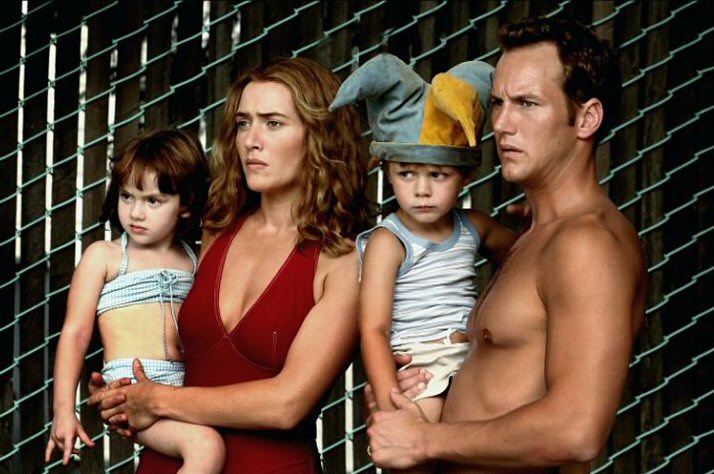 This review was originally published at Christianity Today in October 2006.
–
Ever watch moths fluttering around bright lights at night and ask yourself, “Don’t they know that they’ll burn themselves up?”
And yet, so many of us play out the same sad drama. Restless with longing, we respond to dangerous temptations and indulge misguided passions. And then we — and sometimes our families — pay for it.
This metaphor comes to vivid life in Todd Field’s riveting new film Little Children. Working from a screenplay that he and Tom Perrota adapted from Perrota’s novel, Field paints a deeply disturbing picture of a cozy New England neighborhood in which everyone is pursuing happiness in misguided ways.
In fact, the movie will be too disturbing for some, because it is unflinchingly truthful about sins such as lust, sexual infidelity, and pedophilia. And while Perrota’s story is profoundly moral, Field brings it to life in illustrations so explicit that some viewers may be led into temptation themselves.
This is Todd Field’s second film about the reckless pursuit of satisfaction. The first, In the Bedroom(2001), reminded us that our desire to judge and punish evildoers can easily lead us into evils of our own. Similarly, Little Children shows what can happen when we respond to disappointment and longing with childish recklessness.
But Little Children is more ambitious. Field skillfully weaves wry humor, absorbing drama, and nerve-wracking suspense in a style that reflects the influence of Stanley Kubrick. (Field had a small role in Kubrick’sEyes Wide Shut, another film in which lustful fantasies have a corrosive effect upon a marriage.)
It took some kind of mad genius to cast Will Lymon, the voice of PBS’s “Frontline” documentaries, as the film’s narrator. Lymon describes these relational catastrophes with a clinical matter-of-factness, the way a doctor might lecture about cancer. And while big screen narration usually ends up insulting viewer intelligence, in this movie it serves as a tongue-in-cheek way of saying that those of us who behave like terrible toddlers sometimes need even the simplest things explained to us.
The story he tells goes like this:
Trying to be a good mother, Sarah Pierce (Kate Winslet) frequently takes her daughter Lucy to their suburban neighborhood park. Sarah dropped out of graduate school to raise Lucy, and motherhood doesn’t come as naturally to her as it does to the three uber-moms she encounters at the park.
As catty and cruel as schoolgirls, those judgmental women make it painfully clear to Sarah that she doesn’t live up to their standards of conformity. They’re obsessed with perfecting their willful offspring. “All they want is sugar,” sighs one. “Constantly.”
But they have their own unhealthy desires. All three women betray marital dissatisfaction by gazing dreamily at “the prom king.” That’s what they call Brad Adamson (Patrick Wilson), the muscular, handsome young father who brings his son Aaron to the park.
But Brad has problems of his own. Working as a househusband while he studies to pass the bar exam, Brad struggles with embarrassment while his wife, a brunette bombshell named Kathy (Jennifer Connelly), is off making PBS documentaries. Intimidated by her professional success, and longing for the freedom of childhood, Brad spends hours watching young skateboarders, drawn to the glow of their freedom and energy. And when he’s invited to join a community football league, he pursues his dream of quarterback glory. “Trying new things made him feel alive,” says the narrator.
The real trouble begins with a casual error in judgment. Repulsed by the smugness of her self-righteous peers, Sarah playfully provokes them by befriending the object of their affection, ultimately leading to a reckless sexual affair. Like a nervous teen, Brad asks, “Do you feel bad about this?”
But Sarah and Brad aren’t the only “kids” breaking the “playground rules” here. Sarah’s husband Richard (Gregg Edelman) is on his own careless pursuit of pleasure, hiding in his office and staring at pictures of “Slutty Kay,” an online porn star. Elsewhere, Brad’s wife Kathy is devoted to diversions that, while far less scandalous, are similarly detrimental to her marriage.
So we watch them go, like moths to various flames.
And it gets worse. Just out of jail, a pedophile named Ronnie (Jackie Earle Haley) has moved into the neighborhood to live with his overly affectionate mother (Phyllis Somerville). The community is appropriately concerned, and so are we.
If Field was trying to lampoon traditional family life, the wayAmerican Beauty did, he might have made Ronnie more sympathetic, in order to paint the families who fear him as devils and hypocritical conservatives. But Field’s too smart for that. He shows us that Ronnie’s disease really is dangerous and perverse. Clearly, Ronnie’s mother is wrong in assuming that all he needs is a girlfriend his own age. And when he slips into a community swimming pool full of vulnerable children, his predatory nature is accentuated by his black scuba gear. It’s as scary as a scene from Jaws.
And yet, Field asks us, is anyone willing to offer him some grace, compassion, and help?
For some, healthy concern quickly swells into explosive paranoia and rage. Brad’s friend Larry (Noah Emmerich), a retired policeman and head of the Committee for Concerned Parents, is so upset about Ronnie’s sins that he declares a sort of “war on terror” against the pedophile. He attacks him at his home, vandalizes his property, and stands on the lawn delivering hysterical late-night tirades. Field doesn’t hesitate to draw a stark comparison between this and certain present-day global dramas—the destructive effects of fear mongering, and the way in which rash retaliation makes a bad situation worse. Are we any safer for having carried swift, drastic, poorly coordinated violence into someone else’s “yard” in the name of “homeland security”?
Ultimately, it becomes clear that the children in this town are endangered not only by the pedophile, but by the secret sins and fears of their childish parents.
Unfortunately, in his courage to expose the ugliness of sin with stark honesty, Field oversteps the bounds of propriety. He was smart to portray Brad and Sarah’s sexual escapes as urgent, desperate grabs for happiness. But in doing so, he asks them to expose too much. For many this will be shocking, disrupting the flow of the film. For others, it will offer fuel for the fires of their own destructive fantasies.
That’s a serious flaw in what is otherwise a profound work of art. Few films have been more truthful in showing us how our “secret sins”—those indiscretions we try to rationalize—are like weeds that take root, spread, and shatter our foundations. Little Children is sure to remind viewers of other discomforting studies of infidelity, including The Ice Storm, We Don’t Live Here Anymore, and The Squid and the Whale. And thankfully, it avoids the mistakes of American Beauty, which took its characters’ reckless indulgence too lightly, and let them off the hook by damning a convenient scapegoat: a villainous conservative family man.
But Field is after something far more ambitious and profound than any of those films. He wants us to remember that all have sinned, and that we thus should treat one another with compassion and grace. Sometimes, Christians are the people who need to hear this the most. In our zeal for righteousness, we can easily become cruel and condemning reactionaries, forgetting Christ’s demonstration of compassion and gentleness toward the depraved and the desperate.
This idea is captured beautifully in a scene during which Sarah explains her sympathy for the promiscuous title character of Madame Bovary. “It’s the hunger,” she says, “the hunger for an alternative and the refusal to accept a life of unhappiness.” Sarah acknowledges that Madame Bovary did not make the best choices, but she confesses her understanding that the sin stems from needs that are not being met, from an absence of love.
The film is exceptional not only in its truth, but in its craftsmanship. It’s a showcase of superb acting. Patrick Wilson makes a strong leading man. Jackie Earle Haley’s turn as the pedophile is incredibly complex, and he’s likely to earn an Oscar nomination. So is Kate Winslet, who develops Sarah into a character so three-dimensional and real that, by comparison, some of the other characters—Richard, Larry, and the judgmental mothers—seem simplistic and even cartoonish.
Little Children does not conclude with a “happily ever after” ending. Field isn’t interested in appeasing the audience’s expectation for gushing confessions and teary-eyed reconciliation. That would be dishonest and unrealistic. Instead, he tells the truth. Our sinful appetites cannot be entirely eliminated in this lifetime, and thus none of us can boast. No relationships, vocations, or neighborhoods can solve our hunger for the sugar that will rot our teeth. And yet, if we allow the scorching glow of temptation to steer us away from our responsibilities, while we may experience fleeting jolts of happiness, we’ll lose the opportunity for lasting fulfillment and joy.
Perhaps it’s no coincidence that the film’s tag line reads, “Let the little children come unto me.”
–
Director – Todd Field; writers – Todd Field and Tom Perrotta, based on the novel by Mr. Perrotta; director of photography – Antonio Calvache; editor – Leo Trombetta; music – Thomas Newman; production designer – David Gropman; producers – Albert Berger, Ron Yerxa and Todd Field. Starring – Kate Winslet (Sarah Pierce), Patrick Wilson (Brad Adamson), Jennifer Connelly (Kathy Adamson), Gregg Edelman (Richard Pierce), Noah Emmerich (Larry Hedges), Jackie Earle Haley (Ronald James McGorvey), Phyllis Somerville (May McGorvey), Ty Simpkins (Aaron Adamson) and Sadie Goldstein (Lucy Pierce).New Line Cinema. 137 minutes.
Previous Post

October 4, 2006
Tomorrow's Film Forum May Catch Angry CT Movies Readers By Surprise.
Next Post
October 11, 2006 Byrne Wowed by Sufjan
Browse Our Archives
Select a Category Blog Bloggers on "Through a Screen Darkly" Browser Coming Soon Endorsements Fiction Books Film Forum Film Reviews Inspirations Interviews Journal Kindlings Muse Movie buzz Music Reviews Non-Fiction Books radio Reviewers on "Through a Screen Darkly" The Auralia Thread Through a Screen Darkly Through a Screen Darkly - Bonus Materials Top 10 (or 20 or 100) lists Uncategorized
Select a Month June 2015 May 2015 April 2015 March 2015 February 2015 January 2015 December 2014 November 2014 October 2014 September 2014 August 2014 July 2014 June 2014 May 2014 April 2014 March 2014 February 2014 January 2014 December 2013 November 2013 October 2013 September 2013 August 2013 July 2013 June 2013 May 2013 April 2013 March 2013 February 2013 January 2013 December 2012 November 2012 October 2012 September 2012 August 2012 July 2012 June 2012 May 2012 April 2012 March 2012 February 2012 January 2012 December 2011 November 2011 October 2011 September 2011 August 2011 July 2011 June 2011 May 2011 April 2011 March 2011 February 2011 January 2011 December 2010 November 2010 October 2010 September 2010 August 2010 July 2010 June 2010 May 2010 April 2010 March 2010 February 2010 January 2010 December 2009 November 2009 October 2009 September 2009 August 2009 July 2009 June 2009 May 2009 April 2009 March 2009 February 2009 January 2009 December 2008 November 2008 October 2008 September 2008 August 2008 July 2008 June 2008 May 2008 April 2008 March 2008 February 2008 January 2008 December 2007 November 2007 October 2007 September 2007 August 2007 July 2007 June 2007 May 2007 April 2007 March 2007 February 2007 January 2007 December 2006 November 2006 October 2006 September 2006 August 2006 July 2006 June 2006 May 2006 April 2006 March 2006 February 2006 January 2006 December 2005 November 2005 October 2005 September 2005 August 2005 July 2005 June 2005 May 2005 April 2005 March 2005 February 2005 January 2005 December 2004 November 2004 October 2004 September 2004 August 2004 July 2004 June 2004 May 2004 April 2004 July 2003 May 2003 March 2003 September 1999
Follow Us!
TAKE THE
Religious Wisdom Quiz
Who led the Israelites into the Promised Land?
Select your answer to see how you score.
Moses Caleb Joshua Aaron
Related posts from Looking Closer

This Is Not Goodbye. But It is... See...



What Specialists Are Saying About Jurassic World
TRENDING AT PATHEOS Religious Music & Entertainment

"Les Diabolique" and Transgression
Alongside something like Arrival, Vertigo, or Charade, Les Diaboliques is a...

"The Plague Dogs" and Mortality
So, flashback to the late 70s, early 80s. Walt Disney Studios is...

With the recent and highly successful release of Christopher Nolan’s epic film,...

"L'avventura" and Human Weakness
Today's piece is going to be a little different for a few...

I first want to apologize for not posting or writing anything. I'm...

I've engaged in the multi-year project of reading through the Church Fathers,...
view all Religious Music & Entertainment blogs
Ad-Free & Subscriber Log-In Subscription Support
- About Us
- 2026 Calendar
- Videos
- Podcasts
- Library of World Religions
- Faith In Media Tracker
- Advertise With Us
- Write for Us
- Privacy Policy
- Terms of Service
- Do Not Sell My Data
- Contact Us
- Radiant Digital
- Manage Newsletter Subscriptions
- Unsubscribe From Notifications
- Sitemap
Copyright 2008-2026, Patheos. All rights reserved.
Subscription Support Ad-Free & Subscriber Log-In
Follow Patheos