
BuddhistCatholicContemplativeEvangelicalGeneral ChristianHinduJewishLatter-day SaintMuslimNew VisionsProgressive Christian
Beliefs
- Buddhist
- Catholic
- Contemplative
- Evangelical
- General Christian
- Hindu
- Jewish
- Latter-day Saint
- More Voices
- Muslim
- New Visions
- Pagan
- Progressive Christian
Topics
- Religion News
- Food and Religion
- Sports and Religion
- Religious Art
- Religious Music and Entertainment
- Religious Events
- History and Religion
- Style and Religion
- Politics and Religion
- Women in Religion
- Recreation Outdoors and Religion
- Business Finance and Religion
- Careers Workplace and Religion
- Education and Religion
- Family Parenting and Religion
- Health Fitness and Religion
- Home and Religion
- Relationships and Religion
- Technology and Religion
- Travel and Religion
Columnists
- Buddhist Columnists
- Business Finance and Religion Columnists
- Careers Workplace and Religion Columnists
- Catholic Columnists
- Contemplative Columnists
- Education and Religion Columnists
- Evangelists Columnists
- Family Parenting and Religion Columnists
- General Christian Columnists
- Health Fitness and Religion Columnists
- Hindu Columnists
- History and Religion Columnists
- Home and Religion Columnists
- Jewish Columnists
- More Voices Columnists
- Latter Day Columnists
- Muslim Columnists
- New Visions Columnists
- Nonreligious Columnists
- Pagan Columnists
- Politics and Religion Columnists
- Progressive Columnists
- Recreation Outdoors and Religion Columnists
- Relationships and Religion Columnists
- Religion News Columnists
- Religious Art Columnists
- Religious Events Columnists
- Religious Music and Entertainment Columnists
- Sports and Religion Columnists
- Style and Religion Columnists
- Technology and Religion Columnists
- Travel and Religion Columnists
- Women in Religion Columnists
Resource Library
- 2026 Calendar
- Library of World Religions
- The 100 Most Holy Places on Earth
- Patheos Answers
- Podcasts
- Videos
- Faith Leaders Database
- Anglican Episcopalian
- Bahai
- Baptist
- Buddhism
- Christianity
- Confucianism
- Eastern Orthodoxy
- Hinduism
- Holiness and Pentecostal
- ISKCON
- Islam
- Judaism
- Lutheran
- Methodist
- The Church of Jesus Christ of Latter-day Saints
- New Age
- Paganism
- Presbytarian and Reformed
- Protestantism
- Religion Behind the Scenes
- Roman Catholic
- Scientology
- Shia Islam
- Sikhism
- Sufism
- Sunni Islam
- Taoism
- Zen
- See all religions
Research Tools
 Ad-Free & Subscriber Log-In Subscription Support
Ad-Free & Subscriber Log-In Subscription Support
Follow Patheos 

- Trending:
- Forgiveness
- |
- Marriage
- |
- Consciousness
- |
- Death Penalty
- |
- Election
- |
- Halloween
 Looking Closer
- Home
- Religious Music & Entertainment
- Crash (2005)
Crash (2005)
Last updated on: September 5, 2012 at 3:03 pm by Guest Contributor
Crash (2005) 2012-09-05T15:03:32-06:00 Guest Contributor
Patheos Explore the world's faith through different perspectives on religion and spirituality! Patheos has the views of the prevalent religions and spiritualities of the world.
This review was originally published at Christianity Today in May 2005.
–
Alexander and the Terrible, Horrible, No Good, Very Bad Day is a classic children’s story about a day in which everything that can go wrong does go wrong for a young disgruntled kid. Paul Haggis’s first film Crash is similar, only it’s about the whole city of Los Angeles having a terrible, horrible, no good, very bad day.
Alexander’s mishaps came in all shapes and sizes, but the stressed-out L.A.-dwellers of Crash are suffering various manifestations of the same disease—racial prejudice. Discrimination seems to have conquered the city in an epidemic, the way the “Rage” virus turned Londoners into zombies in 28 Days Later. And unlike Alexander’s story, Crash doesn’t wrap things up in a tidy, happy ending. While each of the characters’ hate-filled confrontations is plausible, a two-hour barrage of them leaves us weary and groping for something more meaningful and hopeful than this film has to offer.
Haggis, who adapted the similarly bleak Million Dollar Baby from the stories of F.X. Toole, has a flair for dark tales of human weakness. The screenplay he wrote for Clint Eastwood’s Oscar-winner was powerful because it focused on three characters intently, drawing us deeply into their relationships. Crash, by contrast, has enough characters to fill a phone book. As in Grand Canyon, Short Cuts, Magnolia, and Thirteen Stories About One Thing, myriad wheels of narrative are turning all at once, interlocking in surprising ways. We’re as dazzled by Haggis’s plot-juggling act as we are by the intensity of his lament for a world that seems broken beyond fixing.
Perhaps the most effective quality of Crash is its scope. We all recognize certain familiar varieties of discrimination—government oppression, hate crimes, unflattering cultural caricatures. But under Haggis’s microscope, the tumors of this cancer show up in people of all races, economic strata, and occupations, even in everyday business transactions. Many viewers will come away with a greater awareness of racism’s complexity and the folly of believing that the government or the cops can fix the problem. They may even come to recognize the influence of racist ideas in their own behavior.
It’s also impressive that Haggis’s actors—well, most of them—are able to make scenes of clash and confrontation work without overreaching.
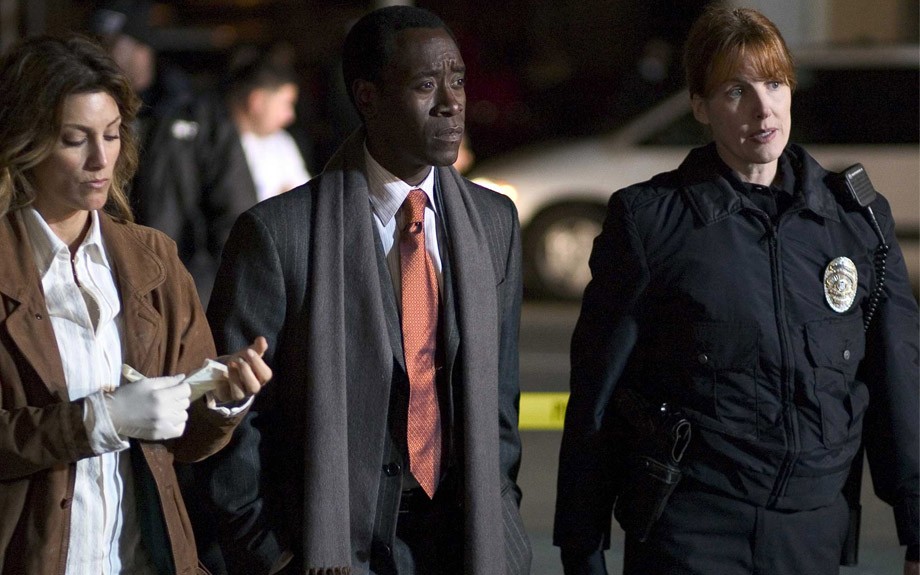
As Graham, a black, brooding, ambitious police detective, Don Cheadle (Hotel Rwanda) delivers another strong, slow-burn performance. Graham’s the kind of cop who waxes philosophical as he watches a fender-bender turn into road rage. He’s trying to be a man of integrity in a world that’s unfair, but he’s not above exploiting race in heated exchanges. When his coked-out mother stings him over the phone, he slaps her by revealing he’s “having sex with a white woman.”
That white woman, Ria (Jennifer Esposito of Taxi, Summer of Sam), who happens to be his partner on the force, has issues of her own. When she’s rear-ended by a Chinese woman who speaks English poorly, she sneers, “What? Oh, I blake too fast?”
Crash frequently focuses on the almost impossible maze of political and personal challenges that big city policemen face on a daily basis. Ryan Phillippe (Gosford Park) plays Thomas, a rookie cop repulsed by his misbehaving partner Ryan (Matt Dillon). Ryan’s such a bigot, he’ll judge people on their name alone. When he can’t get cooperation from a health insurance staffer named Chiniqua (Loretta Devine), he scoffs, “I look at you and I’m thinking about the five or six white guys who didn’t get your job!”
When Ryan pulls over an African-American couple and proceeds to sexually molest the attractive mixed-race wife Christine (The Truth About Charlie’s Thandie Newton) in front of her husband Cameron (Ray’s Terrence Howard in an extraordinary performance), Thomas is too bewildered, horrified, and frightened to intervene. If there is a pivotal scene in the film, this is it—we sympathize with Thomas, we feel Christine’s humiliation, and we share Cameron’s anguish as he stands helpless. But Ryan’s obscene act is just the beginning; it draws out surprisingly different reactions, motivated by different perspectives on racism, in everyone involved. Soon Christine and her husband are attacking each other, and Cameron snaps, “The closest you ever came to being black was watching The Cosby Show!”
Meanwhile, Anthony (rap star Chris “Ludacris” Bridges) and his happy-go-lucky pal Peter (Larenz Tate) dodge the cops, arguing about prejudice even as Anthony inspires it. He sees discrimination everywhere it can be found and in places it can’t. When his temper gets triggered by a flinching white woman, what does he do about it? He steals a Lincoln Navigator from some rich people and takes it for a joyride.
But this time, he’s nabbed the wrong vehicle. The SUV belongs to district attorney Rick Cabot (Brendan Fraser) and his perpetually angry wife Jean (Sandra Bullock). Fraser strikes the perfect tone, convincing us that Cabot’s political platform is a house of cards. If the D.A. doesn’t spin the car-theft story to the press just right, he’ll infuriate black voters or alienate those who just want him to “take a bite out of crime.” Meanwhile, Jean responds to the theft by taking it out on her Hispanic housekeeper and hurling accusations at a Hispanic locksmith (Michael Pena). Playing Miss *Non-*Congeniality seems like a bold move for Bullock; she lashes out with expletives as if trying to crack the façade of her famously likeable Hollywood persona. But Jean is a one-note character, and thus the performance comes off as a comedienne’s audition for dramatic roles instead.
If this is starting to sound complicated, and if the ironies seem to be piling up, well, that’s exactly the case. Haggis deftly weaves these various threads together in a remarkably cohesive narrative so that we never lose our place or forget a face. But his attention is focused so narrowly on The Big Issue that his characters seem incapable of talking about anything but prejudice.
In Grand Canyon, Lawrence Kasdan’s characters had more developed personalities and enjoyed moments of levity and redemption. Spike Lee’s Do the Right Thing was vibrant with memorable human beings, and thus the stakes seemed very high indeed when the dam holding back suppressed racial anger finally broke. Paul Thomas Anderson’s Magnolia was full of lost souls, but there were also agents of grace; he invited us to make connections, compare and contrast relationships, and find common themes. The dialogue of Haggis’s characters spells things out for us. “In L.A., nobody touches you. We’re always behind this metal and glass,” Graham muses after a car crash. “It’s the sense of touch. I think we miss that touch so much that we crash into each other just so we can feel something.” Too many lines like this cause Crash to compromise the first rule of art—it tells too much and shows too little.
The billboard-sized ironies and convenient coincidences make things worse. When a man hit by a car is abandoned in front of the emergency room, he’s left lying next to a Nativity scene. A cop’s attempt to distance himself from the problem of prejudice is cut short by a superior officer who can’t help him … because of racial prejudice. To some, it may seem clever that the film begins and ends with fender-benders; for others, this conclusion will close a circle with far too little hope inside, implying endlessness.
While he has little to say about hope, there’s value in Haggis’s perspective on the problem. He never stoops to making a scapegoat of anyone—each character is fractured, biased, blind in some way, and by implication, so are we. Crash may provoke viewers to wrestle with relevant questions: Do we react differently to the person who cuts us off in traffic depending on her color? Do we smile at one stranger and then flinch at the next? Do our choices reinforce damaging racial stereotypes? When we’re the victim of a prejudice “crash,” how do we respond? With grace? Or do we throw fuel on the fires of anger and contempt?
Magnolia showed us that selfishness thrives on spiritual emptiness, and it suggested a divine benevolence could intervene and influence our broken human existence. Haggis doesn’t seem interested in looking upward or outward; he can only look down and shake his head in despair, wishing that human beings would just stop being so mean to each other. Racism, like pride, selfishness, and all of those ongoing sins, is too deep-rooted for us to solve on our own. Anybody who looks closely at history knows that placing tomorrow’s hopes entirely on human nature will lead to a terrible, horrible, no good, very bad future.
Previous Post

May 6, 2005
"Kingdom of Heaven" - Reviews, Responses
Next Post
May 6, 2005 The new issue of Response and "Born Into Brothels"
Browse Our Archives
Select a Category Blog Bloggers on "Through a Screen Darkly" Browser Coming Soon Endorsements Fiction Books Film Forum Film Reviews Inspirations Interviews Journal Kindlings Muse Movie buzz Music Reviews Non-Fiction Books radio Reviewers on "Through a Screen Darkly" The Auralia Thread Through a Screen Darkly Through a Screen Darkly - Bonus Materials Top 10 (or 20 or 100) lists Uncategorized
Select a Month June 2015 May 2015 April 2015 March 2015 February 2015 January 2015 December 2014 November 2014 October 2014 September 2014 August 2014 July 2014 June 2014 May 2014 April 2014 March 2014 February 2014 January 2014 December 2013 November 2013 October 2013 September 2013 August 2013 July 2013 June 2013 May 2013 April 2013 March 2013 February 2013 January 2013 December 2012 November 2012 October 2012 September 2012 August 2012 July 2012 June 2012 May 2012 April 2012 March 2012 February 2012 January 2012 December 2011 November 2011 October 2011 September 2011 August 2011 July 2011 June 2011 May 2011 April 2011 March 2011 February 2011 January 2011 December 2010 November 2010 October 2010 September 2010 August 2010 July 2010 June 2010 May 2010 April 2010 March 2010 February 2010 January 2010 December 2009 November 2009 October 2009 September 2009 August 2009 July 2009 June 2009 May 2009 April 2009 March 2009 February 2009 January 2009 December 2008 November 2008 October 2008 September 2008 August 2008 July 2008 June 2008 May 2008 April 2008 March 2008 February 2008 January 2008 December 2007 November 2007 October 2007 September 2007 August 2007 July 2007 June 2007 May 2007 April 2007 March 2007 February 2007 January 2007 December 2006 November 2006 October 2006 September 2006 August 2006 July 2006 June 2006 May 2006 April 2006 March 2006 February 2006 January 2006 December 2005 November 2005 October 2005 September 2005 August 2005 July 2005 June 2005 May 2005 April 2005 March 2005 February 2005 January 2005 December 2004 November 2004 October 2004 September 2004 August 2004 July 2004 June 2004 May 2004 April 2004 July 2003 May 2003 March 2003 September 1999
Follow Us!
TAKE THE
Religious Wisdom Quiz
Who was known as the doubter among Jesus' disciples?
Select your answer to see how you score.
John Thomas James Peter
Related posts from Looking Closer



Tomorrowland? Or Tomorrow-bland?

TRENDING AT PATHEOS Religious Music & Entertainment

"Les Diabolique" and Transgression
Alongside something like Arrival, Vertigo, or Charade, Les Diaboliques is a...

"The Plague Dogs" and Mortality
So, flashback to the late 70s, early 80s. Walt Disney Studios is...

With the recent and highly successful release of Christopher Nolan’s epic film,...

"L'avventura" and Human Weakness
Today's piece is going to be a little different for a few...

I first want to apologize for not posting or writing anything. I'm...

I've engaged in the multi-year project of reading through the Church Fathers,...
view all Religious Music & Entertainment blogs
Ad-Free & Subscriber Log-In Subscription Support
- About Us
- 2026 Calendar
- Videos
- Podcasts
- Library of World Religions
- Faith In Media Tracker
- Advertise With Us
- Write for Us
- Privacy Policy
- Terms of Service
- Do Not Sell My Data
- Contact Us
- Radiant Digital
- Manage Newsletter Subscriptions
- Unsubscribe From Notifications
- Sitemap
Copyright 2008-2026, Patheos. All rights reserved.
Subscription Support Ad-Free & Subscriber Log-In
Follow Patheos