
BuddhistCatholicContemplativeEvangelicalGeneral ChristianHinduJewishLatter-day SaintMuslimNew VisionsProgressive Christian
Beliefs
- Buddhist
- Catholic
- Contemplative
- Evangelical
- General Christian
- Hindu
- Jewish
- Latter-day Saint
- More Voices
- Muslim
- New Visions
- Pagan
- Progressive Christian
Topics
- Religion News
- Food and Religion
- Sports and Religion
- Religious Art
- Religious Music and Entertainment
- Religious Events
- History and Religion
- Style and Religion
- Politics and Religion
- Women in Religion
- Recreation Outdoors and Religion
- Business Finance and Religion
- Careers Workplace and Religion
- Education and Religion
- Family Parenting and Religion
- Health Fitness and Religion
- Home and Religion
- Relationships and Religion
- Technology and Religion
- Travel and Religion
Columnists
- Buddhist Columnists
- Business Finance and Religion Columnists
- Careers Workplace and Religion Columnists
- Catholic Columnists
- Contemplative Columnists
- Education and Religion Columnists
- Evangelists Columnists
- Family Parenting and Religion Columnists
- General Christian Columnists
- Health Fitness and Religion Columnists
- Hindu Columnists
- History and Religion Columnists
- Home and Religion Columnists
- Jewish Columnists
- More Voices Columnists
- Latter Day Columnists
- Muslim Columnists
- New Visions Columnists
- Nonreligious Columnists
- Pagan Columnists
- Politics and Religion Columnists
- Progressive Columnists
- Recreation Outdoors and Religion Columnists
- Relationships and Religion Columnists
- Religion News Columnists
- Religious Art Columnists
- Religious Events Columnists
- Religious Music and Entertainment Columnists
- Sports and Religion Columnists
- Style and Religion Columnists
- Technology and Religion Columnists
- Travel and Religion Columnists
- Women in Religion Columnists
Resource Library
- 2026 Calendar
- Library of World Religions
- The 100 Most Holy Places on Earth
- Patheos Answers
- Podcasts
- Videos
- Faith Leaders Database
- Anglican Episcopalian
- Bahai
- Baptist
- Buddhism
- Christianity
- Confucianism
- Eastern Orthodoxy
- Hinduism
- Holiness and Pentecostal
- ISKCON
- Islam
- Judaism
- Lutheran
- Methodist
- The Church of Jesus Christ of Latter-day Saints
- New Age
- Paganism
- Presbytarian and Reformed
- Protestantism
- Religion Behind the Scenes
- Roman Catholic
- Scientology
- Shia Islam
- Sikhism
- Sufism
- Sunni Islam
- Taoism
- Zen
- See all religions
Research Tools
 Ad-Free & Subscriber Log-In Subscription Support
Ad-Free & Subscriber Log-In Subscription Support
Follow Patheos 

- Trending:
- Forgiveness
- |
- Marriage
- |
- Consciousness
- |
- Death Penalty
- |
- Election
- |
- Halloween
 Looking Closer
- Home
- Religious Music & Entertainment
- The Best of Youth (2003) – A Guest Review by J. Robert Parks
The Best of Youth (2003) – A Guest Review by J. Robert Parks
Last updated on: August 30, 2012 at 12:29 pm by Jeffrey Overstreet
The Best of Youth (2003) – A Guest Review by J. Robert Parks 2012-08-30T12:29:16-06:00 Jeffrey Overstreet
Patheos Explore the world's faith through different perspectives on religion and spirituality! Patheos has the views of the prevalent religions and spiritualities of the world.
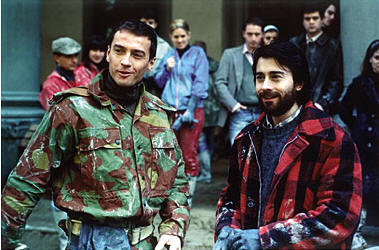
This is a guest review contributed by J. Robert Parks.
–
How can I convince you to devote six hours of your life to a single movie? Especially when that movie is an Italian film starring actors you’ve probably never heard of. And unlike Hollywood’s marketing obsessions, there’s no sex, little violence, and no special effects. Why would anyone travel up to Chicago’s Music Box theater (starting this Friday) for such a thing when spring is hopefully around the corner?
Well, let me put it this way. You may not find a richer, more engrossing story than The Best of Youth all year long. The narrative focuses on two brothers, Matteo (Alessio Boni) and Nicola (Luigi Lo Cascio). It’s the end of the university year, and both are studying for their oral exams. Literature student Matteo, in a burst of anger and frustration, walks out of his. Medical student Nicola passes with a high grade, in part because his professor credits him with the “sympathetic factor”–the belief that a doctor’s ability to be sympathetic to his patients is more important than what he knows. Surrounding these two figures are some of the most interesting characters I’ve seen in months of moviegoing-the bickering but loving parents, the older responsible sister, the younger sister who idolizes her brothers, the fellow student and friend, a beautiful but troubled young woman, an idealistic music student who protests against the government, a pretty photographer from Sicily. We watch all of them grow older and mature as the movie unspools their stories over the next several hours.
The acting is universally strong, and the ensemble work is exquisite. Nicola’s aging from a teenager to a man approaching old age isn’t quite believable, but every other character grows dramatically richer over time. And the movie’s patience means that we have the great joy of watching even minor characters reappear and surprise us. My favorite was the idealistic economist Carlo, so it was especially delightful for me to see his wedding that closes the movie’s first part and then watch as his family grows through the second. But I suspect each audience member will identify with a different person.
One of the great advantages of the film’s length is that it can let its characters develop slowly. Not every utterance out of someone’s mouth is the be-all-and-end-all of that character. Instead, the movie portrays life in the way that we live it, filled with little moments of joy and pain, tenderness and anger, rather than all-defining scenes of LOVE or HATRED or BETRAYAL, which is often how even good films have to handle their two-hour plots.
The Best of Youth takes a similar approach to history. The movie spans the years from 1966 to 2003 and deals with some of the pivotal moments in Italian society during that time: the 1966 Florence flood, the protests of the late ’60s and early ’70s, the rise and fall of the Red Brigade, the Sicilian Mafia’s murder of various magistrates. But Best of Youth treats these historical events as markers in time, not the all-consuming forces in which epics often revel. It realizes that for most of us, our lives are defined not so much by who was elected president but by the women we married, the friends we met, the children we raised, the parents we buried. It finds a beautiful balance between the personal and political, recognizing how the latter influences the former but never assuming that the grand gesture is more important than the small kiss.
That balance extends to how the characters perceive themselves. You might assume that a film with the title “Best of Youth” might privilege passion over experience, but that’s not the case. Neither, though, does it mock the follies of youth. It rather has the amazing ability to portray all sides with grace and understanding. The freedom and endless possibilities of the young and their burning desire to make a mark are held up as worthy of admiration. Even their naivety is embraced. Early on, Nicola travels through Norway and is compelled to exclaim, “Everything is beautiful.” And while the rest of the film casts doubt on that belief, the movie ends with another young man coming to the same conclusion. But the disillusionments and compromises of old age aren’t ridiculed, either. A small, funny rhyme happens late in the film when a much older Nicola curses a young man for driving too quickly. What Nicola doesn’t remember but we do is that he himself enjoyed speeding down the narrow roads as a younger man. It’s an ironic moment, but not a mean one. It doesn’t mock Nicola’s age but instead gently reminds us of how we all change as we grow older.
And while the movie may focus on its storytelling, it also has a sturdy visual style. Straightforward and realistic in most places, it also celebrates the Italian landscape. A subplot set on the island of Stromboli is an interesting counterpoint to Roberto Rossellini’s famous 1950 feature. More important, though, is the film’s theme of photographs. Director Marco Tullio Giordana presents them not only as personal mementos but also records of history, things that you pass on as well as objects that you share. They are a way to capture a moment in time but also a reminder of the fleeting nature of memory. Late in the film, Nicola is looking at a photo of his brother and reminiscing with an old acquaintance. “Remember that summer when we were young?” he asks. “Who was I?” The question is particularly piercing given who he’s talking to (I won’t spoil the surprise), but it’s one that can apply to all of us. And the film itself becomes a photograph that embodies all of these aspects.
Hopefully, this rave has peaked your interest. To make things even easier, the Music Box is showing the movie in two three-hour parts (separate admission required), with a screening of each part every day. So you don’t have to commit to the whole six hours. Check out part one, and if you like it, come back later in the week for part two. Given the film’s “sympathetic factor,” I’m pretty sure you will.
Four 1/2 stars out of five
Previous Post

March 27, 2005
Dogville (2004)
Next Post
March 28, 2005 At last! Paul Thomas Anderson's got a new movie!
Browse Our Archives
Select a Category Blog Bloggers on "Through a Screen Darkly" Browser Coming Soon Endorsements Fiction Books Film Forum Film Reviews Inspirations Interviews Journal Kindlings Muse Movie buzz Music Reviews Non-Fiction Books radio Reviewers on "Through a Screen Darkly" The Auralia Thread Through a Screen Darkly Through a Screen Darkly - Bonus Materials Top 10 (or 20 or 100) lists Uncategorized
Select a Month June 2015 May 2015 April 2015 March 2015 February 2015 January 2015 December 2014 November 2014 October 2014 September 2014 August 2014 July 2014 June 2014 May 2014 April 2014 March 2014 February 2014 January 2014 December 2013 November 2013 October 2013 September 2013 August 2013 July 2013 June 2013 May 2013 April 2013 March 2013 February 2013 January 2013 December 2012 November 2012 October 2012 September 2012 August 2012 July 2012 June 2012 May 2012 April 2012 March 2012 February 2012 January 2012 December 2011 November 2011 October 2011 September 2011 August 2011 July 2011 June 2011 May 2011 April 2011 March 2011 February 2011 January 2011 December 2010 November 2010 October 2010 September 2010 August 2010 July 2010 June 2010 May 2010 April 2010 March 2010 February 2010 January 2010 December 2009 November 2009 October 2009 September 2009 August 2009 July 2009 June 2009 May 2009 April 2009 March 2009 February 2009 January 2009 December 2008 November 2008 October 2008 September 2008 August 2008 July 2008 June 2008 May 2008 April 2008 March 2008 February 2008 January 2008 December 2007 November 2007 October 2007 September 2007 August 2007 July 2007 June 2007 May 2007 April 2007 March 2007 February 2007 January 2007 December 2006 November 2006 October 2006 September 2006 August 2006 July 2006 June 2006 May 2006 April 2006 March 2006 February 2006 January 2006 December 2005 November 2005 October 2005 September 2005 August 2005 July 2005 June 2005 May 2005 April 2005 March 2005 February 2005 January 2005 December 2004 November 2004 October 2004 September 2004 August 2004 July 2004 June 2004 May 2004 April 2004 July 2003 May 2003 March 2003 September 1999
Follow Us!
TAKE THE
Religious Wisdom Quiz
What disciple walked on water toward Jesus?
Select your answer to see how you score.
Matthew James Peter John
Related posts from Looking Closer

My 10,000th Tweet is An Announcement.

The most rebellious album I've heard all year.


An Unexpected Pleasure: Snow White and the Huntsman
TRENDING AT PATHEOS Religious Music & Entertainment

"Les Diabolique" and Transgression
Alongside something like Arrival, Vertigo, or Charade, Les Diaboliques is a...

"The Plague Dogs" and Mortality
So, flashback to the late 70s, early 80s. Walt Disney Studios is...

With the recent and highly successful release of Christopher Nolan’s epic film,...

"L'avventura" and Human Weakness
Today's piece is going to be a little different for a few...

I first want to apologize for not posting or writing anything. I'm...

I've engaged in the multi-year project of reading through the Church Fathers,...
view all Religious Music & Entertainment blogs
Ad-Free & Subscriber Log-In Subscription Support
- About Us
- 2026 Calendar
- Videos
- Podcasts
- Library of World Religions
- Faith In Media Tracker
- Advertise With Us
- Write for Us
- Privacy Policy
- Terms of Service
- Do Not Sell My Data
- Contact Us
- Radiant Digital
- Manage Newsletter Subscriptions
- Unsubscribe From Notifications
- Sitemap
Copyright 2008-2026, Patheos. All rights reserved.
Subscription Support Ad-Free & Subscriber Log-In
Follow Patheos