
BuddhistCatholicContemplativeEvangelicalGeneral ChristianHinduJewishLatter-day SaintMuslimNew VisionsProgressive Christian
Beliefs
- Buddhist
- Catholic
- Contemplative
- Evangelical
- General Christian
- Hindu
- Jewish
- Latter-day Saint
- More Voices
- Muslim
- New Visions
- Pagan
- Progressive Christian
Topics
- Religion News
- Food and Religion
- Sports and Religion
- Religious Art
- Religious Music and Entertainment
- Religious Events
- History and Religion
- Style and Religion
- Politics and Religion
- Women in Religion
- Recreation Outdoors and Religion
- Business Finance and Religion
- Careers Workplace and Religion
- Education and Religion
- Family Parenting and Religion
- Health Fitness and Religion
- Home and Religion
- Relationships and Religion
- Technology and Religion
- Travel and Religion
Columnists
- Buddhist Columnists
- Business Finance and Religion Columnists
- Careers Workplace and Religion Columnists
- Catholic Columnists
- Contemplative Columnists
- Education and Religion Columnists
- Evangelists Columnists
- Family Parenting and Religion Columnists
- General Christian Columnists
- Health Fitness and Religion Columnists
- Hindu Columnists
- History and Religion Columnists
- Home and Religion Columnists
- Jewish Columnists
- More Voices Columnists
- Latter Day Columnists
- Muslim Columnists
- New Visions Columnists
- Nonreligious Columnists
- Pagan Columnists
- Politics and Religion Columnists
- Progressive Columnists
- Recreation Outdoors and Religion Columnists
- Relationships and Religion Columnists
- Religion News Columnists
- Religious Art Columnists
- Religious Events Columnists
- Religious Music and Entertainment Columnists
- Sports and Religion Columnists
- Style and Religion Columnists
- Technology and Religion Columnists
- Travel and Religion Columnists
- Women in Religion Columnists
Resource Library
- 2026 Calendar
- Library of World Religions
- The 100 Most Holy Places on Earth
- Patheos Answers
- Podcasts
- Videos
- Faith Leaders Database
- Anglican Episcopalian
- Bahai
- Baptist
- Buddhism
- Christianity
- Confucianism
- Eastern Orthodoxy
- Hinduism
- Holiness and Pentecostal
- ISKCON
- Islam
- Judaism
- Lutheran
- Methodist
- The Church of Jesus Christ of Latter-day Saints
- New Age
- Paganism
- Presbytarian and Reformed
- Protestantism
- Religion Behind the Scenes
- Roman Catholic
- Scientology
- Shia Islam
- Sikhism
- Sufism
- Sunni Islam
- Taoism
- Zen
- See all religions
Research Tools
 Ad-Free & Subscriber Log-In Subscription Support
Follow Patheos 

- Trending:
- Advent
- |
- Forgiveness
- |
- Thanksgiving
- |
- Election
- |
- Seasonal Holidays
- |
- Marriage
 Looking Closer
- Home
- Religious Music & Entertainment
- My Constantine Adventure: Interviewing Keanu Reeves, Rachel Weisz, Shia LaBeouf, and others.
My Constantine Adventure: Interviewing Keanu Reeves, Rachel Weisz, Shia LaBeouf, and others.
Last updated on: September 26, 2013 at 9:06 pm by Jeffrey Overstreet
My Constantine Adventure: Interviewing Keanu Reeves, Rachel Weisz, Shia LaBeouf, and others. 2013-09-26T21:06:09-06:00 Jeffrey Overstreet
Patheos Explore the world's faith through different perspectives on religion and spirituality! Patheos has the views of the prevalent religions and spiritualities of the world.

Angels. Demons. Humans caught in the middle. Heroes trying to resist temptation and defeat Satan’s emissaries.
Sounds a lot like an adventure yarn from the mind of Frank Perretti.
But Francis Lawrence’s action-horror flick Constantine is a far cry from This Present Darkness. While the hero is an exorcist casting out demons right and left, he’s not exactly driven by humility or selflessness. And he’s not too fond of God.
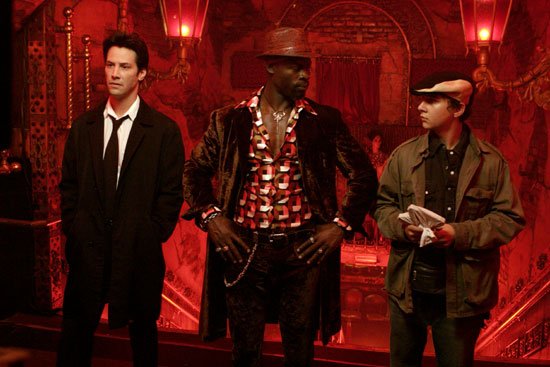
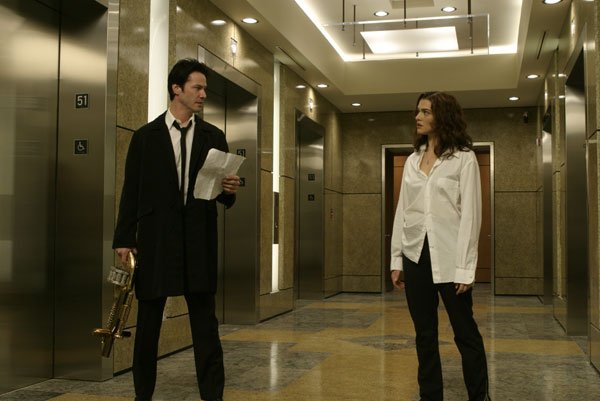
Keanu Reeves plays John Constantine, a chain-smoking exorcist who knows he’s going to hell after his lung cancer does him in. He spends his days trying to earn his way into God’s good graces by investing in his favorite side of the cosmic battle between good and evil.
That’s the premise. The studio execs were excited about marketing this movie to Christian moviegoers. It has angels and demons! Surely Christians will eat this up!
Well, Terry Mattingly at GetReligion sat bewildered with the rest of us religious-press journalists after the L.A. screening of Constantine. We were all trying to make sense of this spectacular mess. Today, at GetReligion, Mattingly highlights some words from the angel Gabriel … or rather, some words from the actress who plays him (her? it?). Tilda Swinton contradicts the other cast members and the director, who said it’s not a political film. Wait until you read her interpretation of the movie.
Constantine doesn’t have a moment of meaningful insight when it comes to Christian spirituality. In fact, it can’t say anything worthwhile. It’s too busy choking on its murky theology and crooked logic, and it delivers more than its fair share of gratuitous violence and gore.
But it’s going to be a hit, due to its star power and special effects.
So, since moviegoers will be buzzing about it in the coming months, CT Movies posed some questions to the filmmakers about the movie’s ideas about good, evil, the afterlife, and redemption. Lawrence and Reeves joined screenwriters Kevin Brodbin and Frank Capello, and supporting actors Rachel Weisz (The Mummy Returns), Djimon Hounsou (In America), Shia LeBeouf (Holes), and Gavin Rossdale (of the rock group Bush), in L.A. to address questions (paraphrased in this article) from religious press journalists.
Here are a few revealing excerpts:

(For the record, Mr. Reeves was particularly reluctant to address any questions about his thoughts on religion or spirituality. In fact, when one reporter inquired about Keanu’s religious beliefs, he immediately responded, “Please don’t. It’s something that’s very personal, that’s very private.”)
Does this kind of movie scare you?
Rachel Weisz: I don’t like it actually. It’s not scary to make the movie, but it’s scary to watch it. It’s not a feeling I enjoy. [This one’s] right on the edge of what I can handle. When you’re doing something very intense, I like to be silly, make a joke, let off steam. We don’t walk around thinking about demons. It’s make-believe. I get paid to make believe. I’m very lucky.
Djimon Hounsou: I may seem cool and collected, but I don’t really like watching movies of this nature. Just the fact that we did it meant I had to watch it. But otherwise, I wouldn’t go. I don’t have the nerves for it. I used to, when I was a lot younger. But now I just can’t deal with it. And I just don’t see the need to have my hair stand on end.
Rachel, looking over your career, this seems like it may be the first film you’ve been in that deals heavily with supernatural stuff—except for The Mummy, of course, which approaches it in a Saturday Morning Cartoon kind of way. Was it discomforting to you at all to work within a story based on such a strong religious tradition, which people take very very seriously? Does it resonate with you as true, on any level, in your personal life? Or does it feel more like an elaborate comic book language?
Rachel Weisz: I’d never read the comic books. So I was coming to it without knowing about that huge comic book cult community.
The world it’s set in, with angels and demons, is Judeo-Christian mythology … from the Old Testament to the New Testament. I’m familiar with those two books. That’s what I was raised reading.
So, did it bother me? No. I thought it was very interesting. Obviously it’s a Hollywood movie. Obviously it’s entertaining and scary, but it’s set within a universe where really important questions are asked. These are very serious themes and questions housed within an entertaining Hollywood movie. I don’t see why one can’t have both.

What kind of meaning do you hope viewers will take away from seeing Constantine?
Francis Lawrence: I hope viewers get the simple story—the hero’s journey. You have this guy who’s dying of cancer and he knows he’s going to hell. He’s trying to prevent it. He’s a selfish guy, doing things for selfish reasons. And then, he has that turn. It’s a movie about redemption.
Down underneath that, there are [other] ideas that we play with—like the perception of good and evil. What is good? What is evil? It’s not just what we’re told is good and evil. We have to think about that for ourselves.
But you don’t have to be Catholic to relate [to Constantine]. There are these broad ideas that work for a lot of people, spiritually or philosophically.
Shia LeBeouf: I don’t think this movie was made to push ideas or philosophies on anybody. It’s a fun ride. It’s purely for enjoyment purposes only. I think if somebody walks into it with a serious mindset, it could permanently affect them and give them nightmares they don’t want or put them in a place they don’t want to be.
I understand that it’s dealing with religious philosophies, and there’s probably a lesson in the film. But I don’t necessarily think anybody’s walking away from the film going, ‘Wow, that’s right. You know what? Now I’m going to change my life because of that.’ I don’t think that was the purpose of making the film. It’s not The Passion of the Christ that we’ve made.
Rachel Weisz: It’s about the capacity that we as human beings have to do good or to do evil. Good and evil occur on the earth, and we have freewill. We can choose. But there is also a question of predestination—God’s will. There’s a tension between these two things, and it’s in a state of flux. It’s one of the biggest questions you can ask. For me it’s a question that is unanswerable. We can’t say to what degree we’re in charge. We don’t know these things. It’s a mystery.
Gavin Rossdale: It’s a wonderful thing that this movie [shows] us: the power of change. It’s so poignant, so resonant. Constantine shows us this man’s journey, what he learns about himself, and … the satisfaction that comes from giving yourself away. It gave me the shivers when I watched it. I’m so proud to be part of this film because it has a positive message.
Frank Capello: The idea of redemption came about [partly] due to casting Keanu. Keanu’s a very spiritual person in his own right. He basically believes that we all have a purpose here.
Keanu Reeves: I think of it as just a kind of secular religiosity. The piece itself is using icons and a platform of a kind Catholic heaven and hell, God and the devil, human souls, fighting for those. But … I was hoping that these concepts could become a platform that [is] humanistic … that the journey of this particular hero is hopefully relatable to [viewers] — even though they’re such fantastical characters and situations. It’s still a man trying to figure it out.
I think those kinds of journeys—the hero’s journey or with Siddartha—these are all kind of seeking aspects [that] have some kind of value to our lives … that we can take with us. And they’re entertaining, you know.
They offer up [questions like] ‘Where have you come from?’ ‘What are you fighting for?’ ‘What is striving against you?’ [They’re about] coming into a kind of grace … into a kind of light. I think they’re worthwhile.
I don’t want to go to a movie and come away without something that I can think about, that adds to something. Because otherwise it’s like, ‘Thanks! Thanks for the pedophilia! Yes. I know. We’re f—-d up!’
Do you think good and evil exist in a balance, or is one of them stronger?
Djimon Hounsou: I don’t think evil is stronger, or I don’t think any of us would be here! What is the balance? I don’t know. I don’t know that I have the ability to see that. So that’s one subject I’ll leave alone.
Francis Lawrence: I believe that the world exists in a polarized way. For there to be good, there has to be evil. There are people around us who have these kinds of energies about them. I think there are two equal forces—there is a balance, and when it shifts one way or the other, something changes. You need one to have the other.
Gavin Rossdale: Ultimately, I believe in good over evil.
Whatever the balance—why is it that this movie shows us so much hell, and so little heaven?
Frank Capello: That’s the point of this story—that it has changed, the balance is shifting, something is going wrong. [Good and evil] are supposed to be equal, they’re supposed to be balanced. So then why are we seeing demons? The balance is upset. Constantine … helps balance it out.
The reason why heaven isn’t shown as much in these kinds of movies, honestly, is that no one knows how to depict it in a cool way. It seems like an audience loves hell—they want to see demonic images—but if you show them angelic, if you show them light, if you show them white, they go, ‘Oh gosh….’ It is hard to get away from that classic image of light, angels, that sort of thing. So it is a practicality. You’re trying to do something cool, and what does the audience want to see?”
Francis Lawrence: [Heaven] is definitely part of John Constantine’s world. It just wasn’t as much a part of this story, because he had to do the fighting.
From his ultimatums to demons, we know that John Constantine clearly understands that one must ask for God’s forgiveness to be forgiven for sins. Why does he insist on working his way into heaven? Why doesn’t he repent and ask God for forgiveness?
Frank Capello: He wouldn’t. That’s the thing about his character—his pride gets in the way of him asking to be let off the hook. He basically says, ‘I’m going to do it myself. I believe in myself.’ When you believe in yourself, you’re not going to ask for help. You don’t want to lower yourself to beg. And that’s what he almost does.
When you walk that line with John Constantine, knowing there’s a heaven, knowing there’s a hell—there’s no faith there! He knows it. He’s not going by blind faith. He’s been there. He’s seen it. What we all wish we knew… some people accept it totally, some people say, ‘Prove it to me. I have to see it.’ John’s seen it.
The idea of redemption came about [partly] due to casting Keanu. Keanu’s a very spiritual person in his own right. He basically believes that we all have a purpose here.
Keanu Reeves: Repentance. I think the aspect of repentance is born and expressed in his act—I don’t want to give it away—but his final act, what he asks from, as he calls Lucifer, ‘Lu.’ That’s his repentance, and I think—and his sacrifice, and what goes on there—I think that’s what .. gives him a shot at going Upstairs. But there’s also the Constantinian twist of did he make the sacrifice so that he could go to heaven, or does he really mean it? But … ultimately he does. Otherwise the Man Upstairs knows –just like Santa Claus—if you’re telling a lie or if you’re really nice. He knows.
What was it like, working on a movie set, surrounded by the symbols and the language of this religious tradition?
Shia LeBeouf: I’m not extremely religious. I’m still finding myself. I’ve always thought there is a presence—I do believe in God. I don’t believe in any certain scripture, per se. I was raised Jewish, but I just don’t feel it. [He laughs.] Like any Jew in Los Angeles, after your bar mitzvah, you’re pretty much through being Jewish!
I remember when we were learning how to exorcise people. The priest was very serious about it. I was wanting for the [mimics shave-and-a-haircut drumbeat] duh-duh-DUH! He says, ‘You place your hands there.’ And I said, ‘Well, this is just a movie.’ And he said, “No. This is where you place your hand. And this is where you place your hand. This is what you hold. This is what you say.” And you’re learning Latin, and you’re going, ‘This is archaic language. What’s the point?’
And the priest is so serious, it wobbles you a little bit. You think, ‘He’s really taking this seriously. There’s a reason. He can’t just be some crazy. They’re bringing him in on this film to help us, to guide us in the religion, in a way. He has expertise on this, he’s gone to a university, and people follow him … so he can’t just be some nut job!’ So you take that into account. And if he’s teaching you how to exorcise people, then that means it happens!
This happened every day: You’d be sitting in the cab, and you’d see a Satanic Bible. You’d pick it up and [go] through the pages and it would start scaring you. There was so much material on the set to read and to find things that you didn’t want to find out. Djimon says this a lot—you didn’t want to go in-depth with the research for your character, because you might find yourself in a place you don’t want to be.
Djimon Hounsou: I think this is one of very few projects you’d ever want to be involved in where you don’t really research. This is one subject you don’t want to do much research on it. It’s only given to very few people to have the ability to take those things in. I strongly feel there are certainly things that are not for everyone to hear or see.
For example, Jesus Christ. Jesus Christ is one of those people that I think exists that does have that unique ability to see—they can read you, inside out, like a book. They know your story even before you discover where you’re headed. That makes Jesus Christ a very special being, a very gifted being. I think [the character of] John Constantine is kind of like that. We talk about [these people] as if we are equal to them, but we are not necessarily given to be receptive to certain things.
Francis Lawrence: It’s a fascinating world. That’s part of what draws some people to films like this—that fascination. A lot of people have an interest until that moment when it might be too close to them, and then they say, ‘No, I don’t want to know anything.’ There was a little of that on the set. People wanted to be very cautious and respectful.
What relevance does this story—the conflict good versus evil, God versus the devil, and the possibility of redemption—have for you in your daily life? Is it a real thing? Or is this all just comic-book fantasy to you?
Djimon Hounsou: One connection it has for me for me: Africa, and certainly my country [of Benin], is a source of voodoo. Being born there, growing up there, I heard firsthand some stories.
The relevance it has in real life for me has to do with the way I carry myself and the way I treat people and … interact with people. If heaven and hell exist, it may be just a condition of our minds. I truly believe those two worlds do exist. If they don’t exist in the sense of God or the devil, they exist in the sense that what you do and how you carry yourself in this life experience leads you to a better life in the afterlife.
Francis Lawrence: I don’t think these things do exist, I don’t think they don’t exist. I’m the person who doesn’t know, and who’s open to all ideas. I was raised by parents who were both lapsed Catholics. My mom was raised Catholic and fell out of it, and my dad was raised Episcopalian and fell out. So I have this weird mix of having Catholicism in my life and real science and logic in my life. I’m somewhere in between. Maybe some of that came through [in the film].
Gavin Rossdale: I consider myself a very religious person, but on a much more personal level than the structured religion of necessarily following a particular denomination. I feel very close to a higher power, which I’m used to calling ‘God,’ but I wouldn’t force that on someone else. I would just hope that they have some idea that [serves as] a conscience. I think that kind of struggle goes through people every day—this idea of temptation, the idea of selfish versus selfless.
I firmly believe that you can’t just explain things away on society, or on your childhood. There’s a real sense of evil that is the only explanation for atrocious acts that happen to innocent people on a daily basis. It’s very sad.
Keanu Reeves: Spirituality is a word that I really don’t feel is something to apply to Constantine. If is, it’s very humanistic—as it always is, obviously. It’s more ‘flesh and blood’ than spiritual.

Rachel, your character Angela has a sister who is locked up in an institution because she has this spiritual awareness and is considered crazy. Does that resonate with you as something that is actually happening in culture, where we are stifling serious things with drugs or other repressing agents?
Rachel Weisz: We live in a culture where there’s a pill for everything. It’s no coincidence that the pharmaceutical industry is a multi-billion-gazillion dollar industry lobbying the government all the time. I think it’s a tragedy that oftentimes children just need to be listened to. They need some extra help in some area, and they’re medicated. It’s the same with adults. We’re living in a terrifying time in terms of medication. Everybody is bi-polar. How did this happen? That can’t be! It’s a scary thing. This is a horror movie, but that’s a horror in real life.
These characters seem alienated from their families, from each other, and John is clearly alienated from God. Do you think that is meant to mirror some alienation manifest in our own society?
Rachel Weisz: The breakdown of the relationship between man and God, and the breakdown of nuclear families … society is moving more and more toward very alienated individuals. Individuals are on computers all day, and [they’re] not interacting with other human beings, not being part of a church, not being part of a community. They’re [interacting] less and less. People are alone and alienated. Playing computer games—for me, that’s a very alienating thing to do. Anything where you’re not in relation to family, friends, community, God … that’s alienating.
So yes, I think the movie is holding up a light to something that’s happening in the world, even though it’s a completely supernatural kind of [story]. But it is the world, isn’t it? It’s a world with supernatural edges that take over. I would say [the movie’s] a comment on that.
Shia, as a young actor, who do you look up to? What actors do you admire for their career, their public persona, their choices?
Shia LeBeouf: There’s people I want to emulate, careers I want to have, resumes I’d like to attain. My route is very original. I don’t necessarily want to be a comedian forever. I’m a dramatic actor at heart as well. That’s why the comedy works so well. I’m trying to mix it up as much as possible. In October, there’s an epic film called The Greatest Game Ever Played which is a completely different role. I’m also trying to grow with my audience and raise them. I have to maintain quality, or they’re going to be like, “Oh, no. This is another Raise Your Voice. Goodbye!” I just have to make sure I’m consistent with the quality of film that I pick and the role that I pick. Maybe Dustin Hoffman would be my favorite actor. And my favorite career would be Tom Cruise or Keanu Reeves.
Previous Post

February 14, 2005
"Constantine"'s biggest mistake
Next Post
February 15, 2005 My first-ever link regarding architecture
Browse Our Archives
Select a Category Blog Bloggers on "Through a Screen Darkly" Browser Coming Soon Endorsements Fiction Books Film Forum Film Reviews Inspirations Interviews Journal Kindlings Muse Movie buzz Music Reviews Non-Fiction Books radio Reviewers on "Through a Screen Darkly" The Auralia Thread Through a Screen Darkly Through a Screen Darkly - Bonus Materials Top 10 (or 20 or 100) lists Uncategorized
Select a Month June 2015 May 2015 April 2015 March 2015 February 2015 January 2015 December 2014 November 2014 October 2014 September 2014 August 2014 July 2014 June 2014 May 2014 April 2014 March 2014 February 2014 January 2014 December 2013 November 2013 October 2013 September 2013 August 2013 July 2013 June 2013 May 2013 April 2013 March 2013 February 2013 January 2013 December 2012 November 2012 October 2012 September 2012 August 2012 July 2012 June 2012 May 2012 April 2012 March 2012 February 2012 January 2012 December 2011 November 2011 October 2011 September 2011 August 2011 July 2011 June 2011 May 2011 April 2011 March 2011 February 2011 January 2011 December 2010 November 2010 October 2010 September 2010 August 2010 July 2010 June 2010 May 2010 April 2010 March 2010 February 2010 January 2010 December 2009 November 2009 October 2009 September 2009 August 2009 July 2009 June 2009 May 2009 April 2009 March 2009 February 2009 January 2009 December 2008 November 2008 October 2008 September 2008 August 2008 July 2008 June 2008 May 2008 April 2008 March 2008 February 2008 January 2008 December 2007 November 2007 October 2007 September 2007 August 2007 July 2007 June 2007 May 2007 April 2007 March 2007 February 2007 January 2007 December 2006 November 2006 October 2006 September 2006 August 2006 July 2006 June 2006 May 2006 April 2006 March 2006 February 2006 January 2006 December 2005 November 2005 October 2005 September 2005 August 2005 July 2005 June 2005 May 2005 April 2005 March 2005 February 2005 January 2005 December 2004 November 2004 October 2004 September 2004 August 2004 July 2004 June 2004 May 2004 April 2004 July 2003 May 2003 March 2003 September 1999
Follow Us!
TAKE THE
Religious Wisdom Quiz
I denied my Lord three times before dawn broke and a bird announced the morning. What creature's cry fulfilled the prophecy?
Select your answer to see how you score.
A raven An eagle A rooster A dove
Related posts from Looking Closer
This Is Not Goodbye. But It is... See...

A Conversation with Sam Phillips: Revisiting The Image...

The Complete 2014 Christmas Playlist
A Novelist, A Horror Filmmaker, and Two Critics:...
TRENDING AT PATHEOS Religious Music & Entertainment

A Christian, a Narnia Fan, and a Filmmaker...
Watching The Narnia Trailer As A Fan And A Filmmaker Ever since...

Great Spiritual Horror Films of the 20th Century...
For the Christian, horror movies are often troubling—and many would say that...

"Les Diabolique" and Transgression
Alongside something like Arrival, Vertigo, or Charade, Les Diaboliques is a...

"The Plague Dogs" and Mortality
So, flashback to the late 70s, early 80s. Walt Disney Studios is...

With the recent and highly successful release of Christopher Nolan’s epic film,...

"L'avventura" and Human Weakness
Today's piece is going to be a little different for a few...
view all Religious Music & Entertainment blogs
Ad-Free & Subscriber Log-In Subscription Support
- About Us
- 2026 Calendar
- Videos
- Podcasts
- Library of World Religions
- Faith In Media Tracker
- Advertise With Us
- Write for Us
- Privacy Policy
- Terms of Service
- Do Not Sell My Data
- Contact Us
- Radiant Digital
- Manage Newsletter Subscriptions
- Unsubscribe From Notifications
- Sitemap
Copyright 2008-2026, Patheos, part of the Radiant Digital network of media brands. All rights reserved.
Subscription Support Ad-Free & Subscriber Log-In
Follow Patheos