
BuddhistCatholicContemplativeEvangelicalGeneral ChristianHinduJewishLatter-day SaintMuslimNew VisionsProgressive Christian
Beliefs
- Buddhist
- Catholic
- Contemplative
- Evangelical
- General Christian
- Hindu
- Jewish
- Latter-day Saint
- More Voices
- Muslim
- New Visions
- Pagan
- Progressive Christian
Topics
- Religion News
- Food and Religion
- Sports and Religion
- Religious Art
- Religious Music and Entertainment
- Religious Events
- History and Religion
- Style and Religion
- Politics and Religion
- Women in Religion
- Recreation Outdoors and Religion
- Business Finance and Religion
- Careers Workplace and Religion
- Education and Religion
- Family Parenting and Religion
- Health Fitness and Religion
- Home and Religion
- Relationships and Religion
- Technology and Religion
- Travel and Religion
Columnists
- Buddhist Columnists
- Business Finance and Religion Columnists
- Careers Workplace and Religion Columnists
- Catholic Columnists
- Contemplative Columnists
- Education and Religion Columnists
- Evangelists Columnists
- Family Parenting and Religion Columnists
- General Christian Columnists
- Health Fitness and Religion Columnists
- Hindu Columnists
- History and Religion Columnists
- Home and Religion Columnists
- Jewish Columnists
- More Voices Columnists
- Latter Day Columnists
- Muslim Columnists
- New Visions Columnists
- Nonreligious Columnists
- Pagan Columnists
- Politics and Religion Columnists
- Progressive Columnists
- Recreation Outdoors and Religion Columnists
- Relationships and Religion Columnists
- Religion News Columnists
- Religious Art Columnists
- Religious Events Columnists
- Religious Music and Entertainment Columnists
- Sports and Religion Columnists
- Style and Religion Columnists
- Technology and Religion Columnists
- Travel and Religion Columnists
- Women in Religion Columnists
Resource Library
- 2026 Calendar
- Library of World Religions
- The 100 Most Holy Places on Earth
- Patheos Answers
- Podcasts
- Videos
- Faith Leaders Database
- Anglican Episcopalian
- Bahai
- Baptist
- Buddhism
- Christianity
- Confucianism
- Eastern Orthodoxy
- Hinduism
- Holiness and Pentecostal
- ISKCON
- Islam
- Judaism
- Lutheran
- Methodist
- The Church of Jesus Christ of Latter-day Saints
- New Age
- Paganism
- Presbytarian and Reformed
- Protestantism
- Religion Behind the Scenes
- Roman Catholic
- Scientology
- Shia Islam
- Sikhism
- Sufism
- Sunni Islam
- Taoism
- Zen
- See all religions
Research Tools
 Ad-Free & Subscriber Log-In Subscription Support
Ad-Free & Subscriber Log-In Subscription Support
Follow Patheos 

- Trending:
- Forgiveness
- |
- Marriage
- |
- Consciousness
- |
- Death Penalty
- |
- Election
- |
- Halloween
 Looking Closer
- Home
- Religious Music & Entertainment
- Hero (2002)
Hero (2002)
Last updated on: August 23, 2012 at 5:57 pm by Guest Contributor
Hero (2002) 2012-08-23T17:57:44-06:00 Guest Contributor
Patheos Explore the world's faith through different perspectives on religion and spirituality! Patheos has the views of the prevalent religions and spiritualities of the world.
This review was originally published at Christianity Today.
–
The Grand Canyon. The Northern Lights. Van Gogh’s sunflowers. We’ve all been stricken speechless by vivid displays of color. For me, there’s the Georgia O’Keefe museum in Santa Fe, New Mexico; the shimmering metallic blue of Pacific Ocean waves at twilight; the day I discovered first-hand that ladybugs sometimes hibernate on mountaintops, clustered together in masses, blood red against white snow (hard to believe, but true).
To that list of awe-inspiring and vividly colorful experiences, I’d have to add the first time I saw Zhang Yimou’s Hero on the big screen.
It’s strange to consult a thesaurus for words that mean “beautiful” while I’m writing a review of a martial arts epic. But that’s what Hero does to its audience. The gravity-defying duels between swordsmen are some of the most spectacular you’ll ever see. An all-star team of China’s most talented screen actors delivers performances of astounding physical skill and delicate emotion. Adventures, debates, epic battles, and revenge quests weave together into a complex tapestry. And the soundtrack by Tan Dun (Crouching Tiger, Hidden Dragon) is lush and stirring. But those colors …
Sometimes, we miss out on the best films merely because they’re “foreign.” Hero sat neglected on the shelf at Miramax for two years while gaining popularity in China and with fans of Hong Kong cinema who got hold of import DVDs. Those responsible for stalling it should be rounded up and fired. It won an Oscar nomination in 2003 while still unreleased in the States, but the Academy voters who didn’t give it a fair shake should be ashamed of themselves. If you miss seeing Hero on the big screen, you have missed one of the peaks of cinematic spectacle.
Perhaps political bias stifled the film’s exhibition. Hero is one of those rare works of art that serves both as an intimate character drama and as a national myth. While Zhang Yimou was not commissioned to make Hero by the Chinese government, the movie would have made such an investment worth every penny. It is surpassingly excellent in every technical category. But there have been murmurs of discontent in China over whether or not the director is paying homage to Chinese Imperialism. And indeed he does portray a tyrannical king as wise and conscientious. But he also offers devastating displays of destruction unleashed by that same conqueror. The conflicts occur between the “warring states” of China, circa 220 B.C. Aiming to become emperor, the King of the country of Qin, Chin Shi Huang Di (played with authority by Chen Dao Ming), crushes the cultures of six opposing regions to gain supremacy.
This portrayal of violence and brutality runs counter to a wholesale endorsement of imperialism. Hero is about the way that the spread of an empire can all too easily devalue and destroy the valuable distinctions defined by the language, personality, and artistry of differing cultures. In direct contrast to the film’s colorful characters, the King’s armies drain color from the screen. They’re like minions of Tolkien’s orcs—dark and cold—and the King oversees this like a contemplative spider at the center of a web, where he too is haunted by the cost of his campaign.
As the film opens, the king honors a warrior called Nameless, who has slain three famous assassins that threatened the throne during the conquest. The reward: a private meeting with the king. This hero, played perfectly by international martial arts legend Jet Li, grants the king’s wish; he relates the stories of how he outwitted these legendary killers—Broken Sword (Tony Leung), Flying Snow (Maggie Cheung), and Sky (Donnie Yen).
In the style of Rashomon, Nameless’s stories are offered to us in multiple, contradictory flashbacks. Each story he relates raises the king’s suspicion and requires a revision. Thus, Nameless and his targets are portrayed in a variety of relationships, sometimes meeting different fates. Each enthralling flashback is portrayed in a distinct array of colors.
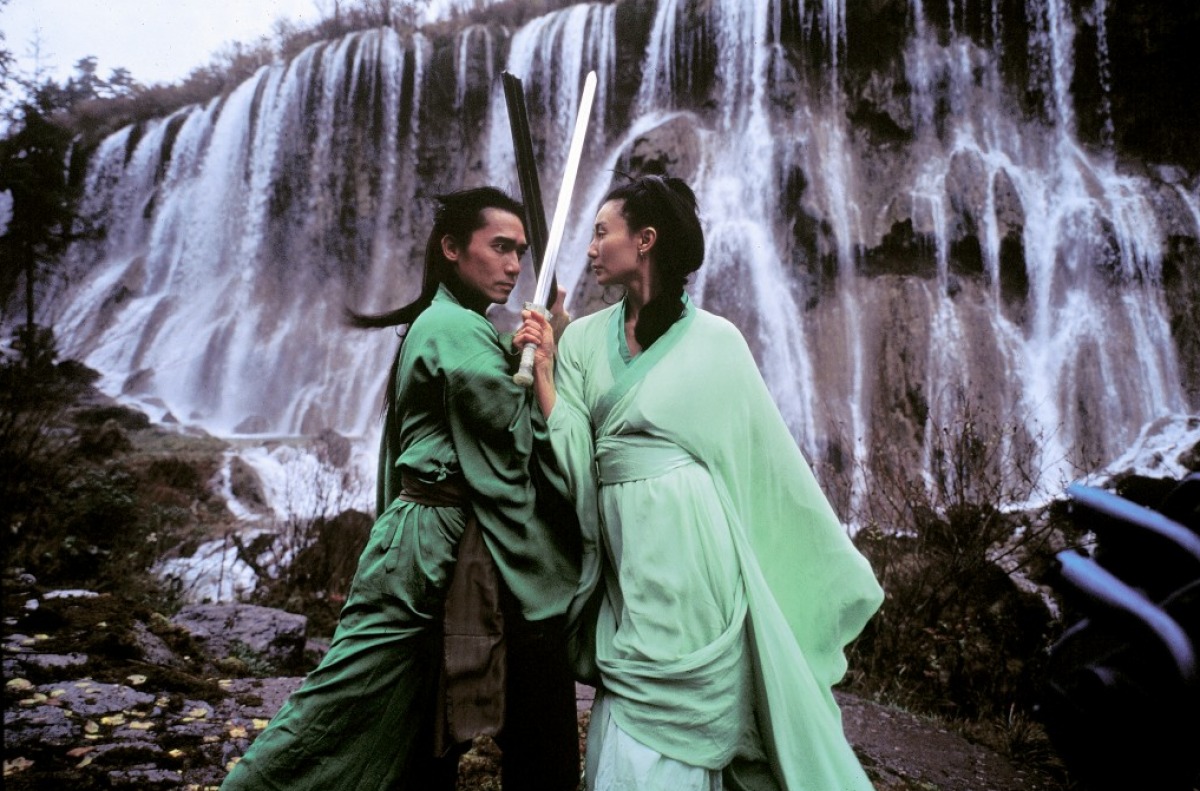
In one, Nameless and Sky meet in a spectacular duel that’s as much a match between their minds as it is between their blades. In another, Nameless helps Broken Sword and Flying Snow defend a calligraphy school from the oncoming forces of the king’s warriors. This involves deflecting relentless torrents of arrows that are launched in a siege that resembles the ferocity of The Two Towers‘ Battle of Helm’s Deep. Nameless opposes this siege in order to gain the killers’ trust, to learn their weakness, and to defeat them using their own passions for one another. Zhang Ziyi, sporting the same youthful ego and impertinence that she portrayed in Crouching Tiger, Hidden Dragon, plays a key role here as Broken Sword’s servant, Moon. Two more astonishing clashes—one a breathtaking ballet in a storm of falling yellow leaves, the other a battle on the surface of a magnificent lake—are each worth the price of admission; it’s unlikely you’ll see anything so memorable all year.
But the most important clash is the one between the hero’s narratives and the king’s questioning. Nameless is clearly superior to those whose weapons he has claimed and set down before the king. But what has made him such an unparalleled warrior? And what will he ask of the king now that he has performed this feat as a volunteer?
To say more about the plot would be to spoil the story’s most interesting twist. And besides, there is much to say in honor of the cast and crew.
Nameless is a perfect role for Jet Li. The part asks little of his acting talents (fortunately) and much from his athletic abilities. Similarly, Donnie Yen (Blade II, Shanghai Knights) turns Sky into a man who gets right down to business, letting his sword do the talking.
The juiciest roles go to Tony Leung and Maggie Cheung, who earned acclaim for playing as the leads of Wong Kar-Wai’s In the Mood for Love. Here, they embody one of the most tempestuous romances in the annals of film. United with a passion for excellence both in art and in combat, but divided by political ambitions, Broken Sword and Flying Snow swoon, argue, duel, dance, and smash each others’ hearts to pieces. Their director intensifies their emotions with colorful backdrops—blood reds, emerald greens, the white of sun-bleached sands. Are there any American actors who are as multi-talented as Leung, Cheung, and Zhang Ziyi, able to move our hearts, tantalize our minds, and then kick our butts with acrobatic fight scenes? They don’t just deserve Oscars—give them Olympic medals!
But the true masters of the show are Zhang Yimou and his cinematographer Christopher Doyle (The Quiet American, In the Mood for Love). They find rarely seen backdrops in China that rival the New Zealand landscapes of Peter Jackson’s Lord of the Rings films.
Zhang gets a lot of support from Oscar-winner Emi Wada’s extraordinary costume design. Production designer Tingxiao Huo brings this ancient world to life, so that the armies riding through the gates of the cities seem to be charging right out of the history books. Itzhak Perlman’s soulful violin stands out against the stormy backdrop of the Kodo Drummers’s drums in Tan Dun’s soundtrack. (The themes are too similar to his work for Crouching Tiger, but then again, they’re perfectly suited to the material.)
Zhang has a long list of marvelous films, including Ju Dou and Raise the Red Lantern, both of which earned him Oscar nominations, and the recent, romantic short story The Road Home. He calls To Live (1994) his most important movie, and it’s true—that epic about family and hardship in Chinese history is his most accomplished work of storytelling. But Hero is his masterpiece of visual imagination.
While it is almost impossible to discuss Hero without comparing it to Ang Lee’s Crouching Tiger, Hidden Dragon, that’s only because American viewers are unfamiliar with a genre called wuxia—a decades-old tradition of Chinese martial arts films. If they must be compared, yes, both feature warriors with the supernatural abilities to run up walls and bound through the treetops; but Crouching Tiger is more melancholy and romantic, whereas the action and spectacle in Hero make Ang Lee’s film look like a high school play.
Hero also burns with immediacy and relevance. As China struggles with the division between Beijing and Taiwan, Zhang Yimou poses a heartfelt challenge. He acknowledges the value of unification and peace. He knows that militant resistance of the empire’s progress can lead only to more violence and loss. But he reminds the viewer that the peculiarity of unique, diverse cultures produces valuable, irreplaceable rewards … and people. It is as if the storyteller cannot find a satisfactory conclusion to his own epic.
Thus, American viewers may be unsettled by the conclusion, as there seems to be no room for democracy in Hero‘s paradigm. In a worldview that reveres the will of a conqueror over the will of a benevolent God, “peace” comes at a cost that will give no one true peace. That is why, in the end, Hero remains a conflicted, colorfully turbulent film. By the time the climactic challenge occurs, few will find themselves unmoved by the king’s good intentions; but after his bloody campaigns, he is not the man who earns the title “hero.”
Seen in this light, Hero‘s distinct, aerobatic duels come to represent the power of art to communicate ideas across borders and languages, from common people to kings, emperors, and presidents. The story’s emphasis on the art of calligraphy is connected to its exhibitions of swordsmanship—in developing an artful style of writing, Broken Sword and Flying Snow prove that the pen can indeed be mightier than the sword. This metaphor, along with the film’s explorations of conscience, fidelity, trust, and responsibility, make Hero ultimately an insightful and rewarding achievement.
2004 doesn’t have a new Lord of the Rings film to fill the screen with bedazzlement and wonder. But it does have Hero. Do yourself the favor of catching it on the big screen. And leave yourself plenty of time to discuss it with your friends afterward. It may be two years old, but it’s still the richest cinematic feast on American movie screens so far this year.
Note: Near the end of the film, a character delivers an important message in two words—”Our land.” In the Chinese version, there are actually three words—”All under heaven.” Zhang Yimou changed it out of concern that it would not translate properly. Frankly, I prefer “All under heaven.”
•
Director – Zhang Yimou; Mandarin, with English subtitles; writers – Li Feng, Zhang Yimou, and Wang Bin, based on their story; director of photography – Christopher Doyle; editors – Zhai Ru and Angie Lam; music – Tan Dun, with violin and fiddle solos performed by Itzhak Perlman; production designers – Huo Ting Xiao and Yi Zhen Zhou; producers – Bill Kong and Zhang Yimou. Starring – Jet Li (Nameless), Tony Leung Chiu-wai (Broken Sword), Maggie Cheung Man-yuk (Snow), Zhang Ziyi (Moon), Chen Dao Ming (The King of Qin) and Donnie Yen (Sky). Miramax Films. 99 minutes. PG-13.
Previous Post

September 9, 2004
J. Robert Parks - Live From the Toronto International Film Festival
Next Post
September 14, 2004 Sam Phillips - the official site
Browse Our Archives
Select a Category Blog Bloggers on "Through a Screen Darkly" Browser Coming Soon Endorsements Fiction Books Film Forum Film Reviews Inspirations Interviews Journal Kindlings Muse Movie buzz Music Reviews Non-Fiction Books radio Reviewers on "Through a Screen Darkly" The Auralia Thread Through a Screen Darkly Through a Screen Darkly - Bonus Materials Top 10 (or 20 or 100) lists Uncategorized
Select a Month June 2015 May 2015 April 2015 March 2015 February 2015 January 2015 December 2014 November 2014 October 2014 September 2014 August 2014 July 2014 June 2014 May 2014 April 2014 March 2014 February 2014 January 2014 December 2013 November 2013 October 2013 September 2013 August 2013 July 2013 June 2013 May 2013 April 2013 March 2013 February 2013 January 2013 December 2012 November 2012 October 2012 September 2012 August 2012 July 2012 June 2012 May 2012 April 2012 March 2012 February 2012 January 2012 December 2011 November 2011 October 2011 September 2011 August 2011 July 2011 June 2011 May 2011 April 2011 March 2011 February 2011 January 2011 December 2010 November 2010 October 2010 September 2010 August 2010 July 2010 June 2010 May 2010 April 2010 March 2010 February 2010 January 2010 December 2009 November 2009 October 2009 September 2009 August 2009 July 2009 June 2009 May 2009 April 2009 March 2009 February 2009 January 2009 December 2008 November 2008 October 2008 September 2008 August 2008 July 2008 June 2008 May 2008 April 2008 March 2008 February 2008 January 2008 December 2007 November 2007 October 2007 September 2007 August 2007 July 2007 June 2007 May 2007 April 2007 March 2007 February 2007 January 2007 December 2006 November 2006 October 2006 September 2006 August 2006 July 2006 June 2006 May 2006 April 2006 March 2006 February 2006 January 2006 December 2005 November 2005 October 2005 September 2005 August 2005 July 2005 June 2005 May 2005 April 2005 March 2005 February 2005 January 2005 December 2004 November 2004 October 2004 September 2004 August 2004 July 2004 June 2004 May 2004 April 2004 July 2003 May 2003 March 2003 September 1999
Follow Us!
TAKE THE
Religious Wisdom Quiz
Who said, "Even the wind and the waves obey him!"?
Select your answer to see how you score.
Jesus' disciples The Roman governor John the Baptist The Pharisees
Related posts from Looking Closer



Tomorrowland? Or Tomorrow-bland?

TRENDING AT PATHEOS Religious Music & Entertainment

"Les Diabolique" and Transgression
Alongside something like Arrival, Vertigo, or Charade, Les Diaboliques is a...

"The Plague Dogs" and Mortality
So, flashback to the late 70s, early 80s. Walt Disney Studios is...

With the recent and highly successful release of Christopher Nolan’s epic film,...

"L'avventura" and Human Weakness
Today's piece is going to be a little different for a few...

I first want to apologize for not posting or writing anything. I'm...

I've engaged in the multi-year project of reading through the Church Fathers,...
view all Religious Music & Entertainment blogs
Ad-Free & Subscriber Log-In Subscription Support
- About Us
- 2026 Calendar
- Videos
- Podcasts
- Library of World Religions
- Faith In Media Tracker
- Advertise With Us
- Write for Us
- Privacy Policy
- Terms of Service
- Do Not Sell My Data
- Contact Us
- Radiant Digital
- Manage Newsletter Subscriptions
- Unsubscribe From Notifications
- Sitemap
Copyright 2008-2026, Patheos. All rights reserved.
Subscription Support Ad-Free & Subscriber Log-In
Follow Patheos