
BuddhistCatholicContemplativeEvangelicalGeneral ChristianHinduJewishLatter-day SaintMuslimNew VisionsProgressive Christian
Beliefs
- Buddhist
- Catholic
- Contemplative
- Evangelical
- General Christian
- Hindu
- Jewish
- Latter-day Saint
- More Voices
- Muslim
- New Visions
- Pagan
- Progressive Christian
Topics
- Religion News
- Food and Religion
- Sports and Religion
- Religious Art
- Religious Music and Entertainment
- Religious Events
- History and Religion
- Style and Religion
- Politics and Religion
- Women in Religion
- Recreation Outdoors and Religion
- Business Finance and Religion
- Careers Workplace and Religion
- Education and Religion
- Family Parenting and Religion
- Health Fitness and Religion
- Home and Religion
- Relationships and Religion
- Technology and Religion
- Travel and Religion
Columnists
- Buddhist Columnists
- Business Finance and Religion Columnists
- Careers Workplace and Religion Columnists
- Catholic Columnists
- Contemplative Columnists
- Education and Religion Columnists
- Evangelists Columnists
- Family Parenting and Religion Columnists
- General Christian Columnists
- Health Fitness and Religion Columnists
- Hindu Columnists
- History and Religion Columnists
- Home and Religion Columnists
- Jewish Columnists
- More Voices Columnists
- Latter Day Columnists
- Muslim Columnists
- New Visions Columnists
- Nonreligious Columnists
- Pagan Columnists
- Politics and Religion Columnists
- Progressive Columnists
- Recreation Outdoors and Religion Columnists
- Relationships and Religion Columnists
- Religion News Columnists
- Religious Art Columnists
- Religious Events Columnists
- Religious Music and Entertainment Columnists
- Sports and Religion Columnists
- Style and Religion Columnists
- Technology and Religion Columnists
- Travel and Religion Columnists
- Women in Religion Columnists
Resource Library
- 2026 Calendar
- Library of World Religions
- The 100 Most Holy Places on Earth
- Patheos Answers
- Podcasts
- Videos
- Faith Leaders Database
- Anglican Episcopalian
- Bahai
- Baptist
- Buddhism
- Christianity
- Confucianism
- Eastern Orthodoxy
- Hinduism
- Holiness and Pentecostal
- ISKCON
- Islam
- Judaism
- Lutheran
- Methodist
- The Church of Jesus Christ of Latter-day Saints
- New Age
- Paganism
- Presbytarian and Reformed
- Protestantism
- Religion Behind the Scenes
- Roman Catholic
- Scientology
- Shia Islam
- Sikhism
- Sufism
- Sunni Islam
- Taoism
- Zen
- See all religions
Research Tools
 Ad-Free & Subscriber Log-In Subscription Support
Ad-Free & Subscriber Log-In Subscription Support
Follow Patheos 

- Trending:
- Forgiveness
- |
- Marriage
- |
- Consciousness
- |
- Death Penalty
- |
- Election
- |
- Halloween
 Looking Closer
- Home
- Religious Music & Entertainment
- Harry Potter and the Sorcerer’s Stone (2001)
Harry Potter and the Sorcerer’s Stone (2001)
Last updated on: August 28, 2012 at 11:02 am by Guest Contributor
Harry Potter and the Sorcerer’s Stone (2001) 2012-08-28T11:02:51-06:00 Guest Contributor
Patheos Explore the world's faith through different perspectives on religion and spirituality! Patheos has the views of the prevalent religions and spiritualities of the world.
[Here’s my own original review, which was first published at the original Looking Closer website on January 21, 2001. I also covered the Christian media coverage of Harry Potter and the Sorceror’s Stone in Christianity Today’s Film Forum.]
–
For the record, I’m not a big fan of the Harry Potter books — So already I’m in the minority. And many will immediately disqualify my opinion of the film because of it.
But Harry Potter and the Sorcerer’s Stone is a film now, and needs to be fairly treated as one. It should not be a prerequisite to have read, or be a fan of, Rowling’s books in order to offer an opinion of the films. While it would be worthwhile to discuss how closely it adheres to the novel, it deserves to be assessed for its strengths and weaknesses as a movie.
So in this review I’ll first say a few words about my response to the book, then review the film in detail, and then I’ll close with some comments on the controversy over Harry’s interest in wizardry.
THE BOOK
I did read and enjoy the first book, but a few things nagged at me. I couldn’t help realizing that kids are enjoying these books immensely having not yet been exposed to so many of the great works of fantasy from which it borrows. Rowling is given so much credit for her imagination, and yes, she does fuse elements of traditional myths and fairy tales very inventively. But we mustn’t overstate it and give her credit for creating these ideas she has borrowed.
It’s painful to note that most kids’ first encounters with unicorns, magic wands, flying broomsticks, spooky castle corridors, dark forests, trolls, and long-bearded wizards will come from Rowling’s efficient, eager-to-entertain fiction. They will forever connect their first impressions of all of these things with Harry Potter, rather than those who brought them to life before her. Writers stir up stews of past ideas all the time. I just find a lot of the hoopla over her work to stem from enthusiasm over mythical contexts that have existed for ages.
It is also difficult to hear critics claim that her works will last as timeless classics beside the books of those who so strongly influenced her: T.H. White, J.R.R. Tolkien, C.S. Lewis, Lewis Carroll, Roald Dahl, Shakespeare, Sir Thomas Malory, Hans Christian Anderson, and The Grimm Brothers, to name a few. She definitely has a talent for entertaining commercial fiction, but she lacks the poetry, the multiple paths of meaning that wind through the works of those great writers. Again, this isn’t a criticism of her or her work, but of those who admire her work too much. (Of course, we can always hope kids will go on to read greater works, now that their taste for literature has been whetted. And Potter’s world is a better alternative than the cartoonized, sugar-coated, oversimplified treatments that Disney has given fairy tales.)
I hear that Rowling’s writing improves as the series progresses. That’s great. I’m thrilled kids are reading and using their imaginations. I just hope they will open their minds to heavier, deeper, more challenging stuff in the waiting periods between Potter releases.
THE MOVIE
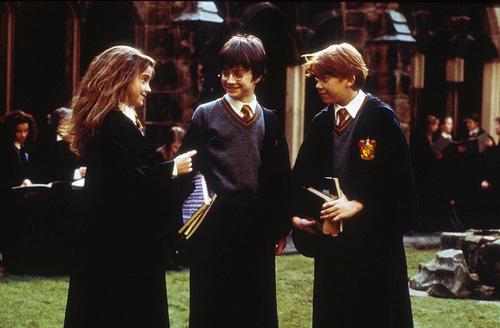
The Harry Potter movie is here, and it more a success than a flop. That is, what’s in the book is onscreen, bearing a remarkable resemblance to what readers probably imagined.
The environments are surprising, spooky, and inviting. The script never becomes dull; Steve Kloves’ writing lets each character’s particular wit shine. And congratulations to the cast. It’s harder work to portray these things effectively onscreen than just to write them down. (But then again, it’s healthier for us to read and imagine them than just to be spoon-fed them by Hollywood, isn’t it?)
It’s Chris Columbus’s direction that kills my enthusiasm for the film. While most scenes are adequate but not sensational, I found myself longing for a DVD, so I could scan from scene to scene and get to the heart of the story faster. The book gives us a more suspenseful buildup, while the movie just works its way through a series of introductions and tests. I couldn’t help but notice that while the matinee began at 1:40 p.m., the “sorcerer’s stone” mentioned in the title was not even mentioned until 3:30! This was a problem with the book as well, but perhaps the movie should be re-named.
How about calling it “The Many Expressions of Harry Potter”? The film introduces us to a vast cast of characters and important magical objects, and for each one the camera zooms in on Harry’s reaction-puzzlement, happiness, semi-wicked glee, astonishment. Harry is so busy reacting that we don’t get to know him. The film passes up many opportunities to let our focus shift from his surroundings to him. The only reason we root for him is because bad things happen TO him, instead of because we know what’s on his mind or his heart.
At one point, we see him sitting in the window of his room at Hogwarts, and there’s a great opportunity to sense longing or loneliness, like the moment when Luke Skywalker stares out at the two suns of Tattooine in Star Wars. Because George Lucas paused and let the moment resonate, that image became the heart and soul of “Star Wars”, the moment when Luke became the true central character. But Columbus rushes right on past moments like that. He’s in too big a hurry to pack in every page of the book (with only a couple of exceptions, noticeable because everything else made it in).
That’s too bad. In the books, Harry taps into our longings for identity and family. In the hands of a director with greater vision, Big-Screen Harry could have done the same thing. Instead, Harry is reduced to a wide-eyed cipher, looking about at characters far more interesting, witty, and surprising than he.
And what a colorful crew they are. My personal favorite is Hermione, the brainy girl who befriends Harry. Her cocksure attitude makes her a big screen cousin to Princess Leia. If this was real life, the story would degenerate into a romantic tug-of-war between Harry and Ron, and if I was one of their adolescent classmates you’d have to count me in as well. She’s played by Emma Watson, only one of many talented young actors making their big screen debuts here, and it’s not hard to imagine her growing up to be the next Kate Winslet or Helena Bonham Carter.
The entire cast is to be commended. Veteran actors John Hurt (Alien) and Alan Rickman (Die Hard, Galaxy Quest) almost steal the movie with their brief but vivid scenes and over-the-top line delivery. Richard Harris wisely plays the benevolent Professor Dumbledore with surprising and effective restraint. And it is uncanny how Robbie Coltrane brings Hagrid to life. He’s burly, brusque, and prone to blunders, and whenever he’s onscreen the film gains much-needed energy and personality. Being a lifelong fan of owls, I must say I became twice as alert whenever they graced the screen (thus, once scene in particular was like a dream come true.) Even in the company of such a distinguished cast, they were more dignified, interesting, and memorable than anyone.
Unfortunately, these fine performances are nearly wasted by Columbus’s predictable direction and John Williams’ overbearing, relentless soundtrack. There’s nothing distinct about Columbus. He’s happy to resemble other directors, Spielberg most of all, with innumerable slow-zooms of gaping youngsters, reminding us that this is the man responsible for those nagging memories of open-mouthed Macaulay Culkin. The camera just points and shoots, offering those who read the book no new surprises. It is, for the record, Columbus’s most impressive work to date, and he pulls off some of the necessarily spooky scenes like the voyage into the archetypically “dark forest” or the energy of a Quidditch match (for which he obviously studied the Pod Race in “The Phantom Menace”.) But his high-action scenes are not nearly as coherent as Spielberg’s; they’re generally chaotic, noisy, and full of unconvincing digital effects. And the confrontation with Shrek’s big brother in a dank Hogwart’s ladies’ room only made me long for a troll that’s actually scary (Just wait until The Fellowship of the Ring opens next month. There you’ll see what a troll should be.)
And Potter brings out the worst in composer John Williams. His overdramatic and redundant themes sound like a parody of his earlier work, ripping off Schindler’s List (the main theme is only a few notes different), Star Wars, Indiana Jones, and above all, Hook. At times the music drowns out action and even dialogue, getting emotional so you don’t have to, telling you “This is scary!”, “This is sad!”, “Be happy!”
Since Columbus can’t offer us anything interesting to replace Rowling’s peppy narrative, the movie ends up being a far inferior experience, a big moving-picture book with very little storytelling… just a bunch of introductions and tests to be passed. The central plot of the book…Harry’s predestined conflict with Voldemort… is shoved aside until the last few moments of a very, very long movie.
But the script and the sets make it all worthwhile. Steve Kloves’ adaptation really moves, and it’s full of good humor. The sets are distractingly gorgeous. The paintings on the walls in Hogwarts move, just as they do in the book, and some of them are hauntingly beautiful. The perfect DVD would allow you to enlarge and enjoy the drama in each of those museum-quality frames. The children have good chemistry, and I look forward to seeing them grow up in the sequels… which, by the way, are already being produced.
THE CONTROVERSY
A few words about the controversy, for those worried about the effect of the “magic” in Harry Potter’s world upon children. A lot of worried Christians are going around condemning the books, believing what they are told (sometimes by their church leaders). And they’re being told that the Potter franchise is, and I quote, “a training manual for witchcraft.”
I highly recommend that adults investigate the book for themselves. (By that I mean… read it.) Your kids are going to be surrounded with this stuff, if they aren’t already. You don’t want to tell them things about Potter that you haven’t confirmed.
I am not in any way convinced that there is any wicked agenda behind the Harry Potter books. I’ve heard the claims about Harry’s lightning-bolt scar being shaped like a satanic symbol. I’m sorry, but a lightning bolt is a very common symbol; I once wrote a story where a character had the same scar as Harry, and that doesn’t make me a Satanist.
As for the spells and Harry’s education at a school for wizards, this is all based on whimsy, fairy tale, and stereotypes that have developed over decades of Halloween parties. What does their “good magic” enable them to do? All the stuff kids like to imagine. Fly. Become invisible. Lift things off the ground without touching them. They aren’t cursing anyone’s souls. They aren’t using voodoo dolls. They’re not killing. The villains of the story show us the truly fearsome behavior. Evil is shown as evil. Good is represented symbolically as good magic.
It’s also worth noting that the characters in the book and in the movie celebrate Christmas, which strikes me as odd if the book wanted to turn kids against Christianity.
Furthermore, Scripture has a lot more to say on the subject than protesters want to admit.
In Deuteronomy 18:10-12, we are indeed exhorted by God, “There shall not be found among you anyone that maketh his son or his daughter to pass through the fire, or that useth divination … or an enchanter or a witch. Or a charmer, or a consulter with familiar spirits, or a wizard … For all that do these things are an abomination unto the Lord.”
This verse admonishes us not to become witches or sorcerers in the real world… and it’s referring to attempts to connect with and harness the spirit world for one’s own advancement, one’s own power. It does not say we cannot use the fanciful idea of magic the way it has been used as a convention in literary traditions for ages. Since the stories of Arthur, and earlier, such “magic” has been a way of symbolizing mystery and intangible things like virtue, bravery, and the abuse of power.
Indeed, if you find your children pursuing a serious interest in the Occult, then you should challenge them with conversation and questions about how they perceive the difference between fairy tales and reality. Parents who read fairy tales to children and teach them how to interpret them will be a step ahead of those who let television and media do the babysitting. But I have yet to hear of any children who, after reading Harry, has done anything more unusual than start reading more books.
The Bible has more to say, though, about something that you won’t hear on the paranoid-hysteria-building video “Harry Potter: Witchcraft Repackaged”.
David Bruce at HollywoodJesus.com suggests how the Apostle Paul might respond to such popular phenomena:
Zeus was considered a demon by certain early Christians. They protested Zeus, destroying his images and statues. They burned books about Zeus and warned others to avoid Zeus. There are Christians today who want to do the same thing to Harry Potter images, books and movies and for the same reasons. Yet the Apostle Paul approach to Zeus was very different. Standing before the Council in Athens, Paul said. ‘…For in him we live and move and exist. As one of your own poets says, ‘We are his offspring.'” (Acts 17:28) * So the approach Paul employed was to use Zeus, and not trash Zeus. However I fear there will be too many Christians will participate in a Harry Potter/Zeus Witch Hunt.
Bruce concludes with a passionate plea:
Please, let’s end the Witch Hunts! Use Harry Potter for the glory of God, just like Paul used Zeus for the glory of God. Please! Let’s end the insanity. Enough already.
Zeus was actually worshipped by people in Athens, celebrated as a real god. Harry Potter is perceived as a fiction. Surely, if Paul approached the cult of Zeus as a corrupt belief that could be discussed and used for God’s glory, then we can approach Rowling’s storybooks with the same patience and discernment. Rather than burn books, let’s open them and help young readers see what is true and false within them. Parents, lead by example.
To break down the distinction between active worldly witchcraft and the childlike imagination that can mature into great faith discredits the storytelling traditions that have influenced our understanding of good and evil for centuries. Good old Merlin is a wizard — should we burn The Sword and the Stone and the other Arthur legends? Wonderland is full of magic for curious Alice, but kids rarely climb down rabbit holes. Nobody in my neighborhood has jumped out a window believing that they’ll fly like Peter Pan if they “think of a wonderful thought.” In South Carolina’s The State newspaper, editorial writer John Monk suggests, “You might as well say Gone With The Wind teaches young readers to be slave owners, or Treasure Island entices children to be pirates.”
By fourth or fifth grade, most children can distinguish between Shrek and the Real World, between Veggie-Tales and vegetables. While you read to your own child, you can make sure they understand the important thing in Harry Potter is not the way spells work, but what sets brave Harry apart from proud Malfoy and power-hungry Voldemort. Pay attention as Harry responds to the devil’s temptations. It is the Darth Vader-ish villain who snarls, “There is no good and evil; there is only power, and those too weak to seek it.” Harry bravely disagrees.
The gulf between the religion of real witchcraft and the use of symbolic magic in storytelling is a vast one. Rowling’s fantasies, like The Chronicles of Narnia, A Wrinkle in Time, and The Lord of the Rings before them, give readers a whimsical language for discussing the forces at work inside them and around them. Harry’s magical gifts are symbols, metaphors for mysterious things in the real world, invisible powers like creativity, love, hate, humility, pride, generosity, and selfishness. Science Fiction does the same thing—just exchange magic wands with lightsabers or laser guns, magic brooms with the Starship Enterprise or pod racers, spells with secret codes in The Matrix.
Approach your movies and your storybooks the way you approach Thanksgiving dinner. There’s a lot on the table — you can stuff your face with some of it, but you’ve got to be careful with others. Sure, it’s conceivable that someone could choke on a bone if they’re not careful. Should we skip the turkey out of fear and settle for a plate of mashed potatoes?
Happy Thanksgiving. Chew your movies carefully.
–
Director – Chris Columbus; writers – Steve Kloves; based on the novel by J. K. Rowling; director of photography – John Seale; editor – Richard Francis-Bruce; music – John Williams; production designer – Stuart Craig; visual effects supervisor – Rob Legato; producer – David Heyman. Starring – Daniel Radcliffe (Harry Potter), Rupert Grint (Ron Weasley), Emma Watson (Hermione Granger), John Cleese (Nearly Headless Nick), Robbie Coltrane (Rubeus Hagrid), Warwick Davis (Professor Flitwick), Richard Griffiths (Vernon Dursley), Richard Harris (Professor Dumbledore), Ian Hart (Professor Quirrell), John Hurt (Mr. Ollivander), Alan Rickman (Professor Snape), Fiona Shaw (Petunia Dursley), Maggie Smith (Professor McGonagall), Julie Walters (Mrs. Weasley), Zoe Wanamaker (Madame Hooch), Tom Felton (Draco Malfoy), Harry Melling (Dudley Dursley), David Bradley (Mr. Filch) and Richard Bremmer (Lord Voldemort). Warner Brothers. 146 minutes. Rated PG.
Harry Potter and the Sorcerer's Stone
Previous Post

May 11, 2004
Man on Fire (2004)
Next Post
May 11, 2004 Hellboy (2004)
Browse Our Archives
Select a Category Blog Bloggers on "Through a Screen Darkly" Browser Coming Soon Endorsements Fiction Books Film Forum Film Reviews Inspirations Interviews Journal Kindlings Muse Movie buzz Music Reviews Non-Fiction Books radio Reviewers on "Through a Screen Darkly" The Auralia Thread Through a Screen Darkly Through a Screen Darkly - Bonus Materials Top 10 (or 20 or 100) lists Uncategorized
Select a Month June 2015 May 2015 April 2015 March 2015 February 2015 January 2015 December 2014 November 2014 October 2014 September 2014 August 2014 July 2014 June 2014 May 2014 April 2014 March 2014 February 2014 January 2014 December 2013 November 2013 October 2013 September 2013 August 2013 July 2013 June 2013 May 2013 April 2013 March 2013 February 2013 January 2013 December 2012 November 2012 October 2012 September 2012 August 2012 July 2012 June 2012 May 2012 April 2012 March 2012 February 2012 January 2012 December 2011 November 2011 October 2011 September 2011 August 2011 July 2011 June 2011 May 2011 April 2011 March 2011 February 2011 January 2011 December 2010 November 2010 October 2010 September 2010 August 2010 July 2010 June 2010 May 2010 April 2010 March 2010 February 2010 January 2010 December 2009 November 2009 October 2009 September 2009 August 2009 July 2009 June 2009 May 2009 April 2009 March 2009 February 2009 January 2009 December 2008 November 2008 October 2008 September 2008 August 2008 July 2008 June 2008 May 2008 April 2008 March 2008 February 2008 January 2008 December 2007 November 2007 October 2007 September 2007 August 2007 July 2007 June 2007 May 2007 April 2007 March 2007 February 2007 January 2007 December 2006 November 2006 October 2006 September 2006 August 2006 July 2006 June 2006 May 2006 April 2006 March 2006 February 2006 January 2006 December 2005 November 2005 October 2005 September 2005 August 2005 July 2005 June 2005 May 2005 April 2005 March 2005 February 2005 January 2005 December 2004 November 2004 October 2004 September 2004 August 2004 July 2004 June 2004 May 2004 April 2004 July 2003 May 2003 March 2003 September 1999
Follow Us!
TAKE THE
Religious Wisdom Quiz
Who said, "I am not ashamed of the gospel"?
Select your answer to see how you score.
Paul John James Peter
Related posts from Looking Closer



Tomorrowland? Or Tomorrow-bland?

TRENDING AT PATHEOS Religious Music & Entertainment

"Les Diabolique" and Transgression
Alongside something like Arrival, Vertigo, or Charade, Les Diaboliques is a...

"The Plague Dogs" and Mortality
So, flashback to the late 70s, early 80s. Walt Disney Studios is...

With the recent and highly successful release of Christopher Nolan’s epic film,...

"L'avventura" and Human Weakness
Today's piece is going to be a little different for a few...

I first want to apologize for not posting or writing anything. I'm...

I've engaged in the multi-year project of reading through the Church Fathers,...
view all Religious Music & Entertainment blogs
Ad-Free & Subscriber Log-In Subscription Support
- About Us
- 2026 Calendar
- Videos
- Podcasts
- Library of World Religions
- Faith In Media Tracker
- Advertise With Us
- Write for Us
- Privacy Policy
- Terms of Service
- Do Not Sell My Data
- Contact Us
- Radiant Digital
- Manage Newsletter Subscriptions
- Unsubscribe From Notifications
- Sitemap
Copyright 2008-2026, Patheos. All rights reserved.
Subscription Support Ad-Free & Subscriber Log-In
Follow Patheos