
BuddhistCatholicContemplativeEvangelicalGeneral ChristianHinduJewishLatter-day SaintMuslimNew VisionsProgressive Christian
Beliefs
- Buddhist
- Catholic
- Contemplative
- Evangelical
- General Christian
- Hindu
- Jewish
- Latter-day Saint
- More Voices
- Muslim
- New Visions
- Pagan
- Progressive Christian
Topics
- Religion News
- Food and Religion
- Sports and Religion
- Religious Art
- Religious Music and Entertainment
- Religious Events
- History and Religion
- Style and Religion
- Politics and Religion
- Women in Religion
- Recreation Outdoors and Religion
- Business Finance and Religion
- Careers Workplace and Religion
- Education and Religion
- Family Parenting and Religion
- Health Fitness and Religion
- Home and Religion
- Relationships and Religion
- Technology and Religion
- Travel and Religion
Columnists
- Buddhist Columnists
- Business Finance and Religion Columnists
- Careers Workplace and Religion Columnists
- Catholic Columnists
- Contemplative Columnists
- Education and Religion Columnists
- Evangelists Columnists
- Family Parenting and Religion Columnists
- General Christian Columnists
- Health Fitness and Religion Columnists
- Hindu Columnists
- History and Religion Columnists
- Home and Religion Columnists
- Jewish Columnists
- More Voices Columnists
- Latter Day Columnists
- Muslim Columnists
- New Visions Columnists
- Nonreligious Columnists
- Pagan Columnists
- Politics and Religion Columnists
- Progressive Columnists
- Recreation Outdoors and Religion Columnists
- Relationships and Religion Columnists
- Religion News Columnists
- Religious Art Columnists
- Religious Events Columnists
- Religious Music and Entertainment Columnists
- Sports and Religion Columnists
- Style and Religion Columnists
- Technology and Religion Columnists
- Travel and Religion Columnists
- Women in Religion Columnists
Resource Library
- 2026 Calendar
- Library of World Religions
- The 100 Most Holy Places on Earth
- Patheos Answers
- Podcasts
- Videos
- Faith Leaders Database
- Anglican Episcopalian
- Bahai
- Baptist
- Buddhism
- Christianity
- Confucianism
- Eastern Orthodoxy
- Hinduism
- Holiness and Pentecostal
- ISKCON
- Islam
- Judaism
- Lutheran
- Methodist
- The Church of Jesus Christ of Latter-day Saints
- New Age
- Paganism
- Presbytarian and Reformed
- Protestantism
- Religion Behind the Scenes
- Roman Catholic
- Scientology
- Shia Islam
- Sikhism
- Sufism
- Sunni Islam
- Taoism
- Zen
- See all religions
Research Tools
 Ad-Free & Subscriber Log-In Subscription Support
Ad-Free & Subscriber Log-In Subscription Support
Follow Patheos 

- Trending:
- Forgiveness
- |
- Marriage
- |
- Consciousness
- |
- Death Penalty
- |
- Election
- |
- Halloween
 The Living Tradition
- Home
- Muslim
- The Hajj and Forgiveness
The Hajj and Forgiveness
Last updated on: July 24, 2021 at 4:03 am by Mahmoud Mostafa
The Hajj and Forgiveness 2021-07-24T04:03:17-04:00 Mahmoud Mostafa
Patheos Explore the world's faith through different perspectives on religion and spirituality! Patheos has the views of the prevalent religions and spiritualities of the world.
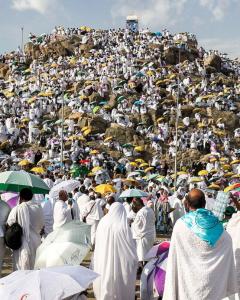
Pilgrims on Jabalu-r Rahma Courtesy ABC News
On Monday, the pilgrims marched out in their great multitudes from the plain of Mina outside of Mecca, to Arafat, a small mountain about 8 miles away. Millions of souls heading in the same direction, for the same purpose, calling out in the same way with their collective voices resounding in every direction:
“Labayk Allahumma Labayk, Labayka la Shareeka Laka Labayk. Innal Hamda, Wan Ni’mata laka wal mulk, la Shareeka lak”.
“Here I am O my God, here I am! There is no one equal to You, here I am! All praise is Yours all bounty is Yours, and all sovereignty is Yours. There is no equal to You, Here I am!”
They traveled from the plain of Mina (which means Hope) seeking the heights of Jabalu-r Rahmah (Mountain of Mercy) carrying in their hearts their deepest and dearest hopes for forgiveness.
Every step of the Hajj is meant to bring us to this unique and paradoxical moment. It is indeed remarkable that the entire journey of the Hajj is defined by and culminates with this tremendous procession and standing. It is a movement of millions together towards a common destination, yet it is a totally solitary standing for each soul, alone, in its own inimitable longing, humility and helplessness before the Lord of All the Worlds, humbly seeking His forgiveness.
When we realize this truth about the Hajj, we may come to understand how forgiveness is such a fundamental pillar of the Islamic faith and how it is such a vital aspect of the relationship of unconditional love, of Rahmah, between God and humanity.
To understand the centrality of forgiveness in Islam we can look to the Quran and Traditions of the Prophet (AS) to reflect on the guidance they contain about forgiveness.
In the Quran, Allah’s name the Forgiving (Al Ghafur), is most often paired with the name the Most Merciful (Al Raheem). Al Raheem is the Divine Name of the quality that actively bestows unconditional love and when it is paired with Al Ghafur, this intimates to us that forgiveness is intrinsically related to the experience of unconditional love.
In a unique and decisive verse, Allah commands us to, “Make it known to My servants that I, I am The Forgiving (Al Ghafur), The Most Merciful (Al Raheem)” 15:49. This divine command to the Prophet (AS), and to anyone else who receives the guidance of the Quran, makes it clear that it is our responsibility as human beings, as God’s viceregents (Khalifah) on this earth, to make these two qualities known to our fellow humans. How do we do so? We fulfill this command by manifesting these two qualities in our being. We make people know it when we ourselves become forgiving and merciful.
But we are human, we are prone to forgetfulness and to falling into the traps of our egos. We can find ourselves stuck in arrogance, pride, grudges, resentments, cruel judgments, anger, and the desire to wound others when we ourselves are wounded. How then do we uphold this divine command to make forgiveness and unconditional love known among God’s servants? We can do so by following the example of the Prophet (AS), the one who is sent only as a Mercy to All the Worlds. Let’s look at how the Prophet (AS) understood and accepted the human condition, how he tamed his own ego and how he manifested forgiveness and unconditional love.
In his teachings, the Prophet (AS) made it clear that we are fallible, that we are prone to error, that we are habitually causing harm to ourselves and to others and he freed us of the bondage of guilt and the hopelessness of human expectations by letting us know that this weakness in us is there by Divine Will.
The Prophet (AS) said, “By the One who holds my soul in His hand, if you did not commit sins, God would replace you with others who do sin so that they would seek His forgiveness so that He will forgive them.”
He set our hearts at ease and gave us hope by letting us know that there is nothing that we can do, there is no sin we are capable of committing that is beyond God’s capacity to forgive.
In a sacred tradtion (Hadith Qudsi), he tells us that God says, “O human being! I will forgive without bounds whatever you ask of Me. Even if your sins reach up to the skies and you seek My forgiveness, I will forgive you. Even if you come to Me with enough wrongs to fill this earth, but you have kept your faith in Me, I will meet you with enough forgiveness to fill this earth.”
And he gave us, by his personal example, the guidance we need to be able to bring the qualities of forgiveness and mercy into manifestation.
The Prophet (AS) said, “By God, my heart gets shrouded, and so I seek forgiveness more than 70 times a day.”
Here is practical, actionable guidance on how we can develop our capacity for forgiveness and unconditional love. First, we need to be aware of our inner state, to be conscious of the times when our hearts are covered by darkness. Whenever we become aware of this inner state, we can then use it as a signal to prompt us to turn towards our Lord and seek forgiveness. We keep repeating this as much as possible. The Prophet (AS) tells us that he himself has to do it more than 70 times a day, if he is awake for 16 hours a day this means he is seeking forgiveness at least every 14 minutes or so. We may find we have to do this even more frequently at the beginning. We may find ourselves faltering and failing often as we come face to face with our habitual thoughts and emotions. All of this is alright, we just have to keep seeking over and over again without shame, without guilt, without despair.
Why is seeking forgiveness so important to our faith? It maybe that it keeps us aware of a profound and humbling truth: that we are not the ones who have the power or choice to forgive, we only have the choice to seek forgiveness and it is God who bestows forgiveness upon us. It’s hard to overstate the importance of this truth. If forgiveness were left up to us, we would be doomed to an endless cycle of conflict, revenge, and retaliation. There would be little hope of ever breaking out of this vicious cycle.
The Quran makes this clear to us when it states, “Say: If you were to own the treasuries of my Lord’s Mercy, you would withhold from fear of expending. Truly, the human being gives grudgingly!” 17:100. God’s limitless generosity and love are securely held in His care from whence it can freely flow to His creation. In this, there is safety and security for us from the inflation of our ego. There is a real danger in our thinking, “I will forgive.” And even more danger in thinking, “I will never forgive!”
During the time of the slander against Lady Aisha, her father, Abu Bakr, learned that one of his own relatives was engaging in the vicious gossip about her. This relative was poor and Abu Bakr supported him, so he vowed to cutoff his support in retaliation. When the Prophet learned about this decision, he advised his friend to reconsider, but Abu Bakr was too hurt, and would not change his mind. Then a verse was revealed:
“Let not those among you of virtue and wealth vow not to give to their relatives and the needy and the emigrants in the cause of God. Let them pardon and forebear. Would you not love for God to forgive you? God is Forgiving and Merciful.” 24:22
Upon hearing this verse, Abu Bakr came to the Prophet with tears in his eyes and said, ‘O Messenger of God, I would love God to forgive me.” And he reinstated his support for his relative.
Seeking forgiveness defines our relationship to our Lord, (Rabb), and this, in turn, defines our relationship to one another. If our relationship with God is that of the repentant servant seeking forgiveness, then we will know God as the Merciful and Forgiver. And if we know God in this way, then we will reflect the same qualities in our relationship with His creatures, with our families, friends, and strangers. We will be merciful with ourselves and with others, we will be more forgiving of the wrongs of others. We will be content, and we will joyously submit to God’s Will. We will come to know conscious surrender (Islam).
Seeking forgiveness is the door that leads to the path of maturity and completion of our humanness. It will help us develop noble characteristics such as courage, gentleness, forbearance, honesty, sincerity, and humility. When we seek forgiveness, we bring to the Divine our heavy burdens and we are relieved of them by the Divine’s limitless capacity for forgiveness and mercy and this will determine what kind of human beings we ultimately are to become at the end of our earthly journey. The Prophet (AS) said, “The one who repents and seeks forgiveness is the same as one who has no sins.”
Previous Post

June 19, 2021
Beyond Gain and Loss: Rumi's Teaching on Surah Ash-Sharh
Next Post

August 30, 2021 Freedom from Food: The Gifts of a Three-Month Fast
Browse Our Archives
Select a Category activism Community Divine Names Fear Feminine Islam Listening Mevlana Jalaluddin Rumi Mevlevi Music Prophet Muhammad Psychology Quran Ramadan Remembrance Rumi Sacred Space Shadow Work Shams of Tabriz Spiritual Imagination spirituality Sufism Suleyman Dede Uncategorized Universal Intelligence Zikr Zikr Allah
Select a Month October 2021 August 2021 July 2021 June 2021 April 2021 March 2021 February 2021 January 2021 November 2020 August 2020 June 2020 May 2020 April 2020 March 2020 February 2020 January 2020 December 2019 November 2019 October 2019 September 2019 August 2019 July 2019 June 2019 May 2019 April 2019 March 2019 February 2019 January 2019 December 2018 November 2018 October 2018 September 2018 August 2018 July 2018 June 2018 May 2018 April 2018 March 2018 February 2018 January 2018 December 2017 November 2017 October 2017 September 2017 August 2017 July 2017 June 2017 May 2017 April 2017 March 2017 February 2017 January 2017 December 2016 November 2016 October 2016 September 2016 August 2016 July 2016 June 2016 May 2016 April 2016
Follow Us!
TAKE THE
Religious Wisdom Quiz
What does "Elohim" mean in Hebrew?
Select your answer to see how you score.
God Creator The Almighty Holy One
Related posts from The Living Tradition


Freedom from Food: The Gifts of a Three-Month...
Beyond Gain and Loss: Rumi's Teaching on Surah...

TRENDING AT PATHEOS Muslim

25 Years Later: How Much Has Changed for...
As we approach the 25th anniversary of September 11th, I’ve found myself...

Podcast: Third Spaces & The Rise of Yemeni...
In the latest episode of The Artistic Foodies Podcast, hosts Abbas...

HalalFest Picks: Best 60 Halal Spots for Super...
Back in 2016, I came up with a list of 29...

Unity Is America’s Strength — Division Is Its...
by Hidayatullah Ahsan When Valentina Gomez, a Republican candidate for Congress in...

Zohran Mamdani and New York’s Fight Against Islamophobia
This past June, against all odds, Zohran Mamdani won the Democratic primary...

What the Fourth of July Means to a...
As we mark another Fourth of July, millions of Americans will celebrate...
view all Muslim blogs
Ad-Free & Subscriber Log-In Subscription Support
- About Us
- 2026 Calendar
- Videos
- Podcasts
- Library of World Religions
- Faith In Media Tracker
- Advertise With Us
- Write for Us
- Privacy Policy
- Terms of Service
- Do Not Sell My Data
- Contact Us
- Radiant Digital
- Manage Newsletter Subscriptions
- Unsubscribe From Notifications
- Sitemap
Copyright 2008-2026, Patheos. All rights reserved.
Subscription Support Ad-Free & Subscriber Log-In
Follow Patheos