
BuddhistCatholicContemplativeEvangelicalGeneral ChristianHinduJewishLatter-day SaintMuslimNew VisionsProgressive Christian
Beliefs
- Buddhist
- Catholic
- Contemplative
- Evangelical
- General Christian
- Hindu
- Jewish
- Latter-day Saint
- More Voices
- Muslim
- New Visions
- Pagan
- Progressive Christian
Topics
- Religion News
- Food and Religion
- Sports and Religion
- Religious Art
- Religious Music and Entertainment
- Religious Events
- History and Religion
- Style and Religion
- Politics and Religion
- Women in Religion
- Recreation Outdoors and Religion
- Business Finance and Religion
- Careers Workplace and Religion
- Education and Religion
- Family Parenting and Religion
- Health Fitness and Religion
- Home and Religion
- Relationships and Religion
- Technology and Religion
- Travel and Religion
Columnists
- Buddhist Columnists
- Business Finance and Religion Columnists
- Careers Workplace and Religion Columnists
- Catholic Columnists
- Contemplative Columnists
- Education and Religion Columnists
- Evangelists Columnists
- Family Parenting and Religion Columnists
- General Christian Columnists
- Health Fitness and Religion Columnists
- Hindu Columnists
- History and Religion Columnists
- Home and Religion Columnists
- Jewish Columnists
- More Voices Columnists
- Latter Day Columnists
- Muslim Columnists
- New Visions Columnists
- Nonreligious Columnists
- Pagan Columnists
- Politics and Religion Columnists
- Progressive Columnists
- Recreation Outdoors and Religion Columnists
- Relationships and Religion Columnists
- Religion News Columnists
- Religious Art Columnists
- Religious Events Columnists
- Religious Music and Entertainment Columnists
- Sports and Religion Columnists
- Style and Religion Columnists
- Technology and Religion Columnists
- Travel and Religion Columnists
- Women in Religion Columnists
Resource Library
- 2026 Calendar
- Library of World Religions
- The 100 Most Holy Places on Earth
- Patheos Answers
- Podcasts
- Videos
- Faith Leaders Database
- Anglican Episcopalian
- Bahai
- Baptist
- Buddhism
- Christianity
- Confucianism
- Eastern Orthodoxy
- Hinduism
- Holiness and Pentecostal
- ISKCON
- Islam
- Judaism
- Lutheran
- Methodist
- The Church of Jesus Christ of Latter-day Saints
- New Age
- Paganism
- Presbytarian and Reformed
- Protestantism
- Religion Behind the Scenes
- Roman Catholic
- Scientology
- Shia Islam
- Sikhism
- Sufism
- Sunni Islam
- Taoism
- Zen
- See all religions
Research Tools
 Ad-Free & Subscriber Log-In Subscription Support
Ad-Free & Subscriber Log-In Subscription Support
Follow Patheos 

- Trending:
- Forgiveness
- |
- Marriage
- |
- Consciousness
- |
- Death Penalty
- |
- Election
- |
- Halloween
 The Living Tradition
- Home
- Muslim
- Unveiling the Qur’an
Unveiling the Qur’an
Last updated on: February 11, 2019 at 7:07 pm by Saimma Dyer
Unveiling the Qur’an 2019-02-11T19:07:41-04:00 Saimma Dyer
Patheos Explore the world's faith through different perspectives on religion and spirituality! Patheos has the views of the prevalent religions and spiritualities of the world.
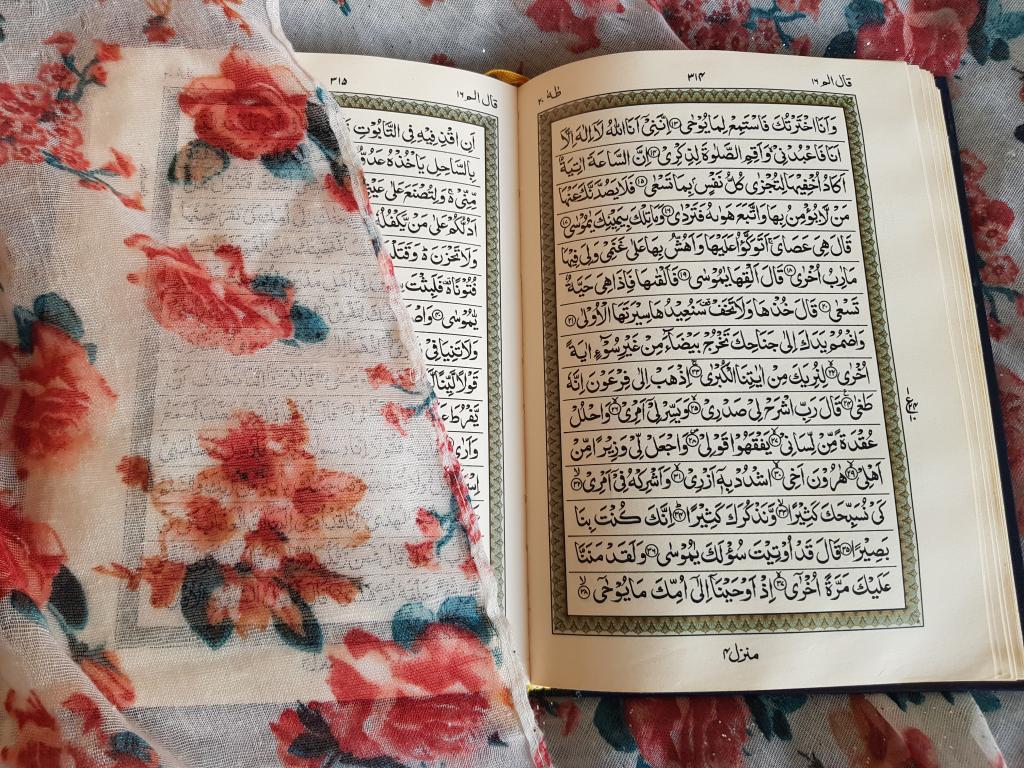 I grew up with an Islam that seemed only about hellfire and damnation. The gardens of heaven did exist somewhere but were mainly reserved for the prophets and saints – certainly not for the average believer who was in a constant state of sin and being reminded about it daily. My parents shouted at me to do my daily prayers or I would go to hell. The imam at the mosque shouted that I had to obey my parents or I would go to hell. The imam’s wife shouted at me to cover my hair – or I would go to hell.
I tried to read the Qur’an in English when I felt old enough to understand some of the archaic early English translations, to find something beyond hellfire and damnation. But I didn’t get far as Abraham’s God continued to shout at me about the torment of hell.
And yet, despite it all, I retained a reverence for the Qur’an. I reasoned to myself that I didn’t understand what it was saying because the translators were flawed in their ability to express God’s word. This may seem an arrogant viewpoint for a teenager to hold but my heart felt that this must be so – as my God could not be so patriarchal, judgemental, and mean – otherwise why create the universe if it was just going to be a long, miserable wait to get to hell? I still felt guilty that I couldn’t relate to the Qur’an and hoped that ‘one day’ it would reveal itself to me when I was ready to understand.
That ‘one day’ arrived very unexpectedly in my late twenties when I attended my first Sufi retreat in the UK and met Shaikha Camille Helminski. Not your typical shaikha, especially if you come from a Pakistani background. She was white (intriguing), American (disconcerting), and didn’t wear a hijab (shocking). Neither did I – but my hypocritical, ingrained cultural conditioning seemed to expect it from her! As I sat in a roomful of people, struggling with all my conflicting feelings, Shaikha Camille very unassumedly lifted her carefully placed scarf from her shoulder and draped it casually over her head.
And then she recited a verse from the Qur’an.
I say recite, but this word does not quite capture what happened. My experience of Qur’anic recitation was of men shouting it through shoddy speakers with ridiculous reverb at the mosque, or men shouting it on the television on the growing number of Islamic cable channels, or rows of young boys and girls chanting it in monotone at the madrassa when I was young.
This recitation struck me like a vision, as clouds parting and light streaming into the room to bathe Shaikha Camille in radiance. Her melody was unlike anything I had experienced: sacred, angelic, and slightly Celtic, it perfectly came together in holy harmony. The verse was short – I think – I was a puddle of perplexity and ecstasy and I don’t remember what happened next. At some point the session ended and I retreated to sob where no one could hear me. This was not the Islam I thought I knew; was it therefore an abominable innovation? But if this was sinful, why did it feel so angelic and bright? My heart’s sudden expansion had highlighted the iron bars in my chest that I hadn’t even realised had been there my whole life, and it hurt.
The next morning shattered further illusions as Shaikha Camille recited more verses and gave their translations in English. I was left feeling like she was surely reading from a different book. And when she referred to God as ‘He/She’ my mind felt like it was going to explode: this was wrong (but why?); this was blasphemous (but how?); this was definitely not Islam (and yet…).
My inner turmoil left me unable to approach Shaikha Camille and speak to her directly, but I noted that the book that she was reading from was available in the retreat bookstore and I grabbed one of the few copies to dissect when I returned home. The Mevlevi Wird is a litany of prayers recited daily by Mevlevi students. Shaikha Camille compiled the current publication with English translation and transliteration of the Arabic so you can read it in either language.
I was amazed to find verses – that I thought I knew very well – translated in new and unexpectedly beautiful ways. The Throne verse in particular is one I had recited regularly in Arabic. I thought I had a cursory understanding of the English meaning but the Wird gave new depths to the familiar words. And the jarring quality of seeing ‘He/She’ instead of the traditional ‘He’ shook me. Intellectually I knew God was beyond gender, and yet a whole lifetime (and centuries before me) had shaped God into a male, patriarchal, stern father figure – not quite the old man in the cloud and yet not far off that image either. To see the gender-inclusive language was a physically shocking experience, and reading God as She opened me in new ways to the compassion and mercy that is promised at the start of nearly every surah of the Qur’an. The first time I recited the Throne verse in English, aloud after my prayers, using the feminine pronoun, left me sobbing for some time into my prayer rug.
And so I met the Qur’an.
Mevlana Rumi says:
The Qur’an is like a bride. Although you pull aside her veil, she will not show you her face. The reason you have no pleasure or discovery in all your study of it is that it rejects your attempt to pull off its veil. It tricks you and shows itself to you as ugly, as if to say, “I am not that beauty.” It is capable of showing any face it wants.*
He goes on to say that you must not ‘tug at the veil’ but be patient and do ‘service from afar’, and ‘without pulling at its veil, it will show you its face’. I find it fascinating that Mevlana uses the imagery of a bride to describe the Qur’an.
And he concludes with a verse from the Qur’an to illustrate his point:
Seek the people of God, enter among my servants; and enter my paradise [89:29-30].
I definitely felt that I had met people of God at that first retreat and my study of the Qur’an grew through reading Shaikha Camille’s translations. She was one of the first western women to render a significant portion of the Qur’an into English in The Light of Dawn, A Daybook of Verses from the Holy Qur’an. This volume collects some of the most essential verses from the Qur’an and continues to shake preconceived understandings with its gender-inclusive language that forces a fresh evaluation of the holy message.
I hope to continue these reflections in my next post, but in the meantime I would like to leave you with the heart-quaking verse that radically altered my connection to God:
In the name of God, the Infinitely Compassionate, the Infinitely Merciful.
God – there is no deity but Hu,
the Ever-Living, the Self-Subsisting Source of All Being.
No slumber can seize Her nor sleep.
All things in heaven and on earth belong to Her.
Who could intercede in Her presence without Her permission?
She knows all that lies open before human beings and all that is hidden from them,
nor can they encompass any knowledge of Her except what She wills.
Her throne extends over the heavens and the earth,
and She feels no fatigue in guarding and preserving them,
for She is the Highest and Most Exalted.[Qur’an 2:255]
* Fihi ma Fihi: Discourse 65, The Rumi Daybook, translated by Kabir & Camille Helminski
Previous Post

January 19, 2019
La Illaha illa Allah and Connecting to Our Shadows
Next Post

March 10, 2019 The Grace of Love: Leonard Cohen and the Sufis (Part 3)
Browse Our Archives
Select a Category activism Community Divine Names Fear Feminine Islam Listening Mevlana Jalaluddin Rumi Mevlevi Music Prophet Muhammad Psychology Quran Ramadan Remembrance Rumi Sacred Space Shadow Work Shams of Tabriz Spiritual Imagination spirituality Sufism Suleyman Dede Uncategorized Universal Intelligence Zikr Zikr Allah
Select a Month October 2021 August 2021 July 2021 June 2021 April 2021 March 2021 February 2021 January 2021 November 2020 August 2020 June 2020 May 2020 April 2020 March 2020 February 2020 January 2020 December 2019 November 2019 October 2019 September 2019 August 2019 July 2019 June 2019 May 2019 April 2019 March 2019 February 2019 January 2019 December 2018 November 2018 October 2018 September 2018 August 2018 July 2018 June 2018 May 2018 April 2018 March 2018 February 2018 January 2018 December 2017 November 2017 October 2017 September 2017 August 2017 July 2017 June 2017 May 2017 April 2017 March 2017 February 2017 January 2017 December 2016 November 2016 October 2016 September 2016 August 2016 July 2016 June 2016 May 2016 April 2016
Follow Us!
TAKE THE
Religious Wisdom Quiz
Which letter wraps up with the reminder, "Let everything be done decently and in order"?
Select your answer to see how you score.
1 Timothy James Hebrews 1 Corinthians
Related posts from The Living Tradition


Beyond Gain and Loss: Rumi's Teaching on Surah...

TRENDING AT PATHEOS Muslim

25 Years Later: How Much Has Changed for...
As we approach the 25th anniversary of September 11th, I’ve found myself...

Podcast: Third Spaces & The Rise of Yemeni...
In the latest episode of The Artistic Foodies Podcast, hosts Abbas...

HalalFest Picks: Best 60 Halal Spots for Super...
Back in 2016, I came up with a list of 29...

Unity Is America’s Strength — Division Is Its...
by Hidayatullah Ahsan When Valentina Gomez, a Republican candidate for Congress in...

Zohran Mamdani and New York’s Fight Against Islamophobia
This past June, against all odds, Zohran Mamdani won the Democratic primary...

What the Fourth of July Means to a...
As we mark another Fourth of July, millions of Americans will celebrate...
view all Muslim blogs
Ad-Free & Subscriber Log-In Subscription Support
- About Us
- 2026 Calendar
- Videos
- Podcasts
- Library of World Religions
- Faith In Media Tracker
- Advertise With Us
- Write for Us
- Privacy Policy
- Terms of Service
- Do Not Sell My Data
- Contact Us
- Radiant Digital
- Manage Newsletter Subscriptions
- Unsubscribe From Notifications
- Sitemap
Copyright 2008-2026, Patheos. All rights reserved.
Subscription Support Ad-Free & Subscriber Log-In
Follow Patheos