
BuddhistCatholicContemplativeEvangelicalGeneral ChristianHinduJewishLatter-day SaintMuslimNew VisionsProgressive Christian
Beliefs
- Buddhist
- Catholic
- Contemplative
- Evangelical
- General Christian
- Hindu
- Jewish
- Latter-day Saint
- More Voices
- Muslim
- New Visions
- Pagan
- Progressive Christian
Topics
- Religion News
- Food and Religion
- Sports and Religion
- Religious Art
- Religious Music and Entertainment
- Religious Events
- History and Religion
- Style and Religion
- Politics and Religion
- Women in Religion
- Recreation Outdoors and Religion
- Business Finance and Religion
- Careers Workplace and Religion
- Education and Religion
- Family Parenting and Religion
- Health Fitness and Religion
- Home and Religion
- Relationships and Religion
- Technology and Religion
- Travel and Religion
Columnists
- Buddhist Columnists
- Business Finance and Religion Columnists
- Careers Workplace and Religion Columnists
- Catholic Columnists
- Contemplative Columnists
- Education and Religion Columnists
- Evangelists Columnists
- Family Parenting and Religion Columnists
- General Christian Columnists
- Health Fitness and Religion Columnists
- Hindu Columnists
- History and Religion Columnists
- Home and Religion Columnists
- Jewish Columnists
- More Voices Columnists
- Latter Day Columnists
- Muslim Columnists
- New Visions Columnists
- Nonreligious Columnists
- Pagan Columnists
- Politics and Religion Columnists
- Progressive Columnists
- Recreation Outdoors and Religion Columnists
- Relationships and Religion Columnists
- Religion News Columnists
- Religious Art Columnists
- Religious Events Columnists
- Religious Music and Entertainment Columnists
- Sports and Religion Columnists
- Style and Religion Columnists
- Technology and Religion Columnists
- Travel and Religion Columnists
- Women in Religion Columnists
Resource Library
- 2026 Calendar
- Library of World Religions
- The 100 Most Holy Places on Earth
- Patheos Answers
- Podcasts
- Videos
- Faith Leaders Database
- Anglican Episcopalian
- Bahai
- Baptist
- Buddhism
- Christianity
- Confucianism
- Eastern Orthodoxy
- Hinduism
- Holiness and Pentecostal
- ISKCON
- Islam
- Judaism
- Lutheran
- Methodist
- The Church of Jesus Christ of Latter-day Saints
- New Age
- Paganism
- Presbytarian and Reformed
- Protestantism
- Religion Behind the Scenes
- Roman Catholic
- Scientology
- Shia Islam
- Sikhism
- Sufism
- Sunni Islam
- Taoism
- Zen
- See all religions
Research Tools
 Ad-Free & Subscriber Log-In Subscription Support
Ad-Free & Subscriber Log-In Subscription Support
Follow Patheos 

- Trending:
- Forgiveness
- |
- Marriage
- |
- Consciousness
- |
- Death Penalty
- |
- Election
- |
- Halloween
 The Living Tradition
- Home
- Muslim
- My Journey From ‘Moderate’ Muslim to Seeker of Love
My Journey From ‘Moderate’ Muslim to Seeker of Love
Last updated on: March 24, 2018 at 3:15 am by Daliah Merzaban
My Journey From ‘Moderate’ Muslim to Seeker of Love 2018-03-24T03:15:31-04:00 Daliah Merzaban
Patheos Explore the world's faith through different perspectives on religion and spirituality! Patheos has the views of the prevalent religions and spiritualities of the world.
For many years starting at around the time of the 9-11 terror attacks, I referred to myself a “moderate Muslim.” I used the term on my Facebook profile and pronounced it if asked about my religious beliefs.
The label was in many ways a reactive disclaimer to popular opinion about Muslims. It meant for me that I was raised in an Arab, Islamic household in the West, I rejected extremism and was tolerant of diversity and multiculturalism. I was an approachable and modern professional who didn’t take religion too seriously. I still felt a deep connection to my inherited identity, albeit with limited critical reflection. I believed in God, fasted during Ramadan and prayed on occasion, but rarely with a deep amount of presence or the Divine at the center of my consciousness.
I suppose the label also insinuated that I wasn’t fully Muslim in the way people perceived Muslims. Becoming “fundamentalist” in following the tenets of the mainstream religion was seen as synonymous with being radicalized. So I didn’t bother.
Several years passed and life, as it does, handed me one setback to negotiate after another. Each of them, slowly but surely, pulled me further and further away from God. I was left questioning what the point of faith, and for that matter life, was at all. Then, just as I was abandoning the religion I’d known my whole life, I had my first encounter with spiritual Islam.
It was almost eight years ago, and the tender sensations that coursed through my veins still induce goose bumps. Unable to sleep, I’d been sitting on my living room floor trying to decipher how to cope with my latest misfortune and understand why I deserved it. Then, in a burst of inspiration, my perception shifted. I saw that what I’d perceived just the moment before as a disappointment was actually a blessing, for it led me to be receptive to the guidance that was unfolding within me.
In that moment of clarity, my consciousness awakened to the realization that it was futile to search outside of myself for fulfillment, because the transience of relationships to things, people and places can never offer enduring satisfaction. All at once, I became aware of being held in the arms of a Love so great it encompassed everything. The burden on my heart was replaced with an immense sense of peace. That moment changed the course of my life for it allowed me to grasp the true magnificence of my own consciousness and its ability to come in contact with the realm of Spirit.
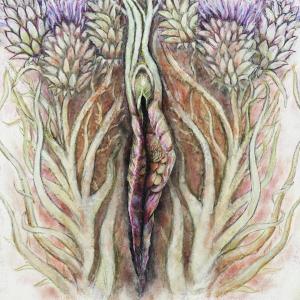
Thistle, by Jacqueline Secor
Islam came alive. It wasn’t a rigid, dogmatic system of rituals, dress codes and obligations, but a direct experience of Divine Compassion and Mercy. It wasn’t a religion of fear, but a tender, beautiful path toward Unconditional Love. Rather than a label or identity, it was a state of being in surrender to the natural flow of the Divine Reality, or Allah.
As I embarked on this stage of my journey, the word “moderate” dropped out of my vocabulary and off my Facebook profile. Simply being Muslim satisfied me for a handful of years. I didn’t miss a prayer, fasted regularly and truly began to encounter God in my daily life, in nature, in interactions. Immersing myself in that energy increased my generosity, compassion and patience.
And yet, as much as my connection with the Divine deepened, I became aware of an agitation in my heart, as though the peace I felt was skin deep. I knew then I needed a spiritual guide to help me understand what I couldn’t see. My journey led me to Mevlevi Sufism, first through reading the books of a couple who would later become my beloved teachers and simultaneously feeling inexplicably drawn to the whirling dervishes during a visit to Turkey.
What I didn’t realize until later is that I’d bypassed some entrenched psychological wounds and couldn’t see the ways I was beholden to my false self: to the shame that comes with growing up in a patriarchal Islamic doctrine that belittles women and left me feeling ashamed of my femininity and sexuality. To the constant cultural hammering that if I wanted to be seen and accepted, I couldn’t be myself; I needed to be an obedient girl who didn’t get angry, didn’t challenge others, was always polite, and never showed too much emotion or disappointment.
Sufism is a spiritual psychology that calls on me to be a constant witness to my states. It involves zooming out of my thoughts, feelings, emotions and sensations and observing them from a more objective vantage point. I acknowledge the grip that shame and fear had/has on me, as well as a mix of envy, pride and resentment. Then, slowly and gently, they are transformed in the alchemy that is zikr, the repetition of Divine names and attributes that transports us into another realm of conscious awareness.
Essentially the sufi way is about knowing myself and my wounds more deeply, something our beloved Prophet Muhammad, peace and blessings be upon him, counselled is essential on the path to truly knowing the Divine that is closer to us than our jugular veins. What I’ve discovered is that I’m someone, like anyone, who has idiosyncrasies and mental knots, obstacles and conditioned behaviors that I need to decode with care and compassion.
In dervishhood, I’ve come to find the label Muslim no longer feels appropriate. Paradoxically, the more I hone my inward presence and spend time in worship, the less in Surrender, or Islam, I realize I am. It’s a state I aspire to, but that feels further away as I more honestly acknowledge my humanness, my delusions, my shifting states and degrees of separation from Reality.
So, after shedding my identity as a “moderate Muslim.” After moving away from my definition as a Muslim who has things figured out. I find myself sitting at the threshold of my innermost heart, longing to be guided by it in every moment: a seeker of the Infinite Love that threads together all existence.
Engaging with each day, I realize more and more the depth of my need for the Sustainer in every breath of this journey and, as Mevlana Rumi describes, aware of the immense suffering and the boundless Love that reveal themselves while traveling it:
Whether one moves slowly or with speed
the one who is a seeker will be a finder.
Always seek with your whole self
for the search is an excellent guide on the way.
Though you are lame and limping,
though your figure is bent and clumsy,
always creep towards the One. Make that One your quest.
By speech, and by silence, and by fragrance,
catch the scent of the King everywhere.
(Masnavi III, 978-981, translated by Camille and Kabir Helminski)
Previous Post

March 9, 2018
Book Review: Rumi Comes to America
Next Post

April 5, 2018 The Many Directions of Prayer
Browse Our Archives
Select a Category activism Community Divine Names Fear Feminine Islam Listening Mevlana Jalaluddin Rumi Mevlevi Music Prophet Muhammad Psychology Quran Ramadan Remembrance Rumi Sacred Space Shadow Work Shams of Tabriz Spiritual Imagination spirituality Sufism Suleyman Dede Uncategorized Universal Intelligence Zikr Zikr Allah
Select a Month October 2021 August 2021 July 2021 June 2021 April 2021 March 2021 February 2021 January 2021 November 2020 August 2020 June 2020 May 2020 April 2020 March 2020 February 2020 January 2020 December 2019 November 2019 October 2019 September 2019 August 2019 July 2019 June 2019 May 2019 April 2019 March 2019 February 2019 January 2019 December 2018 November 2018 October 2018 September 2018 August 2018 July 2018 June 2018 May 2018 April 2018 March 2018 February 2018 January 2018 December 2017 November 2017 October 2017 September 2017 August 2017 July 2017 June 2017 May 2017 April 2017 March 2017 February 2017 January 2017 December 2016 November 2016 October 2016 September 2016 August 2016 July 2016 June 2016 May 2016 April 2016
Follow Us!
TAKE THE
Religious Wisdom Quiz
Who was the king of Israel known for his wisdom?
Select your answer to see how you score.
David Hezekiah Saul Solomon
Related posts from The Living Tradition

Freedom from Food: The Gifts of a Three-Month...


Prophet Muhammad and the Garbage Thrower
TRENDING AT PATHEOS Muslim

25 Years Later: How Much Has Changed for...
As we approach the 25th anniversary of September 11th, I’ve found myself...

Podcast: Third Spaces & The Rise of Yemeni...
In the latest episode of The Artistic Foodies Podcast, hosts Abbas...

HalalFest Picks: Best 60 Halal Spots for Super...
Back in 2016, I came up with a list of 29...

Unity Is America’s Strength — Division Is Its...
by Hidayatullah Ahsan When Valentina Gomez, a Republican candidate for Congress in...

Zohran Mamdani and New York’s Fight Against Islamophobia
This past June, against all odds, Zohran Mamdani won the Democratic primary...

What the Fourth of July Means to a...
As we mark another Fourth of July, millions of Americans will celebrate...
view all Muslim blogs
Ad-Free & Subscriber Log-In Subscription Support
- About Us
- 2026 Calendar
- Videos
- Podcasts
- Library of World Religions
- Faith In Media Tracker
- Advertise With Us
- Write for Us
- Privacy Policy
- Terms of Service
- Do Not Sell My Data
- Contact Us
- Radiant Digital
- Manage Newsletter Subscriptions
- Unsubscribe From Notifications
- Sitemap
Copyright 2008-2026, Patheos. All rights reserved.
Subscription Support Ad-Free & Subscriber Log-In
Follow Patheos