
BuddhistCatholicContemplativeEvangelicalGeneral ChristianHinduJewishLatter-day SaintMuslimNew VisionsProgressive Christian
Beliefs
- Buddhist
- Catholic
- Contemplative
- Evangelical
- General Christian
- Hindu
- Jewish
- Latter-day Saint
- More Voices
- Muslim
- New Visions
- Pagan
- Progressive Christian
Topics
- Religion News
- Food and Religion
- Sports and Religion
- Religious Art
- Religious Music and Entertainment
- Religious Events
- History and Religion
- Style and Religion
- Politics and Religion
- Women in Religion
- Recreation Outdoors and Religion
- Business Finance and Religion
- Careers Workplace and Religion
- Education and Religion
- Family Parenting and Religion
- Health Fitness and Religion
- Home and Religion
- Relationships and Religion
- Technology and Religion
- Travel and Religion
Columnists
- Buddhist Columnists
- Business Finance and Religion Columnists
- Careers Workplace and Religion Columnists
- Catholic Columnists
- Contemplative Columnists
- Education and Religion Columnists
- Evangelists Columnists
- Family Parenting and Religion Columnists
- General Christian Columnists
- Health Fitness and Religion Columnists
- Hindu Columnists
- History and Religion Columnists
- Home and Religion Columnists
- Jewish Columnists
- More Voices Columnists
- Latter Day Columnists
- Muslim Columnists
- New Visions Columnists
- Nonreligious Columnists
- Pagan Columnists
- Politics and Religion Columnists
- Progressive Columnists
- Recreation Outdoors and Religion Columnists
- Relationships and Religion Columnists
- Religion News Columnists
- Religious Art Columnists
- Religious Events Columnists
- Religious Music and Entertainment Columnists
- Sports and Religion Columnists
- Style and Religion Columnists
- Technology and Religion Columnists
- Travel and Religion Columnists
- Women in Religion Columnists
Resource Library
- 2026 Calendar
- Library of World Religions
- The 100 Most Holy Places on Earth
- Patheos Answers
- Podcasts
- Videos
- Faith Leaders Database
- Anglican Episcopalian
- Bahai
- Baptist
- Buddhism
- Christianity
- Confucianism
- Eastern Orthodoxy
- Hinduism
- Holiness and Pentecostal
- ISKCON
- Islam
- Judaism
- Lutheran
- Methodist
- The Church of Jesus Christ of Latter-day Saints
- New Age
- Paganism
- Presbytarian and Reformed
- Protestantism
- Religion Behind the Scenes
- Roman Catholic
- Scientology
- Shia Islam
- Sikhism
- Sufism
- Sunni Islam
- Taoism
- Zen
- See all religions
Research Tools
 Ad-Free & Subscriber Log-In Subscription Support
Ad-Free & Subscriber Log-In Subscription Support
Follow Patheos 

- Trending:
- Forgiveness
- |
- Marriage
- |
- Consciousness
- |
- Death Penalty
- |
- Election
- |
- Halloween
 The Living Tradition
- Home
- Muslim
- Complex Trauma and Spiritual Healing Power of Sufism
Complex Trauma and Spiritual Healing Power of Sufism
Last updated on: December 18, 2017 at 10:03 pm by Daliah Merzaban
Complex Trauma and Spiritual Healing Power of Sufism 2017-12-18T22:03:05-04:00 Daliah Merzaban
Patheos Explore the world's faith through different perspectives on religion and spirituality! Patheos has the views of the prevalent religions and spiritualities of the world.
Since I was a 13-year-old spending recesses in the schoolyard composing poems inspired by my turbulent home life, I’ve been passionate about storytelling. My career has centered on telling thousands of stories about the interplay between economics, politics and financial markets in developing countries. I also love blogging about the ways the spiritual tradition of Islam, or the act of surrendering oneself to the Divine, unfolds in my life.
Some may say writing comes naturally to me, that it’s my calling. But not me.
Each time I sit on my worn out brown-leather couch staring at the blank Word document on my laptop, I’m overwhelmed by a feeling that this time, I will fail. The same happens when I start almost every editing assignment I get at work, day after day, year after year: a gnawing sensation consumes me that this time, I will disappoint. This time, my efforts will not be good enough.

Preparing to write, by Chris Blakeley
Self doubt is a glaring, ever-present demon in my life. It creeps up on me in the form of a sharp constriction in my upper chest in scenarios as mundane as whether the friend I’ve invited for dinner will be disappointed by the restaurant I’ve chosen — even if it happens to be a favorite. I’m sometimes so fearful of disappointing others that I feel unreasonably responsible for things that are out of my control, like the weather.
I’d long presumed the excessive lack of confidence that lurked just beneath the surface was an inherent flaw in me; until, that is, I became aware several months ago that I suffer from a condition known as Complex trauma.
Complex trauma is a form of Post Traumatic Stress Disorder, only rather than resulting from a one-off psychological shock, it arises due to repeated, prolonged exposure to different forms of abuse, usually beginning in childhood. In researching the condition, I’ve learned how common it is. Wounds are often inflicted unwittingly and it’s easy to be oblivious to the toll they’ve taken on our psychological and spiritual health.
Working with a psychotherapist who uses a Sufi-influenced approach to treatment that regards the essential nature of clients as spiritual, I’ve come to learn that the emotional injuries inflicted in my youth caused me to split myself into pieces to survive. I denied and subjugated the parts that didn’t fit the image of what I was told I should be, among them: happy, not sad; obedient, not rebellious; calm, not angry.
Because of this, my traumatized younger self was not nurtured or validated enough to feel secure. It is as if, over time, she became locked in a limbo between my past and present; a dark place within my psyche where she hid petrified and underdeveloped as everything around her began to change. I became an adult, the stakes in my life became greater and I unconsciously began to drown out her cries and unrequited needs.
I didn’t realize until now how often this young girl manifests in my life. She’s the part of me that’s so desperate to be seen and accepted that she effaces herself to meet the needs of others, seeking to please and comfort them. Self-evasion has long seemed like common sense and moral behavior to me. I failed to see that until I understood my internal conflicts and showed myself compassion, I couldn’t reintegrate those parts that got divided due to trauma.
This is why bringing my emotional injuries into the forefront of my daily consciousness for the first time, while incredibly jarring and painful, has also been validating. I’m learning to see it as an essential step toward the spiritual maturity needed not only to progress in adulthood, but also to move closer to Islam. After all, if I don’t know my innermost self (or selves), how can I surrender?
The thirteenth century Persian poet Rumi often describes the healing power of wounds, how the cure is in the pain, and the Light of God enters through our wounds. His words, such as these lines drawn from the poem Unearthing the Treasure, are coming alive for me on a visceral level as I wrestle with my trauma:
The health of the senses of this world
comes from the well-being of the body;
the health of one’s spiritual sense
arises from the body’s ruin.The spiritual path wrecks the body;
but afterward restores it to health:
it destroys the house to unearth the treasure,
then with that treasure builds it better than before.The water is stopped and the riverbed cleansed,
so that purer water might flow.
The flesh is cut open to draw out the arrow—
So that fresh skin might heal the wound.
(Mathnawi 1: 305-308, translated by Kabir and Camille Helminski)
Sufi teachings have shown me that every human being is born whole, with Divine Light illuminating in each of our hearts. No matter how deep the trauma and how ingrained my psychological reactions are, that place of wholeness can’t be contaminated. Rather, it is a place that through spiritual healing, I’m learning to contact and to live from.
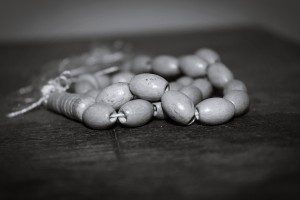
Tasbih, by Ruzaqir Rachman
During daily meditations and remembrance of God through zikr, I consciously breathe into my wounds to try to tap into that place that resides beyond the injuries. I understand now that spiritual growth will happen when I bring the unwieldy aspects of myself into awareness and show them compassion so that inner trust and serenity can gradually grow.
Recently, my therapist suggested we start our weekly session with a 20-minute breathing exercise because I was too tense to start talking. I sat in a chair with my feet firmly on the carpet and my shoulders nestled into the cushioned backrest, relaxing so I could hear what was reverberating within. As I closed my eyes and diligently attended each inhalation and exhalation, my awareness turned to the shallow pace of my breath and the sensation of feeling trapped in that narrow place just under my throat. This is what happens when my younger self grabs hold of the reins.
I positioned my right hand on my heart and my left on my abdomen so I could feel the life-giving breath move through my body. Instinctively, I started silently reciting a zikr we do in the Mevlevi tradition: With each out breath La illaha (There is no god) to remind myself to let go of the reactions that separate me from true Being. With each inhalation, il Allah or (but the Divine Reality) to affirm Being within me.
As I repeated La illaha il Allah (There is no God, but the Divine Reality), air percolated deeper into my lungs until, about 15 minutes into the meditation, I was consciously breathing from my belly. The tightness in my chest loosened, giving way to an air of wholeness to my inner world where the complex parts of me felt nourished and more integrated. I find myself leaning on this intrinsic healing power of breath in response to daily stresses.
As hard as it is, I try not to silence my younger self anymore, even if my body and mind do sometimes feel wrecked in the way Rumi describes. Now, when she appears as I start writing, for instance, I know it’s her there judging herself as not good enough. But I also know that this reaction doesn’t have to be my present and future. I’m slowly learning to sit with her, feel her pain and let her know that, together, we can wrestle the self doubts to the ground and write our way to the final sentence.
Previous Post

April 20, 2017
On Saints as Friends of the Divine
Next Post
May 22, 2017 The Feminine Power Supporting the Prophets
Browse Our Archives
Select a Category activism Community Divine Names Fear Feminine Islam Listening Mevlana Jalaluddin Rumi Mevlevi Music Prophet Muhammad Psychology Quran Ramadan Remembrance Rumi Sacred Space Shadow Work Shams of Tabriz Spiritual Imagination spirituality Sufism Suleyman Dede Uncategorized Universal Intelligence Zikr Zikr Allah
Select a Month October 2021 August 2021 July 2021 June 2021 April 2021 March 2021 February 2021 January 2021 November 2020 August 2020 June 2020 May 2020 April 2020 March 2020 February 2020 January 2020 December 2019 November 2019 October 2019 September 2019 August 2019 July 2019 June 2019 May 2019 April 2019 March 2019 February 2019 January 2019 December 2018 November 2018 October 2018 September 2018 August 2018 July 2018 June 2018 May 2018 April 2018 March 2018 February 2018 January 2018 December 2017 November 2017 October 2017 September 2017 August 2017 July 2017 June 2017 May 2017 April 2017 March 2017 February 2017 January 2017 December 2016 November 2016 October 2016 September 2016 August 2016 July 2016 June 2016 May 2016 April 2016
Follow Us!
TAKE THE
Religious Wisdom Quiz
Which Gospel is addressed to "Theophilus"?
Select your answer to see how you score.
Matthew John Luke Mark
Related posts from The Living Tradition

Freedom from Food: The Gifts of a Three-Month...
Prophet Muhammad and the Garbage Thrower
TRENDING AT PATHEOS Muslim

25 Years Later: How Much Has Changed for...
As we approach the 25th anniversary of September 11th, I’ve found myself...

Podcast: Third Spaces & The Rise of Yemeni...
In the latest episode of The Artistic Foodies Podcast, hosts Abbas...

HalalFest Picks: Best 60 Halal Spots for Super...
Back in 2016, I came up with a list of 29...

Unity Is America’s Strength — Division Is Its...
by Hidayatullah Ahsan When Valentina Gomez, a Republican candidate for Congress in...

Zohran Mamdani and New York’s Fight Against Islamophobia
This past June, against all odds, Zohran Mamdani won the Democratic primary...

What the Fourth of July Means to a...
As we mark another Fourth of July, millions of Americans will celebrate...
view all Muslim blogs
Ad-Free & Subscriber Log-In Subscription Support
- About Us
- 2026 Calendar
- Videos
- Podcasts
- Library of World Religions
- Faith In Media Tracker
- Advertise With Us
- Write for Us
- Privacy Policy
- Terms of Service
- Do Not Sell My Data
- Contact Us
- Radiant Digital
- Manage Newsletter Subscriptions
- Unsubscribe From Notifications
- Sitemap
Copyright 2008-2026, Patheos. All rights reserved.
Subscription Support Ad-Free & Subscriber Log-In
Follow Patheos