
BuddhistCatholicContemplativeEvangelicalGeneral ChristianHinduJewishLatter-day SaintMuslimNew VisionsProgressive Christian
Beliefs
- Buddhist
- Catholic
- Contemplative
- Evangelical
- General Christian
- Hindu
- Jewish
- Latter-day Saint
- More Voices
- Muslim
- New Visions
- Pagan
- Progressive Christian
Topics
- Religion News
- Food and Religion
- Sports and Religion
- Religious Art
- Religious Music and Entertainment
- Religious Events
- History and Religion
- Style and Religion
- Politics and Religion
- Women in Religion
- Recreation Outdoors and Religion
- Business Finance and Religion
- Careers Workplace and Religion
- Education and Religion
- Family Parenting and Religion
- Health Fitness and Religion
- Home and Religion
- Relationships and Religion
- Technology and Religion
- Travel and Religion
Columnists
- Buddhist Columnists
- Business Finance and Religion Columnists
- Careers Workplace and Religion Columnists
- Catholic Columnists
- Contemplative Columnists
- Education and Religion Columnists
- Evangelists Columnists
- Family Parenting and Religion Columnists
- General Christian Columnists
- Health Fitness and Religion Columnists
- Hindu Columnists
- History and Religion Columnists
- Home and Religion Columnists
- Jewish Columnists
- More Voices Columnists
- Latter Day Columnists
- Muslim Columnists
- New Visions Columnists
- Nonreligious Columnists
- Pagan Columnists
- Politics and Religion Columnists
- Progressive Columnists
- Recreation Outdoors and Religion Columnists
- Relationships and Religion Columnists
- Religion News Columnists
- Religious Art Columnists
- Religious Events Columnists
- Religious Music and Entertainment Columnists
- Sports and Religion Columnists
- Style and Religion Columnists
- Technology and Religion Columnists
- Travel and Religion Columnists
- Women in Religion Columnists
Resource Library
- 2026 Calendar
- Library of World Religions
- The 100 Most Holy Places on Earth
- Patheos Answers
- Podcasts
- Videos
- Faith Leaders Database
- Anglican Episcopalian
- Bahai
- Baptist
- Buddhism
- Christianity
- Confucianism
- Eastern Orthodoxy
- Hinduism
- Holiness and Pentecostal
- ISKCON
- Islam
- Judaism
- Lutheran
- Methodist
- The Church of Jesus Christ of Latter-day Saints
- New Age
- Paganism
- Presbytarian and Reformed
- Protestantism
- Religion Behind the Scenes
- Roman Catholic
- Scientology
- Shia Islam
- Sikhism
- Sufism
- Sunni Islam
- Taoism
- Zen
- See all religions
Research Tools
 Ad-Free & Subscriber Log-In Subscription Support
Ad-Free & Subscriber Log-In Subscription Support
Follow Patheos 

- Trending:
- Forgiveness
- |
- Marriage
- |
- Consciousness
- |
- Death Penalty
- |
- Election
- |
- Halloween
 The Living Tradition
- Home
- Muslim
- The Mercy of the Ailing Body
The Mercy of the Ailing Body
Last updated on: March 27, 2017 at 3:00 am by Anna Rohleder
The Mercy of the Ailing Body 2017-03-26T11:11:44-04:00 Anna Rohleder
Patheos Explore the world's faith through different perspectives on religion and spirituality! Patheos has the views of the prevalent religions and spiritualities of the world.
One evening a few weeks before my 25th birthday, I alighted from a train in the Heidelberg railway station and took off running. It was a twice-weekly routine at the time. I was taking evening classes at the University of the Frankfurt, and the train returning me to Heidelberg arrived just a few minutes before the last tram of the night departed, leaving it up to me to make the short connection in a burst of sheer personal speed.
I am not a runner by inclination. Yet I managed to run fast enough to catch the tram every time. On the night in question, I caught it too. But as I sank into my seat on the tram afterward, I noticed that something felt strange about my knee. There was an odd kind of catch about it. It was almost as though, along with my heaving chest and pounding heart, my knee was out of breath too.
The next morning, the catch turned into a searing pain. I could neither bend nor fully straighten my knee. Upon going to the doctor, I learned I had torn my meniscus, an injury that was difficult to repair. I remember thinking to myself, with a mixture of panic and resignation: So. I’m officially getting old.

Portrait of a man holding a skull, by Frans Hals (1615), via Wikimedia Commons
Almost two decades have passed since then. Now, thanks to my spiritual practice, I feel younger at age 43 in some ways than I did at 25. I am less critical, certainly, and also more optimistic, but it’s my feeling toward the aging body that has probably undergone the most dramatic shift.
Rumi says:
The spiritual path wrecks the body
and afterwards restores it to health.
It demolishes the house to unearth the treasure,
and with that treasure rebuilds it better than before.
Before I came to Sufism, I was involved in spiritual traditions where the awareness of impermanence and loss were important components of understanding the true nature of things. Meditation, in this view, was practicing how to die. “Live life with death as your advisor,” one of my teachers counseled explicitly.
The benefits of those teachings have been many and manifold in my life. I have been able to reach out and tell those dear to me that I love them, for example, and in some cases heal estranged relationships while there is still time to enjoy the renewed connection. But living with an awareness of mortality has been even more valuable in my relationship with my embodied self, especially given the denial of aging and death that prevails in our culture.
Until the modern era, the memento mori was part of the Western tradition. Living people might have their portrait painted with their hand resting on a skull. Still life paintings often included dead game or rotting fruit. Those images delivered a specific message that everyone understood: Remember you must die.
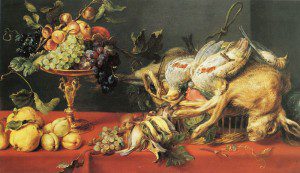
Frans Snyders, Game and fruit on a table (1625) via Wikimedia Commons
For me, momento mori are also those unexpected moments when I glimpse my own mortality. Going into a dressing room to try on clothes and instead noticing a new hollowness to my cheeks. Discovering freckles that have blurred into age spots. Observing certain pains arising, and persisting, while noticing that other functions of the body have become unreliable. Even my teeth do not seem to be set so solidly in my jaw anymore. Add to this the increasing incidence of random occurrences, like spells of dizziness or a heartbeat that hesitates, and the trend toward entropy is clear. Things fall apart, us included.
What is different for me now, on the Sufi path, is the sense that my own impermanence has a purpose. It’s the realization that all of the travails and troubles of aging – living in an ailing, failing body – are actually a gift in disguise, an instance of the Divine mercy.
Rumi says:
This world is like a tree,
and we are the half-ripe fruit upon it.
Unripe fruit clings tight to the branch
because, immature, it’s not ready for the palace.
When fruits become ripe, sweet and juicy,
then biting their lips, they loosen their hold.
When the mouth has been sweetened by felicity,
the kingdom of the world loses its appeal.
When the body is young, strong and healthy, the pleasures of the senses are so entirely pleasurable that they can become addictive. When the body itself becomes less comfortable to inhabit, however, its pleasures fade in proportion. I understand that process now as its own form of ripening. The spiritually mature soul can allow all of its former connections to worldly life and bodily pleasures to gradually drop away as it gathers its sweetness from within.
Despite knowing this, the process still isn’t always easy for me. I don’t like being in pain, and the increasing unpredictability of the body is hard to accept for a nafs that likes the illusion of being in control. But when I can be in Presence, and remember that the nature of the Divine is unconditional compassion and mercy, I can take the body’s failures as a series of gentle reminders. It’s as though Allah is whispering in my ear: “Dear one, your home is not in this body or in this world. You are only a traveler here, stopping over for a short time. Remember who you really are, and where you are journeying to. Don’t give your heart to impermanent things, because it will be lost when they pass away. Give your heart and soul to Me, and you will become truly alive in Life and Light.”
I am so grateful to be part of a tradition now that has its own memento mori tradition in literature. There are many beautiful verses by Mevlana both about spiritual ripening, as well as death as its own kind of birth, a transition into the next world. But on the subject of mortality, I want to give the last word to Yunus Emre, who says it better than anyone else:
Since this journey of Being began,
the Friend has rushed to meet us.Light has filled the ruins of this heart.
Let this universe of mine be shattered.I have passed up dreams.
I have tired of summers and winters.I have found the Gardener of flowers.
Let this garden of mine be dug up.Yunus, you say it well,
smooth as honey.I have found the honey of honeys.
Let this hive of mine be given away.
Previous Post
March 9, 2017
The Most Important Thing I Learned From Our Murshid
Next Post

April 4, 2017 What the Heart Knows
Browse Our Archives
Select a Category activism Community Divine Names Fear Feminine Islam Listening Mevlana Jalaluddin Rumi Mevlevi Music Prophet Muhammad Psychology Quran Ramadan Remembrance Rumi Sacred Space Shadow Work Shams of Tabriz Spiritual Imagination spirituality Sufism Suleyman Dede Uncategorized Universal Intelligence Zikr Zikr Allah
Select a Month October 2021 August 2021 July 2021 June 2021 April 2021 March 2021 February 2021 January 2021 November 2020 August 2020 June 2020 May 2020 April 2020 March 2020 February 2020 January 2020 December 2019 November 2019 October 2019 September 2019 August 2019 July 2019 June 2019 May 2019 April 2019 March 2019 February 2019 January 2019 December 2018 November 2018 October 2018 September 2018 August 2018 July 2018 June 2018 May 2018 April 2018 March 2018 February 2018 January 2018 December 2017 November 2017 October 2017 September 2017 August 2017 July 2017 June 2017 May 2017 April 2017 March 2017 February 2017 January 2017 December 2016 November 2016 October 2016 September 2016 August 2016 July 2016 June 2016 May 2016 April 2016
Follow Us!
TAKE THE
Religious Wisdom Quiz
Who said: "Now to him who is able to keep you from stumbling and to present you before his glorious presence without fault"?
Select your answer to see how you score.
John Jude Paul Peter
Related posts from The Living Tradition


Freedom from Food: The Gifts of a Three-Month...


Prophet Muhammad and the Garbage Thrower
TRENDING AT PATHEOS Muslim

25 Years Later: How Much Has Changed for...
As we approach the 25th anniversary of September 11th, I’ve found myself...

Podcast: Third Spaces & The Rise of Yemeni...
In the latest episode of The Artistic Foodies Podcast, hosts Abbas...

HalalFest Picks: Best 60 Halal Spots for Super...
Back in 2016, I came up with a list of 29...

Unity Is America’s Strength — Division Is Its...
by Hidayatullah Ahsan When Valentina Gomez, a Republican candidate for Congress in...

Zohran Mamdani and New York’s Fight Against Islamophobia
This past June, against all odds, Zohran Mamdani won the Democratic primary...

What the Fourth of July Means to a...
As we mark another Fourth of July, millions of Americans will celebrate...
view all Muslim blogs
Ad-Free & Subscriber Log-In Subscription Support
- About Us
- 2026 Calendar
- Videos
- Podcasts
- Library of World Religions
- Faith In Media Tracker
- Advertise With Us
- Write for Us
- Privacy Policy
- Terms of Service
- Do Not Sell My Data
- Contact Us
- Radiant Digital
- Manage Newsletter Subscriptions
- Unsubscribe From Notifications
- Sitemap
Copyright 2008-2026, Patheos. All rights reserved.
Subscription Support Ad-Free & Subscriber Log-In
Follow Patheos