
BuddhistCatholicContemplativeEvangelicalGeneral ChristianHinduJewishLatter-day SaintMuslimNew VisionsProgressive Christian
Beliefs
- Buddhist
- Catholic
- Contemplative
- Evangelical
- General Christian
- Hindu
- Jewish
- Latter-day Saint
- More Voices
- Muslim
- New Visions
- Pagan
- Progressive Christian
Topics
- Religion News
- Food and Religion
- Sports and Religion
- Religious Art
- Religious Music and Entertainment
- Religious Events
- History and Religion
- Style and Religion
- Politics and Religion
- Women in Religion
- Recreation Outdoors and Religion
- Business Finance and Religion
- Careers Workplace and Religion
- Education and Religion
- Family Parenting and Religion
- Health Fitness and Religion
- Home and Religion
- Relationships and Religion
- Technology and Religion
- Travel and Religion
Columnists
- Buddhist Columnists
- Business Finance and Religion Columnists
- Careers Workplace and Religion Columnists
- Catholic Columnists
- Contemplative Columnists
- Education and Religion Columnists
- Evangelists Columnists
- Family Parenting and Religion Columnists
- General Christian Columnists
- Health Fitness and Religion Columnists
- Hindu Columnists
- History and Religion Columnists
- Home and Religion Columnists
- Jewish Columnists
- More Voices Columnists
- Latter Day Columnists
- Muslim Columnists
- New Visions Columnists
- Nonreligious Columnists
- Pagan Columnists
- Politics and Religion Columnists
- Progressive Columnists
- Recreation Outdoors and Religion Columnists
- Relationships and Religion Columnists
- Religion News Columnists
- Religious Art Columnists
- Religious Events Columnists
- Religious Music and Entertainment Columnists
- Sports and Religion Columnists
- Style and Religion Columnists
- Technology and Religion Columnists
- Travel and Religion Columnists
- Women in Religion Columnists
Resource Library
- 2026 Calendar
- Library of World Religions
- The 100 Most Holy Places on Earth
- Patheos Answers
- Podcasts
- Videos
- Faith Leaders Database
- Anglican Episcopalian
- Bahai
- Baptist
- Buddhism
- Christianity
- Confucianism
- Eastern Orthodoxy
- Hinduism
- Holiness and Pentecostal
- ISKCON
- Islam
- Judaism
- Lutheran
- Methodist
- The Church of Jesus Christ of Latter-day Saints
- New Age
- Paganism
- Presbytarian and Reformed
- Protestantism
- Religion Behind the Scenes
- Roman Catholic
- Scientology
- Shia Islam
- Sikhism
- Sufism
- Sunni Islam
- Taoism
- Zen
- See all religions
Research Tools
 Ad-Free & Subscriber Log-In Subscription Support
Follow Patheos 

- Trending:
- Advent
- |
- Forgiveness
- |
- Thanksgiving
- |
- Election
- |
- Seasonal Holidays
- |
- Marriage

- Home
- Progressive Christian
- St. Francis and Saving Christianity – A Dialogue with Historian Jon Sweeney
St. Francis and Saving Christianity – A Dialogue with Historian Jon Sweeney
Last updated on: October 2, 2014 at 2:01 pm by Bruce Epperly
St. Francis and Saving Christianity – A Dialogue with Historian Jon Sweeney 2014-10-02T14:01:40-04:00 Bruce Epperly
Patheos Explore the world's faith through different perspectives on religion and spirituality! Patheos has the views of the prevalent religions and spiritualities of the world.
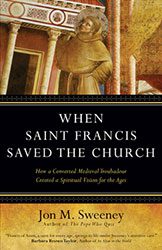 Jon Sweeney’s When Saint Francis Saved the Church presents a vision of Francis’ message that is as relevant today as it was in Francis’ time. Today’s church needs saving, and so do we. We need to move from pathways of death to thoroughfares of abundant life. We need to choose Jesus over Caesar, and love over coercion, first in the church and then in the world. We need a faith that is fluid and lively, and awake to the world in which we live.
We are on the verge of a new adventure in Christianity. The spiritual landscape has radically changed in both the Northern and Southern hemispheres, and the novelty of our time calls for changes in our vision of Christ’s mission for today.
The first participants in the Way of Jesus truly made it up as they went along. They had no established doctrines, institutions, or scriptures of their own. They were often at odds with each other (for example, Paul and Peter, as reported by Paul in Galatians, on the question of kosher and non-kosher practices) in trying to articulate appropriately flexible boundaries of the new faith. The only scriptures they had were what we today call the Old or First Testament and the meaning of these words was in flux in light of the ministry, mission, cross, and resurrection of Jesus.
Today, we are also making it up as we go along. The old pathways are in question and new routes are still emerging. Some will be fruitful, some dead ends, others bounding on the heretical but in their heresy contributing new energy to the church. Perhaps, this is the way it has always been. In his own time, St. Francis may also have seen himself as making it up along the way, trying to forge a new vision of Christianity in a time of institutional stagnation and religiosity that betrayed the simple teachings of the Galilean savior.
Francis got back to the basics – simplicity of life, appreciation and care for embodiment and the non-human world, and faithfulness to the non-hierarchical and welcoming vision of Jesus. These values are still relevant to our time, and perhaps even more so than in Francis’ time.
Francis lived as well as taught simplicity, and we need to follow his path today. We need to embrace a spiritual downward mobility to match our necessary environmental simplicity. Global climate change, in whatever form we understand it, challenges us to rethink our economics, politics, and spirituality. We must live more simply so others can simply live, and many of these “others” are our future unborn generations. If we love our grandchildren and their unborn children, our calling is to preserve their world and this means taking, in our case, a twenty-first century pathway of St. Francis. We don’t need to wear a loin cloth, or scorn material possessions to live more simply. Still, we need to live with modesty, walking gently on the earth and focusing more on processes (experiences) than possessions.
Francis appreciated embodiment and the non-human world. Though steeped in the doctrines of the church, especially original sin and denigration of the temporal in light of eternity, Francis was surprisingly this-worldly and incarnational in his approach to life. We are called to love God in the flesh and this means caring for our bodies and the bodies of others. It also means seeing the presence of God revealing itself to us in the non-human world. Non-human creatures have value apart from our interests and make an ethical claim on us. They are not at our disposal; we must adapt to their needs and honor their feelings, especially the reality of suffering among non-humans. This inspires an earth-ethic, honoring brother sun, sister moon, the birds of the air, the animals of the field, and the sea creatures.
Francis aimed at an egalitarian, non-hierarchical world, and a non-hierarchal and egalitarian church. Following Jesus’ welcome table, Francis affirmed that everyone belonged at God’s table; the church was to be inclusive in practice. There is no “other,” no one totally alien from us. Francis sought to reach out to Muslims despite the vitriol of the Crusades. He reminds us that the goal of our policies today, especially with the Arab and Muslim world, should aim at friendship and not annihilation. We may not be able to hug members of ISIS, and we must find ways to neutralize their power, but we need not demonize them. Can we see God’s presence – Allah’s presence – in an ISIS militant? This isn’t easy, especially when they mercilessly kill others, whose deaths call for military action on our part.
Francis may have “saved” Western Christianity many centuries ago. The pathway he took is saving the church in its many manifestations today through its challenge to embody radical grace and affirmation of all God’s human and non-human creation.
Read more about this book at the Patheos Book Club here!
Previous Post

September 30, 2014
Every Moment a Call: Responding to Mark Labberton’s Called
Next Post
October 4, 2014 Adventurous Lectionary - October 12, 2014 - Pentecost 18
Browse Our Archives
Select a Category Book Reviews The Adventurous Lectionary Uncategorized
Select a Month November 2026 October 2026 September 2026 August 2026 July 2026 June 2026 May 2026 April 2026 March 2026 February 2026 January 2026 December 2025 November 2025 October 2025 September 2025 August 2025 July 2025 June 2025 May 2025 April 2025 March 2025 February 2025 January 2025 December 2024 November 2024 October 2024 September 2024 August 2024 July 2024 June 2024 May 2024 April 2024 March 2024 February 2024 January 2024 December 2023 November 2023 October 2023 September 2023 August 2023 July 2023 June 2023 May 2023 March 2023 February 2023 January 2023 December 2022 November 2022 October 2022 September 2022 August 2022 July 2022 June 2022 May 2022 April 2022 March 2022 February 2022 January 2022 December 2021 November 2021 October 2021 September 2021 August 2021 July 2021 June 2021 May 2021 April 2021 March 2021 February 2021 January 2021 December 2020 November 2020 October 2020 September 2020 August 2020 July 2020 June 2020 May 2020 April 2020 March 2020 February 2020 January 2020 December 2019 November 2019 October 2019 September 2019 August 2019 July 2019 June 2019 May 2019 April 2019 March 2019 February 2019 January 2019 December 2018 November 2018 October 2018 September 2018 August 2018 July 2018 June 2018 May 2018 April 2018 March 2018 February 2018 January 2018 December 2017 November 2017 October 2017 September 2017 August 2017 July 2017 June 2017 May 2017 April 2017 March 2017 February 2017 January 2017 December 2016 November 2016 October 2016 September 2016 August 2016 July 2016 June 2016 May 2016 April 2016 March 2016 February 2016 January 2016 December 2015 November 2015 October 2015 September 2015 August 2015 July 2015 June 2015 May 2015 April 2015 March 2015 February 2015 January 2015 December 2014 November 2014 October 2014 September 2014 August 2014 July 2014 June 2014 May 2014 April 2014 March 2014 February 2014 January 2014 December 2013 November 2013 October 2013 September 2013 August 2013 July 2013 June 2013 May 2013 April 2013 March 2013 February 2013 January 2013 December 2012 November 2012 October 2012 September 2012 August 2012 July 2012 June 2012 May 2012 April 2012 March 2012 February 2012 December 2011 May 2011 April 2011 March 2011 February 2011 January 2011
TAKE THE
Religious Wisdom Quiz
What was the primary conflict resolution method in Biblical times?
Select your answer to see how you score.
Lottery Sword fight Public debate Elder council
Books by This Author Books by Living A Holy Adventure
Related posts from Living A Holy Adventure
Theology Matters to LGBTQ Persons: A Response to...

Mysticism, Hallucinations, and Designer Spirituality
Does the Pursuing God Ever Stop Pursuing?

Balancing Self Interest and World Loyalty: On Dee...
TRENDING AT PATHEOS Progressive Christian

Smart people saying smart things (11.24.26)
Please take time to listen to Perry Bacon, Sarah Posner, Adam Serwer,...

The Contingency of Our Technology
Last week we were hit with a raft of massive technology outages....

In 1939, President Franklin D. Roosevelt moved Thanksgiving from November 30 to...

Reasons for Restraint: Ricardo Gonzalez, Florida and Dec...
The Morning of January 3 I begin with the dead. On the...

I published this column for Thanksgiving 2012 in the Deseret News....

For many years, Catholicism has been caught up in division over the...
view all Progressive Christian blogs
Ad-Free & Subscriber Log-In Subscription Support
- About Us
- 2026 Calendar
- Videos
- Podcasts
- Library of World Religions
- Faith In Media Tracker
- Advertise With Us
- Write for Us
- Privacy Policy
- Terms of Service
- Do Not Sell My Data
- Contact Us
- Radiant Digital
- Manage Newsletter Subscriptions
- Unsubscribe From Notifications
- Sitemap
Copyright 2008-2026, Patheos, part of the Radiant Digital network of media brands. All rights reserved.
Subscription Support Ad-Free & Subscriber Log-In
Follow Patheos