
BuddhistCatholicContemplativeEvangelicalGeneral ChristianHinduJewishLatter-day SaintMuslimNew VisionsProgressive Christian
Beliefs
- Buddhist
- Catholic
- Contemplative
- Evangelical
- General Christian
- Hindu
- Jewish
- Latter-day Saint
- More Voices
- Muslim
- New Visions
- Pagan
- Progressive Christian
Topics
- Religion News
- Food and Religion
- Sports and Religion
- Religious Art
- Religious Music and Entertainment
- Religious Events
- History and Religion
- Style and Religion
- Politics and Religion
- Women in Religion
- Recreation Outdoors and Religion
- Business Finance and Religion
- Careers Workplace and Religion
- Education and Religion
- Family Parenting and Religion
- Health Fitness and Religion
- Home and Religion
- Relationships and Religion
- Technology and Religion
- Travel and Religion
Columnists
- Buddhist Columnists
- Business Finance and Religion Columnists
- Careers Workplace and Religion Columnists
- Catholic Columnists
- Contemplative Columnists
- Education and Religion Columnists
- Evangelists Columnists
- Family Parenting and Religion Columnists
- General Christian Columnists
- Health Fitness and Religion Columnists
- Hindu Columnists
- History and Religion Columnists
- Home and Religion Columnists
- Jewish Columnists
- More Voices Columnists
- Latter Day Columnists
- Muslim Columnists
- New Visions Columnists
- Nonreligious Columnists
- Pagan Columnists
- Politics and Religion Columnists
- Progressive Columnists
- Recreation Outdoors and Religion Columnists
- Relationships and Religion Columnists
- Religion News Columnists
- Religious Art Columnists
- Religious Events Columnists
- Religious Music and Entertainment Columnists
- Sports and Religion Columnists
- Style and Religion Columnists
- Technology and Religion Columnists
- Travel and Religion Columnists
- Women in Religion Columnists
Resource Library
- 2026 Calendar
- Library of World Religions
- The 100 Most Holy Places on Earth
- Patheos Answers
- Podcasts
- Videos
- Faith Leaders Database
- Anglican Episcopalian
- Bahai
- Baptist
- Buddhism
- Christianity
- Confucianism
- Eastern Orthodoxy
- Hinduism
- Holiness and Pentecostal
- ISKCON
- Islam
- Judaism
- Lutheran
- Methodist
- The Church of Jesus Christ of Latter-day Saints
- New Age
- Paganism
- Presbytarian and Reformed
- Protestantism
- Religion Behind the Scenes
- Roman Catholic
- Scientology
- Shia Islam
- Sikhism
- Sufism
- Sunni Islam
- Taoism
- Zen
- See all religions
Research Tools
 Ad-Free & Subscriber Log-In Subscription Support
Follow Patheos 

- Trending:
- Advent
- |
- Forgiveness
- |
- Thanksgiving
- |
- Election
- |
- Seasonal Holidays
- |
- Marriage

- Home
- Progressive Christian
- When Mental Illness Hits Home
When Mental Illness Hits Home
Last updated on: May 1, 2013 at 5:47 pm by Bruce Epperly
When Mental Illness Hits Home 2013-05-01T17:47:44-04:00 Bruce Epperly
Patheos Explore the world's faith through different perspectives on religion and spirituality! Patheos has the views of the prevalent religions and spiritualities of the world.
 I have always enjoyed an optimistic personality and have typically looked on the sunny side of life, always open to new possibilities and believing that hidden within every problem is a promise of creative transformation. One of my favorite verses is Romans 8:28: “in all things God works for good.” I don’t blame God for the pain of the world; I see God as a companion who provides comfort, energy, and possibility in life’s most difficult situations. God is not the source of diseases of body, mind, or spirit; nor are such incidents the result of divine punishment or some inexorable karmic debt, even though I believe that we share some responsibility for certain health conditions. God does not cause our pain or test us with suffering, but seeks wholeness in situations that God neither desires nor could totally control.
As a result of my spiritual practices and affirmative approach to life I had always felt myself more or less immune to the mental health issues that plagued my mother and brother, both of whom had serious mental health issues related to anxiety, depression, obsessional thinking, and schizoid tendencies, according to the judgment of health care professionals. In fact, these mental health issues often “set me apart” emotionally and relationally. I wasn’t always as patient or understanding as I could have been, no doubt some of this due to the inconveniences, emotional bullying, and traumatic encounters I experienced during my brother’s lifelong struggle with mental illness.
I felt immune from such emotional aberrations until one Friday evening a few months after my brother’s death. I had an important interview and was scheduled to give a sermon as prelude to being one of the finalists for a congregation in the Washington DC area. As I prepared to go to bed, I discovered that I couldn’t get a deep breath. I felt short of breath and there was nothing I could do about it. I discerned it wasn’t heart-related. This went on for three nights and often during the day. None of my typical creative responses to stress – meditation, walking, or even two gin and tonics – eliminated my growing sense of panic regarding my breathing. I survived and did well in both the sermon and interview, but I still felt ill at ease. On Monday, I secured a medical appointment, took tests to rule out any somatic based problems, and received prescriptions for Ambien and Zoloft. In a few days, my condition was resolved, although I on occasion have a brief sense of shortness of breath when I think of that weekend, experience a stressful event, or when I eat heavy foods. I have returned to “normal” but always have a concern that the condition might return without notice.
My anxiety-related episode was a window into my brother’s condition. He was anxious most every day and night and often was nearly paralyzed by feelings of panic. I often was harder on him than he deserved, although sometimes my “tough love” enabled him to grow emotionally and in life skills. Although he had died earlier that year, my brief experience was a lesson in empathy that now joins me with others. As a pastor, I was trained in mental health issues, but when it came to my brother, who regularly called me several times a day, often with unreasonable requests, I often emotionally shut down, had diminished empathy, and, even if he was unaware of it, perceived him as a nuisance and constant test of patience. He was the “other.” But, was he really?
My brief weekend of anxiety, regardless of the cause – emotional, grief, physiological, or all three and then some – awakened me to the reality that there is no “other.” We are all vulnerable. Our mental well-being exists within a small comfort zone; we are all susceptible to the maladies we associate with the mentally ill. We are all vulnerable and in our recognition, we can find a healing of the spirit that enables us to reach out to fellow companions currently struggling with mental illness.
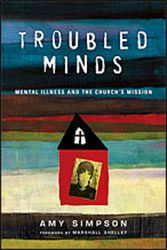
Amy Simpson’s Troubled Minds: Mental Illness and the Church’s Mission is a wake up call to the pervasive realities of mental illness in congregations and our need to move from alienation and otherness to communion and partnership. Within the body of Christ, everyone counts – our joys and sorrows are one. There is no “other” – we are joined in an intricate fabric of relationships in which the health of one shapes the health of all, and the health of the community shapes the health of each of its members. Our sense of invulnerability is the greatest source of alienation and judgment. We think “it couldn’t happen to me or my child” and then discover that what we perceived as alien is a daily companion, shaping every decision and interaction.
Although the theology behind Simpson’s Troubled Minds is more conservative than my own, her practical applications come from someone with a heart for healing. We share a common vision of congregations as places of healing and wholeness; safe places for those who suffer from mental illness. I believe that Jesus is both a model and source of transformation for us as we explore mental health issues. Jesus’ healing ministry was characterized by both affirmation and negation – by his words and deeds and by what he did not do or say. Jesus’ touched persons suffering from illnesses of body, mind, and spirit. He welcomed them, reached out to them, and accepted them. He did not require confession or apology, he simply healed. In a time in which physical and mental illnesses bore the stigma of contagion, ritual uncleanliness, sin, punishment, and divine displeasure, Jesus embraced lepers and demon possessed (persons we would describe today as epileptics and mentally ill). Jesus recognized that many illnesses were beyond our powers and could not be solved by an act of will on our part. Only the Great Physician can restore us to a future and a hope.
Jesus’ healing ministry was also characterized by what he did not say: he did not blame the victim, see illness as God’s will, or related illness to divine punishment. Jesus saw the angelic and the holy beneath layers of emotional and mental disease. He experienced God in their pleas and committed himself to bringing forth the divine hidden by all its “distressing disguises.”
I do not want to repeat that weekend of anxiety. But, I am grateful for the lesson in empathy I received. I am “one of them,” and in no way immune or superior. My well-being is not solely of my own creation but the result of many forces outside my control, any of which could contribute to a recurrence of this or another mental health issue. There is a hidden grace in such vulnerability: it opens our hearts, deepens our spirits, and joins us with our diverse companions on the human adventure.
Visit the Patheos Book Club for more conversation on Troubled Minds.
Previous Post

May 1, 2013
The Adventurous Lectionary - The Sixth Sunday of Easter
Next Post
May 6, 2013 The Adventurous Lectionary - The Sixth Sunday of Easter
Browse Our Archives
Select a Category Book Reviews The Adventurous Lectionary Uncategorized
Select a Month November 2026 October 2026 September 2026 August 2026 July 2026 June 2026 May 2026 April 2026 March 2026 February 2026 January 2026 December 2025 November 2025 October 2025 September 2025 August 2025 July 2025 June 2025 May 2025 April 2025 March 2025 February 2025 January 2025 December 2024 November 2024 October 2024 September 2024 August 2024 July 2024 June 2024 May 2024 April 2024 March 2024 February 2024 January 2024 December 2023 November 2023 October 2023 September 2023 August 2023 July 2023 June 2023 May 2023 March 2023 February 2023 January 2023 December 2022 November 2022 October 2022 September 2022 August 2022 July 2022 June 2022 May 2022 April 2022 March 2022 February 2022 January 2022 December 2021 November 2021 October 2021 September 2021 August 2021 July 2021 June 2021 May 2021 April 2021 March 2021 February 2021 January 2021 December 2020 November 2020 October 2020 September 2020 August 2020 July 2020 June 2020 May 2020 April 2020 March 2020 February 2020 January 2020 December 2019 November 2019 October 2019 September 2019 August 2019 July 2019 June 2019 May 2019 April 2019 March 2019 February 2019 January 2019 December 2018 November 2018 October 2018 September 2018 August 2018 July 2018 June 2018 May 2018 April 2018 March 2018 February 2018 January 2018 December 2017 November 2017 October 2017 September 2017 August 2017 July 2017 June 2017 May 2017 April 2017 March 2017 February 2017 January 2017 December 2016 November 2016 October 2016 September 2016 August 2016 July 2016 June 2016 May 2016 April 2016 March 2016 February 2016 January 2016 December 2015 November 2015 October 2015 September 2015 August 2015 July 2015 June 2015 May 2015 April 2015 March 2015 February 2015 January 2015 December 2014 November 2014 October 2014 September 2014 August 2014 July 2014 June 2014 May 2014 April 2014 March 2014 February 2014 January 2014 December 2013 November 2013 October 2013 September 2013 August 2013 July 2013 June 2013 May 2013 April 2013 March 2013 February 2013 January 2013 December 2012 November 2012 October 2012 September 2012 August 2012 July 2012 June 2012 May 2012 April 2012 March 2012 February 2012 December 2011 May 2011 April 2011 March 2011 February 2011 January 2011
TAKE THE
Religious Wisdom Quiz
Who climbed a sycamore tree to see Jesus?
Select your answer to see how you score.
Nicodemus Simon Zacchaeus Bartimaeus
Books by This Author Books by Living A Holy Adventure
Related posts from Living A Holy Adventure

Adventurous Lectionary -1st. Sunday of Advent - November...

Reign of Christ Sunday - November 22, 2026

The Adventurous Lectionary: Pentecost 25 - November 15,...

Adventurous Lectionary - Pentecost 4 - November 8,...
TRENDING AT PATHEOS Progressive Christian

Smart people saying smart things (11.24.26)
Please take time to listen to Perry Bacon, Sarah Posner, Adam Serwer,...

The Contingency of Our Technology
Last week we were hit with a raft of massive technology outages....

In 1939, President Franklin D. Roosevelt moved Thanksgiving from November 30 to...

Reasons for Restraint: Ricardo Gonzalez, Florida and Dec...
The Morning of January 3 I begin with the dead. On the...

I published this column for Thanksgiving 2012 in the Deseret News....

For many years, Catholicism has been caught up in division over the...
view all Progressive Christian blogs
Ad-Free & Subscriber Log-In Subscription Support
- About Us
- 2026 Calendar
- Videos
- Podcasts
- Library of World Religions
- Faith In Media Tracker
- Advertise With Us
- Write for Us
- Privacy Policy
- Terms of Service
- Do Not Sell My Data
- Contact Us
- Radiant Digital
- Manage Newsletter Subscriptions
- Unsubscribe From Notifications
- Sitemap
Copyright 2008-2026, Patheos, part of the Radiant Digital network of media brands. All rights reserved.
Subscription Support Ad-Free & Subscriber Log-In
Follow Patheos