
BuddhistCatholicContemplativeEvangelicalGeneral ChristianHinduJewishLatter-day SaintMuslimNew VisionsProgressive Christian
Beliefs
- Buddhist
- Catholic
- Contemplative
- Evangelical
- General Christian
- Hindu
- Jewish
- Latter-day Saint
- More Voices
- Muslim
- New Visions
- Pagan
- Progressive Christian
Topics
- Religion News
- Food and Religion
- Sports and Religion
- Religious Art
- Religious Music and Entertainment
- Religious Events
- History and Religion
- Style and Religion
- Politics and Religion
- Women in Religion
- Recreation Outdoors and Religion
- Business Finance and Religion
- Careers Workplace and Religion
- Education and Religion
- Family Parenting and Religion
- Health Fitness and Religion
- Home and Religion
- Relationships and Religion
- Technology and Religion
- Travel and Religion
Columnists
- Buddhist Columnists
- Business Finance and Religion Columnists
- Careers Workplace and Religion Columnists
- Catholic Columnists
- Contemplative Columnists
- Education and Religion Columnists
- Evangelists Columnists
- Family Parenting and Religion Columnists
- General Christian Columnists
- Health Fitness and Religion Columnists
- Hindu Columnists
- History and Religion Columnists
- Home and Religion Columnists
- Jewish Columnists
- More Voices Columnists
- Latter Day Columnists
- Muslim Columnists
- New Visions Columnists
- Nonreligious Columnists
- Pagan Columnists
- Politics and Religion Columnists
- Progressive Columnists
- Recreation Outdoors and Religion Columnists
- Relationships and Religion Columnists
- Religion News Columnists
- Religious Art Columnists
- Religious Events Columnists
- Religious Music and Entertainment Columnists
- Sports and Religion Columnists
- Style and Religion Columnists
- Technology and Religion Columnists
- Travel and Religion Columnists
- Women in Religion Columnists
Resource Library
- 2026 Calendar
- Library of World Religions
- The 100 Most Holy Places on Earth
- Patheos Answers
- Podcasts
- Videos
- Faith Leaders Database
- Anglican Episcopalian
- Bahai
- Baptist
- Buddhism
- Christianity
- Confucianism
- Eastern Orthodoxy
- Hinduism
- Holiness and Pentecostal
- ISKCON
- Islam
- Judaism
- Lutheran
- Methodist
- The Church of Jesus Christ of Latter-day Saints
- New Age
- Paganism
- Presbytarian and Reformed
- Protestantism
- Religion Behind the Scenes
- Roman Catholic
- Scientology
- Shia Islam
- Sikhism
- Sufism
- Sunni Islam
- Taoism
- Zen
- See all religions
Research Tools
 Ad-Free & Subscriber Log-In Subscription Support
Ad-Free & Subscriber Log-In Subscription Support
Follow Patheos 

- Trending:
- Forgiveness
- |
- Marriage
- |
- Consciousness
- |
- Death Penalty
- |
- Election
- |
- Halloween
 Living Our Labor
- Home
- Careers, Workplace and Religion
- Connecting work-lives and God-lives
Connecting work-lives and God-lives
Last updated on: March 21, 2014 at 6:53 pm by Made to Flourish
Connecting work-lives and God-lives 2014-03-21T18:53:23+00:00 Made to Flourish
Patheos Explore the world's faith through different perspectives on religion and spirituality! Patheos has the views of the prevalent religions and spiritualities of the world.
Klaus Issler
What are some ways in which people can bring their God-lives into their work-lives? The brief reflections presented here give us three insightful frameworks. The first offers a broader scope of insight, while the other two offer some practical guidance to help close the Sunday-Monday gap.
Dallas Willard, as usual, offers an intriguing, big-picture perspective that helps us understand how our day jobs can fit into our Kingdom lives. Imagine a sheet of paper that has four concentric circles drawn on it: three smaller circles nested within a larger circle. Your “job” is portrayed by the smallest circle in the very middle. The next circle is your “ministry,” or “calling.” The third is your “work,” and the largest circle encompassing the others is your “life.
Willard says that “it is extremely important for you to distinguish those [four] things if you’re going to take care of yourself and be the kind of person who can stand in the world of business as a whole person for Christ.” He explains further:
Job: “Your job is what you get paid to do. You can immediately see that for many people there’s a problem in that their job will become their whole life.”
Ministry/Calling: “There are some things that God specially wants done in your time and in your place, and He’s given those things to you to do.
Work: “The total amount of good that you will accomplish in your lifetime. For many of us, our family will be a large part of that.”
Life: “Encompassing all these is your life. That’s you. God is more interested in your life than he is in any of the other things there. . . . If you are careful to distinguish between who you are and what you do, then you’ll have a basis to stand in the face of the pressures that can tear you apart in this world.” [Dallas Willard, “Appendix A: How God is in Business,” in Bill Heatley, The Gift of Work: Spiritual Disciplines for the Workplace (Colorado Springs, CO: NavPress, 2008), 147-148.]
Keeping Willard’s perspective in mind, let’s briefly consider two practical frameworks for bringing our God-lives into our work-lives. The frameworks overlap in some ways, but they also bring out distinctive contributions.
Ken Eldred, longtime Silicon Valley entrepreneur and author on faith and work, suggests one integrative model that highlights a three-fold Christian focus at the workplace:
1. A ministry AT work: Pointing those around us to God (living and sharing the good news).
2. A ministry OF work: Serving and creating via work itself (doing our work well and enjoying the use of our competencies and creativity as we serve others).
3. A ministry TO work: Redeeming the practices, policies, and structures of institutions (practicing our work in light of Kingdom values and virtues; bringing greater human flourishing, products, and services to society while addressing matters of unethical actions and issues of injustice). [Ken Eldred, The Integrated Life (Montrose, Colo.: Manna, 2010), p. 107.]
William Peel, head of a prominent faith and work center at LeTourneau University, and his co-author Walter Larimore propose that to bring our God-lives into our work-lives, we must help colleagues become receptive to Jesus by building a platform of credibility with them. We earn credibility for the good news, as well as credibility for ourselves to share the good news, by developing a consistent track record in each of these three areas:
- Competency: Doing excellent work on the job.
- Character: Making wise job decisions with integrity.
- Consideration/Concern: Showing genuine mercy and compassion for our colleagues. [William Peel and Walt Larimore, Workplace Grace: Becoming a Spiritual Influence at Work [Going Public with Your Faith] (Grand Rapids: Zondervan, 2004/2010), 71.]
Each of these three frameworks offers helpful insight on how to connect our God-lives with our work-lives. I encourage people to take one model at a time, meditate on it for a week or month, become familiar with the key concepts, and pray through the model. We can all ask God to bring us discernment for how he would lead us into practicing our faith in our work.
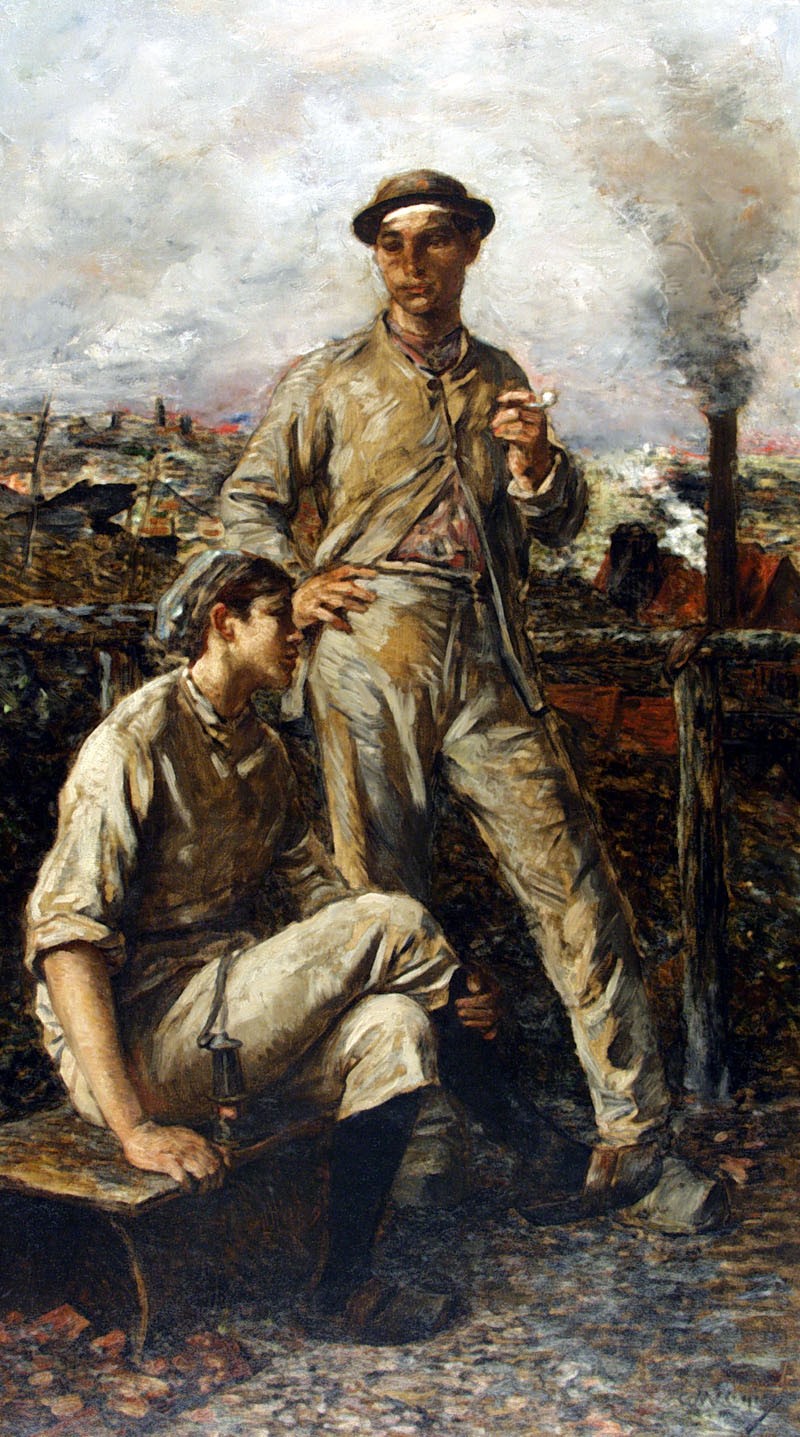
Klaus Issler is professor of Christian Education and Theology at Biola University’s Talbot School of Theology. Some material in this article was adapted from a small ebook, “Jesus, Money and Work: Practices for Forming Christian Character” (InterVarsity 2012), available on Amazon. From the Kern Pastors Network. Image: “The Miners,” Constantin-Emile Meunier, courtesy of the Grohmann Museum at the Milwaukee School of Engineering.
Previous Post

March 16, 2014
A family affair: A post from a Kern pastor
Next Post

March 23, 2014 We only wanted a youthworker....
Browse Our Archives
Select a Category Faith and Family Faith and the Marketplace Faith and the Workplace
Select a Month September 2014 April 2014 March 2014 February 2014 January 2014 December 2013
TAKE THE
Religious Wisdom Quiz
Who said, "For I know that my Redeemer lives"?
Select your answer to see how you score.
David Job Isaiah Paul
Related posts from Living Our Labor


The best kind of redistribution

Work must serve more than the bottom line
TRENDING AT PATHEOS Careers, Workplace and Religion

St. Francis by Bill Droel Pope Leo XIV declares 2026 as “Year...

Catholics are schooled in the faith by memorizing dogmatic points and lots...

The Good News of Our Human Limitations -...
After another day of trying to meet deadlines and working on projects,...

Quiet Holy Attentiveness (podcast) with Sarah Clarkson
We know that quiet is an essential aspect of the spiritual life,...

Every Vocation Everywhere All At Once
What is a vocation? How does it endure through the years? Can...

I promise this is not going to become a Taylor Swift Studies...
view all Careers, Workplace and Religion blogs
Ad-Free & Subscriber Log-In Subscription Support
- About Us
- 2026 Calendar
- Videos
- Podcasts
- Library of World Religions
- Faith In Media Tracker
- Advertise With Us
- Write for Us
- Privacy Policy
- Terms of Service
- Do Not Sell My Data
- Contact Us
- Radiant Digital
- Manage Newsletter Subscriptions
- Unsubscribe From Notifications
- Sitemap
Copyright 2008-2026, Patheos. All rights reserved.
Subscription Support Ad-Free & Subscriber Log-In
Follow Patheos