
BuddhistCatholicContemplativeEvangelicalGeneral ChristianHinduJewishLatter-day SaintMuslimNew VisionsProgressive Christian
Beliefs
- Buddhist
- Catholic
- Contemplative
- Evangelical
- General Christian
- Hindu
- Jewish
- Latter-day Saint
- More Voices
- Muslim
- New Visions
- Pagan
- Progressive Christian
Topics
- Religion News
- Food and Religion
- Sports and Religion
- Religious Art
- Religious Music and Entertainment
- Religious Events
- History and Religion
- Style and Religion
- Politics and Religion
- Women in Religion
- Recreation Outdoors and Religion
- Business Finance and Religion
- Careers Workplace and Religion
- Education and Religion
- Family Parenting and Religion
- Health Fitness and Religion
- Home and Religion
- Relationships and Religion
- Technology and Religion
- Travel and Religion
Columnists
- Buddhist Columnists
- Business Finance and Religion Columnists
- Careers Workplace and Religion Columnists
- Catholic Columnists
- Contemplative Columnists
- Education and Religion Columnists
- Evangelists Columnists
- Family Parenting and Religion Columnists
- General Christian Columnists
- Health Fitness and Religion Columnists
- Hindu Columnists
- History and Religion Columnists
- Home and Religion Columnists
- Jewish Columnists
- More Voices Columnists
- Latter Day Columnists
- Muslim Columnists
- New Visions Columnists
- Nonreligious Columnists
- Pagan Columnists
- Politics and Religion Columnists
- Progressive Columnists
- Recreation Outdoors and Religion Columnists
- Relationships and Religion Columnists
- Religion News Columnists
- Religious Art Columnists
- Religious Events Columnists
- Religious Music and Entertainment Columnists
- Sports and Religion Columnists
- Style and Religion Columnists
- Technology and Religion Columnists
- Travel and Religion Columnists
- Women in Religion Columnists
Resource Library
- 2026 Calendar
- Library of World Religions
- The 100 Most Holy Places on Earth
- Patheos Answers
- Podcasts
- Videos
- Faith Leaders Database
- Anglican Episcopalian
- Bahai
- Baptist
- Buddhism
- Christianity
- Confucianism
- Eastern Orthodoxy
- Hinduism
- Holiness and Pentecostal
- ISKCON
- Islam
- Judaism
- Lutheran
- Methodist
- The Church of Jesus Christ of Latter-day Saints
- New Age
- Paganism
- Presbytarian and Reformed
- Protestantism
- Religion Behind the Scenes
- Roman Catholic
- Scientology
- Shia Islam
- Sikhism
- Sufism
- Sunni Islam
- Taoism
- Zen
- See all religions
Research Tools
 Ad-Free & Subscriber Log-In Subscription Support
Ad-Free & Subscriber Log-In Subscription Support
Follow Patheos 

- Trending:
- Forgiveness
- |
- Marriage
- |
- Consciousness
- |
- Death Penalty
- |
- Election
- |
- Halloween
 Lisa Hendey
- Home
- Catholic
- Avoiding the Sins of the Media
Avoiding the Sins of the Media
Last updated on: March 12, 2015 at 4:42 pm by Lisa M. Hendey
Avoiding the Sins of the Media 2015-03-12T16:42:47-07:00 Lisa M. Hendey
Patheos Explore the world's faith through different perspectives on religion and spirituality! Patheos has the views of the prevalent religions and spiritualities of the world.
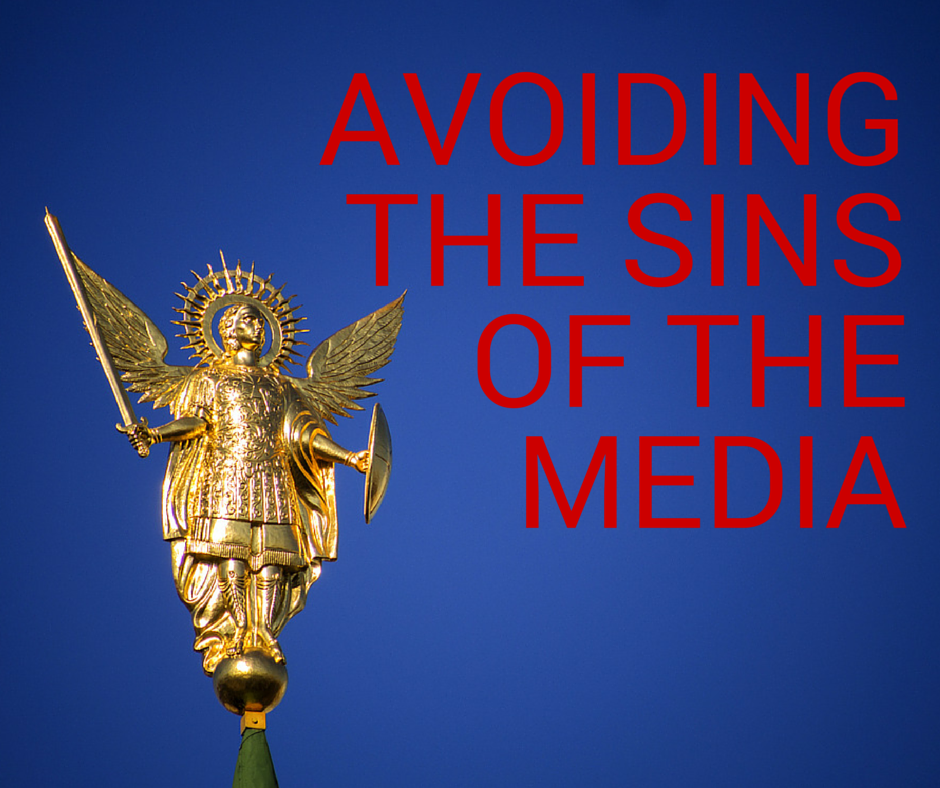
IgorGolovniov, Archangel Michael in St. Sophia monastery, Kiev, Ukraine, courtesy of Shutterstock, Inc.
Have you sat down and watched television lately? I mean, really, truly watched it?
I’d guess that I’ve spent approximately ten hours in the last month watching TV. That figure comes from my estimated five hours of watching my favorite show, Survivor, and five hours of sitting next to my husband working while he watches football. Aside from these two tv pastimes, the bulk of my viewing happens commercial-free and on demand. This frees me from the relentless Viagra commercials and scenes on too many television series that seem to have become quite steamy.
I do view a lot of news, but I tend to do so from the app on my phone, mostly while doing chores or during late night bouts of insomnia. Come to think of it… perhaps that’s causing some of my insomnia!
But despite my lack of television viewership, I did pay attention this week when Pope Francis addressed the staff and management of TV2000, an Italian Church television broadcasting company.
In his address, Pope Francis made three main points (included below from the original press release) which are impactful for any of us who communicate:
1. Parrhesia–Courage
“the Catholic media have a very difficult mission in relation to social communication: seeking to preserve it from all that distorts and twists it for other purposes. Often communication is subject to propaganda, ideologies, political ends, or for the control of the economy or technology. The first thing that is beneficial to communication is parrhesia, or rather the courage to speak directly, to speak frankly and freely. … If, instead, we are worried about tactical aspects, our words become artificial, and we communicate nothing. Freedom also means freedom from fashions, clichés, pre-packaged formulas. … We must reawaken words. But every word has a spark of fire and life within. Reawaken that spark, so that it comes out. So this is the first task of the communicator: to reawaken the word”
Am I bold and courageous in my communication, or do I err on the side of holding back truths that I fear will make others uncomfortable? Communicating the faith takes both passion and courage. In “reawakening words”, I must strive to communicate freely but also respectfully. When passion for our message bleeds into disrespect for our intended audience, fruitful dialogue is blocked and so is reception of what we are trying to say. I see this mission as a teeter totter, a balancing act where I am both bold and committed to effective discourse in communication.
2. Filling & Closing
Secondly, he emphasized the need to avoid “filling” and “closing”; the first takes the form of “saturating our perceptions with an excess of slogans that annul our thoughts instead of setting them into motion”, whereas the second is that of seeking short cuts instead of favoring longer and more complex routes of understanding, “choosing to present an individual as if he or she could solve all our problems, or on the contrary, as a scapegoat onto whom we can discharge all our responsibilities. [It is] jumping to conclusions immediately, instead of making the effort to represent the complexity of real life”.
Am I committed to communicating the truth in my message, or am I simply looking for a “quick fix”? In an age of 140 character tweets and so many words filling the blogosphere, I must challenge myself by asking if I what I write or speak adds to the font of truth, or simply fills air. Pope Francis reminds us to avoid jumping to easy conclusions. Most good stories can’t be told in a 500 word blog post or a sixty second video clip. The truth takes time. Being effective as communicators means that we must guard our words and images cautiously, and spend them effectively in pursuit of truth.
3. Speaking to the Whole Person and Avoiding Disinformation
Francis mentioned the third mission, “speaking to the whole person … avoiding the sins of the media: disinformation, slander and defamation”. Authentic communication, he stressed, “is not concerned with attention-grabbing. … It is necessary to speak to people as a whole: to their mind and their heart, so that they know how to see beyond the immediate, beyond a present that risks being forgetful and fearful of the future”. Of these three sins, “the most insidious is disinformation, as it leads to mistakes and to believing only a part of the truth”.
Disinformation, slander, defamation? If you’ve hung out in the comboxes of Facebook or blogs, you’ve likely seen them all. Pope Francis reminds me not to write for attention but rather for authenticity. Our goal as Catholic communicators is to serve the whole person–mind, heart and soul–always with an eye towards accuracy and truth.
While his message was addressed at television professionals, this message to “avoid the sins of the media” is helpful for each of us in an age where social media enables us to reach out and share our faith in ever-growing concentric circles of influence. Proverbs 12:19 sums up our marching orders nicely:
Truthful lips endure forever,
the lying tongue, for only a moment.
Truth endures. Let’s go out and tell it.
A question for you: Are you cognizant in your use of social media of your role as a communicator? How do you seek to avoid the sins of the media?
Next Post

December 17, 2014 USCCB & Bishop Oscar Cantú on Release of Alan Gross and #CubaPolicy
Browse Our Archives
Select a Category @Pontifex Books Catholic Geek Stuff Catholic Moments Family Life Good Measures Liturgical Calendar New Evangelization News Reviews Rwanda Saints Speaking Tanzania Journal Top Catholic Tweets Travel Uncategorized Vocations Yes
Select a Month August 2015 July 2015 June 2015 May 2015 April 2015 March 2015 February 2015 January 2015 December 2014 November 2014 October 2014 September 2014 August 2014 July 2014 June 2014 May 2014 April 2014 March 2014 February 2014 January 2014 December 2013 November 2013 October 2013 September 2013 August 2013 July 2013 June 2013 May 2013 April 2013 March 2013 February 2013 January 2013 December 2012 November 2012 October 2012
Follow Us!
TAKE THE
Religious Wisdom Quiz
Which New Testament book is written as a sermon?
Select your answer to see how you score.
Acts Galatians Hebrews James
Related posts from Lisa Hendey

Lisa's Sunday Update Video for 7/5/15
Seeing and Believing: Recognizing Christ amid Social Inequalities

Lou Holtz Rocks It at Franciscan U #Steubenville

#LaudatoSi: The Encyclical, The Movie?
TRENDING AT PATHEOS Catholic

Rejecting Doom: Christian Hope And Human Action
Christianity is a religion of hope. We are to have hope and...

It’s What Comes From Within Which Matters
One of the most difficult things for us to understand is why...

Why I Choose the Eucharist Over the Sermon
Choose the Eucharist, Not the Sermon What are we supposed to get...

5 Design Elements Found in Spiritually Rooted Homes
Putting Spirituality Into Home Decor Our homes are more than our living...

Credo: A Story of God Told with the...
About 10 years ago, I began to imagine a personal "Credo" that...

The Anatomy of Divine Revelation in Catholic Thought
The claim that God has made Himself known to human beings is...
view all Catholic blogs
Ad-Free & Subscriber Log-In Subscription Support
- About Us
- 2026 Calendar
- Videos
- Podcasts
- Library of World Religions
- Faith In Media Tracker
- Advertise With Us
- Write for Us
- Privacy Policy
- Terms of Service
- Do Not Sell My Data
- Contact Us
- Radiant Digital
- Manage Newsletter Subscriptions
- Unsubscribe From Notifications
- Sitemap
Copyright 2008-2026, Patheos. All rights reserved.
Subscription Support Ad-Free & Subscriber Log-In
Follow Patheos