
BuddhistCatholicContemplativeEvangelicalGeneral ChristianHinduJewishLatter-day SaintMuslimNew VisionsProgressive Christian
Beliefs
- Buddhist
- Catholic
- Contemplative
- Evangelical
- General Christian
- Hindu
- Jewish
- Latter-day Saint
- More Voices
- Muslim
- New Visions
- Pagan
- Progressive Christian
Topics
- Religion News
- Food and Religion
- Sports and Religion
- Religious Art
- Religious Music and Entertainment
- Religious Events
- History and Religion
- Style and Religion
- Politics and Religion
- Women in Religion
- Recreation Outdoors and Religion
- Business Finance and Religion
- Careers Workplace and Religion
- Education and Religion
- Family Parenting and Religion
- Health Fitness and Religion
- Home and Religion
- Relationships and Religion
- Technology and Religion
- Travel and Religion
Columnists
- Buddhist Columnists
- Business Finance and Religion Columnists
- Careers Workplace and Religion Columnists
- Catholic Columnists
- Contemplative Columnists
- Education and Religion Columnists
- Evangelists Columnists
- Family Parenting and Religion Columnists
- General Christian Columnists
- Health Fitness and Religion Columnists
- Hindu Columnists
- History and Religion Columnists
- Home and Religion Columnists
- Jewish Columnists
- More Voices Columnists
- Latter Day Columnists
- Muslim Columnists
- New Visions Columnists
- Nonreligious Columnists
- Pagan Columnists
- Politics and Religion Columnists
- Progressive Columnists
- Recreation Outdoors and Religion Columnists
- Relationships and Religion Columnists
- Religion News Columnists
- Religious Art Columnists
- Religious Events Columnists
- Religious Music and Entertainment Columnists
- Sports and Religion Columnists
- Style and Religion Columnists
- Technology and Religion Columnists
- Travel and Religion Columnists
- Women in Religion Columnists
Resource Library
- 2026 Calendar
- Library of World Religions
- The 100 Most Holy Places on Earth
- Patheos Answers
- Podcasts
- Videos
- Faith Leaders Database
- Anglican Episcopalian
- Bahai
- Baptist
- Buddhism
- Christianity
- Confucianism
- Eastern Orthodoxy
- Hinduism
- Holiness and Pentecostal
- ISKCON
- Islam
- Judaism
- Lutheran
- Methodist
- The Church of Jesus Christ of Latter-day Saints
- New Age
- Paganism
- Presbytarian and Reformed
- Protestantism
- Religion Behind the Scenes
- Roman Catholic
- Scientology
- Shia Islam
- Sikhism
- Sufism
- Sunni Islam
- Taoism
- Zen
- See all religions
Research Tools
 Ad-Free & Subscriber Log-In Subscription Support
Ad-Free & Subscriber Log-In Subscription Support
Follow Patheos 

- Trending:
- Forgiveness
- |
- Marriage
- |
- Consciousness
- |
- Death Penalty
- |
- Election
- |
- Halloween

- Home
- Pagan
- Education and Religion
- The Ethics of Magical Reciprocity in Modern Life
The Ethics of Magical Reciprocity in Modern Life
Last updated on: August 27, 2026 at 1:05 pm by Rev. Emily Guenther
The Ethics of Magical Reciprocity in Modern Life 2026-08-27T13:05:17-05:00 Rev. Emily Guenther
Patheos Explore the world's faith through different perspectives on religion and spirituality! Patheos has the views of the prevalent religions and spiritualities of the world.
Reciprocity has always been one of the quiet pillars of magical practice, even when we don’t name it directly. It’s woven into the way we speak about energy, intention, and relationship. It’s present in the way we talk about offerings, gratitude, and the exchange between the seen and unseen. But in modern life – especially in a world shaped by digital communities, parasocial relationships, and the constant hum of online interaction – the ethics of reciprocity have become more complicated. The old ways of giving and receiving haven’t disappeared, but they’ve been stretched, reshaped, and sometimes distorted by the pace and structure of contemporary life.
Reciprocity is a Cosmic Principle
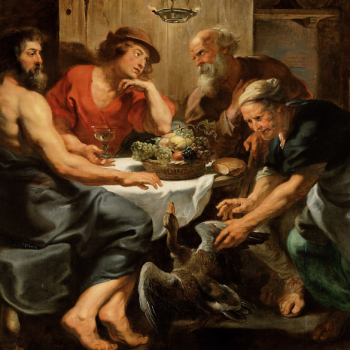
When I wrote about Zeus’s Law, I touched on the idea that reciprocity is not merely a polite gesture but a cosmic principle. It’s the understanding that energy moves in cycles, that relationships are sustained through mutual exchange, and that nothing thrives in a vacuum. But that was a conversation rooted in mythic language, in the stories of gods and mortals. What I want to explore now is how reciprocity functions in the everyday lives of modern practitioners, those who cast spells, meditate, divine, heal, teach, and create in a world where connection is both easier and more fragile than ever.

The Ethics of Magical Reciprocity in Modern Life
One of the first things we have to acknowledge is that magical reciprocity is not transactional. It’s not a cosmic vending machine where you insert an offering and receive a result. It’s relational. Reciprocity is about tending to the flow of energy between yourself and the world around you. In older communities, this was easier to understand because relationships were tangible. You knew the people you practiced with. You knew the land you lived on. You knew the spirits or ancestors you honored. Reciprocity was built into the rhythm of daily life.
Reciprocity in the Digital Age
But now, many people practice alone. Many learn from creators online. Many participate in communities where they may never meet another member in person. The relationships are real, but they are mediated through screens, algorithms, and curated glimpses of one another’s lives. This shift has created a new kind of magical ecosystem, one where reciprocity is still essential, but the pathways for expressing it are less obvious.
Consider the way people seek guidance today. A practitioner might post a video about tarot, or energy work, or spellcraft. Thousands of people may watch it. Some will learn from it. Some will use the techniques in their own practice. Some will reach out with questions, hoping for personalized guidance. The creator becomes, unintentionally, a teacher, a mentor, a spiritual companion. But the relationship is one‑sided. The viewer receives, but the creator may not receive anything in return—not even acknowledgment. This isn’t malicious; it’s simply the nature of digital consumption. But it does raise ethical questions. If we are taking energy, wisdom, or inspiration from someone, what is our responsibility to give back?

The Ethics of Magical Reciprocity in Modern Life
Giving Back is a Spiritual Practice
Reciprocity doesn’t have to be grand. It can be as simple as expressing gratitude, supporting someone’s work, or engaging in a way that nourishes the relationship rather than draining it. But it does require awareness. It requires recognizing that even digital exchanges carry energetic weight. When we treat creators, teachers, or community leaders as endless wells of information, we participate in an imbalance that ultimately harms the ecosystem we rely on.
The same is true in magical communities themselves. Many groups, whether online or in person, are held together by a handful of people who do the emotional labor, the organizing, the teaching, the conflict resolution, and the spiritual caretaking. These individuals often give far more than they receive, not because they are obligated to, but because they care deeply about the community’s wellbeing. But reciprocity is necessary here too. Communities thrive when members contribute, when they show up, when they offer their own gifts, when they share responsibility. Without reciprocity, even the strongest communities begin to fray.
Parasocial Hurdles
There is also the matter of parasocial relationships, which have become increasingly common in spiritual spaces. When someone shares their practice publicly, people may begin to feel connected to them in ways that aren’t mutual. They may project expectations, desires, or emotional needs onto the practitioner. They may assume a level of intimacy that doesn’t exist. This can create a subtle but powerful drain on the practitioner’s energy. Reciprocity becomes distorted because the relationship is imagined rather than shared.
This is not the fault of the viewer; parasocial bonds are a natural outcome of human psychology. But it does mean that practitioners who share their work publicly must navigate boundaries carefully. They must decide what they can give, what they cannot, and how to maintain their own wellbeing while still offering their gifts to the world. And those who follow their work must learn to engage ethically—to appreciate without possessing, to learn without demanding, to receive without assuming entitlement.

The Ethics of Magical Reciprocity in Modern Life
Honoring the Unseen
Reciprocity also extends to the unseen aspects of magical practice. When we work with energy, spirits, ancestors, or the land, we enter into relationship. These relationships require care and respect. They require offerings, not because offerings bribe the unseen, but because they acknowledge the exchange. These relationships affirm that we are not taking without giving. They remind us that magic is not a solitary act but a collaborative one.
In modern life, offerings can take many forms. They can be physical: food, incense, flowers, water. Offerings can be energetic: gratitude, attention, intention, care. They can also be behavioral: acts of kindness, acts of service, acts of alignment with the values we claim to hold. Reciprocity is not limited to ritual spaces; it can be woven into the way we move through the world. When we treat others with compassion, when we honor our commitments, when we act with integrity, we participate in the same cycle of exchange that underlies magical practice.
Reciprocity with Ourselves
There is also a deeper layer to reciprocity, the relationship between the practitioner and themselves. Magic is not only an outward act, it is also an inward one. When we ask something of ourselves – strength, healing, transformation – we must also give something in return. Rest. Nourishment. Honesty. Time. Magic that demands without replenishing becomes self‑harm. Magic that replenishes without demanding becomes stagnation. Reciprocity keeps us balanced.
In a world that moves quickly, reciprocity asks us to slow down. It asks us to notice where energy is flowing and where it is pooling. It asks us to consider whether we are participating in cycles that nourish or cycles that deplete. It asks us to be intentional about the relationships we form – human, spiritual, digital, or internal.
Connection is Part of Reciprocity
Modern life has made connection easier, but it has also made it easier to forget the weight of connection. We can consume endlessly without realizing we are consuming. We can take without noticing we are taking. We can lean on others without recognizing the strain we place on them. Reciprocity is the antidote to this unconsciousness. It is the practice of remembering that every exchange carries meaning.
When we engage in magical reciprocity, we affirm that we are part of a larger web. We acknowledge that our actions ripple outward. We recognize that our practice is not isolated but interconnected. And we choose to participate in those connections with care.

The Ethics of Magical Reciprocity in Modern Life
Reciprocity is Our Commitment
Reciprocity is not a rule, it is a way of being. It is a commitment to balance, to relationship, to awareness. It is a promise that we will not take more than we give, that we will honor the sources of our nourishment, and that we will contribute to the ecosystems – magical, spiritual, communal, or digital – that sustain us.
In modern life, where so much feels fragmented, reciprocity offers a path back to wholeness. It reminds us that magic is not only what we do, but how we relate. It reminds us that every act of giving strengthens the bonds that hold us. And it reminds us that in a world full of noise, the quiet act of returning what we have received is one of the most powerful forms of magic we have.
Relationships and Religion
Previous Post

August 4, 2026
Zeus's Law, The Odyssey and Modern Politics
Next Post

October 1, 2026 5 Tips to Boost Your Magick
Browse Our Archives
Select a Category Dark Goddess Divination Divine Masculine Just for Fun Sabbats Spells Tarot Teaching Thoughts Uncategorized
Select a Month October 2026 August 2026 July 2026 June 2026 May 2026 April 2026 March 2026 February 2026 January 2026 December 2025 November 2025 October 2025 September 2025 August 2025 July 2025 June 2025 May 2025 April 2025 March 2025 February 2025 January 2025 December 2024 November 2024 October 2024 September 2024 August 2024 July 2024 June 2024 May 2024 April 2024 March 2024 February 2024 January 2024 December 2023 November 2023 October 2023 September 2023
Follow Us!
TAKE THE
Religious Wisdom Quiz
Who walked with God and was taken to heaven without dying?
Select your answer to see how you score.
Elijah Enoch Moses Daniel
Related posts from Light Your Path

Zeus's Law, The Odyssey and Modern Politics


The Solar Feminine, the Mirror, and the Path...
TRENDING AT PATHEOS Pagan

'The Chosen' S6 Trailer: The Passion Gets Very...
Not many watching 'The Chosen' worry about spoilers, but just because they...

The purpose-driven labor priest
A labor activist reads Rick Warren and it gets me wondering about...

The Golden Rule Demands More than We Think
Everyone is related, and everything is connected. That sets a high standard...

What Will We Be Able to do on...
The term perfect is often misused when it describes our state in...

‘Conceivable’ Opens Friday: Faith, Family & a Surprise...
A new faith-based drama inspired by a true story opens in theaters...

Pope Leo has Lung Cancer. We Need Him...
I’ve been caught up with a conundrum in my own life and...
view all Pagan blogs
Ad-Free & Subscriber Log-In Subscription Support
- About Us
- 2026 Calendar
- Videos
- Podcasts
- Library of World Religions
- Faith In Media Tracker
- Advertise With Us
- Write for Us
- Privacy Policy
- Terms of Service
- Do Not Sell My Data
- Contact Us
- Radiant Digital
- Manage Newsletter Subscriptions
- Unsubscribe From Notifications
- Sitemap
Copyright 2008-2026, Patheos. All rights reserved.
Subscription Support Ad-Free & Subscriber Log-In
Follow Patheos