
BuddhistCatholicContemplativeEvangelicalGeneral ChristianHinduJewishLatter-day SaintMuslimNew VisionsProgressive Christian
Beliefs
- Buddhist
- Catholic
- Contemplative
- Evangelical
- General Christian
- Hindu
- Jewish
- Latter-day Saint
- More Voices
- Muslim
- New Visions
- Pagan
- Progressive Christian
Topics
- Religion News
- Food and Religion
- Sports and Religion
- Religious Art
- Religious Music and Entertainment
- Religious Events
- History and Religion
- Style and Religion
- Politics and Religion
- Women in Religion
- Recreation Outdoors and Religion
- Business Finance and Religion
- Careers Workplace and Religion
- Education and Religion
- Family Parenting and Religion
- Health Fitness and Religion
- Home and Religion
- Relationships and Religion
- Technology and Religion
- Travel and Religion
Columnists
- Buddhist Columnists
- Business Finance and Religion Columnists
- Careers Workplace and Religion Columnists
- Catholic Columnists
- Contemplative Columnists
- Education and Religion Columnists
- Evangelists Columnists
- Family Parenting and Religion Columnists
- General Christian Columnists
- Health Fitness and Religion Columnists
- Hindu Columnists
- History and Religion Columnists
- Home and Religion Columnists
- Jewish Columnists
- More Voices Columnists
- Latter Day Columnists
- Muslim Columnists
- New Visions Columnists
- Nonreligious Columnists
- Pagan Columnists
- Politics and Religion Columnists
- Progressive Columnists
- Recreation Outdoors and Religion Columnists
- Relationships and Religion Columnists
- Religion News Columnists
- Religious Art Columnists
- Religious Events Columnists
- Religious Music and Entertainment Columnists
- Sports and Religion Columnists
- Style and Religion Columnists
- Technology and Religion Columnists
- Travel and Religion Columnists
- Women in Religion Columnists
Resource Library
- 2026 Calendar
- Library of World Religions
- The 100 Most Holy Places on Earth
- Patheos Answers
- Podcasts
- Videos
- Faith Leaders Database
- Anglican Episcopalian
- Bahai
- Baptist
- Buddhism
- Christianity
- Confucianism
- Eastern Orthodoxy
- Hinduism
- Holiness and Pentecostal
- ISKCON
- Islam
- Judaism
- Lutheran
- Methodist
- The Church of Jesus Christ of Latter-day Saints
- New Age
- Paganism
- Presbytarian and Reformed
- Protestantism
- Religion Behind the Scenes
- Roman Catholic
- Scientology
- Shia Islam
- Sikhism
- Sufism
- Sunni Islam
- Taoism
- Zen
- See all religions
Research Tools
 Ad-Free & Subscriber Log-In Subscription Support
Ad-Free & Subscriber Log-In Subscription Support
Follow Patheos 

- Trending:
- Forgiveness
- |
- Marriage
- |
- Consciousness
- |
- Death Penalty
- |
- Election
- |
- Halloween

- Home
- Pagan
- Education and Religion
- The Witch Trials We Repeat
The Witch Trials We Repeat
Last updated on: October 2, 2025 at 1:58 pm by Rev. Emily Guenther
The Witch Trials We Repeat 2025-10-02T13:58:39-05:00 Rev. Emily Guenther
Patheos Explore the world's faith through different perspectives on religion and spirituality! Patheos has the views of the prevalent religions and spiritualities of the world.
Witch trials. They never get old.
I try not to write a lot about politics. I would rather leave that to the professional journalists, but that does not mean that I do not pay attention to what is happening in my community, my country and across the world. Locally, my city has become the test subject of our regime’s latest game. Military and federal forces are currently occupying my city, hoping to prove to Trump that he can officially militarize all police forces and take over the regions in America that do not support him. Those are facts, but how does one write about them in a coherent way? Because all I feel is rage and fear and uncertainty. So I am not going to write about it. I’ve been thinking about what to write about here and I remembered something that I wrote a few years ago that seems important again now. Something about self respect.
I was asked by a friend of mine who is a Unitarian Universality minister to do a sermon at his church way back in 2021. He asked me if I would preach about witchcraft to his congregation on October 31, which just happened to be a Sunday that year. As I began the journey of writing that sermon, my very first sermon, I landed on the Salem Witch Trials as a topic.
The sermon that I wrote in October 2021 is sadly still relevant, perhaps more so today. And I would like to share parts of that sermon with you here. What follows below is taken from my sermon given that Sunday. I have divided it into smaller sections using subheadings to make it easier to read but all of the following words in this entry come from that sermon.
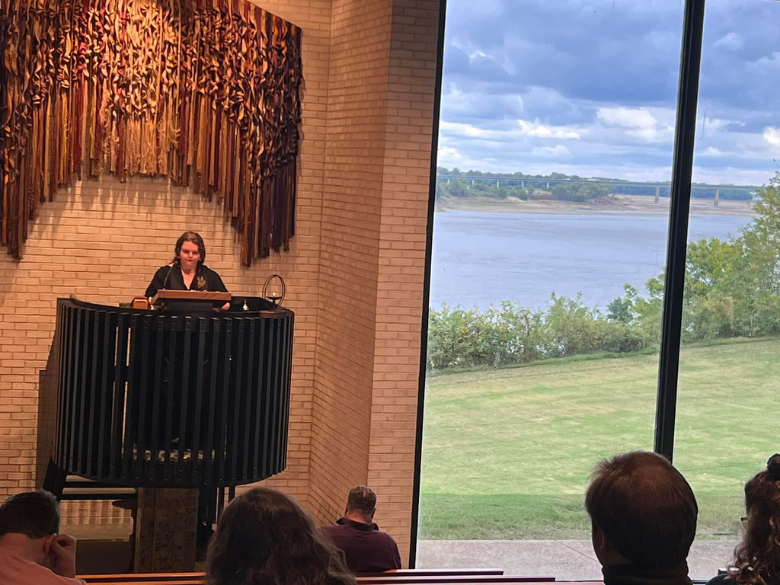
Author giving a sermon
Witches Give Sermons Too
While being a witch is a lifestyle for myself and many others, October is a time of year when the rest of the community begins to look to us, and in some cases, look for us. Requests for witches for hire for Halloween events usually begin trickling in starting in September. But being a witch, and in my case a Wiccan, is more than a seasonal gig. This is a label I wear all year long, and everywhere I go. And while overt hatred is not something I experience on a regular basis, many people are still harassed and bullied because of their religion or lifestyle. Unfortunately, the human race has a history of harassing and discriminating against “others” since time began.
This bad behavior of hatred and judgment at times gets so flagrant that people take notice, and sometimes positive things result from that. But just because we’re not talking about it doesn’t mean it isn’t happening in between these big moments. Today I’d like us to take a look at one of those historical moments from America’s past: the Salem Witch Trials.
Salem Witch Trials
The Salem Witch trials occurred in colonial Massachusetts between 1692 and 1693. More than 200 people were accused of practicing witchcraft and 20 were executed. Several centuries ago, many practicing Christians, and those of other religions, had a strong belief that the Devil could give certain people, labeled as witches, the power to harm others in return for their loyalty. A “witchcraft craze” rippled through Europe from the 1300s to the end of the 1600s. Tens of thousands of supposed witches—mostly women—were executed. The Salem Witch Trials occurred at the tail end of the European craze and helped to close the door on the legal persecution of innocents.
The Salem Witch Trials began in January of 1692, after a group of Puritan girls began behaving strangely and a local doctor ruled that they were bewitched. The girls then accused a local slave, Tituba, and two other women of bewitching them.
Tituba was arrested a few days later, where she confessed to being a witch and stated there were other witches in Salem. The colonists panicked and began a massive witch hunt to find these other witches.
Many historians believe that people in the colony quickly took advantage of this witch hunt and mass hysteria by accusing rival neighbors or other colonists that they disapproved of or wanted revenge against.
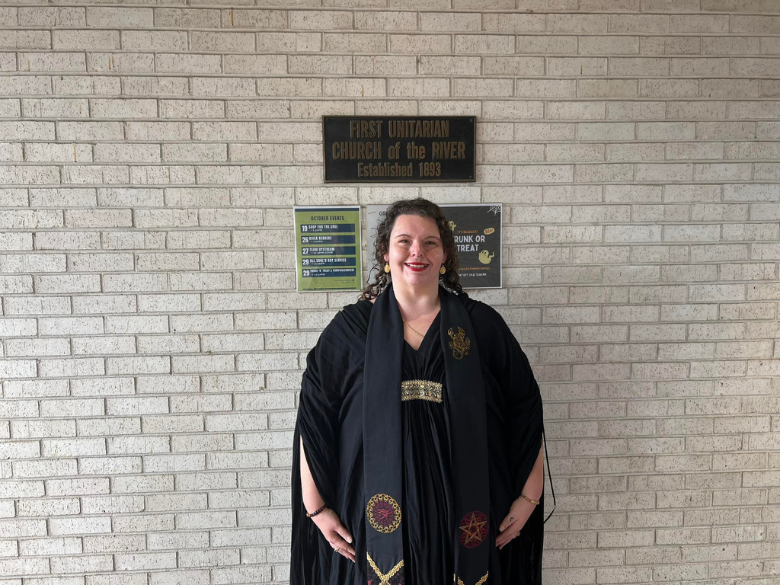
Author at UU Church
What Happened During the Witch Trials
Puritans were very hostile towards colonists who didn’t follow the strict religious and societal rules in the colony. The Puritans were English Protestants who believed that the reforms of the Church of England did not go far enough. In their view, the liturgy was still too Catholic. Bishops lived like princes. Ecclesiastical courts were corrupt. Because the king of England was head of both church and state, the Puritans’ opposition to religious authority meant they also defied the civil authority of the state. In 1630, the Puritans set sail for America. Unlike the Pilgrims who had left 10 years earlier, the Puritans did not break with the Church of England but instead sought to reform it. Seeking comfort and reassurance in the Bible, they imagined themselves re-enacting the story of the biblical Exodus.
As a result of the Puritans’ conservative beliefs, it is not surprising that many of the accused witches were outspoken women, Quakers, slaves, colonists with criminal backgrounds and/or prior witchcraft accusations or colonists who criticized the witch trials. According to the book The Societal History of Crime and Punishment in America:
“A number of historians have speculated as to why the witch hunts occurred and why certain people were singled out. These proposed reasons have included personal vendettas, fear of strong women, and economic competition. Regardless, the Salem Witch Trials are a memorial and a warning to what hysteria, religious intolerance, and ignorance can cause in the criminal justice system.”
All of these factors created a volatile and dangerous situation that resulted in the imprisonment and death of many innocent people. Eventually, the colony admitted the trials were a mistake and compensated the families of those convicted.
I don’t know all the circumstances that set the Salem Witch Trials into motion. I’m not sure if anyone does, although many historians and scientists have made educated guesses. But in hindsight, it is clear to me that the trials were not about witches, or magick, or the devil. They were about power, fear, and ignorance.

Eli Wiesel – Wikimedia Commons
About Eli Wiesel
I’d like to share a passage from Eli Wiesel’s speech at the Salem Witch Trials Memorial Dedication. Eli, was born in 1928 in what is now part of Romania. During World War II, he, with his family and other Jews from the area, were deported to the German concentration and extermination camps, where his parents and little sister were killed. Wiesel and his two older sisters survived.
Liberated from the concentration camp in 1945 by Allied troops, he was taken to Paris where he studied and worked as a journalist. In 1958, Eli published his first book, Night, a memoir of his experiences in the concentration camps. Mr. Wiesel, a charismatic lecturer and humanities professor, was the author of several dozen books. In 1986, he was awarded the Nobel Peace Prize. But he was defined not so much by the work he did as by the gaping void he filled. In the aftermath of the Germans’ systematic massacre of Jews, no voice had emerged to drive home the enormity of what had happened and how it had changed mankind’s conception of itself and of God. For almost two decades, the traumatized survivors seemed frozen in silence. But by the sheer force of his personality and his gift for the haunting phrase, Mr. Wiesel, who had been liberated from Buchenwald as a 16-year-old with the tattoo A-7713 on his arm, gradually exhumed the Holocaust from the burial ground of the history books. It was this speaking out against forgetfulness and violence that the Nobel committee recognized when it awarded him the peace prize in 1986.
“Wiesel is a messenger to mankind,” the Nobel citation said. “His message is one of peace, atonement and human dignity. His belief that the forces fighting evil in the world can be victorious is a hard-won belief.”
Eli Wiesel on the Witch Trials
During his dedication speech, Eli said: “There was a woman in Germany, in Berlin, a simple woman, a housewife – I’m not saying housewives are simple – but she was a simple housewife, and she saved some Jews during the war, during the whole war in Berlin, therefore they gave her a medal. There were many journalists there and they all asked her why did you do it? Where did you get the courage to do what you have done? And, why, why, why…? And she didn’t understand the questions. In the end she straightened herself up, and she said, “You want to know why I did it – I will tell you. Because of self-respect.” It’s a matter of self-respect. To help someone who needs our help means self-respect. To fight racism means self-respect. To fight intolerance done to another means self-respect. And therefore, when I read stories of Salem I find that the victims had a lot of self-respect. I am so embarrassed by the judges; I cannot tell you how. When I found out that the chief justice … later became governor after the trials. But what happened to the people in Salem, Massachusetts? He became Governor. He should have discredited himself from all (times?) to come. But he became governor. He had power. He didn’t give it up, didn’t relinquish it. I cannot tell you how sad I am when I think of those who accepted the verdict, but I’m proud of the victims who did not accept the verdict. Of those who said to the end, no. No! Your justice is not mine, your faith is not mine. And I go on claiming my right to humanity, which is my right to believe in the God that I believe in. What have we learned from that? That in times of inhumanity, humanity is still possible. If I cannot fight the hatred all over the world at least I can fight hatred somewhere, in one person, in me. The key word, I’ve found, that is part of the vocabulary of this tragedy, is fanaticism. It is because people were fanatic that Salem was possible. It is because a fanatic has it easy. It is so easy to believe that the children really saw the demon in the witch. It is so easy to believe that the chief justice spoke on behalf of justice. And fanaticism is the greatest evil that faces us today. For today, too, there are Salems…”
Witches Are Just Like You
As a member of my Mid-South Pagan community I am here to help others. As Wiccans we strive to be the hands and mouth for the god and goddess. We have the same divine work to do that everyone, regardless of religion, has. We are here to love, to help one another, and to try to make the world a better place. It does not matter which god we answer to. Because in Wicca, all gods are one in the same, and the divine work is the same work.
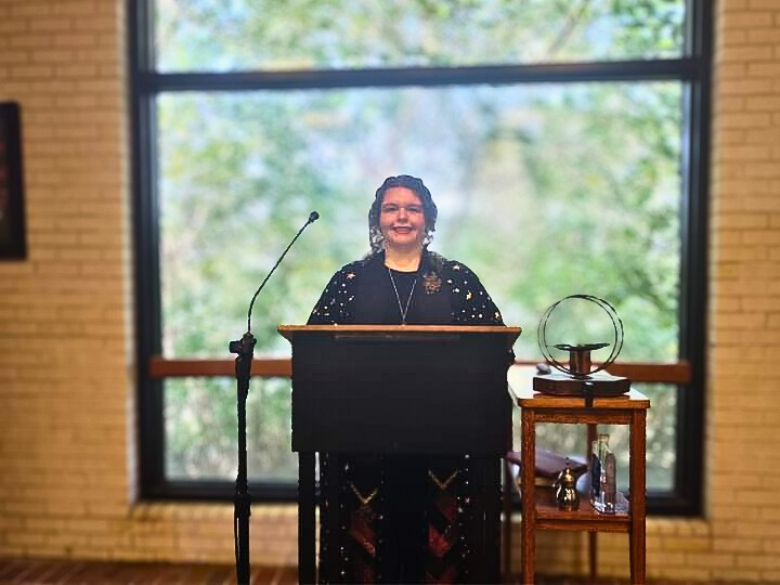
Author at the pulpit
It is now October, the season of the Witch. And today, we still have our own Salems to face down. Open your phone, watch TV, read the news, the same fanaticism that almost destroyed Salem still exists in our world today. And if we don’t do something about it, its going to always be there. In many historical cases, persecution is something that happens somewhere else. War is something that happens in other places. Many of us do not think of these things happening in our own backyard. Ellie Wiesel, a survivor of the Holocaust, talks about events that happened in Germany; in a previous lifetime for many, but not all, of us. But the Salem Witch Trials didn’t happen in Europe. It happened here, in America. The Puritans turned on their own people, their own friends and family, their own colony that they created out of an ideal. Witch trials can happen anywhere, at any time, to anyone, for any reason. It’s time to stop scapegoating, time to stop being afraid, time to stop reaching for power. It’s time to stop judging others over minute differences. Many of us are who we are simply by an accident of birth. And that accident has helped shape our entire lives, and yet none of us had any say so in where we were born, to whom, or when.
Witches Have Self Respect
And if we’re being honest, we are all different. Each of us is unique and wonderful. What a boring place this world would be if we were all the same. As trite as that sounds, we say it because it’s true. So today, this Samhain season, as we look back at our history, as we look at the fear and discrimination that fed the Salem Witch Trials, I ask you all to take the time to look at yourself. See how different you are from your family, your neighbors, your friends. Embrace this uniqueness, appreciate it in yourself and others. Today, as a witch, I ask you to put your fear aside and embrace others who are different from you. To do so, you don’t have to make any big changes to your life, just little ones. Push past the fear of meeting people who are different. Stop blaming others. Honor yourself and respect yourself, just like that German housewife. Honor and respect others. Even though we are all different, we are also all the same in many ways. And what we all want is respect, love, and a chance. A chance to practice our faith and worship the divine of our hearts. A chance to live without fear of persecution. A chance to be authentic.
Politics and Religion
Previous Post

September 4, 2025
The Goddess Wheel: Archetypes Across the Seasons
Next Post

October 20, 2025 The God Wheel: Archetypes Across the Seasons
Browse Our Archives
Select a Category Dark Goddess Divination Divine Masculine Just for Fun Sabbats Spells Tarot Teaching Thoughts Uncategorized
Select a Month October 2026 August 2026 July 2026 June 2026 May 2026 April 2026 March 2026 February 2026 January 2026 December 2025 November 2025 October 2025 September 2025 August 2025 July 2025 June 2025 May 2025 April 2025 March 2025 February 2025 January 2025 December 2024 November 2024 October 2024 September 2024 August 2024 July 2024 June 2024 May 2024 April 2024 March 2024 February 2024 January 2024 December 2023 November 2023 October 2023 September 2023
Follow Us!
TAKE THE
Religious Wisdom Quiz
Who is the coauthor of some of Paul's epistles and delivered them to churches?
Select your answer to see how you score.
Barnabas Andrew Timothy Silas
Related posts from Light Your Path


Honoring the Final Days of Winter
A Tour of February's Lesser Known Pagan Festivals
TRENDING AT PATHEOS Pagan

Swimfan: Forgotten Aughts Pleasures
This is a recovery effort. In 2002, My Big Fat Greek Wedding...

Top Three Anti-Catholic Lies About Catholicism
This is my initial transcript for the video, "THE 3 WORST...

Pope Leo Celebrates Mass for Nurses & Docs...
I don't have any idea how he did it, but Pope Leo...

The Sermon on the Mount, Part I: Matthew...
The Sermon on the Mount, Part I (Matthew 4:12-5:12) St. Matthew moves...

What's up from Crossway: Reviewing some of their latest A few weeks...

Janie Learns the Way of the Cross: A...
Teaching children about Jesus' Passion can be challenging. Many parents and educators...
view all Pagan blogs
Ad-Free & Subscriber Log-In Subscription Support
- About Us
- 2026 Calendar
- Videos
- Podcasts
- Library of World Religions
- Faith In Media Tracker
- Advertise With Us
- Write for Us
- Privacy Policy
- Terms of Service
- Do Not Sell My Data
- Contact Us
- Radiant Digital
- Manage Newsletter Subscriptions
- Unsubscribe From Notifications
- Sitemap
Copyright 2008-2026, Patheos. All rights reserved.
Subscription Support Ad-Free & Subscriber Log-In
Follow Patheos