
BuddhistCatholicContemplativeEvangelicalGeneral ChristianHinduJewishLatter-day SaintMuslimNew VisionsProgressive Christian
Beliefs
- Buddhist
- Catholic
- Contemplative
- Evangelical
- General Christian
- Hindu
- Jewish
- Latter-day Saint
- More Voices
- Muslim
- New Visions
- Pagan
- Progressive Christian
Topics
- Religion News
- Food and Religion
- Sports and Religion
- Religious Art
- Religious Music and Entertainment
- Religious Events
- History and Religion
- Style and Religion
- Politics and Religion
- Women in Religion
- Recreation Outdoors and Religion
- Business Finance and Religion
- Careers Workplace and Religion
- Education and Religion
- Family Parenting and Religion
- Health Fitness and Religion
- Home and Religion
- Relationships and Religion
- Technology and Religion
- Travel and Religion
Columnists
- Buddhist Columnists
- Business Finance and Religion Columnists
- Careers Workplace and Religion Columnists
- Catholic Columnists
- Contemplative Columnists
- Education and Religion Columnists
- Evangelists Columnists
- Family Parenting and Religion Columnists
- General Christian Columnists
- Health Fitness and Religion Columnists
- Hindu Columnists
- History and Religion Columnists
- Home and Religion Columnists
- Jewish Columnists
- More Voices Columnists
- Latter Day Columnists
- Muslim Columnists
- New Visions Columnists
- Nonreligious Columnists
- Pagan Columnists
- Politics and Religion Columnists
- Progressive Columnists
- Recreation Outdoors and Religion Columnists
- Relationships and Religion Columnists
- Religion News Columnists
- Religious Art Columnists
- Religious Events Columnists
- Religious Music and Entertainment Columnists
- Sports and Religion Columnists
- Style and Religion Columnists
- Technology and Religion Columnists
- Travel and Religion Columnists
- Women in Religion Columnists
Resource Library
- 2026 Calendar
- Library of World Religions
- The 100 Most Holy Places on Earth
- Patheos Answers
- Podcasts
- Videos
- Faith Leaders Database
- Anglican Episcopalian
- Bahai
- Baptist
- Buddhism
- Christianity
- Confucianism
- Eastern Orthodoxy
- Hinduism
- Holiness and Pentecostal
- ISKCON
- Islam
- Judaism
- Lutheran
- Methodist
- The Church of Jesus Christ of Latter-day Saints
- New Age
- Paganism
- Presbytarian and Reformed
- Protestantism
- Religion Behind the Scenes
- Roman Catholic
- Scientology
- Shia Islam
- Sikhism
- Sufism
- Sunni Islam
- Taoism
- Zen
- See all religions
Research Tools
 Ad-Free & Subscriber Log-In Subscription Support
Ad-Free & Subscriber Log-In Subscription Support
Follow Patheos 

- Trending:
- Forgiveness
- |
- Marriage
- |
- Consciousness
- |
- Death Penalty
- |
- Election
- |
- Halloween

- Home
- Pagan
- Education and Religion
- Honoring the God in Paganism
Honoring the God in Paganism
Last updated on: June 26, 2025 at 12:58 pm by Rev. Emily Guenther
Honoring the God in Paganism 2025-06-26T12:58:21-05:00 Rev. Emily Guenther
Patheos Explore the world's faith through different perspectives on religion and spirituality! Patheos has the views of the prevalent religions and spiritualities of the world.
Honoring the God in Paganism does not often get the attention that I think it deserves. This is one of my soapbox issues, and I felt that since we are in the heights of Midsummer, it is a perfect time to talk about it.
In Paganism and the alternative spirituality community, there is a lot of talk about The Goddess. I have written about Her quite a bit myself. But in my experience, there is not much talk about The God.
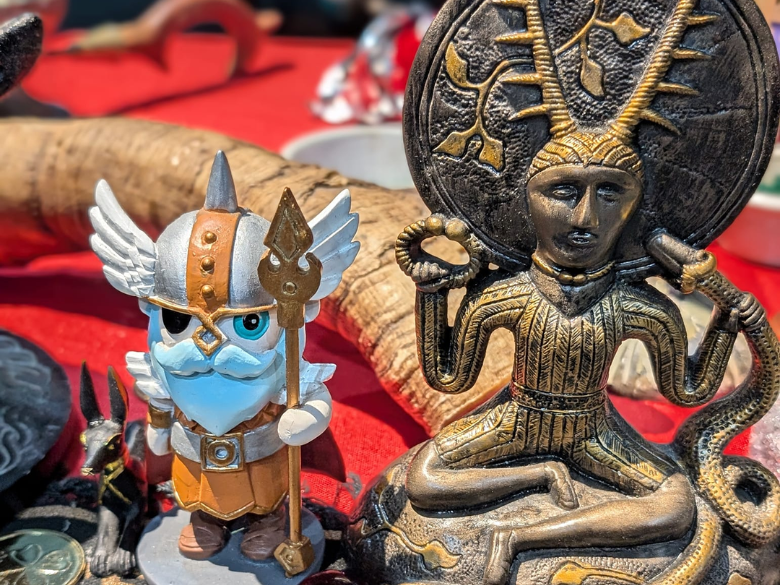
Gods on Altar
Leftovers from The Church
I usually chalk this up to many Pagans’ discomfort with the teachings of The Church and their god, Yahweh. Most Christian denominations do not honor or acknowledge the Divine Feminine in any form. There are a few exceptions to this with the branches of Christianity that venerate Mary, but even still they do not worship her as they do their god. Sometimes when Pagans leave The Church, we run from anything that reminds of us that, including worshiping a male deity.
Honoring The God in Wicca or working with gods in Paganism is not as popular as working with The Goddess or goddesses. Again, I think this is partly because of the teachings of The Church, but I also partly blame modern Paganism.
The High Priest
Wicca is a large, well known part of the modern Pagan movement. Wicca is not the end all or be all of Paganism. It works for many and it does not work for many others. The beauty of Paganism is that we get to find the path that works for us. Wicca is where I stepped onto the Pagan path, like many others. It is still one of my primary religious traditions and does influence a lot of what I practice.
In Wicca, there is a focus on the Divine Feminine, which I love. It is one of the things that resonates with many of us when looking for a spiritual path that feels more natural and more inclusive. Wicca honors The God alongside The Goddess, but sometimes it feels more like lip service than actual worship.
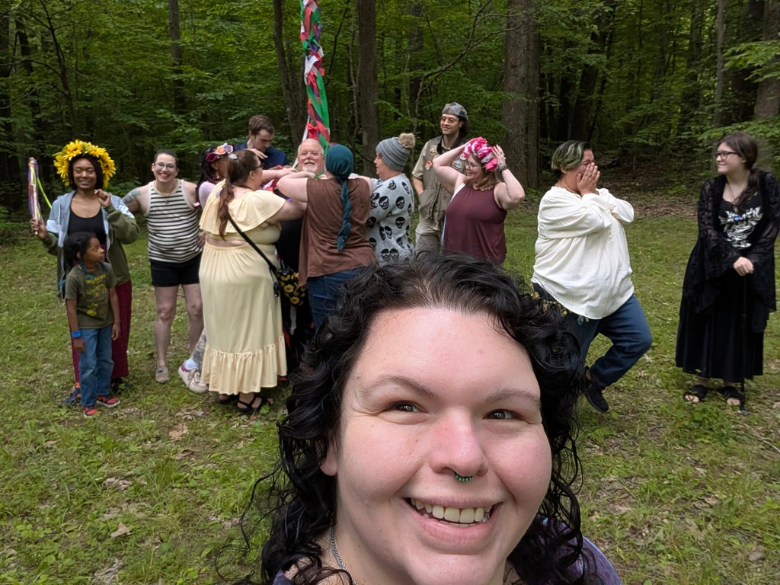
High Priest, representing The God, tied to the Maypole
In Wicca and Witchcraft related groups, we call down the moon (a term used for ritual channeling of the goddess). The high priestess is often the leader and focus of the ritual, and the one who does most of the energetic work. But very few people talk about drawing down the sun (the term that is used for the ritual channeling of The God). One of my favorite books is titled Drawing Down the Sun and it is about solar goddesses. In Wicca and Witchcraft groups, sometimes the High Priest can feel like an empty role, since all the focus is on the High Priestess.
Wiccan Influence
Let’s focus on Wicca for a moment, as it is one of the traditions I know best. In Wicca the High Priestess, the representation of The Goddess for the ritual, is oftentimes the focal point in circle. In some groups, she may do most of the talking or lead most of the ritual. The High Priestess is the one who casts circle, holding everyone in her energy. What is sometimes forgotten is that the High Priestess could not do this as easily if she did not have the High Priest to lean on. The High Priest, the representation of The God in ritual, lends his energy and strength to the High Priestess for the energy work that she must do in circle. Typically the High Priest is the one who issues challenges in circle – although that is not something you see very often anymore. Traditionally the High Priest is seen as the assistant to the High Priestess and enforcer when necessary. This secondary role often leaves little space to uplift the Divine Masculine in ritual or to truly honor the presence of The God.
I know that as the world evolves, Wicca, Witchcraft and modern Pagan practices also evolve. The role of the High Priest is changing, and I am extremely happy to see so many men not only practicing Paganism but also being involved publicly in their communities and groups. In my own Wiccan church, our High Priest, my husband, co-leads the ritual with me, and is often the one we lean on when leading the group in spell casting or blessings. It is one of his strong suits and I am happy to let him take the lead.
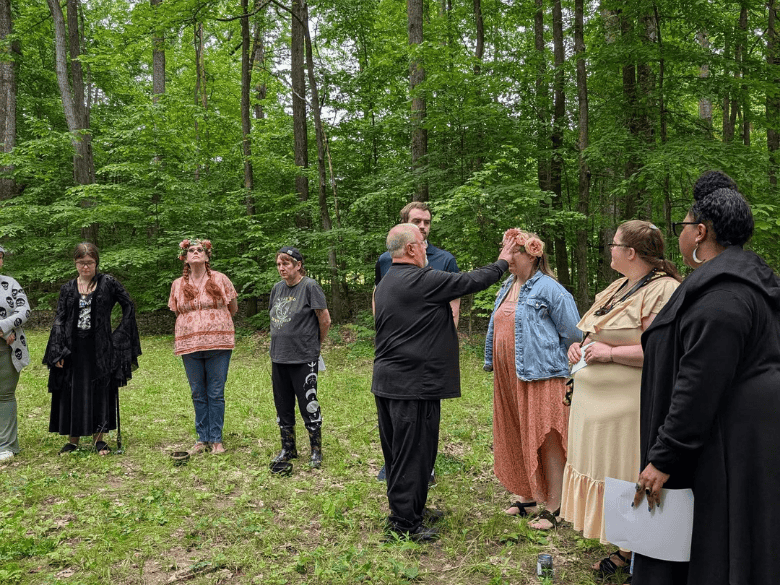
High Priest, representing The God, offering Blessings in Circle
Balance
Every person’s path is their own, and I am not here to say that no one works with gods. Every group/church/coven’s path is unique, and they will incorporate the deities that best fit their group. I do not mean to imply that Pagans shun The God or male deities because of Christianity. But in the greater spiritual community, I see a lack of attention and devotion to gods. And again, while I can see some of the reasoning behind this movement, I also know that it is an out of balance practice, just as much as The Church ignoring the Divine Feminine is.
I struggle with the Summer Sabbats in my tradition. Midsummer and Lughnasadh are a chore for me personally. I used to feel bad about this until I realized that I am not the only Southern Pagan who can’t dredge up the energy in the hottest part of the year to do much. It was also very freeing to be reminded that I don’t have to celebrate Litha or Lammas the way I celebrate Mabon or Beltane with a much bigger to do. But the one saving grace for Midsummer is that it is a holiday that primarily focuses on The God. I have yet to find my personal saving grace for Lughnasadh though. I know it’s the bread holiday, but for some reason that doesn’t excite me much. I eat bread everyday.
Gods in Paganism
When I began to really embrace Paganism it was the Egyptian deities that drew me in. Have you heard the idiom that every child has an Ancient Egyptian phase? Well, I never grew out of that. I even thought I wanted to be an Egyptologist and when I enrolled in college, that was my plan. I quickly realized that was a dead end career for most people. I also didn’t want to spend half of my adult life in college when I had already spent my entire childhood in school. I am one of the lucky ones though, as my art history major has come in surprisingly helpful in my spiritual and professional path.
The first Pagan deity that I ever worked with was Horus. And I am not unaware of how Jesus-like Horus can be. Perhaps that was the plan. Send a god who has some familiarities to soften the landing. And the landing was relatively soft on all fronts, until Sekhmet showed up.
Over the years, I have worked with a large variety of deities from all over the world. And I am very honored to include many gods on that list. I have a soft spot for misunderstood deities which means my altars are filled with representations of deities like Sobek, Sutekh, Ogun, Loki, Fenrir and Baron Samedi. I also have statues of many lesser known deities such as Min, Ptah, Bes, Shu, Geb, Hapi, Khnum, Khepri and the Apis Bull from Egyptian mythology next to Anubis, Thoth, Ra and Horus. Ogun, Shango, and Elegua are some of the Orishas who have shown up in my life at various times.
I will say that my Norse Pagan practice features more male deities than many other heavily practiced traditions. Perhaps that is one reason I resonated with it so much. Every ritual I lead with my Norse kindred includes the honoring of at least one male deity. It is summer now, so we’ll spend the next couple of months plying Freyr and Thor with offerings for a good harvest. Our last ritual involved working with Tyr, Odin, and Freyr (along with Freya). As we wind down the year with fall and winter, there will be more focus on Odin as a god of the dead and the Yule Father.
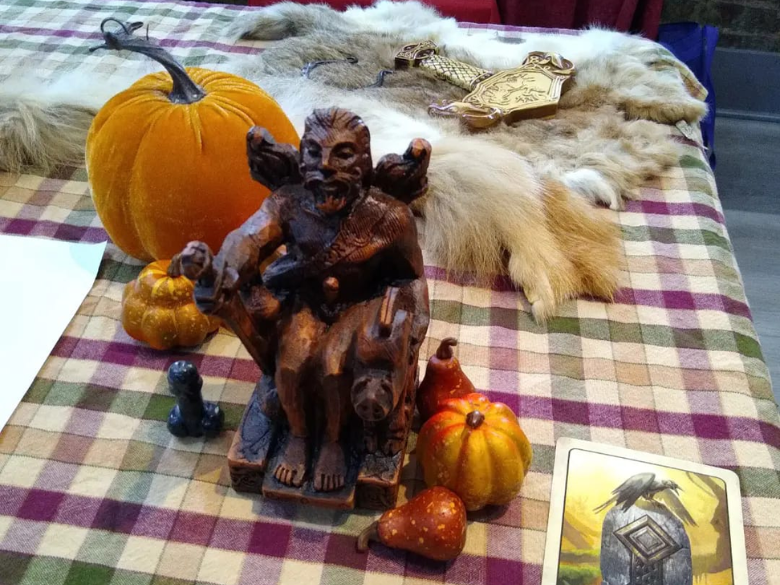
Norse God Freyr on Altar
Thank You for Coming to my TED Talk
To summarize my soapbox, TED talk here, I want to encourage everyone to balance their spiritual practice by honoring a god alongside a goddess. There will be times in your life that your goddess is forefront in your practice, and that is ok. This has been my reality lately. I believe a well-rounded spiritual practice includes a meaningful relationship with a god. While I don’t always view the gods as heavenly parents, I do feel we need the love, lessons, and guidance of both gods and goddesses. Each offers unique wisdom, and just as there are many expressions of the Goddess, so too are there many faces of the God. To cultivate a balanced path, we must make space in our hearts for the Divine Masculine.
Previous Post
May 27, 2025
Speaking with a Pagan Wordsmith - Katherine Genet
Next Post
July 17, 2025 Lughnasadh for the Less Enthused
Browse Our Archives
Select a Category Dark Goddess Divination Divine Masculine Just for Fun Sabbats Spells Tarot Teaching Thoughts Uncategorized
Select a Month October 2026 August 2026 July 2026 June 2026 May 2026 April 2026 March 2026 February 2026 January 2026 December 2025 November 2025 October 2025 September 2025 August 2025 July 2025 June 2025 May 2025 April 2025 March 2025 February 2025 January 2025 December 2024 November 2024 October 2024 September 2024 August 2024 July 2024 June 2024 May 2024 April 2024 March 2024 February 2024 January 2024 December 2023 November 2023 October 2023 September 2023
Follow Us!
TAKE THE
Religious Wisdom Quiz
How many books in the Bible are classified as poetry?
Select your answer to see how you score.
6 5 7 4
Related posts from Light Your Path
Honoring the Final Days of Winter

The God Wheel: Archetypes Across the Seasons
Was That a Sign… or Just a Beautiful...
TRENDING AT PATHEOS Pagan

When Halloween Unmasks Married Hearts
Written by Dr. David K. Ewen from Eternal Truth Bible College Behind...

Aristotle. He’s been called the father of logic, the father of the...

Methodist Central Hall and Westminster Abbey
Situated on the same square is Methodist Central Hall and Westminster Abbey. ...

57th Dove Awards Honor Dolly Parton, Crown New...
On gospel music’s biggest night, the 57th annual GMA Dove Awards honored...

The First Eucharistic Controversy: Christ’s Real Presence
For Catholics, the Eucharist is the source and summit of the Christian...

What a Stop Sign Can Teach Us About...
How to Make a Decision When You Can't Hear God Main point:...
view all Pagan blogs
Ad-Free & Subscriber Log-In Subscription Support
- About Us
- 2026 Calendar
- Videos
- Podcasts
- Library of World Religions
- Faith In Media Tracker
- Advertise With Us
- Write for Us
- Privacy Policy
- Terms of Service
- Do Not Sell My Data
- Contact Us
- Radiant Digital
- Manage Newsletter Subscriptions
- Unsubscribe From Notifications
- Sitemap
Copyright 2008-2026, Patheos. All rights reserved.
Subscription Support Ad-Free & Subscriber Log-In
Follow Patheos