
BuddhistCatholicContemplativeEvangelicalGeneral ChristianHinduJewishLatter-day SaintMuslimNew VisionsProgressive Christian
Beliefs
- Buddhist
- Catholic
- Contemplative
- Evangelical
- General Christian
- Hindu
- Jewish
- Latter-day Saint
- More Voices
- Muslim
- New Visions
- Pagan
- Progressive Christian
Topics
- Religion News
- Food and Religion
- Sports and Religion
- Religious Art
- Religious Music and Entertainment
- Religious Events
- History and Religion
- Style and Religion
- Politics and Religion
- Women in Religion
- Recreation Outdoors and Religion
- Business Finance and Religion
- Careers Workplace and Religion
- Education and Religion
- Family Parenting and Religion
- Health Fitness and Religion
- Home and Religion
- Relationships and Religion
- Technology and Religion
- Travel and Religion
Columnists
- Buddhist Columnists
- Business Finance and Religion Columnists
- Careers Workplace and Religion Columnists
- Catholic Columnists
- Contemplative Columnists
- Education and Religion Columnists
- Evangelists Columnists
- Family Parenting and Religion Columnists
- General Christian Columnists
- Health Fitness and Religion Columnists
- Hindu Columnists
- History and Religion Columnists
- Home and Religion Columnists
- Jewish Columnists
- More Voices Columnists
- Latter Day Columnists
- Muslim Columnists
- New Visions Columnists
- Nonreligious Columnists
- Pagan Columnists
- Politics and Religion Columnists
- Progressive Columnists
- Recreation Outdoors and Religion Columnists
- Relationships and Religion Columnists
- Religion News Columnists
- Religious Art Columnists
- Religious Events Columnists
- Religious Music and Entertainment Columnists
- Sports and Religion Columnists
- Style and Religion Columnists
- Technology and Religion Columnists
- Travel and Religion Columnists
- Women in Religion Columnists
Resource Library
- 2026 Calendar
- Library of World Religions
- The 100 Most Holy Places on Earth
- Patheos Answers
- Podcasts
- Videos
- Faith Leaders Database
- Anglican Episcopalian
- Bahai
- Baptist
- Buddhism
- Christianity
- Confucianism
- Eastern Orthodoxy
- Hinduism
- Holiness and Pentecostal
- ISKCON
- Islam
- Judaism
- Lutheran
- Methodist
- The Church of Jesus Christ of Latter-day Saints
- New Age
- Paganism
- Presbytarian and Reformed
- Protestantism
- Religion Behind the Scenes
- Roman Catholic
- Scientology
- Shia Islam
- Sikhism
- Sufism
- Sunni Islam
- Taoism
- Zen
- See all religions
Research Tools
 Ad-Free & Subscriber Log-In Subscription Support
Ad-Free & Subscriber Log-In Subscription Support
Follow Patheos 

- Trending:
- Forgiveness
- |
- Marriage
- |
- Consciousness
- |
- Death Penalty
- |
- Election
- |
- Halloween

- Home
- Pagan
- Education and Religion
- Let the Egyptian God Bes Bring You Joy
Let the Egyptian God Bes Bring You Joy
Last updated on: November 21, 2024 at 12:12 pm by Rev. Emily Guenther
Let the Egyptian God Bes Bring You Joy 2024-11-21T12:12:18-06:00 Rev. Emily Guenther
Patheos Explore the world's faith through different perspectives on religion and spirituality! Patheos has the views of the prevalent religions and spiritualities of the world.
There has been a lot of talk, and writing, lately about ways to support our communities and find strength. I may sound like a broken record, but the longer the tower times progress, the more I am called back to the messages Loki has given us. Part of his message is that we need to find our joy.
When asked to find your joy, you may have certain things that come to mind. Certain people, certain gods. When talking about finding joy, my mind usually returns to a certain deity who is known to be a protector but also known for making people laugh. His name is Bes, and he is an Ancient Egyptian deity who I have always loved. And you can find my essay on Bes in this book.
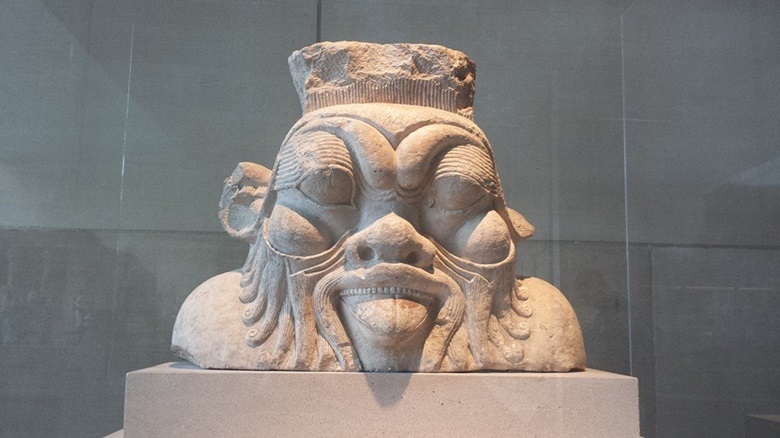
Bes statue at The Metropolitan Museum of Art NYC / Author’s photo
Who is Bes?
Bes’ origins are lost in history, but in one form or another, he was worshipped by the Ancient Egyptians since Old Kingdom times (2686 –2181 BCE). Bes is the Ancient Egyptian demon-queller, protector of the home, women, children and childbirth.
The god whom we now know as Bes may have begun as a variety of other protector deities who were all eventually assimilated into the dwarf-lion Bes. Other dwarf deities with very similar natures to that of Bes include Aha, who was the earliest incarnation of the dwarf god, and the god Hayet. Appearing in the Middle Kingdom (2055 BC – 1650 BCE), Aha was a war-like god who was depicted face-on with legs bent, wearing a lion mask and tail, and holding snakes. Hayet was an exorcist who warded off demonic spirits, especially through dance. He was characterized by having a beard, a crown with five tall feathers, a lion tail and a belt. Other deities, called Tetetenu, Kherau, Amam, Mefdjet and Menew were also associated with, and could be merged with, the dwarf god Bes. Most of these names are related to violence, such as strife, fighting, lamenting, et cetera.
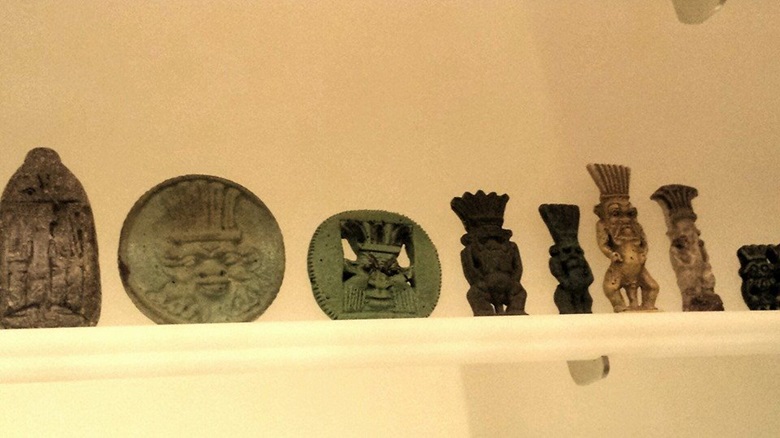
Bes iconography at The Metropolitan Museum of Art NYC / Author’s photo
Bes’ Role in Ancient Egypt
The Ancient Egyptians believed that life and the world was filled with dangers and demons. Demons could take various guises in Ancient Egypt; therefore one had to be sure to live purely and truthfully, and to also be aware of their environments. The idea that gods such as Bes were there to protect people from not only supernatural dangers, but also mundane dangers such as snakes and crocodiles, must have brought great comfort to the people of Ancient Egypt.
Bes has a Unique Appearance
Bes is portrayed as a dwarf god with leonine features. He has short legs, an enlarged head with a beard and a protruding tongue. Bes is often shown with a lion’s mane, lion’s tail or wearing the skin of a lion. Sometimes Bes is shown with a large belly and breasts, perhaps to indicate his protection over pregnant women. In his hands he carries the tools of his trade.
Images of Bes show him carrying rattles and other musical instruments that he would use to scare away demons intent upon causing harm. Some images show Bes carrying an infant, knives or other weapons, or the hieroglyph “sa” which means protection. The “sa” symbol was carried by both Bes and his wife Taweret – the hippopotamus goddess of childbirth and protection, and was used as an amulet by the Ancient Egyptians.
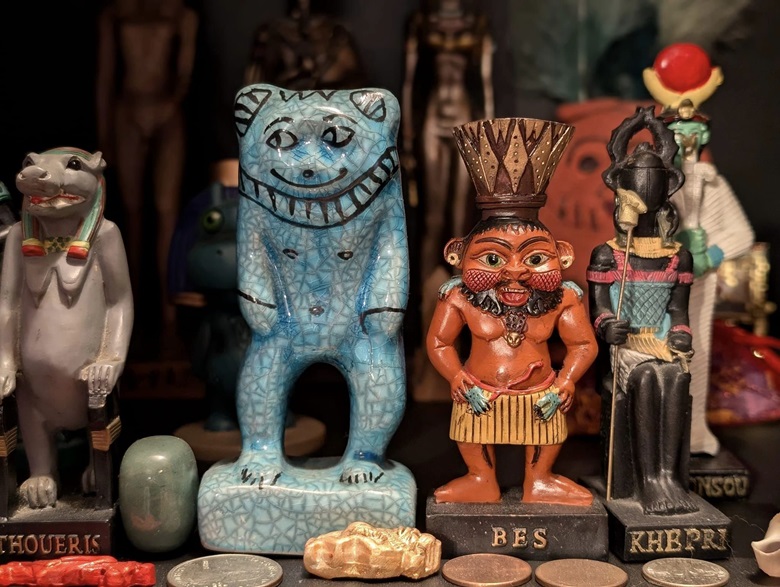
Bes statues / Author’s photo
Bes is one of only two Ancient Egyptian deities portrayed fully facing the observer. Most Egyptian deities are portrayed in profile. The other deity shown face forward is Hathor. Hathor and Bes share connections through their protection, love of music and dance, and the fact that both deities are thought to have originated outside of the land of Egypt.
Bes as a Protector Deity
In his role as protector of women, children and childbirth, Bes’ image was carved or painted on furniture and walls in nurseries or birthing houses. In fact, Bes is one of the few gods that artifacts show was popular with the common people of Ancient Egypt. The Egyptians also saw Bes as one who not only protected but entertained children. When a child smiled for no reason, it was thought that Bes was pulling faces at the child to make them laugh. He is thought to entertain through dancing and singing, and so he was also thought to be a god of happiness and joviality. Bes uses dancing and singing to both entertain children and scare away demons and danger.
It was during the Greek Period (332 – 30 BCE) that the worship of Bes became widespread. The numbers of amulets and charms, as well as reliefs at the temples show how popular the ‘Great Dwarf’ god became. There were even oracles of Bes, to whom the people would ask questions of, written on papyrus.
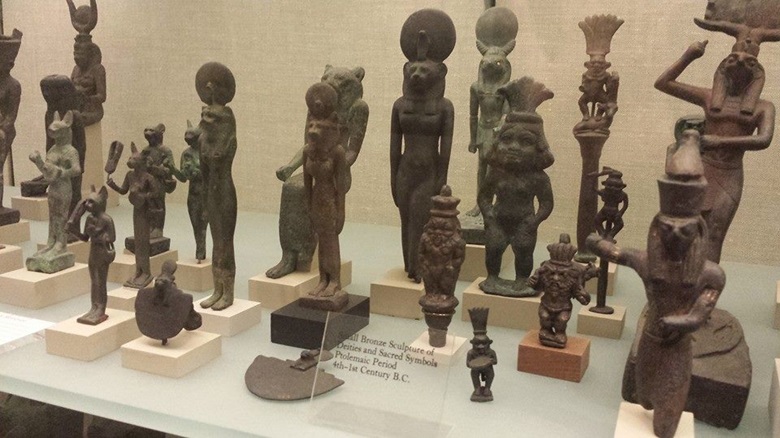
Deity statues, including Bes, at The Metropolitan Museum of Art NYC / Author’s photo
Bes had no temples and no priesthood other than his oracle, although he was a major deity at Khemenu during the Middle Kingdom (2055 BC – 1650 BCE). Later in Egyptian history, statues and depictions of Bes were found in most homes throughout the land of Egypt. Although not originally one of the more famous of the gods, Bes came to be loved by the people of Egypt. It was the dwarf god-demon Bes that they came to call on for protection in their daily lives.
Bes in Modern Times
Modern Pagans who wish to connect with Bes may consider inviting him into their homes and asking him to help protect it. Singing, dancing, and making merry are also ways to connect with Bes and honor him. Handmade crafts made in his image or honor are also well received by the jovial yet fierce god.
Bes was a god of the common people and most of his relics and altars would have been made of mud and other material that did not survive. Very little of the Ancient Egyptian common people’s spiritual practices have survived, most of what we know of Ancient Egypt comes from the ruling class and the things they built in stone. Because Bes was not a god honored often by the royals, much of his lore and worship has been lost.
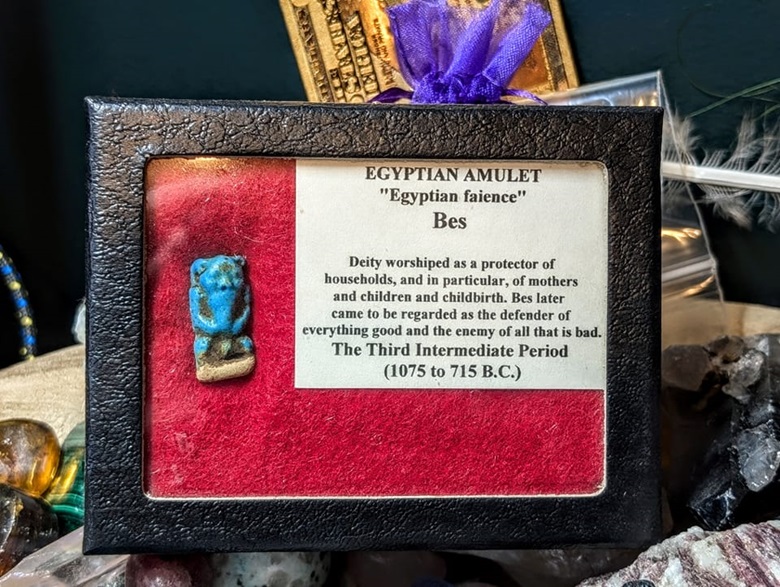
Bes amulet / Author’s photo
When I first encountered Bes during mediation, I feel that he was equally surprised to see me as I was him. I believe that when someone connects with an obscure deity, there is a chance they will be met with surprise as I was. But a person might also be met with gratitude. Some Pagans, and some non-Pagans to be sure, believe that our ancestors and perhaps even our gods will live on as long as they are remembered and worshiped. Our deities need our offerings, energy and prayers to continue to exist and do the work that they are doing. So when a relatively unknown god such as Bes finds himself face to face with an unexpected worshipper, there may be gratitude for helping keep their name alive. And there is powerful magick in having a god like that on your side.
Previous Post

November 7, 2024
One Pagan's Thoughts Post-Election
Next Post
December 12, 2024 Was My Prediction for 2024 Accurate?
Browse Our Archives
Select a Category Dark Goddess Divination Divine Masculine Just for Fun Sabbats Spells Tarot Teaching Thoughts Uncategorized
Select a Month October 2026 August 2026 July 2026 June 2026 May 2026 April 2026 March 2026 February 2026 January 2026 December 2025 November 2025 October 2025 September 2025 August 2025 July 2025 June 2025 May 2025 April 2025 March 2025 February 2025 January 2025 December 2024 November 2024 October 2024 September 2024 August 2024 July 2024 June 2024 May 2024 April 2024 March 2024 February 2024 January 2024 December 2023 November 2023 October 2023 September 2023
Follow Us!
TAKE THE
Religious Wisdom Quiz
"Let your ________ before men, that they may see your good deeds and praise your Father in heaven."
Select your answer to see how you score.
Voice Be Raised Light So Shine Conscience Be Clear Face Shine
Related posts from Light Your Path

A Tour of February's Lesser Known Pagan Festivals
Full Circle for 2026: The Wheel and the...
TRENDING AT PATHEOS Pagan

Emotion in Early Christianity by Andrew Crislip
Andrew Crislip’s Emotion in Early Christianity examines an often overlooked dimension of...

16 Spiritual Touchstones for a More Grounded Life
After decades of spiritual study, here are 16 principles I try...

Catholic Evangelization: Sharing Your Faith Every Day
Welcome back to the Graceful Awakening mini-series called, “From Faith to Mission.” ...

The Pillar of the Boatmen: the Ancient Monument...
The Pillar of the Boatmen is a Romano-Gaulish sculpture that dates from...

In one sense walking into Westminster Abbey is like walking down the...

'Super Scam Me' Exposes AI Jon Bon Jovi...
Leslie Pickett believed she was in a relationship with Jon Bon Jovi....
view all Pagan blogs
Ad-Free & Subscriber Log-In Subscription Support
- About Us
- 2026 Calendar
- Videos
- Podcasts
- Library of World Religions
- Faith In Media Tracker
- Advertise With Us
- Write for Us
- Privacy Policy
- Terms of Service
- Do Not Sell My Data
- Contact Us
- Radiant Digital
- Manage Newsletter Subscriptions
- Unsubscribe From Notifications
- Sitemap
Copyright 2008-2026, Patheos. All rights reserved.
Subscription Support Ad-Free & Subscriber Log-In
Follow Patheos