
BuddhistCatholicContemplativeEvangelicalGeneral ChristianHinduJewishLatter-day SaintMuslimNew VisionsProgressive Christian
Beliefs
- Buddhist
- Catholic
- Contemplative
- Evangelical
- General Christian
- Hindu
- Jewish
- Latter-day Saint
- More Voices
- Muslim
- New Visions
- Pagan
- Progressive Christian
Topics
- Religion News
- Food and Religion
- Sports and Religion
- Religious Art
- Religious Music and Entertainment
- Religious Events
- History and Religion
- Style and Religion
- Politics and Religion
- Women in Religion
- Recreation Outdoors and Religion
- Business Finance and Religion
- Careers Workplace and Religion
- Education and Religion
- Family Parenting and Religion
- Health Fitness and Religion
- Home and Religion
- Relationships and Religion
- Technology and Religion
- Travel and Religion
Columnists
- Buddhist Columnists
- Business Finance and Religion Columnists
- Careers Workplace and Religion Columnists
- Catholic Columnists
- Contemplative Columnists
- Education and Religion Columnists
- Evangelists Columnists
- Family Parenting and Religion Columnists
- General Christian Columnists
- Health Fitness and Religion Columnists
- Hindu Columnists
- History and Religion Columnists
- Home and Religion Columnists
- Jewish Columnists
- More Voices Columnists
- Latter Day Columnists
- Muslim Columnists
- New Visions Columnists
- Nonreligious Columnists
- Pagan Columnists
- Politics and Religion Columnists
- Progressive Columnists
- Recreation Outdoors and Religion Columnists
- Relationships and Religion Columnists
- Religion News Columnists
- Religious Art Columnists
- Religious Events Columnists
- Religious Music and Entertainment Columnists
- Sports and Religion Columnists
- Style and Religion Columnists
- Technology and Religion Columnists
- Travel and Religion Columnists
- Women in Religion Columnists
Resource Library
- 2026 Calendar
- Library of World Religions
- The 100 Most Holy Places on Earth
- Patheos Answers
- Podcasts
- Videos
- Faith Leaders Database
- Anglican Episcopalian
- Bahai
- Baptist
- Buddhism
- Christianity
- Confucianism
- Eastern Orthodoxy
- Hinduism
- Holiness and Pentecostal
- ISKCON
- Islam
- Judaism
- Lutheran
- Methodist
- The Church of Jesus Christ of Latter-day Saints
- New Age
- Paganism
- Presbytarian and Reformed
- Protestantism
- Religion Behind the Scenes
- Roman Catholic
- Scientology
- Shia Islam
- Sikhism
- Sufism
- Sunni Islam
- Taoism
- Zen
- See all religions
Research Tools
 Ad-Free & Subscriber Log-In Subscription Support
Ad-Free & Subscriber Log-In Subscription Support
Follow Patheos 

- Trending:
- Forgiveness
- |
- Marriage
- |
- Consciousness
- |
- Death Penalty
- |
- Election
- |
- Halloween

- Home
- Catholic
- What is “Christian Nationalism”? A Reply to Dennis Knapp
What is “Christian Nationalism”? A Reply to Dennis Knapp
Last updated on: August 13, 2026 at 9:58 pm by Edwin Woodruff Tait
What is “Christian Nationalism”? A Reply to Dennis Knapp 2026-08-13T21:58:03-05:00 Edwin Woodruff Tait
Patheos Explore the world's faith through different perspectives on religion and spirituality! Patheos has the views of the prevalent religions and spiritualities of the world.
Preliminary Considerations
My fellow Patheos blogger Dennis Knapp of “The Latin Right” has raised an excellent question about the meaning of the term “Christian nationalism.” Knapp is responding in turn to an article by Henry Karlson which condemns Christian nationalism. He seems to agree that Christian nationalism, as Karlson describes it, is a bad thing.
Knapp then raises the concern that progressive Christians define any attempt by conservatives to influence society with Christian principles as “Christian nationalism.” I don’t think this is particularly fair as a criticism of Karlson’s article. The closest Karlson gets to such an argument is a dismissive reference to the “culture wars” as something Trump wants Christians to focus on.
I have noticed Knapp take this rather unfair approach to other Catholic Patheos bloggers before. Several years ago he wrote a hostile review of Mark Shea’s excellent book The Church’s Best-Kept Secret. I reviewed that book myself here. Mr. Knapp saw Mark’s book as essentially an argument trying to persuade Catholics to vote for “progressive” politicians, and chose the title, “An InConsistent Life Ethic,” but he failed to show any actual inconsistency in the interpretation of Catholic social ethics Mark defends. Similarly, in his criticism of Karlson he seems to be attacking what he sees as the political agenda behind Karlson’s post rather than anything Karlson actually says.
An Overused Term
I don’t want to take a similarly unfair approach to Mr. Knapp’s post. As I said, he raises an excellent question and I’m happy to address it. Many progressive Christians do use the term “Christian nationalism” far too loosely. Many progressives, whether secular or religious, also have a habit of accusing conservatives of “mixing faith and politics” while being happy to do so themselves. (Similarly, a lot of conservatives seem to think that, for instance, speaking up for the rights of immigrants is “political” while opposing legal abortion isn’t. The inconsistency goes both ways.)
Two Sides to Christian Nationalism
There are two complementary ways in which something may be said to be “Christian nationalism.” One side of “Christian nationalism” is the nationalization of Christianity–i.e., deploying Christianity to promote national identity. This tends, on the whole, to be something conservatives do, but not all conservatives do it. For instance, some traditionalist Catholics are quite anti-American. (Of course, this is why Protestants once saw Catholics as inherently disloyal, just as many Christians see Muslims today. And of course Islamists would be another example of ultra-conservative religious people who are not nationalistic. Even in historically Muslim countries, Sunni Islamists, at least, tend to be opposed to specific national identities.) This is the aspect of Christian nationalism that Mr. Knapp is willing to criticize, at least when it goes too far. (We might disagree on how far is too far, but let’s take the common ground here and move on.)
But there’s another side of Christian nationalism. This is the desire to have Christian values shape the policies and social mores of the nation. For decades, conservative American Christians have complained about America “turning away from God” and have longed to restore the days when America was a “Christian country.” So Christian nationalism, in an American context, is basically the view that America should be a Christian country.
We All Mix Politics and Religion
Of course, this can mean many things. Knapp is absolutely right that progressive Christians also want certain Christian values to shape politics and society. It’s easy to find memes arguing that a truly Christian America would feed the hungry, care for the poor, provide free health care, and so on. Is this “Christian nationalism”? If so, I’m all in favor of it. I have no truck with the idea that “politics and religion should be kept separate,” and I have never seen a consistent application of this dubious idea. (In other words, pretty much everyone likes religiously based politics if it’s the right kind of politics.)
One obvious difference between the two agendas is that the “Christian left” is broadly in agreement with a wide range of other progressives. This is why conservatives often accuse us of being “secularized” or “succumbing to the Zeitgeist.” Generally speaking, a lot of non-religious people will agree that it’s a good thing to scale back the military, abolish capital punishment, provide universal health care, strengthen free public education, ensure that no one is hungry or homeless, and so on. They are less likely to agree that we should protect unborn life or encourage lifelong, monogamous, heterosexual marriage as the universally preferable norm for sexual activity.
But there are Real Differences
In short, one reason to call the conservative Christian vision “Christian nationalism” is that it involves trying to impose laws and social policies that the non-Christian segment of the population generally opposes. Furthermore, many conservative Christians explicitly worry about the loss of Christian dominance in society.
Many are deeply worried about the prospect of a growing Islamic presence in the US, and point to what they see as an already disastrously high Islamic presence in Europe. Since Muslims tend, on the whole, to be the one major non-Christian group that agrees with conservative Christians on the “hot-button issues” (particularly on homosexuality), this is clear evidence that many conservative Christians really do just want Christian dominance. It’s not just Christian moral values they promote, but Christian hegemony. (Peter Kreeft’s call, in the 90s, for an “ecumenical jihad” is a counter-example. I don’t know if he has changed his view at all, but at that time he saw Muslims as potential allies.)
Full-blown Christian Nationalism
So a full-blown Christian nationalist is someone who wants their nation to be explicitly Christian, with a dominant Christian presence and other religious groups in something corresponding to the traditional Islamic “dhimmi” status–tolerated but clearly subordinate. (Of course, some Christian nationalists want there to be no non-Christians in the country at all, but that’s a very extreme position–even Doug Wilson doesn’t go that far.)
At the same time, a full-blown Christian nationalist will argue that Christianity supports the unique values and interests of their particular nation-state. An American Catholic who is a Christian nationalist will, for instance, argue that a strict policy on immigration is entirely compatible with Catholic teaching. Such a Catholic will be disposed to criticize the Pope and dismiss his authority if the Pope calls for a more open attitude to immigration. He may, for instance, cite the “order of charity” as a justification for policies that prioritize the perceived interests of those “already” in the country over those who wish to immigrate.
In other words, I would argue that Vice President Vance is a Christian nationalist, and an example of what a Catholic version of Christian nationalism looks like. Secretary of War Pete Hegseth is a more extreme example of a Christian nationalist. But is it “Christian nationalism” simply to want to have laws banning abortion, or defining marriage as the union of a man and a woman? I wouldn’t use the term in that context myself, if there weren’t other reasons to use it.
The Question that Remains
This leaves the bigger and more complex question: which Christian beliefs and values should we seek to enact as law or social policy? Knapp is absolutely right that conservative and liberal Christians differ not on whether we should seek to shape politics and society with Christian values, but which ones we should prioritize. And, of course, one reason we may disagree about that is that we may disagree about what Christian values should be in the first place.
Conservative Catholics, of course, see such disagreements as simply a matter of liberal heresy. Some will argue that there are no “conservative” or “liberal” Catholics, just orthodox Catholics vs. heretics who aren’t really Catholic at all. I have long argued that “conservative” and “liberal” are terms we need to use to describe good-faith differences in the interpretation of Catholic teaching. I’ve also argued for the legitimacy of “faithful dissent.” So I’m not going to argue that conservatives can’t dissent too. (An example of conservative dissent would be Thomas Woods’ rejection of the concept of the “just wage.” And yes, I think it is a rejection, not simply an interpretation, but that’s a separate argument.) I think pretty consistently that they are wrong to do so. But I am not going to say that they aren’t Catholics.
Three Levels of Disagreement
It seems to me that there are three levels of disagreement possible over the application of Church teaching to politics:
1. We may differ because one side actually dissents from official Church teaching in the first place.
2. We may differ because we interpret Church teaching differently, with both sides fully submitting to all official Magisterial teaching on the subject.
3. Or we may differ even though we agree on doctrine, because one group thinks that this particular teaching is not one that should be enacted into law while the other thinks it should. We could further divide this category into differences of principle and of prudence. (So some Catholics might think that in principle we should not prevent gay couples from entering into legal marriage with the full rights of such a status, while others might think that it would be a bad idea to try to do so under present circumstances.)
To Be Continued
Of course, these categories overlap. One of the things we disagree about is whether a given position really contradicts Church teaching. And the Church has at times expressed itself on the question of whether particular moral teachings should be enacted into law. (Abortion is one obvious example, but just price and the right to immigrate would be others.) So even that third category can become a matter of dissent–and one of the genuine doctrinal disagreements among Catholics is over the status of these kinds of papal statements about what the law should be.
Obviously there’s a lot more to unpack here than I can do in this blog post, so I’ll draw to a close. I would welcome further dialogue with Mr. Knapp on these points. The bottom line is that I agree with him that progressive and conservative Catholics have different visions of what it looks like to shape society according to Christian values. We should try to understand where and why we differ rather than simply throwing slurs at each other.
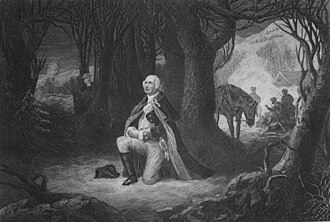
Image: George Washington praying at Valley Forge. Engraving by John C. McRae, 1866, based on a painting by Henry Brueckner. Wikimedia Commons.
Previous Post

August 5, 2026
Love Ordered and Disordered
Browse Our Archives
Select a Category apologetics Bible Catholicism Christianity economics history Middle Ages personal Reformation Rodney Stark Uncategorized
Select a Month August 2026 June 2026 January 2026 December 2025 October 2025 June 2025 February 2025 December 2024 November 2024 June 2024 May 2024 January 2024 December 2023 April 2023 December 2022 November 2022 September 2022 July 2022 June 2022 April 2022 November 2021 September 2021 March 2021 February 2021 January 2021 December 2020 November 2020 October 2020 August 2020 July 2020 June 2020 May 2020 December 2018 October 2018 June 2018 March 2018 December 2017 November 2017 October 2017 September 2017 May 2017 April 2017 March 2017 February 2017 January 2017 December 2016 November 2016 October 2016 September 2016 August 2016 July 2016 June 2016 May 2016 April 2016 March 2016 January 2016 December 2015 November 2015 September 2015 June 2015 May 2015 April 2015 March 2015 February 2015 January 2015 December 2014 November 2014 October 2014 August 2014 June 2014 March 2014 January 2014 September 2013 August 2013 June 2013 August 2012 July 2012 October 2011 June 2011 March 2011 July 2010 March 2010 January 2008 May 2007 April 2007 February 2007 October 2006 August 2006 March 2006 January 2006 November 2005 October 2005 September 2005 August 2005 June 2005 May 2005 April 2005 March 2005 February 2005 January 2005 December 2004 November 2004 September 2004
Follow Us!
TAKE THE
Religious Wisdom Quiz
What did Jesus use to heal a blind man in John 9?
Select your answer to see how you score.
A fig leaf Olive oil Mud and saliva His robe
Related posts from Light in the West



The Dragon's War and the Virgin's Dreams
TRENDING AT PATHEOS Catholic

Rejecting Doom: Christian Hope And Human Action
Christianity is a religion of hope. We are to have hope and...

It’s What Comes From Within Which Matters
One of the most difficult things for us to understand is why...

Why I Choose the Eucharist Over the Sermon
Choose the Eucharist, Not the Sermon What are we supposed to get...

5 Design Elements Found in Spiritually Rooted Homes
Putting Spirituality Into Home Decor Our homes are more than our living...

Credo: A Story of God Told with the...
About 10 years ago, I began to imagine a personal "Credo" that...

The Anatomy of Divine Revelation in Catholic Thought
The claim that God has made Himself known to human beings is...
view all Catholic blogs
Ad-Free & Subscriber Log-In Subscription Support
- About Us
- 2026 Calendar
- Videos
- Podcasts
- Library of World Religions
- Faith In Media Tracker
- Advertise With Us
- Write for Us
- Privacy Policy
- Terms of Service
- Do Not Sell My Data
- Contact Us
- Radiant Digital
- Manage Newsletter Subscriptions
- Unsubscribe From Notifications
- Sitemap
Copyright 2008-2026, Patheos. All rights reserved.
Subscription Support Ad-Free & Subscriber Log-In
Follow Patheos