
BuddhistCatholicContemplativeEvangelicalGeneral ChristianHinduJewishLatter-day SaintMuslimNew VisionsProgressive Christian
Beliefs
- Buddhist
- Catholic
- Contemplative
- Evangelical
- General Christian
- Hindu
- Jewish
- Latter-day Saint
- More Voices
- Muslim
- New Visions
- Pagan
- Progressive Christian
Topics
- Religion News
- Food and Religion
- Sports and Religion
- Religious Art
- Religious Music and Entertainment
- Religious Events
- History and Religion
- Style and Religion
- Politics and Religion
- Women in Religion
- Recreation Outdoors and Religion
- Business Finance and Religion
- Careers Workplace and Religion
- Education and Religion
- Family Parenting and Religion
- Health Fitness and Religion
- Home and Religion
- Relationships and Religion
- Technology and Religion
- Travel and Religion
Columnists
- Buddhist Columnists
- Business Finance and Religion Columnists
- Careers Workplace and Religion Columnists
- Catholic Columnists
- Contemplative Columnists
- Education and Religion Columnists
- Evangelists Columnists
- Family Parenting and Religion Columnists
- General Christian Columnists
- Health Fitness and Religion Columnists
- Hindu Columnists
- History and Religion Columnists
- Home and Religion Columnists
- Jewish Columnists
- More Voices Columnists
- Latter Day Columnists
- Muslim Columnists
- New Visions Columnists
- Nonreligious Columnists
- Pagan Columnists
- Politics and Religion Columnists
- Progressive Columnists
- Recreation Outdoors and Religion Columnists
- Relationships and Religion Columnists
- Religion News Columnists
- Religious Art Columnists
- Religious Events Columnists
- Religious Music and Entertainment Columnists
- Sports and Religion Columnists
- Style and Religion Columnists
- Technology and Religion Columnists
- Travel and Religion Columnists
- Women in Religion Columnists
Resource Library
- 2026 Calendar
- Library of World Religions
- The 100 Most Holy Places on Earth
- Patheos Answers
- Podcasts
- Videos
- Faith Leaders Database
- Anglican Episcopalian
- Bahai
- Baptist
- Buddhism
- Christianity
- Confucianism
- Eastern Orthodoxy
- Hinduism
- Holiness and Pentecostal
- ISKCON
- Islam
- Judaism
- Lutheran
- Methodist
- The Church of Jesus Christ of Latter-day Saints
- New Age
- Paganism
- Presbytarian and Reformed
- Protestantism
- Religion Behind the Scenes
- Roman Catholic
- Scientology
- Shia Islam
- Sikhism
- Sufism
- Sunni Islam
- Taoism
- Zen
- See all religions
Research Tools
 Ad-Free & Subscriber Log-In Subscription Support
Ad-Free & Subscriber Log-In Subscription Support
Follow Patheos 

- Trending:
- Forgiveness
- |
- Marriage
- |
- Consciousness
- |
- Death Penalty
- |
- Election
- |
- Halloween

- Home
- Catholic
- Why Beth Felker Jones is a Protestant, Part 1
Why Beth Felker Jones is a Protestant, Part 1
Last updated on: October 13, 2025 at 8:59 pm by Edwin Woodruff Tait
Why Beth Felker Jones is a Protestant, Part 1 2025-10-13T20:59:14-05:00 Edwin Woodruff Tait
Patheos Explore the world's faith through different perspectives on religion and spirituality! Patheos has the views of the prevalent religions and spiritualities of the world.
And Can It Be?
Beth Felker Jones is a Methodist theologian whom I have known for years and whom I respect greatly. We first met at Duke when I was the “preceptor” (teaching assistant) for an intro church history class she was taking. I was a Ph.D. student and she was pursuing a master’s degree at the time, so it was my job to grade her papers. I took exception to her ending a paper on St. Augustine with quoting the entirety of Charles Wesley’s hymn “And Can It Be” and struck through the text of the hymn with red pen, saying that this was too long and not sufficiently relevant. That is to say, I thought that she was jumping from the fourth century to the eighteenth and reading pietistic Protestantism into Augustine. And as an arrogant young Ph.D. student, I thought that was the sort of thing I was supposed to be rooting out of the students at Duke Divinity School.
In spite of this inauspicious beginning, Beth and I have been friends for more than a quarter of a century now. I have learned far more from her than she from me. Indeed, she is one of several people I knew at Duke who taught me to rediscover the beauty of my own Wesleyan heritage. And so for twenty-five years I, like Beth, have been engaged in thinking about how Wesleyan evangelicalism relates to the faith of the early Church. When Beth was working on her book Marks of His Wounds, based on her dissertation, she sent me the chapter on Augustine for comments. And, once again, I disagreed–more respectfully that time, I hope. In that case it seemed to me that Beth was making Augustine more of a feminist than he was.
Charitable polemic
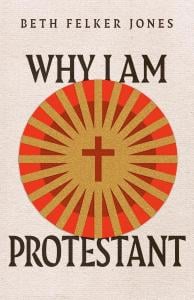
I mention this because in reading her most recent book, Why I Am a Protestant, I find that once again I’m arguing with her about Augustine. But more about that later. First some general comments about the book. It is part of an “Ecumenical Dialogue” series published by InterVarsity. The Catholic volume, by Matthew Levering, has already been published, though I have not yet read it, and there will be an Orthodox volume at some point. (Matthew is also a friend of mine from Duke, as it happens.) The purpose is for theologians from each tradition to “address the challenges and benefits” of the form of Christianity to which they adhere.
In keeping with the ecumenical, charitable purpose of the series, Beth’s book is generally not polemical and is generous in its recognition of the beauty and value of Catholic and Orthodox Christianity. Her first chapter is a beautiful exposition of the common heritage of “small o orthodox” Christianity shared by Protestants, Catholics, and Orthodox, focusing on the Trinitarian and Christological dogmas. Since she highlights the Ecumenical Councils, this does raise the question of how her staunch adherence to this common orthodoxy squares with her later disparagement of sharp doctrinal boundaries and institutional definitions of “the true Church.” But more on that later.
Between charity and polemic
The rest of the book is an argument that in spite of its problems (which on the whole she rather minimizes, from my admittedly biased perspective), Protestantism embodies this common Christian faith just as well as–even better than–Catholicism and Orthodoxy. Thus, she does become somewhat polemical, though never in an overly harsh way (honestly there are criticisms she could have made more strongly than she does), in order to make the case that there are defects in Catholicism and Orthodoxy that correspond to strengths in Protestantism.
Inevitably, given the history of Protestantism as a rejection of certain aspects of medieval Catholicism, she has to make such an argument in order to establish Protestantism as a viable alternative. The major weakness of the book, as I see it, is that the tension between ecumenism and the need to make a polemical case results in a great deal of vagueness. She often gives with one hand and takes away with the other. For her to make the case for Protestantism she wants to make, she needs to be able to condemn Catholicism more harshly than she is willing to do. (Naturally, I agree with her refusal to do so since, like her, I don’t think that more overtly polemical kind of Protestant argument holds up.)
Sola fide
The two classic pillars of Protestantism are “sola fide” and “sola scriptura.” Beth affirms both, but in a rather qualified way. She speaks a lot more about sola scriptura than sola fide, so I’ll start with sola fide and get it out of the way.
She affirms in several places that Protestants proclaim grace more clearly and effectively than Catholics do. This of course is a common claim. In some contexts and in some ways I think it’s actually a true claim. Certainly many people have heard a legalistic message of salvation in Catholicism, and many aspects of Catholic doctrine and practice can lend themselves to that distortion. That’s all Beth really claims. In fact she mostly focuses on late medieval Catholicism against which Luther reacted, and what she says about it is pretty uncontroversial: “But–in at least some circles in late medieval Roman Catholicism–that teaching [Augustine’s teaching which she says comes from Paul] was being distorted in ways that offered a false gospel to the people of God.” She goes on to say that “Late medieval Roman Catholicism . . . was never without grace.” (34)
Imputation–important or not?
I appreciate her generosity here, and obviously as a Catholic I agree. But without doubling down on a specific doctrinal claim on which she thinks Catholicism is erroneous, this is a fairly weak basis for justifying what actually happened in the Reformation. Luther and his followers believed that “Rome” was denying the Gospel. They hammered out specific doctrinal criticisms that isolated where they thought Rome went wrong. The key claim was that justification and sanctification have to be regarded as distinct, with justification defined as God’s declaration that we are righteous based on the imputation of Christ’s righteousness, and sanctification as the process of actually making us righteous. (Actually that second part is more of a Reformed way of putting it–Luther himself, as far as I can recall, doesn’t speak of sanctification in quite this way though he certainly says that good works will flow from faith.)
Beth summarizes this position on p. 105, drawing on Alister McGrath’s account of it in his Iustitia Dei. (She doesn’t mention McGrath’s acknowledgment that this understanding of justification was a “theological novum” and not found in Augustine. See Melanchthon’s admission of that here.) And then she affirms it in a rather lukewarm way: she doesn’t “reject” it, she finds it “valuable,” and “it describes what I too profess.” But then she goes on to say that she finds it a bit too “casuistic,” and that as a Wesleyan she never heard the term “imputation” until she went to grad school.
Now I agree with Beth that Wesleyans do not think about imputation in the same way Lutherans and Reformed do. I also come from a Wesleyan background and unlike Beth I did hear about imputation because I was surrounded by Southern Baptists. I remember when my grandmother listened to a tape of a preacher saying that “when God looks at me he sees Jesus,” and she was horrified. She thought, as Wesley thought, that a full-blown affirmation that Jesus’ righteousness is legally imputed to us makes God a liar. Later on I ran into dogmatic Calvinists who insisted that imputation was absolutely central to the Gospel. And then when I read the canons of Trent, I thought, “this isn’t so different from what I was taught as a Wesleyan.”
So do we actually need Protestantism?
Beth wants to make a staunch, unapologetic defense of Protestantism in general. But on this issue, she’s admitting that she’s rather lukewarm about key elements in classic Protestant soteriology–some of the key points that Lutherans and Reformed would say explain why “Rome” is in error. If these doctrinal niceties don’t actually matter that much, then the claim that we need Protestantism to uphold grace properly doesn’t have a lot of weight behind it.
I’ve spent too long on this, since Beth doesn’t really emphasize the soteriological issues in the book. She spends much more time on ecclesiology. I welcome that emphasis. Ecclesiology was perhaps the central issue driving me to Catholicism, but it was also one of my major difficulties with Catholicism. And it continues to be so. Hence, I’m sympathetic to Beth’s overall argument for the legitimacy of Protestant forms of the Church and the need for diversity within the Church. However, I’m fundamentally in disagreement with many things she argues. Unfortunately, this is going to have to be a second blog post.
Previous Post

June 19, 2025
Does the Church Have a Coherent Social Justice Teaching?
Next Post
October 31, 2025 Why Beth Felker Jones is a Protestant, Part 2
Browse Our Archives
Select a Category apologetics Bible Catholicism Christianity economics history Middle Ages personal Reformation Rodney Stark Uncategorized
Select a Month August 2026 June 2026 January 2026 December 2025 October 2025 June 2025 February 2025 December 2024 November 2024 June 2024 May 2024 January 2024 December 2023 April 2023 December 2022 November 2022 September 2022 July 2022 June 2022 April 2022 November 2021 September 2021 March 2021 February 2021 January 2021 December 2020 November 2020 October 2020 August 2020 July 2020 June 2020 May 2020 December 2018 October 2018 June 2018 March 2018 December 2017 November 2017 October 2017 September 2017 May 2017 April 2017 March 2017 February 2017 January 2017 December 2016 November 2016 October 2016 September 2016 August 2016 July 2016 June 2016 May 2016 April 2016 March 2016 January 2016 December 2015 November 2015 September 2015 June 2015 May 2015 April 2015 March 2015 February 2015 January 2015 December 2014 November 2014 October 2014 August 2014 June 2014 March 2014 January 2014 September 2013 August 2013 June 2013 August 2012 July 2012 October 2011 June 2011 March 2011 July 2010 March 2010 January 2008 May 2007 April 2007 February 2007 October 2006 August 2006 March 2006 January 2006 November 2005 October 2005 September 2005 August 2005 June 2005 May 2005 April 2005 March 2005 February 2005 January 2005 December 2004 November 2004 September 2004
Follow Us!
TAKE THE
Religious Wisdom Quiz
Who said, "Choose for yourselves this day whom you will serve"?
Select your answer to see how you score.
Moses Joshua Gideon Solomon
Related posts from Light in the West

What is "Christian Nationalism"? A Reply to Dennis...



TRENDING AT PATHEOS Catholic

Rejecting Doom: Christian Hope And Human Action
Christianity is a religion of hope. We are to have hope and...

It’s What Comes From Within Which Matters
One of the most difficult things for us to understand is why...

Why I Choose the Eucharist Over the Sermon
Choose the Eucharist, Not the Sermon What are we supposed to get...

5 Design Elements Found in Spiritually Rooted Homes
Putting Spirituality Into Home Decor Our homes are more than our living...

Credo: A Story of God Told with the...
About 10 years ago, I began to imagine a personal "Credo" that...

The Anatomy of Divine Revelation in Catholic Thought
The claim that God has made Himself known to human beings is...
view all Catholic blogs
Ad-Free & Subscriber Log-In Subscription Support
- About Us
- 2026 Calendar
- Videos
- Podcasts
- Library of World Religions
- Faith In Media Tracker
- Advertise With Us
- Write for Us
- Privacy Policy
- Terms of Service
- Do Not Sell My Data
- Contact Us
- Radiant Digital
- Manage Newsletter Subscriptions
- Unsubscribe From Notifications
- Sitemap
Copyright 2008-2026, Patheos. All rights reserved.
Subscription Support Ad-Free & Subscriber Log-In
Follow Patheos