
BuddhistCatholicContemplativeEvangelicalGeneral ChristianHinduJewishLatter-day SaintMuslimNew VisionsProgressive Christian
Beliefs
- Buddhist
- Catholic
- Contemplative
- Evangelical
- General Christian
- Hindu
- Jewish
- Latter-day Saint
- More Voices
- Muslim
- New Visions
- Pagan
- Progressive Christian
Topics
- Religion News
- Food and Religion
- Sports and Religion
- Religious Art
- Religious Music and Entertainment
- Religious Events
- History and Religion
- Style and Religion
- Politics and Religion
- Women in Religion
- Recreation Outdoors and Religion
- Business Finance and Religion
- Careers Workplace and Religion
- Education and Religion
- Family Parenting and Religion
- Health Fitness and Religion
- Home and Religion
- Relationships and Religion
- Technology and Religion
- Travel and Religion
Columnists
- Buddhist Columnists
- Business Finance and Religion Columnists
- Careers Workplace and Religion Columnists
- Catholic Columnists
- Contemplative Columnists
- Education and Religion Columnists
- Evangelists Columnists
- Family Parenting and Religion Columnists
- General Christian Columnists
- Health Fitness and Religion Columnists
- Hindu Columnists
- History and Religion Columnists
- Home and Religion Columnists
- Jewish Columnists
- More Voices Columnists
- Latter Day Columnists
- Muslim Columnists
- New Visions Columnists
- Nonreligious Columnists
- Pagan Columnists
- Politics and Religion Columnists
- Progressive Columnists
- Recreation Outdoors and Religion Columnists
- Relationships and Religion Columnists
- Religion News Columnists
- Religious Art Columnists
- Religious Events Columnists
- Religious Music and Entertainment Columnists
- Sports and Religion Columnists
- Style and Religion Columnists
- Technology and Religion Columnists
- Travel and Religion Columnists
- Women in Religion Columnists
Resource Library
- 2026 Calendar
- Library of World Religions
- The 100 Most Holy Places on Earth
- Patheos Answers
- Podcasts
- Videos
- Faith Leaders Database
- Anglican Episcopalian
- Bahai
- Baptist
- Buddhism
- Christianity
- Confucianism
- Eastern Orthodoxy
- Hinduism
- Holiness and Pentecostal
- ISKCON
- Islam
- Judaism
- Lutheran
- Methodist
- The Church of Jesus Christ of Latter-day Saints
- New Age
- Paganism
- Presbytarian and Reformed
- Protestantism
- Religion Behind the Scenes
- Roman Catholic
- Scientology
- Shia Islam
- Sikhism
- Sufism
- Sunni Islam
- Taoism
- Zen
- See all religions
Research Tools
 Ad-Free & Subscriber Log-In Subscription Support
Ad-Free & Subscriber Log-In Subscription Support
Follow Patheos 

- Trending:
- Forgiveness
- |
- Marriage
- |
- Consciousness
- |
- Death Penalty
- |
- Election
- |
- Halloween

- Home
- Catholic
- Where can I run from your Spirit?
Where can I run from your Spirit?
Last updated on: June 20, 2025 at 9:03 am by Edwin Woodruff Tait
Where can I run from your Spirit? 2025-06-20T09:03:33-05:00 Edwin Woodruff Tait
Patheos Explore the world's faith through different perspectives on religion and spirituality! Patheos has the views of the prevalent religions and spiritualities of the world.
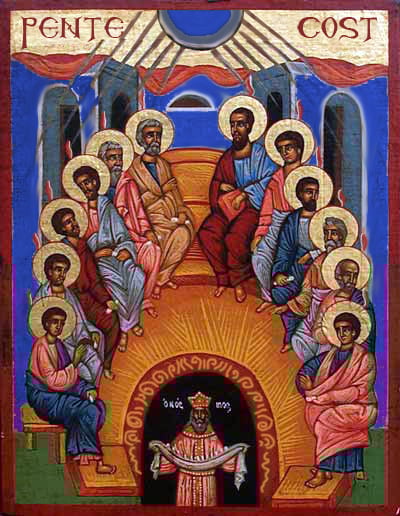
| Image courtesy of Icon of Pentecost, from Wikipedia

Christians often lament that the Holy Spirit is the “neglected member of the Trinity.” The great Pentecostal New Testament scholar Gordon Fee put this argument in historical form a talk I heard him give at Duke some years ago. Fee argued that Catholics think of the Spirit as working through the Sacraments, while Protestants think of the Spirit as working through the Word. In practice, this means that the Spirit “disappears.” Catholics assume that the Spirit is at work wherever the Sacraments are celebrated. Protestants assume that the Spirit is at work when Christians preach the Word or study Scripture. The gift of Pentecostalism to Christianity, according to Fee, is that Pentecostals focus directly on the Spirit in a way that other Christians do not.
Moods of the Spirit
While I didn’t grow up Pentecostal, I did grow up in a family deeply influenced by the Wesleyan Holiness movement. And I heard a lot about the Holy Spirit, and about how other Christians neglected the Spirit. (Or, as we put it in our KJV English, the “Holy Ghost.”) My grandmother particularly emphasized the fact that the Spirit is a Person. She reprinted a pamphlet called “Moods of the Spirit” which argued that since the Spirit is a Person the Spirit must have emotions something like ours. Spirit-led believers should allow the Spirit to express these emotions in them. My grandmother often associated her own emotional moods with those of the Holy Spirit. If she was depressed, it must mean that the Spirit was troubled and she needed to find out the reason why.
My grandmother was fond of saying that the Spirit was “sensitive.” She feared that if she did the wrong thing the Spirit would withdraw from her. To me, as a teenager, this made the Spirit terrifying. It was bad enough worrying about my own adolescent moods and the attitudes of other human beings. Now I had to worry, as well, about this mysterious divine Person hovering over everything who was even more temperamental than my beloved but intimidating grandmother. It was not a relaxing thought.
I found refuge in the austere glories of the Christian intellectual tradition. I took comfort from a C. S. Lewis remark that sometimes he felt closer to God working through a knotty bit of theology than reading a devotional writer. It isn’t that I wanted an unemotional, dry religion. I was deeply sensitive to beauty and valued the Christian mystical tradition. But the language of “seeking the guidance of the Spirit” or generally interacting with the Spirit as a person was uncomfortable for me.
The Academic Spirit?
Then I arrived at Duke University, which I expected to be a bastion of snooty mainline religion, if not of outright godlessness. There was certainly plenty of both. But there were also professors who clearly took historic Christianity with deep seriousness, and whose piety, while certainly intellectual, was not so far removed from my grandmother’s as I might have expected. My advisor, David Steinmetz, was a sophisticated scholar with an ironic wit I have never seen equaled. He was also a deeply committed Methodist of a fairly straightforward, orthodox bent. When I attended church with him once he took his Bible along in, as he put it, “the hope that something might be said at church that has to do with the Bible.”
Another of my professors (good friends with David) was Fr. Ed Mahoney, a cranky Irish-American Catholic priest from New York. Fr. Mahoney’s academic work consisted mostly of what he himself called “very long articles,” about 90% footnotes, on abstruse topics of late medieval and Renaissance philosophy. And it was, somewhat to my surprise, Fr. Mahoney who spoke to me most insistently of the Holy Spirit. He saw me floundering between my native evangelicalism and my longing for Catholicism. He wasn’t a big fan of the idea of my converting to Catholicism–when he found out I had been going to RCIA at a nearby parish he told me sternly to “leave those Franciscans alone.” While no one would accuse him of having an overtly pastoral manner, he rightly saw, I think, that I was flailing wildly about at that point in my life and that any decision I made wouldn’t be coming from a healthy place. And he urged me, repeatedly, to “pray to the Holy Spirit” for guidance. This advice, coming from such a source, made a great impression on me.
The Spirit and the Church
It has, in fact, been my experience that Catholics speak of the Holy Spirit a great deal. Fee is right, of course, that we tend to speak of the Spirit in the context of the Church and the Sacraments. But we also are aware that the Holy Spirit can’t simply be identified with what Church leaders do–far from it. The late Pope Benedict, for instance, had wise words of warning for the people who imagine that papal elections are necessarily the work of the Holy Spirit. We believe that the Spirit guides the Church, but the Spirit does not simply “disappear” into the Church.
I also am not sure that the phenomenon Fee describes is a bad one. The Holy Spirit does, in fact, work through creation. That is the nature of the Spirit’s role in the “economic Trinity.” Just as in the eternal life of God the Spirit is the bond of love between the Father and the Son, so the Spirit works in creation and through the means of grace to bind all things together sweetly and lure them home to God. In the Spirit’s work in the world we see, just as in the Incarnation of the Son, the humility of God, the infinite and irresistible patience of God. When all the bluster has faded and the lies have run their course, when the storm and of our passions sinks down exhausted, then all that is left is the still, small voice of the Spirit, singing in and through everything.
Confessing Jesus as Lord
In his sermon last Sunday, my parish priest Fr. Alfredo Basualdo took his starting point from the Epistle for the day, in which Paul says that no one can confess Jesus as Lord except through the Spirit. This has always been a difficult text for me, because it seems obvious that lots of people claim Jesus as Lord in a glib way, without any of the fruit of the Spirit. Fr. Alfredo made the point that in the first century such a claim required great courage. Since the Emperor took the title “kyrios,” or “Lord,” and this was understood (at least in a Greek context) as a divine claim, calling Jesus Lord was setting up a rival authority to the Emperor.
But more than that, Paul says that this Spirit unites us all into one body: Jews, Greeks, slaves, and free. As Fr. Alfredo pointed out, Corinth was a highly multicultural port city. The Christian community embraced multiple ethnicities and social classes. To confess Jesus as Lord was to identify oneself with this community, to break bread together with slaves and confess that bread as the body of the crucified Jesus, the true Lord, binding us together through the Spirit.
The Pentecostals and charismatics have indeed given many gifts to the Church in encouraging us to think more intentionally about the work of the Spirit and to be open to the manifestations of the Spirit. But the temptation within that “Spirit-centred” strand of Christianity is to identify the Spirit primarily with ecstatic experience and exuberant emotion. The Spirit is most at work when we truly confess Jesus as Lord. When we stand with the oppressed, with the victims, and confess ourselves to be one body with them, then we are truly naming Jesus as Lord. And this happens only through the work of the Spirit.
Image: Icon of Pentecost, from Wikipedia
Previous Post
February 16, 2025
The Weakness of God: A Catholic Response to Tom Oord
Next Post

June 19, 2025 Does the Church Have a Coherent Social Justice Teaching?
Browse Our Archives
Select a Category apologetics Bible Catholicism Christianity economics history Middle Ages personal Reformation Rodney Stark Uncategorized
Select a Month August 2026 June 2026 January 2026 December 2025 October 2025 June 2025 February 2025 December 2024 November 2024 June 2024 May 2024 January 2024 December 2023 April 2023 December 2022 November 2022 September 2022 July 2022 June 2022 April 2022 November 2021 September 2021 March 2021 February 2021 January 2021 December 2020 November 2020 October 2020 August 2020 July 2020 June 2020 May 2020 December 2018 October 2018 June 2018 March 2018 December 2017 November 2017 October 2017 September 2017 May 2017 April 2017 March 2017 February 2017 January 2017 December 2016 November 2016 October 2016 September 2016 August 2016 July 2016 June 2016 May 2016 April 2016 March 2016 January 2016 December 2015 November 2015 September 2015 June 2015 May 2015 April 2015 March 2015 February 2015 January 2015 December 2014 November 2014 October 2014 August 2014 June 2014 March 2014 January 2014 September 2013 August 2013 June 2013 August 2012 July 2012 October 2011 June 2011 March 2011 July 2010 March 2010 January 2008 May 2007 April 2007 February 2007 October 2006 August 2006 March 2006 January 2006 November 2005 October 2005 September 2005 August 2005 June 2005 May 2005 April 2005 March 2005 February 2005 January 2005 December 2004 November 2004 September 2004
Follow Us!
TAKE THE
Religious Wisdom Quiz
Who was Solomon's mother?
Select your answer to see how you score.
Bathsheba Ruth Rahab Tamar
Related posts from Light in the West

What is "Christian Nationalism"? A Reply to Dennis...



TRENDING AT PATHEOS Catholic

Rejecting Doom: Christian Hope And Human Action
Christianity is a religion of hope. We are to have hope and...

It’s What Comes From Within Which Matters
One of the most difficult things for us to understand is why...

Why I Choose the Eucharist Over the Sermon
Choose the Eucharist, Not the Sermon What are we supposed to get...

5 Design Elements Found in Spiritually Rooted Homes
Putting Spirituality Into Home Decor Our homes are more than our living...

Credo: A Story of God Told with the...
About 10 years ago, I began to imagine a personal "Credo" that...

The Anatomy of Divine Revelation in Catholic Thought
The claim that God has made Himself known to human beings is...
view all Catholic blogs
Ad-Free & Subscriber Log-In Subscription Support
- About Us
- 2026 Calendar
- Videos
- Podcasts
- Library of World Religions
- Faith In Media Tracker
- Advertise With Us
- Write for Us
- Privacy Policy
- Terms of Service
- Do Not Sell My Data
- Contact Us
- Radiant Digital
- Manage Newsletter Subscriptions
- Unsubscribe From Notifications
- Sitemap
Copyright 2008-2026, Patheos. All rights reserved.
Subscription Support Ad-Free & Subscriber Log-In
Follow Patheos