
BuddhistCatholicContemplativeEvangelicalGeneral ChristianHinduJewishLatter-day SaintMuslimNew VisionsProgressive Christian
Beliefs
- Buddhist
- Catholic
- Contemplative
- Evangelical
- General Christian
- Hindu
- Jewish
- Latter-day Saint
- More Voices
- Muslim
- New Visions
- Pagan
- Progressive Christian
Topics
- Religion News
- Food and Religion
- Sports and Religion
- Religious Art
- Religious Music and Entertainment
- Religious Events
- History and Religion
- Style and Religion
- Politics and Religion
- Women in Religion
- Recreation Outdoors and Religion
- Business Finance and Religion
- Careers Workplace and Religion
- Education and Religion
- Family Parenting and Religion
- Health Fitness and Religion
- Home and Religion
- Relationships and Religion
- Technology and Religion
- Travel and Religion
Columnists
- Buddhist Columnists
- Business Finance and Religion Columnists
- Careers Workplace and Religion Columnists
- Catholic Columnists
- Contemplative Columnists
- Education and Religion Columnists
- Evangelists Columnists
- Family Parenting and Religion Columnists
- General Christian Columnists
- Health Fitness and Religion Columnists
- Hindu Columnists
- History and Religion Columnists
- Home and Religion Columnists
- Jewish Columnists
- More Voices Columnists
- Latter Day Columnists
- Muslim Columnists
- New Visions Columnists
- Nonreligious Columnists
- Pagan Columnists
- Politics and Religion Columnists
- Progressive Columnists
- Recreation Outdoors and Religion Columnists
- Relationships and Religion Columnists
- Religion News Columnists
- Religious Art Columnists
- Religious Events Columnists
- Religious Music and Entertainment Columnists
- Sports and Religion Columnists
- Style and Religion Columnists
- Technology and Religion Columnists
- Travel and Religion Columnists
- Women in Religion Columnists
Resource Library
- 2026 Calendar
- Library of World Religions
- The 100 Most Holy Places on Earth
- Patheos Answers
- Podcasts
- Videos
- Faith Leaders Database
- Anglican Episcopalian
- Bahai
- Baptist
- Buddhism
- Christianity
- Confucianism
- Eastern Orthodoxy
- Hinduism
- Holiness and Pentecostal
- ISKCON
- Islam
- Judaism
- Lutheran
- Methodist
- The Church of Jesus Christ of Latter-day Saints
- New Age
- Paganism
- Presbytarian and Reformed
- Protestantism
- Religion Behind the Scenes
- Roman Catholic
- Scientology
- Shia Islam
- Sikhism
- Sufism
- Sunni Islam
- Taoism
- Zen
- See all religions
Research Tools
 Ad-Free & Subscriber Log-In Subscription Support
Ad-Free & Subscriber Log-In Subscription Support
Follow Patheos 

- Trending:
- Forgiveness
- |
- Marriage
- |
- Consciousness
- |
- Death Penalty
- |
- Election
- |
- Halloween

- Home
- Catholic
- Disruptions of Tradition: Tradition and Apocalypse, Part I
Disruptions of Tradition: Tradition and Apocalypse, Part I
Last updated on: June 6, 2024 at 9:39 pm by Edwin Woodruff Tait
Disruptions of Tradition: Tradition and Apocalypse, Part I 2024-06-06T21:39:04-05:00 Edwin Woodruff Tait
Patheos Explore the world's faith through different perspectives on religion and spirituality! Patheos has the views of the prevalent religions and spiritualities of the world.
What is tradition?
David Bentley Hart has a habit of saying things that I have already begun to think. But he says them much better and with much more profundity and coherence. Sometimes, to be sure, he puts ideas in my head that weren’t there before. More often, though, he confirms my intuitions and helps me work out their implications in a more systematic way.
That’s definitely the case for the book of his I’ve read most recently, Tradition and Apocalypse. I’ve known the argument and read bits of it, and I’ve read a number of critical reviews, but only just finished reading the whole book. (It’s not a long book but I get distracted easily.) In this book, Hart tackles the question: what do we as Christians mean by “tradition”? He is of course speaking for and to Christians for whom tradition is a positive and important concept, not low-church Protestants who are suspicious of the whole thing.
The tradition of the anti-traditionalists
I grew up, as I’ve said before, in a radical Christian family who regarded much of institutional Christianity as corrupt. We didn’t think of tradition as a good thing. At least, we wouldn’t have used that term. We did think it was important to follow “the old paths” and to steep ourselves in the wisdom of the saints of the past. So we certainly had our own concept of tradition. But we tended to assume that the “old paths” had nearly always been sparsely followed, and that the true heritage of Christianity was likely to be found among people marginalized or persecuted in their own day. My grandmother wrote a book called Him or It? arguing that Christian history had been characterized by a persistent tendency to substitute something else for Jesus, while God had always raised up people to call us back to true, Christ-centered Christianity. (I helped her with the book and among other things toned down the anti-Catholic rhetoric. When the book went to press, by which time I had gone off to grad school and become interested in becoming Catholic, I found that she had put the rhetoric back and even intensified it.)
In other words, even “anti-traditional” Christians have a conception of tradition. They just may not call it that. And even supposedly “traditional” Christians, such as Catholics and Orthodox, have a much more complicated relationship with tradition than their rhetoric typically implies. Both traditions (and some Protestants as well) tend to speak as if there were an easily identifiable “true tradition” that has been more or less the same throughout the centuries. This rhetoric goes back to early Christianity, where it was commonplace to claim that orthodoxy was ancient and unified while heresy was recent and diverse. During the Reformation and for centuries after it, this assumption continued to dominate religious controversy. No matter one’s position, the goal was to show that one’s views were older than those of one’s opponents and more representative of a true, universal Christianity.
The diversity of early Christianity
Modern scholarship has put some serious dents in this picture of the history of Christian doctrine, to put it mildly. The classic book on the subject is Walter Bauer’s Orthodoxy and Heresy in Earliest Christianity. While many aspects of Bauer’s argument would be questioned by scholars today, the core thesis has become dominant among historians of early Christianity. This is that what we think of as “orthodox” Christianity today was originally one of many competing early Christian groups, which did not have an obvious, objective superiority to the others in terms of historicity or universality. Bauer suggests, for instance, than in some areas such as Edessa the earliest forms of Christianity may well have been “heretical,” and that Ignatius of Antioch was the leader of one faction within Antioch rather than of something that an observer would have been able to recognize as the normative expression of Christianity in the city.
The discovery of the Nag Hammadi texts and other examples of “Gnostic” and other “heretical” literature has tended to strengthen this way of thinking about early Christianity. The details can be argued, but the basic picture of early Christian diversity is commonly accepted among scholars. There are exceptions, particularly among conservative evangelicals such as Michael Kruger. But most scholars of a wide range of religious commitments would agree that early Christianity was made up of a number of rival movements, one of which, the “proto-orthodox” who called themselves “the Catholic Church,” eventually gained dominance over the others. The proto-orthodox were already the mainstream by the time of Constantine, which is probably why Constantine chose to favor them. (Constantine didn’t himself seem to have cared too much about theological disputes–he just wanted one institution that he could establish as a religiously unifying force within the empire.) However, their complete dominance over their rivals was in fact the work of the Christian Empire, which actively suppressed the remaining alternatives.
Controversies of the imperial Church
The formation of this “imperial Church” in the fourth century, however, opened up a whole set of new controversies. Because there was plenty of theological diversity within the early “Catholic” or “proto-orthodox” church as well as outside it. As Hart points out in Tradition and Apocalypse, this diversity was much less of a problem before Constantine. The greater level of communication among local Christian communities that resulted from Christianity’s new status, as well as the pressure to provide official moral and spiritual guidance to society as a whole, led Christians to become much more concerned with fine points of theological difference.
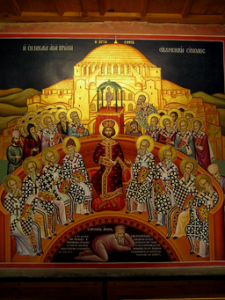
The first and most important controversy following on the legalization of Christianity was, of course, the controversy over the relationship of the Son to the Father which erupted in the late 310s and led to the Council of Nicaea in 325. This “Arian” controversy led to the first “Ecumenical Council” and to the adoption of the Nicene Creed, still (in its 381 revision) the most universally professed Christian statement of belief. It became the paradigm for all later theological controversies.
Which tradition? Whose orthodoxy?
In traditional Trinitarian Christianity, the controversy has often been framed as a conflict between those who defended the historic belief in the divinity of Jesus and a heretic called Arius who denied it. (Many people mistakenly think that Arius thought Jesus was just a human being. In fact he believed Jesus was a pre-existent being and in some sense divine, but of lower status than the Father and created by Him.) And on the other side, Muslims and anti-Trinitarian Christians (and many non-believers) often speak as if the Trinity were just something made up at the Council of Nicea. In fact, things were much more complicated than that.
The “Catholic Church” of the pre-Nicene era had historically proclaimed God as Father, Son, and Holy Spirit. Tertullian had begun using the word “Trinity” at the turn of the third century. That speaking of God involved, in some sense, speaking of a threeness as well as a oneness was not a new teaching. But as Hart points out, the mainstream “Catholic” view during the second and third centuries was a form of “subordinationism.” Most theologians believed that the Logos, who would become incarnate as Jesus, was in some way lesser than the Father and thus could mediate the Father to us. Drawing on passages such as John 1:18, they argued that the Father was unknowable, while the Son was not. Only the Son knew the Father, and thus could transmit a partial knowledge of the Father to us.
The erosion of the middle ground
Arius did go beyond the consensus by arguing that the Son had a beginning and should be firmly put in the category of “creature” over against the uncreated Father. (By putting the subordinationist position so starkly, he provoked a debate that destroyed the traditional position, which now seemed hopelessly vague and muddled. The Council of Nicea raised the stakes by making the criterion of orthodoxy a novel term, “homoousios” (of one substance), which has previously been used only by heretics. This seemed to many people a solution worse than the problem. Hence, lots of Christians in the fourth century, especially in the East, rejected Nicea. That didn’t mean that they were followers of Arius or agreed with Arius’ theology on the whole. But they sought to find some way to preserve both sides of the traditional position–the claim that the Son was divine and not simply a creature, and the claim that the Son was clearly lesser than the Father.
By the end of the fourth century, this middle ground had largely eroded. The two leading contenders were full-blown Trinitarianism, especially as formulated by the “Cappadocian” theologians, and a radical “Arian” position associated with the theologian Eunomius (who wasn’t himself a follower of Arius and whose theology was rather different from that of Arius). In other words, it had become clear to many by the Council of Constantinople in 381 that the Son must either be fully divine or not divine at all.
The innovation of orthodoxy
One of the major arguments of Tradition and Apocalypse is that this was a real innovation in Christian theology. It was not simply the defense of an older position against a new heresy. And even the more nuanced claim that it was a needed clarification in the face of a new challenge isn’t quite right, given how different the Trinitarian theology of the late fourth century is from the sort of theology that would have been accepted as orthodox a century before.
Hart puts this perhaps more strongly than I would by saying that Arius was simply “a traditional Alexandrian believer” and “clearly operating within the ambit of the faith as he had received it from a long Christian past” (p. 119). Hart doesn’t seem to think that Arius’ claim that the Son had a beginning went beyond the consensus, as I claimed above. And he’s more learned in these matters than I so he may be right, or he may possibly be overstating things a bit as he sometimes does. Where he’s clearly right is to say that the theological debates of the fourth century really did lead to a new way of thinking about God. And any appeal to those debates as a model for contemporary controversies over the limits of orthodoxy has to take that fact into account.
So what is tradition? To be continued. . . .
Given these two factors–the diversity of early Christianity and the novelty of key elements of what came to be accepted as orthodoxy–in what sense can we speak, with integrity, of a coherent Christian tradition? What does it mean to be faithful to the tradition? Is the tradition really anything more than simply the result of “power plays” and self-interested reconstructions of history long after the fact? Tradition and Apocalypse sets out to answer that question. In the next post, I’ll discuss how Hart criticizes the most influential attempt (at least in a Catholic context) to argue for the coherence of the concept of Christian tradition: John Henry Newman’s Essay on the Development of Christian Doctrine. Then I’ll talk about Hart’s own answer, why I think it’s fundamentally right, and the problems that I have with it.
Previous Post
May 5, 2024
Not One Dead Remains in the Grave: Easter and Universalism
Next Post
June 17, 2024 The Development of Tradition: the background to Newman
Browse Our Archives
Select a Category apologetics Bible Catholicism Christianity economics history Middle Ages personal Reformation Rodney Stark Uncategorized
Select a Month August 2026 June 2026 January 2026 December 2025 October 2025 June 2025 February 2025 December 2024 November 2024 June 2024 May 2024 January 2024 December 2023 April 2023 December 2022 November 2022 September 2022 July 2022 June 2022 April 2022 November 2021 September 2021 March 2021 February 2021 January 2021 December 2020 November 2020 October 2020 August 2020 July 2020 June 2020 May 2020 December 2018 October 2018 June 2018 March 2018 December 2017 November 2017 October 2017 September 2017 May 2017 April 2017 March 2017 February 2017 January 2017 December 2016 November 2016 October 2016 September 2016 August 2016 July 2016 June 2016 May 2016 April 2016 March 2016 January 2016 December 2015 November 2015 September 2015 June 2015 May 2015 April 2015 March 2015 February 2015 January 2015 December 2014 November 2014 October 2014 August 2014 June 2014 March 2014 January 2014 September 2013 August 2013 June 2013 August 2012 July 2012 October 2011 June 2011 March 2011 July 2010 March 2010 January 2008 May 2007 April 2007 February 2007 October 2006 August 2006 March 2006 January 2006 November 2005 October 2005 September 2005 August 2005 June 2005 May 2005 April 2005 March 2005 February 2005 January 2005 December 2004 November 2004 September 2004
Follow Us!
TAKE THE
Religious Wisdom Quiz
Who was the last king of Israel before the Assyrian conquest?
Select your answer to see how you score.
Shallum Jehoahaz Amon Hoshea
Related posts from Light in the West

What is "Christian Nationalism"? A Reply to Dennis...



TRENDING AT PATHEOS Catholic

Creation, Preservation, and Teleology in Catholic Theology
As I write this, it is very early Monday morning. Like millions...

The Parable Of The Sower And The Word...
One of Christ’s most famous parables is that of the sower who...

Rejecting Doom: Christian Hope And Human Action
Christianity is a religion of hope. We are to have hope and...

Why I Choose the Eucharist Over the Sermon
Choose the Eucharist, Not the Sermon What are we supposed to get...

5 Design Elements Found in Spiritually Rooted Homes
Putting Spirituality Into Home Decor Our homes are more than our living...

Credo: A Story of God Told with the...
About 10 years ago, I began to imagine a personal "Credo" that...
view all Catholic blogs
Ad-Free & Subscriber Log-In Subscription Support
- About Us
- 2026 Calendar
- Videos
- Podcasts
- Library of World Religions
- Faith In Media Tracker
- Advertise With Us
- Write for Us
- Privacy Policy
- Terms of Service
- Do Not Sell My Data
- Contact Us
- Radiant Digital
- Manage Newsletter Subscriptions
- Unsubscribe From Notifications
- Sitemap
Copyright 2008-2026, Patheos. All rights reserved.
Subscription Support Ad-Free & Subscriber Log-In
Follow Patheos