
BuddhistCatholicContemplativeEvangelicalGeneral ChristianHinduJewishLatter-day SaintMuslimNew VisionsProgressive Christian
Beliefs
- Buddhist
- Catholic
- Contemplative
- Evangelical
- General Christian
- Hindu
- Jewish
- Latter-day Saint
- More Voices
- Muslim
- New Visions
- Pagan
- Progressive Christian
Topics
- Religion News
- Food and Religion
- Sports and Religion
- Religious Art
- Religious Music and Entertainment
- Religious Events
- History and Religion
- Style and Religion
- Politics and Religion
- Women in Religion
- Recreation Outdoors and Religion
- Business Finance and Religion
- Careers Workplace and Religion
- Education and Religion
- Family Parenting and Religion
- Health Fitness and Religion
- Home and Religion
- Relationships and Religion
- Technology and Religion
- Travel and Religion
Columnists
- Buddhist Columnists
- Business Finance and Religion Columnists
- Careers Workplace and Religion Columnists
- Catholic Columnists
- Contemplative Columnists
- Education and Religion Columnists
- Evangelists Columnists
- Family Parenting and Religion Columnists
- General Christian Columnists
- Health Fitness and Religion Columnists
- Hindu Columnists
- History and Religion Columnists
- Home and Religion Columnists
- Jewish Columnists
- More Voices Columnists
- Latter Day Columnists
- Muslim Columnists
- New Visions Columnists
- Nonreligious Columnists
- Pagan Columnists
- Politics and Religion Columnists
- Progressive Columnists
- Recreation Outdoors and Religion Columnists
- Relationships and Religion Columnists
- Religion News Columnists
- Religious Art Columnists
- Religious Events Columnists
- Religious Music and Entertainment Columnists
- Sports and Religion Columnists
- Style and Religion Columnists
- Technology and Religion Columnists
- Travel and Religion Columnists
- Women in Religion Columnists
Resource Library
- 2026 Calendar
- Library of World Religions
- The 100 Most Holy Places on Earth
- Patheos Answers
- Podcasts
- Videos
- Faith Leaders Database
- Anglican Episcopalian
- Bahai
- Baptist
- Buddhism
- Christianity
- Confucianism
- Eastern Orthodoxy
- Hinduism
- Holiness and Pentecostal
- ISKCON
- Islam
- Judaism
- Lutheran
- Methodist
- The Church of Jesus Christ of Latter-day Saints
- New Age
- Paganism
- Presbytarian and Reformed
- Protestantism
- Religion Behind the Scenes
- Roman Catholic
- Scientology
- Shia Islam
- Sikhism
- Sufism
- Sunni Islam
- Taoism
- Zen
- See all religions
Research Tools
 Ad-Free & Subscriber Log-In Subscription Support
Ad-Free & Subscriber Log-In Subscription Support
Follow Patheos 

- Trending:
- Forgiveness
- |
- Marriage
- |
- Consciousness
- |
- Death Penalty
- |
- Election
- |
- Halloween

- Home
- Catholic
- Open Theism, Free Will, and Catholicism
Open Theism, Free Will, and Catholicism
Last updated on: January 21, 2024 at 10:58 pm by Edwin Woodruff Tait
Open Theism, Free Will, and Catholicism 2024-01-21T22:58:00-05:00 Edwin Woodruff Tait
Patheos Explore the world's faith through different perspectives on religion and spirituality! Patheos has the views of the prevalent religions and spiritualities of the world.
My Patheos colleague David Schloss has just published a post on the evangelical theological movement known as open theism. I welcome this because I want to see Catholics engage more deeply with the theological discussions going on among Protestants. Also, my own encounter with open theism was tied up with my journey to Catholicism in several ways.
The robot box
First of all, I first encountered open theism in a Catholic context. (At least this is one of the first times I remember running into the idea.) The young Franciscan priest who ran the RCIA program I participated in while in grad school, in the late 90s, defended open theism without using that term. He used a metaphor which I don’t now remember very well to caricature the traditional idea of divine omniscience. It had something to do with a robotic box going “beep, beep, beep” but that’s probably itself a caricature of his imagery. I think he was saying that we would just be robots if God know everything we were going to do. I cited the Catechism to him and was told that the Catechism was really just for bishops and basically I had no business quoting it.
This was one of several interactions which undercut my hope to find rich and solid orthodoxy in Catholicism. These interactions played some role in my deciding that I might as well be Episcopalian, which I was for nineteen years. The priest at my local Episcopal church was considerably more theologically traditional and in my view more theologically astute than the priest running the Catholic RCIA program.
I’ve written elsewhere about my youthful disgust with “liberal” Catholicism and my sympathy with the conservative “resistance” movement which has now turned into a ferocious and potentially schismatic alternative magisterium in the era of Pope Francis. I am a much more broad-minded person theologically than I was then, so perhaps I wouldn’t be quite as put off by that priest today. But he had a tendency to paint in very broad strokes so it was easy to miss any valid points he may have been making.
An alternative to ressourcement
In 2006 I accepted a tenure-track teaching job at an evangelical college in Indiana, Huntington University. Huntington had just fired the open theist John Sanders after several years of controversy over his ideas. In fact I was partially replacing him, which I felt rather bad about until I found out that he had beaten me for the other job I was being considered for! Naturally trying to figure out what I thought about open theism became much more important to me at this point.
One open theist was still teaching in the philosophy program (Sanders had run into controversy because he taught theology and published his ideas in Christianity Today), and one of the most respected open theist philosophers, William Hasker, was a professor emeritus and maintained an office in the same building as mine. Hasker is both formidably brilliant and deeply gracious, and conversations with him forced me to take open theists’ arguments against the traditional understanding of omniscience more seriously than I had done.
When I came to Huntington I was quite confident in my view that evangelical theology was rather shallow and needed to be enriched by returning to the Fathers and the wisdom of the pre-Reformation tradition generally. In the open theists, I discovered people who were confident that by using modern analytic philosophy they could put evangelical theology on a solid intellectual basis and that these methods actually allowed them to solve problems that traditional theology had wrestled with. I wasn’t convinced, but I learned to take their alternative to traditional theology seriously. I’ve written at length about the theology of one major open theist, Greg Boyd, and my points of agreement and disagreement with him. And in my most recent post last month I referred briefly to a post by Sanders and compared his understanding of divine personhood with Ratzinger’s.
Do we really agree on free will?
All of this is to say that I’m happy to see another Catholic blogger take up the task of dialogue with open theism. It’s a theology that proceeds from very different premises than those many of us ressourcement and Thomist types are used to working with. And for that reason it can be a salutary shock to listen carefully to what they have to say.
Here’s where I have to express disagreement with David’s post, though. I think he frames the disagreement between orthodox Catholicism and open theism purely around the question of omniscience, claiming that Catholics agree with open theists on free will. This is where having had an open theist philosopher (Hasker) hold my feet to the fire has changed my perspective. I am not sure that we can hold to the open theist view of free will without also agreeing with them about omniscience. Or at least, I don’t think that the Boethian formula of timeless knowledge simply solves the problem, even though I agree with it. (I love Boethius but I have to say that I think he “hand-waves” the problem of predestination away instead of really solving it.)
Omelets tomorrow, determinism tonight
Hasker puts it this way in his book *God, Time, and Knowledge. (*Note: I’m summarizing my memory of the book and of conversations with Hasker from more than a decade ago now, so it’s possible I’m oversimplifying or distorting to some extent and I encourage people to go read the book for themselves.) Anything God eternally knows to be true is necessarily true. If God knows, for instance, that I will eat an omelet for breakfast tomorrow morning, then that is just as certainly true as that I didn’t eat one this morning. And therefore there is no possibility that I will not do it. Therefore, in modern philosophical terms, I don’t have “libertarian” freedom to choose not to eat the omelet.
Hasker therefore concludes that the traditional view of divine timelessness is incompatible with free will. (He’s somewhat tentative about that conclusion in the book but by the time I talked to him he’d become willing to assert it much more emphatically.)
Libertarian and compatibilist freedom
David defines libertarian freedom as freedom from coercion. But in philosophical discourse that’s not a sufficient account of libertarian freedom. The view that freedom is freedom from coercion is rather the “compatibilist” position. Compatibilists, or “soft determinists,” are people who believe that we can meaningfully speak of free will even if everything that happens could not have happened otherwise. We are free if we are acting according to our judgment and desires, without being coerced. But in a compatibilist view, it might be that given who we are and the circumstances that have formed us we couldn’t possibly choose anything other than what we do in fact choose. As my grad-school advisor David Steinmetz used to put it, if you hate okra then while you are theoretically free to pick it in the cafeteria line, you aren’t going to do so.
So I can’t agree with David’s dichotomy between libertarian free will and “hard determinism.” There are middle positions possible.
Compatibilism in Christian theology
What is the dominant view in the Christian tradition? Here it gets tricky. The Eastern tradition has certainly always affirmed a strong view of human freedom. Whether it’s quite the same as modern libertarianism could be debated I think. But that will need to wait for my upcoming post on David Bentley Hart’s arguments for universalism.
In the West, it gets really tricky. Let’s start with a theologian who is clearly compatibilist: Jonathan Edwards. Edwards’ treatise On the Freedom of the Will, which I read recently, is one of the classic arguments for compatibilism. Edwards argues that freedom most properly means the ability to do something without some external force being able to stop me. So if my will is free it means that there’s nothing external to my will forcing me to choose against my own best judgment and strongest desires. He argues–with quite cogent arguments if one accepts his premises–that it’s simply incoherent to argue for a “freedom of indeterminacy.”
One of his strongest arguments is that defining freedom in terms of a lack of any determination by one’s own desires means that freedom would have to be a completely irrational choice disconnected to one’s character or motivations. So to use the okra analogy again, if I find okra so utterly disgusting that I could not possibly want to eat it, then I’m not “free” to eat it in libertarian (Edwards would say “Arminian”) terms. But by this logic, if I like it so much that I will nearly always want to eat it when possible, I’m only just a little bit free. I would only be truly free to eat okra if I didn’t care at all whether I ate it or not. But that doesn’t make any sense. Hence, Edwards argues, being “determined” by one’s own character and desires is in no way incompatible with freedom.
But surely Catholics are libertarians?
OK, but Edwards was one of those evil Calvinists, right? Surely great Catholic theologians such as Aquinas and Augustine wouldn’t agree? And in fact I don’t think Aquinas would agree with Edwards, in part because he had a more nuanced psychology. Aquinas does, in fact, define free choice (liberum arbitrium) in terms of the ability to choose between contraries. So does Augustine at least in his early work on free choice of the will.
But that’s not the whole story. Aquinas is an intellectualist. He believes that if the intellect is fully convinced the will will follow. That’s why for him once we see the Beatific Vision it’s no longer possible to fall away from God. Yet that doesn’t make us less free. Our wills are naturally determined to choose the ultimate goal of happiness. Once we clearly see that happiness is found in God, we will necessarily choose God. Yet this will not be some kind of loss of freedom but rather a gain. This is incompatible with how modern libertarian philosophers think about free will, which is why they worry about how we can be incapable of sin in heaven.
Compatibilism for God, libertarianism for creatures?
Aquinas is also a “compatibilist” in the sense that he thinks God can bring it about that we choose a particular thing without violating our free wills. He doesn’t give a very detailed account of how that works, leading to later conflicts between “Thomists” and “Molinists.” But he doesn’t seem to think that there’s any problem with that kind of “compatibilism.” A friend of mine who is a Thomist philosopher once put it this way: Aquinas is a compatibilist about God but a libertarian about creatures. I.e., God can effectively move our wills without coercion but other creatures can’t. (However, in a later conversation my friend said that he no longer found this a helpful way to talk about it. Instead, he believed that the whole libertarian/compatibilist distinction doesn’t work well for Aquinas, which is probably true.)
Predestination and knowledge
This means that for Aquinas there’s no conflict between predestination and free will. God chooses to direct some and not others toward the goal of eternal life, but he does this without coercing anyone. And finally, he believes that God’s knowledge is the cause of the things God knows rather than the other way round. As Sanders is fond of pointing out (as a criticism), Aquinas doesn’t think that strictly speaking God relates to us. That is, nothing in us changes or affects God. And that includes God’s knowledge–the causal relationship is always one-way. That’s very different from how open theists–and most modern non-Calvinist Christians–think about free will.
All of this of course applies to Augustine as well, although Augustine isn’t as nuanced a philosopher or as dependent on Aristotle. Augustine argues that the highest freedom is to be incapable of sin. And of course he is the source of Aquinas’ views on predestination.
The real problem with open theism
Thus, I don’t think that traditional Catholic thought actually has the same view of free will as open theism. Whatever we may believe about predestination, we believe (or should) that our freedom is defined by its proper end, which is God. The ability to choose something other than God is a defect, not a perfection.
The bigger issue, however, is our conception of God in the first place. I find that open theists tend to have a very anthropomorphic view of God. They stress God’s personhood and see God as a person much in the same way we are. They tend to think of God’s agency as proceeding according to the same rules as creaturely agency. I don’t see why I should believe this. I don’t see in fact why, rationally speaking, I would believe in God at all if that were the only kind of God available to believe in.
The only belief in God I find rational or compelling is a thoroughly apophatic one, in which God surpasses all our concepts. That is why I don’t think the problems of predestination and knowledge and free will have or need to have a clear and satisfying answer. At the same time, the open theists are right that we shouldn’t use mystery as an excuse for talking nonsense. I respect open theists and have found discussion with them very valuable in clarifying my own ideas. But when all is said and done, I fundamentally disagree with them about what it is we are talking about when we talk about God.
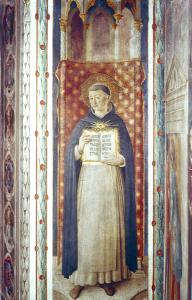
Image: Saint Thomas Aquinas by Fra Angelico. Wikimedia Commons.
Previous Post
December 31, 2023
Persons, not Individuals: The Legacy of Pope Benedict
Next Post
May 5, 2024 Not One Dead Remains in the Grave: Easter and Universalism
Browse Our Archives
Select a Category apologetics Bible Catholicism Christianity economics history Middle Ages personal Reformation Rodney Stark Uncategorized
Select a Month August 2026 June 2026 January 2026 December 2025 October 2025 June 2025 February 2025 December 2024 November 2024 June 2024 May 2024 January 2024 December 2023 April 2023 December 2022 November 2022 September 2022 July 2022 June 2022 April 2022 November 2021 September 2021 March 2021 February 2021 January 2021 December 2020 November 2020 October 2020 August 2020 July 2020 June 2020 May 2020 December 2018 October 2018 June 2018 March 2018 December 2017 November 2017 October 2017 September 2017 May 2017 April 2017 March 2017 February 2017 January 2017 December 2016 November 2016 October 2016 September 2016 August 2016 July 2016 June 2016 May 2016 April 2016 March 2016 January 2016 December 2015 November 2015 September 2015 June 2015 May 2015 April 2015 March 2015 February 2015 January 2015 December 2014 November 2014 October 2014 August 2014 June 2014 March 2014 January 2014 September 2013 August 2013 June 2013 August 2012 July 2012 October 2011 June 2011 March 2011 July 2010 March 2010 January 2008 May 2007 April 2007 February 2007 October 2006 August 2006 March 2006 January 2006 November 2005 October 2005 September 2005 August 2005 June 2005 May 2005 April 2005 March 2005 February 2005 January 2005 December 2004 November 2004 September 2004
Follow Us!
TAKE THE
Religious Wisdom Quiz
True or False: Mordecai refused to bow down to Haman.
Select your answer to see how you score.
TRUE FALSE
Related posts from Light in the West

What is "Christian Nationalism"? A Reply to Dennis...



TRENDING AT PATHEOS Catholic

Rejecting Doom: Christian Hope And Human Action
Christianity is a religion of hope. We are to have hope and...

It’s What Comes From Within Which Matters
One of the most difficult things for us to understand is why...

Why I Choose the Eucharist Over the Sermon
Choose the Eucharist, Not the Sermon What are we supposed to get...

5 Design Elements Found in Spiritually Rooted Homes
Putting Spirituality Into Home Decor Our homes are more than our living...

Credo: A Story of God Told with the...
About 10 years ago, I began to imagine a personal "Credo" that...

The Anatomy of Divine Revelation in Catholic Thought
The claim that God has made Himself known to human beings is...
view all Catholic blogs
Ad-Free & Subscriber Log-In Subscription Support
- About Us
- 2026 Calendar
- Videos
- Podcasts
- Library of World Religions
- Faith In Media Tracker
- Advertise With Us
- Write for Us
- Privacy Policy
- Terms of Service
- Do Not Sell My Data
- Contact Us
- Radiant Digital
- Manage Newsletter Subscriptions
- Unsubscribe From Notifications
- Sitemap
Copyright 2008-2026, Patheos. All rights reserved.
Subscription Support Ad-Free & Subscriber Log-In
Follow Patheos