
BuddhistCatholicContemplativeEvangelicalGeneral ChristianHinduJewishLatter-day SaintMuslimNew VisionsProgressive Christian
Beliefs
- Buddhist
- Catholic
- Contemplative
- Evangelical
- General Christian
- Hindu
- Jewish
- Latter-day Saint
- More Voices
- Muslim
- New Visions
- Pagan
- Progressive Christian
Topics
- Religion News
- Food and Religion
- Sports and Religion
- Religious Art
- Religious Music and Entertainment
- Religious Events
- History and Religion
- Style and Religion
- Politics and Religion
- Women in Religion
- Recreation Outdoors and Religion
- Business Finance and Religion
- Careers Workplace and Religion
- Education and Religion
- Family Parenting and Religion
- Health Fitness and Religion
- Home and Religion
- Relationships and Religion
- Technology and Religion
- Travel and Religion
Columnists
- Buddhist Columnists
- Business Finance and Religion Columnists
- Careers Workplace and Religion Columnists
- Catholic Columnists
- Contemplative Columnists
- Education and Religion Columnists
- Evangelists Columnists
- Family Parenting and Religion Columnists
- General Christian Columnists
- Health Fitness and Religion Columnists
- Hindu Columnists
- History and Religion Columnists
- Home and Religion Columnists
- Jewish Columnists
- More Voices Columnists
- Latter Day Columnists
- Muslim Columnists
- New Visions Columnists
- Nonreligious Columnists
- Pagan Columnists
- Politics and Religion Columnists
- Progressive Columnists
- Recreation Outdoors and Religion Columnists
- Relationships and Religion Columnists
- Religion News Columnists
- Religious Art Columnists
- Religious Events Columnists
- Religious Music and Entertainment Columnists
- Sports and Religion Columnists
- Style and Religion Columnists
- Technology and Religion Columnists
- Travel and Religion Columnists
- Women in Religion Columnists
Resource Library
- 2026 Calendar
- Library of World Religions
- The 100 Most Holy Places on Earth
- Patheos Answers
- Podcasts
- Videos
- Faith Leaders Database
- Anglican Episcopalian
- Bahai
- Baptist
- Buddhism
- Christianity
- Confucianism
- Eastern Orthodoxy
- Hinduism
- Holiness and Pentecostal
- ISKCON
- Islam
- Judaism
- Lutheran
- Methodist
- The Church of Jesus Christ of Latter-day Saints
- New Age
- Paganism
- Presbytarian and Reformed
- Protestantism
- Religion Behind the Scenes
- Roman Catholic
- Scientology
- Shia Islam
- Sikhism
- Sufism
- Sunni Islam
- Taoism
- Zen
- See all religions
Research Tools
 Ad-Free & Subscriber Log-In Subscription Support
Ad-Free & Subscriber Log-In Subscription Support
Follow Patheos 

- Trending:
- Forgiveness
- |
- Marriage
- |
- Consciousness
- |
- Death Penalty
- |
- Election
- |
- Halloween

- Home
- Catholic
- Persons, not Individuals: The Legacy of Pope Benedict
Persons, not Individuals: The Legacy of Pope Benedict
Last updated on: December 31, 2023 at 3:36 pm by Edwin Woodruff Tait
Persons, not Individuals: The Legacy of Pope Benedict 2023-12-31T15:36:16-05:00 Edwin Woodruff Tait
Patheos Explore the world's faith through different perspectives on religion and spirituality! Patheos has the views of the prevalent religions and spiritualities of the world.
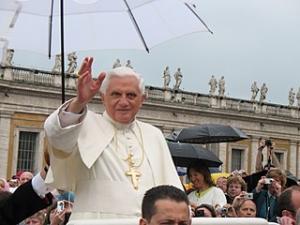
Remembering Benedict a year after his death
The death of Pope Benedict XVI a year ago prompted a wide range of responses, reflecting his decidedly mixed legacy and reputation. I began writing my own reflections but never finished or published them. The one-year anniversary of his death seemed like a good time to revisit that unfinished post, so that’s what I’ve done here. And while I won’t be directly addressing Fiducia Supplicans, I’m well aware that I’m talking about the legacy of the late Pope at a time when the current Pope’s actions are stirring up controversies of their own. What I have to say in this post will, in fact, lay the groundwork for anything I say in the future about Fiducia Supplicans.
Pope Benedict and his controversies
So back to Pope Benedict. I don’t want to address all the controversies surrounding his activity as a cardinal and Pope, except by way of preface to explain why I think it’s legitimate to focus on his theology in my own reflections.
As prefect of the Congregation of the Doctrine of the Faith, he was notorious for going after theologians he considered unorthodox. While his application of Church discipline to theological dissenters was moderate by the standards of the pre-Vatican-II Church, it was more rigorous than Catholics had become used to in the decades following the Council, earning him the title of “God’s Rottweiler.”
In contrast, he’s also been criticized for a failure to take decisive action against priests guilty of sexual abuse. As Thomas Reese (someone with no reason to be overly biased in Pope Benedict’s favor) has pointed out, he acted more decisively than anyone else in Rome had done in defrocking priests who were clearly guilty, applying the same strictness to them that he did to dissenting theologians. But still, that’s a low bar, and since theological dissent and sexual abuse are not remotely the same, the fact that he may have treated them with similar “strictness” still leaves him open to the charge that he was far too harsh on the one and far too lenient on the other.
Theology and practice
In turning from these controversies to his theology, I know I’m open to the charge that I’m privileging theology over the real harm to persons that the Pope was guilty of. Sometimes this is put in terms that imply that theology is basically a frivolous sort of endeavor. I obviously don’t agree with that. I think it matters for how we live our lives. Precisely because it matters, when someone creates deeply beautiful theology while also having done things worthy of criticism, we need to look both at the theology and at the behavior. We need to be willing to see how the theology might have flaws linked to the actions we find worthy of criticism, but also to find value in theology produced by people who have done things we criticize.
This is a very loaded issue these days and would require at least an entire post of its own to do it justice. All I’ll say for now is that I believe (along with Fr. Reese) that Benedict’s piety was genuine and that his errors were committed in good faith, even though I think some of the things he did caused harm. (And of course this could be said of any Pope, including the present one.)
What is a person?
The core of Benedict’s theology as I understand it is (as with his predecessor and for that matter his successor) a respect for the dignity of the human person as made in the image of God. The book of his that means most to me is his relatively early work Introduction to Christianity, one of the finest summaries of what Christian faith means that I’ve ever read. There are many things I love about it, such as the beautiful metaphor of floating over the abyss tied to the Cross, or the powerful exposition of Jesus’ descent into hell. But perhaps the most fundamental concept I took away from it was Ratzinger’s understanding of the meaning of personhood.
Ratzinger argues that a person is fundamentally different from an individual. The term “individual,” as he uses it, means an autonomous entity that exists independently of other entities. A person, on the other hand, is defined by relationship: “There is no such thing as person in the categorical singular.” (180) A person is who they are precisely in and through their relationship with others. It isn’t that we bring our identity fully formed to our interactions with others, but that we are constituted as persons by those interactions.
Being and relationality
What then does it mean to say that God is personal? The evangelical open theist theologian, John Sanders, recently wrote a post arguing that we should start with relationality rather than “being” in how we think about God.(This of course is only a very brief and simple exposition of Sanders’ thought–he’s written a number of books that go into much more detail.)
Ratzinger would, to a point, agree, though I don’t think he’d oppose the concepts to each other in quite the way Sanders does. (Sanders doesn’t say we can’t think about God as being but that in his view this forces us to pick between several undesirable alternatives. I disagree with how he characterizes the alternatives but that’s a subject for another post.)
Trinitarian personhood
But when Ratzinger speaks of God as fundamentally relational he’s thinking first and foremost not of God’s relationship to us but of God’s internal life. Ratzinger suggests that we can’t meaningfully speak of God as personal apart from the doctrine of the Trinity. Indeed, he argues that Trinitarian theology is the origin of the very concept of a person: “the only way that the concept and idea of ‘person’ dawned on the human mind was in the struggle over the Christian image of God and the interpretation of the figure of Jesus of Nazareth.” (181-82; this is very likely an overly triumphalistic claim, but even when Ratzinger is too triumphalistic he is making points worth taking seriously.)
The dogma of the Trinity claims that God is absolutely one in essence but plural in personhood–that God stands in relation to Himself in a threefold life of interpersonal love sharing one undivided essence. Far from being an abstract speculation, this is, for Ratzinger, the basis of Christian ethics and piety. We are created in the image of this interpersonal God and salvation means for the created self to find its way home to the condition of relatedness in which and by which and for which it was made. (190)
The many applications of theology
Ratzinger tends, on the whole, to be more popular in the more conservative sectors of Catholicism. But often his more conservative admirers don’t cite Introduction to Christianity so much as some of his later works. Sometimes I’ve even seen it dismissed. For me, it’s one of the most profound and beautiful expositions of the Christian faith I know, though it is fairly difficult reading. (“Introduction” has the German academic sense of “a book covering the general principles of an area of study” not the more common English sense of “a simple and easy book.”)
An unlikely admirer
One admirer of Ratzinger’s theological work who might seem unlikely at first glance is Fr. James Alison, an openly gay Catholic theologian and exponent of Rene Girard. Fr. Alison has even suggested that Ratzinger was deliberately attempting to pave the way for a change in Church teaching on same-sex relationships. Unlikely as that is, it shows the extent to which Ratzinger’s theology of human personhood can transcend divides over hot-button areas of current controversy.
I’ve deliberately constructed this post so as to address the likely concerns of more liberal readers, Catholic as well as non-Catholic, because they are the ones least likely to appreciate Ratzinger as a theologian already. But as I suggested above, I think that often even his conservative admirers focus on certain aspects of his thought and neglect others. He was, as Fr. Alison says, a very subtle thinker who repays careful reading. We are now more than a decade away from the time when he led the Church, and a year from the anniversary of his death. I hope that as we gain further historical perspective on the late Pope Benedict, more and more people, Catholics and non-Catholics alike, will be challenged and inspired by the spiritual and intellectual profundity of his theological legacy.
Image by Tadeusz Gorny on Wikimedia Commons.

Previous Post
December 16, 2023
The Unique Beauty of Advent
Next Post

January 21, 2024 Open Theism, Free Will, and Catholicism
Browse Our Archives
Select a Category apologetics Bible Catholicism Christianity economics history Middle Ages personal Reformation Rodney Stark Uncategorized
Select a Month August 2026 June 2026 January 2026 December 2025 October 2025 June 2025 February 2025 December 2024 November 2024 June 2024 May 2024 January 2024 December 2023 April 2023 December 2022 November 2022 September 2022 July 2022 June 2022 April 2022 November 2021 September 2021 March 2021 February 2021 January 2021 December 2020 November 2020 October 2020 August 2020 July 2020 June 2020 May 2020 December 2018 October 2018 June 2018 March 2018 December 2017 November 2017 October 2017 September 2017 May 2017 April 2017 March 2017 February 2017 January 2017 December 2016 November 2016 October 2016 September 2016 August 2016 July 2016 June 2016 May 2016 April 2016 March 2016 January 2016 December 2015 November 2015 September 2015 June 2015 May 2015 April 2015 March 2015 February 2015 January 2015 December 2014 November 2014 October 2014 August 2014 June 2014 March 2014 January 2014 September 2013 August 2013 June 2013 August 2012 July 2012 October 2011 June 2011 March 2011 July 2010 March 2010 January 2008 May 2007 April 2007 February 2007 October 2006 August 2006 March 2006 January 2006 November 2005 October 2005 September 2005 August 2005 June 2005 May 2005 April 2005 March 2005 February 2005 January 2005 December 2004 November 2004 September 2004
Follow Us!
TAKE THE
Religious Wisdom Quiz
True or False: David committed adultery with Bathsheba and arranged for her husband Uriah to be killed.
Select your answer to see how you score.
FALSE TRUE
Related posts from Light in the West

What is "Christian Nationalism"? A Reply to Dennis...



TRENDING AT PATHEOS Catholic

Rejecting Doom: Christian Hope And Human Action
Christianity is a religion of hope. We are to have hope and...

It’s What Comes From Within Which Matters
One of the most difficult things for us to understand is why...

Why I Choose the Eucharist Over the Sermon
Choose the Eucharist, Not the Sermon What are we supposed to get...

5 Design Elements Found in Spiritually Rooted Homes
Putting Spirituality Into Home Decor Our homes are more than our living...

Credo: A Story of God Told with the...
About 10 years ago, I began to imagine a personal "Credo" that...

The Anatomy of Divine Revelation in Catholic Thought
The claim that God has made Himself known to human beings is...
view all Catholic blogs
Ad-Free & Subscriber Log-In Subscription Support
- About Us
- 2026 Calendar
- Videos
- Podcasts
- Library of World Religions
- Faith In Media Tracker
- Advertise With Us
- Write for Us
- Privacy Policy
- Terms of Service
- Do Not Sell My Data
- Contact Us
- Radiant Digital
- Manage Newsletter Subscriptions
- Unsubscribe From Notifications
- Sitemap
Copyright 2008-2026, Patheos. All rights reserved.
Subscription Support Ad-Free & Subscriber Log-In
Follow Patheos