
BuddhistCatholicContemplativeEvangelicalGeneral ChristianHinduJewishLatter-day SaintMuslimNew VisionsProgressive Christian
Beliefs
- Buddhist
- Catholic
- Contemplative
- Evangelical
- General Christian
- Hindu
- Jewish
- Latter-day Saint
- More Voices
- Muslim
- New Visions
- Pagan
- Progressive Christian
Topics
- Religion News
- Food and Religion
- Sports and Religion
- Religious Art
- Religious Music and Entertainment
- Religious Events
- History and Religion
- Style and Religion
- Politics and Religion
- Women in Religion
- Recreation Outdoors and Religion
- Business Finance and Religion
- Careers Workplace and Religion
- Education and Religion
- Family Parenting and Religion
- Health Fitness and Religion
- Home and Religion
- Relationships and Religion
- Technology and Religion
- Travel and Religion
Columnists
- Buddhist Columnists
- Business Finance and Religion Columnists
- Careers Workplace and Religion Columnists
- Catholic Columnists
- Contemplative Columnists
- Education and Religion Columnists
- Evangelists Columnists
- Family Parenting and Religion Columnists
- General Christian Columnists
- Health Fitness and Religion Columnists
- Hindu Columnists
- History and Religion Columnists
- Home and Religion Columnists
- Jewish Columnists
- More Voices Columnists
- Latter Day Columnists
- Muslim Columnists
- New Visions Columnists
- Nonreligious Columnists
- Pagan Columnists
- Politics and Religion Columnists
- Progressive Columnists
- Recreation Outdoors and Religion Columnists
- Relationships and Religion Columnists
- Religion News Columnists
- Religious Art Columnists
- Religious Events Columnists
- Religious Music and Entertainment Columnists
- Sports and Religion Columnists
- Style and Religion Columnists
- Technology and Religion Columnists
- Travel and Religion Columnists
- Women in Religion Columnists
Resource Library
- 2026 Calendar
- Library of World Religions
- The 100 Most Holy Places on Earth
- Patheos Answers
- Podcasts
- Videos
- Faith Leaders Database
- Anglican Episcopalian
- Bahai
- Baptist
- Buddhism
- Christianity
- Confucianism
- Eastern Orthodoxy
- Hinduism
- Holiness and Pentecostal
- ISKCON
- Islam
- Judaism
- Lutheran
- Methodist
- The Church of Jesus Christ of Latter-day Saints
- New Age
- Paganism
- Presbytarian and Reformed
- Protestantism
- Religion Behind the Scenes
- Roman Catholic
- Scientology
- Shia Islam
- Sikhism
- Sufism
- Sunni Islam
- Taoism
- Zen
- See all religions
Research Tools
 Ad-Free & Subscriber Log-In Subscription Support
Ad-Free & Subscriber Log-In Subscription Support
Follow Patheos 

- Trending:
- Forgiveness
- |
- Marriage
- |
- Consciousness
- |
- Death Penalty
- |
- Election
- |
- Halloween

- Home
- Catholic
- The One Thing the Reformation Isn’t
The One Thing the Reformation Isn’t
Last updated on: November 3, 2022 at 1:19 pm by Edwin Woodruff Tait
The One Thing the Reformation Isn’t 2022-11-03T13:19:22-05:00 Edwin Woodruff Tait
Patheos Explore the world's faith through different perspectives on religion and spirituality! Patheos has the views of the prevalent religions and spiritualities of the world.
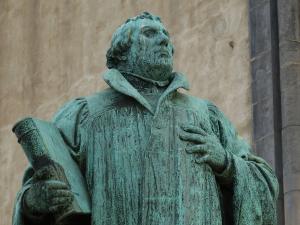
One of the phrases that conservative Protestants like to use about the Reformation is that it “restored the Biblical Gospel.” Or, with more nuance, that it restored it to “full clarity.”
Whatever the Reformation is, that’s the one thing it quite clearly didn’t do. It didn’t take Christians back to a more authentically first-century way of thinking about the faith, at least if we are speaking of the “magisterial Reformation” exemplified above all in Martin Luther. (The Anabaptists could make a better case though they too were very much shaped by their time and place.)
Whose Gospel? Which evangelicals?
One of the most salient and indisputable things about Martin Luther’s teaching, in particular, is that he redefined the word “Gospel.” Previously, the term had been used primarily to mean the proclamation about Jesus’ person and work, including Jesus’ teachings. This goes all the way back to the Gospel of Mark’s use of the word in v. 1. The term came to be applied, in early Christianity, to all four of the canonical books describing Jesus’ life, teachings, death and resurrection.
And so, in the Middle Ages, the term “evangelical” came to mean “a way of life based on the Gospels and structured around the imitation of Jesus.” The Franciscans were the ultimate medieval “evangelicals” in this sense.
Luther would have none of it. He insisted that the “Gospel” in the strict sense of the term was not to be found in the teachings of Jesus such as the Sermon on the Mount. These teachings were oriented toward the Gospel because they pointed to the absolute perfection of God’s law which human beings cannot fulfil. And they certainly provided a guideline for Christian living. (Some people deny Luther taught the “third use of the Law” but I concluded in my doctoral dissertation that he certainly did in substance, even if the one place where he explicitly endorses it may have been added by Melanchthon after Luther’s death.) It’s not that these teachings were dispensable or unimportant for Luther. But they were not the core of the Gospel. Nor were the narrative accounts of Jesus’ many actions in his life prior to the one that truly mattered for Luther: the death and resurrection by which Jesus had overcome death and hell for believers.
Words and works
The saving death and resurrection of Jesus, and the proclamation of salvation to those who believe in this saving work, were for Luther the core of the Gospel. This meant that for him the one of the four Gospels that most fully proclaimed the Gospel was John. The Gospel of John and the writings of Paul were the core of Scripture. The three “Synoptic Gospels” were of less importance. Not that he denied their inspiration or their value. But they were primarily narratives of Jesus’ mighty deeds.
John’s Gospel and St. Paul’s Epistles, especially that to the Romans, and St. Peter’s first Epistle are the true kernel and marrow of all the books. They ought rightly be the first books and it would be advisable for every Christian to read them first and most, and by daily reading, make them as familiar as his daily bread.
In them you find not many works and miracles of Christ described, but you do find it depicted, in masterly fashion, how faith in Christ overcomes sin, death, and hell, and gives life, righteousness, and salvation. This is the real nature of the Gospel, as you have heard.
If I had to do without one or the other, — either the works or preaching of Christ, — I would rather do without His works than His preaching; for the works do not help me, but His words give life, as He Himself says. Now John writes very little about the works of Christ, but very much about His preaching, while the other Evangelists write much of His works and little of His preaching; therefore John’s Gospel is the one, tender, true chief Gospel, far, far to be preferred to the other three and placed high above them. So, too, the Epistles of St. Paul and St. Peter far surpass the other three Gospels, — Matthew, Mark and Luke. (Preface to the New Testament.
Luther’s wording is a bit confusing here because on the one hand he proclaims (in keeping with Christian tradition) that the core of the Gospel is the proclamation of Jesus’ saving acts in his death and resurrection, overcoming death and hell. But on the other, he says that John and Paul are better than the Synoptics because they contain more of Jesus’ “words.” So for Luther, what mattered most were passages that spoke of Jesus’ death and resurrection and its significance. He displaces the Gospel one step–from the narrative proclamation of who Jesus was and what he did and taught, culminating in his death and resurrection, to the parts of Scripture that he could interpret as teaching his preferred explanation of the significance of these acts.
The result, historically, is that Protestants tend to think of the Gospel as a certain explanation of how we are saved. Hence the claims of conservative Protestants that “Rome denies the Gospel.” We all agree that Jesus has saved us from sin and death and hell by his death and resurrection, but we disagree on just how that is applied.
Thus, as I’ve argued elsewhere, Protestants wind up replacing Catholic forms of “works righteousness” with their own form, in which one must believe in just the right way or accept the right doctrines or have the right kind of conversion experience (or some combination of these) in order to be saved.
It’s all Gospel to me
Early Christians, on the other hand, pretty consistently focus on what it is that Jesus did rather than on just how we receive his saving work. And I do not find anything like Luther’s law/Gospel dichotomy in the early centuries of Christianity. Luther’s major inspiration in this regard was Augustine’s De Spiritu et Littera , though even this doesn’t entirely agree with Luther’s mature teaching. But Augustine himself was taking the concept of “letter and spirit” in a new direction.
Obviously early Christians spoke of the contrast between Law and Gospel, but it seems clear to me that they were speaking of the difference between Old and New Testaments (often, be it said, in very anti-Jewish ways). They might find the Gospel anticipated in the Old Testament, certainly (as Luther did). But what was new with Luther was the idea that any command telling us how to live must have the nature of “law” as opposed to “Gospel,” and that the Gospel is pure promise with no command.
Now of course it’s possible, theoretically, that Luther was really recovering something the New Testament authors taught and that all the early Christians after the New Testament just failed to notice it. Possible–but only if we abandon reasonable historical interpretation for a leap of faith. There are no good reasons to think that this is what the NT writers meant. There are no good reasons I can see to think that when Paul gave people instructions on how to live, or when Matthew wrote down the words of the Sermon on the Mount, they thought what they were doing was something other than the “Gospel.” All the evidence I can see indicates that for early Christians, from the New Testament on, the Gospel included a moral path to follow, what two of the earliest non-canonical writings (Didache and Barnabas) call the “way of life” as opposed to the “way of death.”
Recovery or new revelation?
It’s also possible–and a lot more defensible, I think–to argue that Luther’s teaching is a legitimate and much-needed development of something implicit in the New Testament and sometimes grasped in a fragmentary way by early and medieval Christians. That boils down to how we understand development of doctrine and how we distinguish between legitimate and illegitimate developments.
That Luther’s teaching is powerful and compelling, that it grabs hold of you and rattles your bones, that when you turn from it to much earlier Christian teaching on salvation the earlier teaching seems pale and moralistic by comparison, and that he makes certain parts of Scripture seem to come alive in a way that the alternatives don’t–all of this, I think, is true.
What is not plausibly true is that this was a recovery of some earlier truth once clearly known but since lost.
Luther’s teaching belongs squarely in the sixteenth century just as the New Testament belongs squarely in the world of Second Temple Judaism. It makes sense that someone of his time with his cultural and religious formation, a deep piety, a ravenous spiritual hunger, and an unparalleled theological imagination would come up with this teaching. That doesn’t make it false. It does mean that if you think this really is “the Gospel” you are tied in important ways to the assumptions and frameworks of the sixteenth century, as all Christians are tied in far deeper ways to the assumptions and frameworks of Second Temple Judaism.
But I can no more believe that Luther was simply recovering what the New Testament authors meant than I can believe that the New Testament authors were simply recovering what the Old Testament authors had meant.
In short, to be a convinced Protestant is to believe that something analogous to a new revelation happened in the early sixteenth century, drawing on the cultural concepts of that era as the original Gospel drew on the cultural concepts of Hellenistic Judaism.
That is historically believable (though I myself do not believe it). What is not believable is the claim that Luther was recovering the original teaching intended by the human authors of the New Testament.
Image from Falco on Pixabay.
Previous Post

September 25, 2022
The Girl on the Coin: Reflections on Queen Elizabeth
Next Post

November 3, 2022 Why Politics and Religion Can't be Separated
Browse Our Archives
Select a Category apologetics Bible Catholicism Christianity economics history Middle Ages personal Reformation Rodney Stark Uncategorized
Select a Month August 2026 June 2026 January 2026 December 2025 October 2025 June 2025 February 2025 December 2024 November 2024 June 2024 May 2024 January 2024 December 2023 April 2023 December 2022 November 2022 September 2022 July 2022 June 2022 April 2022 November 2021 September 2021 March 2021 February 2021 January 2021 December 2020 November 2020 October 2020 August 2020 July 2020 June 2020 May 2020 December 2018 October 2018 June 2018 March 2018 December 2017 November 2017 October 2017 September 2017 May 2017 April 2017 March 2017 February 2017 January 2017 December 2016 November 2016 October 2016 September 2016 August 2016 July 2016 June 2016 May 2016 April 2016 March 2016 January 2016 December 2015 November 2015 September 2015 June 2015 May 2015 April 2015 March 2015 February 2015 January 2015 December 2014 November 2014 October 2014 August 2014 June 2014 March 2014 January 2014 September 2013 August 2013 June 2013 August 2012 July 2012 October 2011 June 2011 March 2011 July 2010 March 2010 January 2008 May 2007 April 2007 February 2007 October 2006 August 2006 March 2006 January 2006 November 2005 October 2005 September 2005 August 2005 June 2005 May 2005 April 2005 March 2005 February 2005 January 2005 December 2004 November 2004 September 2004
Follow Us!
TAKE THE
Religious Wisdom Quiz
What animal was most often sacrificed for a sin offering in the Old Testament?
Select your answer to see how you score.
A bull A bird A goat A lamb
Related posts from Light in the West

What is "Christian Nationalism"? A Reply to Dennis...



TRENDING AT PATHEOS Catholic

Rejecting Doom: Christian Hope And Human Action
Christianity is a religion of hope. We are to have hope and...

It’s What Comes From Within Which Matters
One of the most difficult things for us to understand is why...

Why I Choose the Eucharist Over the Sermon
Choose the Eucharist, Not the Sermon What are we supposed to get...

5 Design Elements Found in Spiritually Rooted Homes
Putting Spirituality Into Home Decor Our homes are more than our living...

Credo: A Story of God Told with the...
About 10 years ago, I began to imagine a personal "Credo" that...

The Anatomy of Divine Revelation in Catholic Thought
The claim that God has made Himself known to human beings is...
view all Catholic blogs
Ad-Free & Subscriber Log-In Subscription Support
- About Us
- 2026 Calendar
- Videos
- Podcasts
- Library of World Religions
- Faith In Media Tracker
- Advertise With Us
- Write for Us
- Privacy Policy
- Terms of Service
- Do Not Sell My Data
- Contact Us
- Radiant Digital
- Manage Newsletter Subscriptions
- Unsubscribe From Notifications
- Sitemap
Copyright 2008-2026, Patheos. All rights reserved.
Subscription Support Ad-Free & Subscriber Log-In
Follow Patheos