
BuddhistCatholicContemplativeEvangelicalGeneral ChristianHinduJewishLatter-day SaintMuslimNew VisionsProgressive Christian
Beliefs
- Buddhist
- Catholic
- Contemplative
- Evangelical
- General Christian
- Hindu
- Jewish
- Latter-day Saint
- More Voices
- Muslim
- New Visions
- Pagan
- Progressive Christian
Topics
- Religion News
- Food and Religion
- Sports and Religion
- Religious Art
- Religious Music and Entertainment
- Religious Events
- History and Religion
- Style and Religion
- Politics and Religion
- Women in Religion
- Recreation Outdoors and Religion
- Business Finance and Religion
- Careers Workplace and Religion
- Education and Religion
- Family Parenting and Religion
- Health Fitness and Religion
- Home and Religion
- Relationships and Religion
- Technology and Religion
- Travel and Religion
Columnists
- Buddhist Columnists
- Business Finance and Religion Columnists
- Careers Workplace and Religion Columnists
- Catholic Columnists
- Contemplative Columnists
- Education and Religion Columnists
- Evangelists Columnists
- Family Parenting and Religion Columnists
- General Christian Columnists
- Health Fitness and Religion Columnists
- Hindu Columnists
- History and Religion Columnists
- Home and Religion Columnists
- Jewish Columnists
- More Voices Columnists
- Latter Day Columnists
- Muslim Columnists
- New Visions Columnists
- Nonreligious Columnists
- Pagan Columnists
- Politics and Religion Columnists
- Progressive Columnists
- Recreation Outdoors and Religion Columnists
- Relationships and Religion Columnists
- Religion News Columnists
- Religious Art Columnists
- Religious Events Columnists
- Religious Music and Entertainment Columnists
- Sports and Religion Columnists
- Style and Religion Columnists
- Technology and Religion Columnists
- Travel and Religion Columnists
- Women in Religion Columnists
Resource Library
- 2026 Calendar
- Library of World Religions
- The 100 Most Holy Places on Earth
- Patheos Answers
- Podcasts
- Videos
- Faith Leaders Database
- Anglican Episcopalian
- Bahai
- Baptist
- Buddhism
- Christianity
- Confucianism
- Eastern Orthodoxy
- Hinduism
- Holiness and Pentecostal
- ISKCON
- Islam
- Judaism
- Lutheran
- Methodist
- The Church of Jesus Christ of Latter-day Saints
- New Age
- Paganism
- Presbytarian and Reformed
- Protestantism
- Religion Behind the Scenes
- Roman Catholic
- Scientology
- Shia Islam
- Sikhism
- Sufism
- Sunni Islam
- Taoism
- Zen
- See all religions
Research Tools
 Ad-Free & Subscriber Log-In Subscription Support
Ad-Free & Subscriber Log-In Subscription Support
Follow Patheos 

- Trending:
- Forgiveness
- |
- Marriage
- |
- Consciousness
- |
- Death Penalty
- |
- Election
- |
- Halloween

- Home
- Catholic
- Talking Snakes and Rational Inquiry
Talking Snakes and Rational Inquiry
Last updated on: November 8, 2022 at 4:49 pm by Edwin Woodruff Tait
Talking Snakes and Rational Inquiry 2022-11-08T16:49:23-05:00 Edwin Woodruff Tait
Patheos Explore the world's faith through different perspectives on religion and spirituality! Patheos has the views of the prevalent religions and spiritualities of the world.
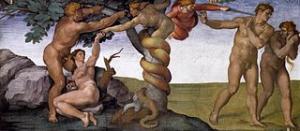
In a Facebook conversation a while ago, I made the claim that all the major religions reached their current form through a long and difficult process of rational inquiry. A number of people (presumably atheists) reacted to this with snarky comments about how ridiculous it was to ascribe “rational inquiry” to religious traditions. The most succinct response was: “A belief in talking snakes does not come [by] rational inquiry. Try again.” So I did. Here’s a longer and more developed version of my reply.
Was the snake ever just a snake?
The crack about “talking snakes” presumably refers to the story found in Genesis 3, in which a talking snake persuades the first two humans to eat the fruit of the tree of knowledge of good and evil. The story is part of the Torah, the five “Books of Moses,” most likely written in its present form roughly around 500 B.C. (OT scholar friends correct me if I’m misrepresenting the current consensus.) But the “J” strand to which Gen. 2-3 belongs may be older than that, and the story itself is most likely a folk tale that had been passed down in oral form for quite a while.
Did the people who originally told the story believe in talking snakes, or were they telling a story they knew to be fictional on the “literal” level? Hard to be sure. But the focus of the story seems to be on the origins of death and various other forms of unpleasant experience (hard manual labor to produce food, painful and dangerous childbirth). There’s inquiry going on here. They’re telling a story to explain their experience. And as that story was folded into the bigger canonical narrative called the “Torah,” and that became part of a larger body of Jewish and/or Christian Scriptures and part of a long tradition of reflection and interpretation and application, people in both Jewish and Christian traditions asked all kinds of questions about the story, very few of which had anything to do with talking snakes per se.
Even if we do suppose that ancient people thought snakes had once literally been able to talk or that a few remarkable snakes here and there might still talk, that’s not antithetical to rational inquiry. We have stories about talking animals in most cultures because one of the things a thoughtful human being will notice about non-human animals is that they clearly have some kind of minds and interact with their environment in ways analogous to the ways they do. It’s common to say of dogs or other intelligent animals we interact with closely that they “practically talk” or they “do everything but talk.”
Ironically, in my youth I thought that anthropomorphizing animals was a silly mistake because my biology textbook warned me sternly not to do it. Then I realized that this was because the textbook had been produced by Bob Jones University and these warnings reflected their ideology, not good science, which is tending more and more to point out the fundamental similarities between humans and other animals. The founder of modern philosophy and self-proclaimed paragon of rational inquiry Rene Descartes thought that animals were basically just machines. Between Descartes and the ancient storytellers who told tales of talking snakes, which were actually engaging in more intelligent analysis of the world around them? I think the ancient storytellers were.
Are there any real literalists?
Of course, the reason atheists make these kinds of silly arguments is that they hear believers claim to interpret the Bible “literally.” But this claim should never be taken at face value. It’s not just that fundamentalists read the Bible badly, but that they don’t actually read it in the way they think they do. In practice, “literal” really means “the primary meaning that pops into my head.” And that meaning is determined by all kind of influences from outside the text.
Back to Genesis and the talking snake. Fundamentalists claim that it’s important to believe that a snake really talked. But it clearly isn’t, as their own actual use of the text indicates. When using the story theologically, practically all Christians interpret the snake as Satan. Fundamentalists may insist that Satan was possessing a real snake and making it talk, but that plays no significant role in their use of the story.
The long and winding course of the ancient serpent
The idea that the snake is Satan not only isn’t anywhere in Genesis, but isn’t anywhere in the Old Testament at all that I can think of. (Though to be sure there are various references to malevolent serpent/dragon-like beings.) It pops up in the Book of Revelation (12:9, 20:2) explicitly and is probably implicit elsewhere. (Romans 16:20 speaks of God crushing Satan under the feet of believers, which is probably a reference to Gen. 3:15; John 8:44 refers to Satan as a liar and a murderer from the beginning, probably an allusion to the serpent bringing death through deceit. 2 Corinthians 11:3 speaks of the serpent deceiving Eve and one can perhaps assume that Paul thinks of the serpent as identical with Satan and of Satan as the one he fears will deceive the Corinthians, but he doesn’t actually explicitly say so.
Since the Jewish tradition also identifies the serpent with Satan, one can assume that the interpretation has its roots in the Second Temple period. (Jewish theology about Satan is significantly different from Christian interpretations, though.) But it obviously resulted from process of inquiry into what the “animal fable” of Genesis 3 could actually mean. What kind of serpent could really cause death and labor pains to come into the world? Over the centuries, both Jews and Christians, in somewhat diverging ways, developed complex theological interpretations of Genesis 3 and its resonance for other parts of Scripture, and these theologies have (at least in Christianity) come to seem so obvious that many people simply assume this is the literal sense of the original text.
Three rival versions of inquiry: the seductive clarity of the Encyclopedia
Nearly all apparently “literal” interpretations have a similarly complex history. But why do we call this process “rational”? For many modern people, “rationality” implies an impartial, objective analysis unaffected by tradition and assumption. This is why so many atheists find it hard to acknowledge the rationality of religious inquiry, and why so many believers are unwilling to recognize the complex nature of the traditions that shape their own assumptions.
My use of the phrase “rational inquiry” is influenced by the work of Alasdair MacIntyre. In MacIntyre’s 1987 Gifford Lectures, Three Rival Versions of Moral Inquiry, published in 1990, he distinguishes between three different approaches to ethics (and by extension to rational inquiry more broadly). The first, the “encyclopedia” method, is characteristic of the Enlightenment. In this approach, truth is something objectively discernible by any rational person. People make mistakes because they are deceived either by their own flaws or by some corrupt external influence which biases their judgment. But all unbiased, reasonable people, looking at the same evidence, will come to the same conclusion.
Genealogy: the grubby roots of truth
The second approach, the “genealogy” method, is characteristic of Nietzsche and of much postmodern thought. In this view, there is no objective truth to be had. Truth claims are fundamentally rhetorical claims of power, and the proper response to such a claim is to unpack the history behind it, showing the contingent (and often disturbing) historical factors that resulted in people coming to believe in the claim. (Here’s one really influential example of this approach in action with regard to a highly charged contemporary issue.)
MacIntyre argues that both these methods are hopelessly flawed as general approaches to moral truth (or truth in general). The Encyclopedia method respects objective truth but is hopelessly naive about the possibility of anyone actually being entirely free from bias. And since people who hold to the encyclopedia approach see divergent views as errors resulting from the bias or corruption of the opponent, it’s hard for them to see where they might be seriously wrong. As MacIntyre argues at more length in his Whose Justice? Which Rationality? much Enlightenment thought took the thought habits of a particular group of British elites to be characteristic of human beings as a whole and thus constructed whole ethical systems that were really the projection of the interests and biases of a narrow section of humanity.
The genealogy method rightly uncovers the grubby roots of the Encyclopedia’s grand claims. Specific pieces of “genealogical” debunking can be of great value in challenging smug assumptions about the obvious rightness of one’s own position. (Balmer’s piece linked above, for instance, is something that all prolifers, particularly evangelicals, should take seriously.) But as a general approach it undermines itself. If all truth claims are susceptible to genealogical debunking, then this includes the claim that the genealogical method is the best one. It is itself a rhetorical claim made in the interests of a particular claim to power. (Balmer’s article has been triumphantly brandished all over the Internet for years by pro-choicers who are heavily invested in not confronting the actual ethical and philosophical arguments of the prolife movement.)
Tradition: truth through story
MacIntyre’s alternative is the “tradition” method. This approach acknowledges that there is a truth outside ourselves, but that we have no way of getting at that truth apart from a particular tradition. A tradition, for MacIntyre, is “an argument extended through time.” It’s not a set of beliefs or practices handed down unchangingly and accepted blindly. Rather, it’s a dynamic process of inquiry with certain parameters that have been worked out in a particular context as the appropriate ones for this particular inquiry. When new circumstances arise, a tradition may face a crisis because its methods and assumptions no longer work as well. But this also generates creative thinking, as adherents of the tradition seek to explain how a particular solution to the new problem makes sense of “the story so far” and explains the new challenges in light of that ongoing story.
I think this is by far the best way to approach questions of truth in general, but it’s particularly applicable to the history of Biblical interpretation. To be a “believer in the Bible” is not simply to believe that a particular text is true but to be part of a very long process of seeking to understand and apply that text. Stories that “don’t make sense,” often because they are removed from their original context, tend to generate particularly intense discussion. Thus, “problem” stories often become mirrors of changing cultural norms. They bridge gaps between generations and provide cultural continuity. This may not look like “rational inquiry” to people seduced by the specious clarity of the encyclopedia. But it is how the human race has historically carried out most of its inquiry into the meaning of life and death, and it is how most people continue to do so.
Michelangelo, Fall and Expulsion from Eden, public domain image from Wikimedia Commons.

Previous Post

November 3, 2022
Why Politics and Religion Can't be Separated
Next Post
December 12, 2022 The Unbroken Bones of Jesus
Browse Our Archives
Select a Category apologetics Bible Catholicism Christianity economics history Middle Ages personal Reformation Rodney Stark Uncategorized
Select a Month August 2026 June 2026 January 2026 December 2025 October 2025 June 2025 February 2025 December 2024 November 2024 June 2024 May 2024 January 2024 December 2023 April 2023 December 2022 November 2022 September 2022 July 2022 June 2022 April 2022 November 2021 September 2021 March 2021 February 2021 January 2021 December 2020 November 2020 October 2020 August 2020 July 2020 June 2020 May 2020 December 2018 October 2018 June 2018 March 2018 December 2017 November 2017 October 2017 September 2017 May 2017 April 2017 March 2017 February 2017 January 2017 December 2016 November 2016 October 2016 September 2016 August 2016 July 2016 June 2016 May 2016 April 2016 March 2016 January 2016 December 2015 November 2015 September 2015 June 2015 May 2015 April 2015 March 2015 February 2015 January 2015 December 2014 November 2014 October 2014 August 2014 June 2014 March 2014 January 2014 September 2013 August 2013 June 2013 August 2012 July 2012 October 2011 June 2011 March 2011 July 2010 March 2010 January 2008 May 2007 April 2007 February 2007 October 2006 August 2006 March 2006 January 2006 November 2005 October 2005 September 2005 August 2005 June 2005 May 2005 April 2005 March 2005 February 2005 January 2005 December 2004 November 2004 September 2004
Follow Us!
TAKE THE
Religious Wisdom Quiz
What animals attacked and killed Job's servants, according to the messengers?
Select your answer to see how you score.
Sabeans and Chaldeans Ammonites and Edomites Philistines and Moabites Syrians and Egyptians
Related posts from Light in the West

What is "Christian Nationalism"? A Reply to Dennis...



TRENDING AT PATHEOS Catholic

Rejecting Doom: Christian Hope And Human Action
Christianity is a religion of hope. We are to have hope and...

It’s What Comes From Within Which Matters
One of the most difficult things for us to understand is why...

Why I Choose the Eucharist Over the Sermon
Choose the Eucharist, Not the Sermon What are we supposed to get...

5 Design Elements Found in Spiritually Rooted Homes
Putting Spirituality Into Home Decor Our homes are more than our living...

Credo: A Story of God Told with the...
About 10 years ago, I began to imagine a personal "Credo" that...

The Anatomy of Divine Revelation in Catholic Thought
The claim that God has made Himself known to human beings is...
view all Catholic blogs
Ad-Free & Subscriber Log-In Subscription Support
- About Us
- 2026 Calendar
- Videos
- Podcasts
- Library of World Religions
- Faith In Media Tracker
- Advertise With Us
- Write for Us
- Privacy Policy
- Terms of Service
- Do Not Sell My Data
- Contact Us
- Radiant Digital
- Manage Newsletter Subscriptions
- Unsubscribe From Notifications
- Sitemap
Copyright 2008-2026, Patheos. All rights reserved.
Subscription Support Ad-Free & Subscriber Log-In
Follow Patheos