
BuddhistCatholicContemplativeEvangelicalGeneral ChristianHinduJewishLatter-day SaintMuslimNew VisionsProgressive Christian
Beliefs
- Buddhist
- Catholic
- Contemplative
- Evangelical
- General Christian
- Hindu
- Jewish
- Latter-day Saint
- More Voices
- Muslim
- New Visions
- Pagan
- Progressive Christian
Topics
- Religion News
- Food and Religion
- Sports and Religion
- Religious Art
- Religious Music and Entertainment
- Religious Events
- History and Religion
- Style and Religion
- Politics and Religion
- Women in Religion
- Recreation Outdoors and Religion
- Business Finance and Religion
- Careers Workplace and Religion
- Education and Religion
- Family Parenting and Religion
- Health Fitness and Religion
- Home and Religion
- Relationships and Religion
- Technology and Religion
- Travel and Religion
Columnists
- Buddhist Columnists
- Business Finance and Religion Columnists
- Careers Workplace and Religion Columnists
- Catholic Columnists
- Contemplative Columnists
- Education and Religion Columnists
- Evangelists Columnists
- Family Parenting and Religion Columnists
- General Christian Columnists
- Health Fitness and Religion Columnists
- Hindu Columnists
- History and Religion Columnists
- Home and Religion Columnists
- Jewish Columnists
- More Voices Columnists
- Latter Day Columnists
- Muslim Columnists
- New Visions Columnists
- Nonreligious Columnists
- Pagan Columnists
- Politics and Religion Columnists
- Progressive Columnists
- Recreation Outdoors and Religion Columnists
- Relationships and Religion Columnists
- Religion News Columnists
- Religious Art Columnists
- Religious Events Columnists
- Religious Music and Entertainment Columnists
- Sports and Religion Columnists
- Style and Religion Columnists
- Technology and Religion Columnists
- Travel and Religion Columnists
- Women in Religion Columnists
Resource Library
- 2026 Calendar
- Library of World Religions
- The 100 Most Holy Places on Earth
- Patheos Answers
- Podcasts
- Videos
- Faith Leaders Database
- Anglican Episcopalian
- Bahai
- Baptist
- Buddhism
- Christianity
- Confucianism
- Eastern Orthodoxy
- Hinduism
- Holiness and Pentecostal
- ISKCON
- Islam
- Judaism
- Lutheran
- Methodist
- The Church of Jesus Christ of Latter-day Saints
- New Age
- Paganism
- Presbytarian and Reformed
- Protestantism
- Religion Behind the Scenes
- Roman Catholic
- Scientology
- Shia Islam
- Sikhism
- Sufism
- Sunni Islam
- Taoism
- Zen
- See all religions
Research Tools
 Ad-Free & Subscriber Log-In Subscription Support
Ad-Free & Subscriber Log-In Subscription Support
Follow Patheos 

- Trending:
- Forgiveness
- |
- Marriage
- |
- Consciousness
- |
- Death Penalty
- |
- Election
- |
- Halloween

- Home
- Catholic
- What Is Communion in Catholicism?
What Is Communion in Catholicism?
Last updated on: August 19, 2022 at 2:44 pm by Edwin Woodruff Tait
What Is Communion in Catholicism? 2022-08-19T14:44:24-05:00 Edwin Woodruff Tait
Patheos Explore the world's faith through different perspectives on religion and spirituality! Patheos has the views of the prevalent religions and spiritualities of the world.
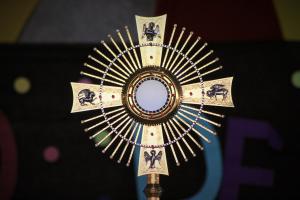
This is part of a series responding to the 100 most common questions people have about various religious traditions. In the case of Catholicism, naturally one of the things people want to know about is our belief regarding what we call the Eucharist and the question calls “communion.”
The terminology is important to clarify at the start. Most Protestants refer to the ceremony of praying over and sharing in bread and wine as “communion,” and there’s a reason for this which I’ll explain later. For Catholics, “communion” is part of the Eucharist but not our usual term for the whole act (though we do sometimes use it in that sense). We more often say “the Eucharist” or “the Sacrament of the Altar” or most commonly, for the whole service that includes Scripture reading and prayer and preaching as well as the Eucharist, “the Mass.”
The Eucharist is, for us, the “source and summit” of the Christian life. Jesus instituted it on the night before he died when he broke bread and poured wine and shared it with his disciples, telling them, “This is my body,” and “this is my blood.” Every day in Catholic churches around the world, priests repeat these words over bread and wine, and we believe that when this happens the bread and wine become the body and blood of Jesus.
Literal flesh and blood?
People often say that we believe that the bread and wine become the “literal” or “physical” body and blood of Jesus. Many Catholics say this too. But actually Church teaching isn’t quite so simple. As you can see from the link above, the Catechism of the Catholic Church uses words like “true” and “real” and “substantial,” but not “literal” or “physical.” Catholic apologists have historically defended the idea that Jesus’ words “this is my body” and “this is my blood” are “literal” rather than figurative. In other words, Jesus was really saying that the bread and wine become his body and blood, not just making a metaphorical statement about what they represent symbolically. There’s a range of opinion among Protestants about just what kind of “Real Presence” might be in the bread and wine, and some of those views come pretty close to Catholicism (Lutheran and Anglican views especially). But most Protestants think that we take the idea of “Real Presence” too far.
What do we really mean by it? As with the Trinity–the other great mystery of our faith, but shared by far more of our fellow Christians–we don’t claim to know exactly. We believe that Jesus–the whole Jesus, body, blood, soul and divinity–is truly and fully present under the “appearances” or “outward forms” of bread and wine. The problem I have with calling the Presence “literal” is that this gives the impression that the bread and wine become “body” and “blood” in the normal senses of those words. In other words, in a truly “literal” view we’re basically gnawing on hunks of bloody flesh but God mercifully fools our senses so that we aren’t grossed out by it. There are Catholics who think that way, but it’s not what the Church says and in my opinion it’s not a very good way to think about it.
It’s certainly not how the great theologian St. Thomas Aquinas talked about it. Aquinas says that Jesus’ body in its “natural dimensions” is in heaven. What he means by “natural dimensions” is basically what we would mean by a “physical” presence–something you can measure and examine with your senses or with scientific instruments and so on. Jesus was once present on earth in that way. But no longer. Now he is present “by way of substance.” He is not present “as in a place.” If you move the Host (the bread that has been consecrated and transformed into Jesus’ body and blood), Jesus’ body isn’t being moved. If you chew the Host (traditionally discouraged to be sure), Jesus’ body isn’t getting chewed up. If you were to trample on the Host, you would be, from a Catholic point of view, committing a terrible act of sacrilege (and you would be really upsetting all Catholics, so please don’t do that), but you wouldn’t actually be hurting Jesus at all.
Note that I said that the bread is transformed into Jesus’ body and blood. So is the wine. The bread doesn’t become flesh while the wine becomes blood. Every particle of both becomes the whole Jesus. (That’s why we can, and often do, receive only the Host–especially during the pandemic and other times of contagious disease. We aren’t getting any “less Jesus” when we do that.) And the Jesus who is fully and really present under the forms of bread and wine is the glorified Jesus with a transformed, risen body.
A new kind of reality
All of this can seem very weird and abstract. It’s weird to be sure. That’s a feature, not a bug. For us the Eucharist is a window into a new kind of reality–the reality of the “world to come” or the “Kingdom.” We speak of it as a “foretaste of the eschatological banquet.” The world into which Jesus calls us is a world where we will still have bodies but they will be radically transformed, as Jesus’ body was in the Resurrection. In Paul’s words (from 1 Corinthians 15), they will be “spiritual bodies,” which sounds to us like a contradiction in terms. It’s a paradox, like so much else in the Christian faith.
We don’t have the vocabulary or the concepts to describe this new, transformed kind of bodily reality. So we do the best we can. We try to use language that preserves the mystery instead of watering it down. That’s why we avoid saying things like “Jesus is spiritually present” or “it’s a profound symbol.” Those statements may well be true in some sense, but in our vocabulary here and now they make what is going on seem too safe. Yes, symbols can be profoundly real. Yes, what is going on in the Eucharist is the work of the Holy Spirit and is obviously “spiritual.” But to say “it’s just spiritual” or “it’s just a symbol” lets us breathe a sigh of relief and go on living in the “normal” world without fully reckoning with the radical challenge posed by the Incarnation to our definition of reality itself.
What does Aquinas mean by “substance”? He gets the term from Aristotle, though Aristotle would think what he was doing with it was very weird. For Aristotle, everything has a “substance” that makes it the kind of thing it is. This isn’t itself a physical, measurable thing. What we can observe and measure are the “accidents,” some of which are necessary “properties” of a thing and others may change over time. Now Aristotle would think it was nonsense to say that you can have the substance of body and blood without any of the accidents, or the accidents of bread and wine without the substance. So it’s not true to say, as many people do, that Aquinas just squeezed the doctrine into Aristotle’s framework. He took language and concepts from Aristotle, but they couldn’t hold the mystery. They broke. All language and concepts break when confronted with the Holy Mysteries. We’re still using this broken language from Aristotle because we haven’t found any other language that does a better job of letting the mystery shine through. That’s all.
The bottom line is this: for us Jesus is present in such a way that it is entirely appropriate, even necessary, to worship him in the Sacrament. We don’t just honor the Eucharist in the way that we would honor, say, the image of a saint or for that matter a crucifix that reminds us of Jesus’ sacrifice. No, we believe that the whole Jesus, human and divine, is present under the forms of bread and wine, and we worship Jesus in that form in the fullest sense of the word. That’s the ultimate dividing point between a Catholic theology of the Eucharist and a Protestant one. We can parse out the metaphysics till we are weary, but the real question is: do you worship or not?
Sacrifice and Communion
Now back to why Protestants are more likely than Catholics to call the Eucharist “Communion.” The Protestant Reformation, the people who would become “Protestants” criticized medieval Catholicism for seeing the Eucharist as a sacrifice. In the late Middle Ages, most laypeople didn’t receive communion more than once a year–three times was considered quite frequent and a sign of great devotion. More than that was suspect–how holy did you think you were to be worthy of receiving communion so often? And when laypeople did receive, they only received the Host, not the Cup.
So for most medieval Catholics, the Eucharist wasn’t primarily about receiving communion. It was a sacrifice offered by the priest, and they participated by saying their own prayers as the priest was praying and then by worshiping Christ in the Sacrament as the priest lifted the Host above his head at the moment of consecration. There were lots of folk beliefs about the benefit of seeing the “elevation” of the Host. In fact, in cathedrals and large churches multiple Masses would be celebrated at the same time and people would allegedly run around the church to see the Elevation as often as possible, much to the annoyance of preachers who wanted them to sit still and listen.
Both Luther and Calvin wanted people to receive communion more often, though they weren’t successful in getting them to do this. But Protestants weren’t willing to celebrate the Eucharist if people weren’t ready to receive. This was because for Protestants the only point of the Eucharist was communion. Thus, Protestants wound up celebrating the Eucharist only a few times a year, not because they didn’t think it was important, but because they didn’t believe in a Eucharist at which only the person celebrating received communion (which was at that time the norm in the Catholic church).
For Catholics, on the other hand, the Eucharist is still the Eucharist even if only the priest receives. For one thing, in our view every Eucharist is fundamentally the same act. The entire host of heaven, all the saints and angels, are present at every Mass. It’s the same Jesus present on every altar in all his fullness. The Mass breaks down the divisions of place and time, so it would be silly to say that it’s not really a Mass just because only one person at that particular place and time was receiving communion.
Not only is every Mass deeply connected to every other Mass, but every Mass is deeply connected to Jesus’ sacrifice on the Cross, which is the whole point of the Mass in the first place. That is why we speak of the Mass as a sacrifice but don’t believe that we are “sacrificing Jesus all over again” as many Protestants claim we are. No, for us there’s only one sacrifice, one saving act. The Protestants are right about that. Jesus offered himself once and made one sacrifice that united us to the Father, destroyed the power of sin and death, opened the kingdom of heaven, and made all creation new.
Every time we celebrate the Mass, we are “plugging in” to that one cosmic act which was also a real historical moment in which a man hung in bloody agony on an instrument of torture. But in the Mass he does not suffer. In the Mass the glorified Jesus eternally offers himself to the Father, and this is the same Jesus who hung upon the cross. The glory takes up the suffering and redeems it, and redeems all of the suffering of the world together with it.
When we receive communion, we are taking our place in that cosmic drama. We are accepting the divine life into us by receiving the Body of Christ so that we can be the Body of Christ. That is communion in Catholicism.
Image by Sergio Alexandre de Carvalho on Pixabay.
Previous Post
June 14, 2022
Why the Trinity saves monotheism
Next Post
September 3, 2022 St. Augustine and Humility
Browse Our Archives
Select a Category apologetics Bible Catholicism Christianity economics history Middle Ages personal Reformation Rodney Stark Uncategorized
Select a Month August 2026 June 2026 January 2026 December 2025 October 2025 June 2025 February 2025 December 2024 November 2024 June 2024 May 2024 January 2024 December 2023 April 2023 December 2022 November 2022 September 2022 July 2022 June 2022 April 2022 November 2021 September 2021 March 2021 February 2021 January 2021 December 2020 November 2020 October 2020 August 2020 July 2020 June 2020 May 2020 December 2018 October 2018 June 2018 March 2018 December 2017 November 2017 October 2017 September 2017 May 2017 April 2017 March 2017 February 2017 January 2017 December 2016 November 2016 October 2016 September 2016 August 2016 July 2016 June 2016 May 2016 April 2016 March 2016 January 2016 December 2015 November 2015 September 2015 June 2015 May 2015 April 2015 March 2015 February 2015 January 2015 December 2014 November 2014 October 2014 August 2014 June 2014 March 2014 January 2014 September 2013 August 2013 June 2013 August 2012 July 2012 October 2011 June 2011 March 2011 July 2010 March 2010 January 2008 May 2007 April 2007 February 2007 October 2006 August 2006 March 2006 January 2006 November 2005 October 2005 September 2005 August 2005 June 2005 May 2005 April 2005 March 2005 February 2005 January 2005 December 2004 November 2004 September 2004
Follow Us!
TAKE THE
Religious Wisdom Quiz
Who was the father of King Solomon?
Select your answer to see how you score.
David Jonathan Saul Samuel
Related posts from Light in the West

What is "Christian Nationalism"? A Reply to Dennis...



TRENDING AT PATHEOS Catholic

Rejecting Doom: Christian Hope And Human Action
Christianity is a religion of hope. We are to have hope and...

It’s What Comes From Within Which Matters
One of the most difficult things for us to understand is why...

Why I Choose the Eucharist Over the Sermon
Choose the Eucharist, Not the Sermon What are we supposed to get...

5 Design Elements Found in Spiritually Rooted Homes
Putting Spirituality Into Home Decor Our homes are more than our living...

Credo: A Story of God Told with the...
About 10 years ago, I began to imagine a personal "Credo" that...

The Anatomy of Divine Revelation in Catholic Thought
The claim that God has made Himself known to human beings is...
view all Catholic blogs
Ad-Free & Subscriber Log-In Subscription Support
- About Us
- 2026 Calendar
- Videos
- Podcasts
- Library of World Religions
- Faith In Media Tracker
- Advertise With Us
- Write for Us
- Privacy Policy
- Terms of Service
- Do Not Sell My Data
- Contact Us
- Radiant Digital
- Manage Newsletter Subscriptions
- Unsubscribe From Notifications
- Sitemap
Copyright 2008-2026, Patheos. All rights reserved.
Subscription Support Ad-Free & Subscriber Log-In
Follow Patheos