
BuddhistCatholicContemplativeEvangelicalGeneral ChristianHinduJewishLatter-day SaintMuslimNew VisionsProgressive Christian
Beliefs
- Buddhist
- Catholic
- Contemplative
- Evangelical
- General Christian
- Hindu
- Jewish
- Latter-day Saint
- More Voices
- Muslim
- New Visions
- Pagan
- Progressive Christian
Topics
- Religion News
- Food and Religion
- Sports and Religion
- Religious Art
- Religious Music and Entertainment
- Religious Events
- History and Religion
- Style and Religion
- Politics and Religion
- Women in Religion
- Recreation Outdoors and Religion
- Business Finance and Religion
- Careers Workplace and Religion
- Education and Religion
- Family Parenting and Religion
- Health Fitness and Religion
- Home and Religion
- Relationships and Religion
- Technology and Religion
- Travel and Religion
Columnists
- Buddhist Columnists
- Business Finance and Religion Columnists
- Careers Workplace and Religion Columnists
- Catholic Columnists
- Contemplative Columnists
- Education and Religion Columnists
- Evangelists Columnists
- Family Parenting and Religion Columnists
- General Christian Columnists
- Health Fitness and Religion Columnists
- Hindu Columnists
- History and Religion Columnists
- Home and Religion Columnists
- Jewish Columnists
- More Voices Columnists
- Latter Day Columnists
- Muslim Columnists
- New Visions Columnists
- Nonreligious Columnists
- Pagan Columnists
- Politics and Religion Columnists
- Progressive Columnists
- Recreation Outdoors and Religion Columnists
- Relationships and Religion Columnists
- Religion News Columnists
- Religious Art Columnists
- Religious Events Columnists
- Religious Music and Entertainment Columnists
- Sports and Religion Columnists
- Style and Religion Columnists
- Technology and Religion Columnists
- Travel and Religion Columnists
- Women in Religion Columnists
Resource Library
- 2026 Calendar
- Library of World Religions
- The 100 Most Holy Places on Earth
- Patheos Answers
- Podcasts
- Videos
- Faith Leaders Database
- Anglican Episcopalian
- Bahai
- Baptist
- Buddhism
- Christianity
- Confucianism
- Eastern Orthodoxy
- Hinduism
- Holiness and Pentecostal
- ISKCON
- Islam
- Judaism
- Lutheran
- Methodist
- The Church of Jesus Christ of Latter-day Saints
- New Age
- Paganism
- Presbytarian and Reformed
- Protestantism
- Religion Behind the Scenes
- Roman Catholic
- Scientology
- Shia Islam
- Sikhism
- Sufism
- Sunni Islam
- Taoism
- Zen
- See all religions
Research Tools
 Ad-Free & Subscriber Log-In Subscription Support
Ad-Free & Subscriber Log-In Subscription Support
Follow Patheos 

- Trending:
- Forgiveness
- |
- Marriage
- |
- Consciousness
- |
- Death Penalty
- |
- Election
- |
- Halloween

- Home
- Catholic
- The Secret That Shouldn’t Be
The Secret That Shouldn’t Be
Last updated on: February 1, 2022 at 1:45 pm by Edwin Woodruff Tait
The Secret That Shouldn’t Be 2022-02-01T13:45:49-05:00 Edwin Woodruff Tait
Patheos Explore the world's faith through different perspectives on religion and spirituality! Patheos has the views of the prevalent religions and spiritualities of the world.
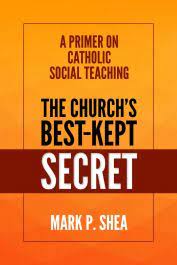
Mark Shea’s excellent primer on Catholic social teaching has the catchy but rather odd title The Church’s Best-Kept Secret. I don’t blame Mark in the least for the oddness. He’s right that many people, both Catholic and non-Catholic, don’t understand the shape of Catholic social teaching. In particular, conservative American Catholics of the past few decades, proudly declaring themselves “faithful to the Magisterium” and denouncing “Cafeteria Catholicism,” have bought into the notion that Catholic social teaching is fundamentally about a limited set of “non-negotiables” which happen to line up with conservative Republican politics. Hence, Hadley Arkes could claim in all seriousness last year that Biden does not agree with Catholic teaching on anything of “moral consequence.” On a Catholic Facebook group recently, when I pointed out that pro-choice Catholic politicians were not simply “not really Catholic” but were in fact inspired by Catholic teachings on social justice, one poster argued that social justice is not a genuinely Catholic concept at all.
Mark’s book offers an antidote to this disastrously common misunderstanding of the Church’s teaching. In less than 150 pages, he expounds the four key principles of Catholic social teaching: human dignity, the common good, subsidiarity, and solidarity. He grounds specific “hot-button” issues in core Catholic theological and moral principles, arguing from impeccably orthodox premises.
Human dignity
Mark’s journey from a fairly standard, though unusually thoughtful and nuanced, spokesman for the Catholic apologetics movement of the late 20th century to a maverick advocate of social justice shunned by many of his former admirers began when he took a stand against the use of torture during the Bush years. This gives his excellent discussion of the dignity of the human person a particular energy. He starts from the premise, which as he says was first clearly articulated at Vatican II though rooted in the principles of previous Catholic teaching, that human beings are “willed by God for their own sake.” That is to say, whenever we make human life a means to some supposedly greater end we sin against the dignity with which God has endowed all human persons. That is why advocates of torture or defenders of the use of weapons of mass destruction (at Hiroshima and Nagasaki, say) are violating Church teaching in exactly the same way as those who advocate abortion.
I myself would go further than Mark insofar as I’d say that actually many abortions are not fairly compared with torture and mass bombing, except perhaps with very extreme and difficult situations where these acts seem necessary to protect the innocent. For instance, many people debate these issues by citing a hypothetical situation where torture seems like the only way to stop a terrorist plot or where there is a grave reason to bomb a target that will result in the deaths of civilians. In such cases we are dealing with some form of “double effect.” (More so with bombing than with torture–the reason torture is such a clear-cut case is that the pain inflicted on the victim is itself the necessary means to the end rather than a side effect, while at the same time it is not legally justified as a punishment even if many people may believe or assume that the victim probably “deserves” it.) But in practice, governments often do these things in the service of a vaguely invoked national interest that may not have a direct connection with protecting specific innocent people from an evident threat. “Ticking time bomb” situations are relatively rare and largely hypothetical.
On the other hand, in many (perhaps most) abortions the death of the child is not itself the end being willed. Abortions where that’s not the case–aborting children with Downs’ Syndrome, say, or even because their birth will interfere with the parents’ economic prospects or career plans–are a fairer comparison. But in cases where the mother’s life or health is under threat, abortion is primarily about protecting the mother by ending a pregnancy that harms her. That doesn’t make it justifiable–for “double effect” to be a justification Catholic ethics requires a very strict set of criteria. But it’s a much more difficult moral question in those cases than simply devaluing one life in order to serve the interests of another.
Of course Mark is writing to–and from the perspective of–those for whom it’s a given that abortion is a particularly horrific form of murder. Throughout the book, Mark’s basically conservative assumptions are evident. That is not odd or remarkable–Mark is an orthodox Catholic who, if anything, leans to the more conservative side of the spectrum of Catholic opinion. But given the conservative slant of Catholic popular discourse in America in recent decades, Mark’s generally “center-right” position seems radically liberal to many people.
The Common Good, Solidarity, and Subsidiarity
Mark’s treatment of the other three principles is similarly solid and clear. He explains the deep Catholic roots of the concept of the “common good,” often criticized as “socialist” by American conservatives. As Mark points out, the principle of the common good is an “extension” of the principle of human dignity, not an opposing principle requiring balance. It isn’t about valuing the collective over the individual but rather about affirming the equal dignity of all persons. Just as the Persons of the Trinity exist in an eternal relationship of communion with each other in which there is no competition and no conflict, so we are called to live in relationship with one another as well as with the God who made us in the image of the Trinity. Mark shows how principles such as the universal destination of goods, the preferential option for the poor, and care for the earth as our common home all develop from this relational, Trinitarian understanding of what it means to be a human being made in God’s image.
Similarly, Mark explodes the idea that solidarity and subsidiarity are conflicting principles to be balanced. Subsidiarity is about being “the hands of God to others,” caring for needs at the most personal level possible. (Though Mark points out that coercion and punishment are important exceptions to this–in those cases we want to “kick them up the ladder as high as possible” rather than allowing people to mete out retribution personally.) It is another expression of the fundamental principle that people are made in God’s image. So is solidarity–the affirmation that “no man is an island” and we are all in this together.
Final thoughts
It’s hard to review a book with which one fundamentally agrees. It’s much easier, at least for a contrarian like me, to point out everything one doesn’t like about a book. There’s not much in that line to point out here. If anything, as I said earlier, Mark is more conservative than I am (which of course may be a damning admission about myself in some people’ eyes). Like C. S. Lewis, whom he quotes in this regard, he’s more interested in the individual than in social change per se. This isn’t a book deeply shaped by liberation theology or promoting any kind of radical or controversial theories not fairly clearly found in the Magisterial documents themselves.
Like all Mark’s writing, it’s crystal clear and brilliantly boils down complex ideas to relatively simple forms illustrated by vivid examples. Perhaps, from my jaded academic perspective, it makes things seem a bit too simple. But someone needs to do that, or we will all wander in a wilderness of nuance forever. And what’s remarkable about this book is how nuanced it manages to be given its size and its generally popular style.
The greatest strength of the book, though, is how deeply it’s rooted in the core convictions of orthodox Catholic faith. Mark’s love for Jesus and his commitment to historic Christian orthodoxy radiate throughout the book. Mark was a huge influence on my own decision, after years of dithering, to become Catholic, and this book illustrates why. If you only buy one book on Catholic social teaching, buy this one.
Previous Post

November 8, 2021
5 Things People Get Wrong About the Reformation
Next Post
April 19, 2022 Punch Or Be Punched? The Crucified God and Nicea's Long Shadow
Browse Our Archives
Select a Category apologetics Bible Catholicism Christianity economics history Middle Ages personal Reformation Rodney Stark Uncategorized
Select a Month August 2026 June 2026 January 2026 December 2025 October 2025 June 2025 February 2025 December 2024 November 2024 June 2024 May 2024 January 2024 December 2023 April 2023 December 2022 November 2022 September 2022 July 2022 June 2022 April 2022 November 2021 September 2021 March 2021 February 2021 January 2021 December 2020 November 2020 October 2020 August 2020 July 2020 June 2020 May 2020 December 2018 October 2018 June 2018 March 2018 December 2017 November 2017 October 2017 September 2017 May 2017 April 2017 March 2017 February 2017 January 2017 December 2016 November 2016 October 2016 September 2016 August 2016 July 2016 June 2016 May 2016 April 2016 March 2016 January 2016 December 2015 November 2015 September 2015 June 2015 May 2015 April 2015 March 2015 February 2015 January 2015 December 2014 November 2014 October 2014 August 2014 June 2014 March 2014 January 2014 September 2013 August 2013 June 2013 August 2012 July 2012 October 2011 June 2011 March 2011 July 2010 March 2010 January 2008 May 2007 April 2007 February 2007 October 2006 August 2006 March 2006 January 2006 November 2005 October 2005 September 2005 August 2005 June 2005 May 2005 April 2005 March 2005 February 2005 January 2005 December 2004 November 2004 September 2004
Follow Us!
TAKE THE
Religious Wisdom Quiz
Who interpreted Nebuchadnezzar's dream of a statue?
Select your answer to see how you score.
Abraham Daniel Joseph Ezekiel
Related posts from Light in the West

What is "Christian Nationalism"? A Reply to Dennis...



TRENDING AT PATHEOS Catholic

Rejecting Doom: Christian Hope And Human Action
Christianity is a religion of hope. We are to have hope and...

It’s What Comes From Within Which Matters
One of the most difficult things for us to understand is why...

Why I Choose the Eucharist Over the Sermon
Choose the Eucharist, Not the Sermon What are we supposed to get...

5 Design Elements Found in Spiritually Rooted Homes
Putting Spirituality Into Home Decor Our homes are more than our living...

Credo: A Story of God Told with the...
About 10 years ago, I began to imagine a personal "Credo" that...

The Anatomy of Divine Revelation in Catholic Thought
The claim that God has made Himself known to human beings is...
view all Catholic blogs
Ad-Free & Subscriber Log-In Subscription Support
- About Us
- 2026 Calendar
- Videos
- Podcasts
- Library of World Religions
- Faith In Media Tracker
- Advertise With Us
- Write for Us
- Privacy Policy
- Terms of Service
- Do Not Sell My Data
- Contact Us
- Radiant Digital
- Manage Newsletter Subscriptions
- Unsubscribe From Notifications
- Sitemap
Copyright 2008-2026, Patheos. All rights reserved.
Subscription Support Ad-Free & Subscriber Log-In
Follow Patheos