
BuddhistCatholicContemplativeEvangelicalGeneral ChristianHinduJewishLatter-day SaintMuslimNew VisionsProgressive Christian
Beliefs
- Buddhist
- Catholic
- Contemplative
- Evangelical
- General Christian
- Hindu
- Jewish
- Latter-day Saint
- More Voices
- Muslim
- New Visions
- Pagan
- Progressive Christian
Topics
- Religion News
- Food and Religion
- Sports and Religion
- Religious Art
- Religious Music and Entertainment
- Religious Events
- History and Religion
- Style and Religion
- Politics and Religion
- Women in Religion
- Recreation Outdoors and Religion
- Business Finance and Religion
- Careers Workplace and Religion
- Education and Religion
- Family Parenting and Religion
- Health Fitness and Religion
- Home and Religion
- Relationships and Religion
- Technology and Religion
- Travel and Religion
Columnists
- Buddhist Columnists
- Business Finance and Religion Columnists
- Careers Workplace and Religion Columnists
- Catholic Columnists
- Contemplative Columnists
- Education and Religion Columnists
- Evangelists Columnists
- Family Parenting and Religion Columnists
- General Christian Columnists
- Health Fitness and Religion Columnists
- Hindu Columnists
- History and Religion Columnists
- Home and Religion Columnists
- Jewish Columnists
- More Voices Columnists
- Latter Day Columnists
- Muslim Columnists
- New Visions Columnists
- Nonreligious Columnists
- Pagan Columnists
- Politics and Religion Columnists
- Progressive Columnists
- Recreation Outdoors and Religion Columnists
- Relationships and Religion Columnists
- Religion News Columnists
- Religious Art Columnists
- Religious Events Columnists
- Religious Music and Entertainment Columnists
- Sports and Religion Columnists
- Style and Religion Columnists
- Technology and Religion Columnists
- Travel and Religion Columnists
- Women in Religion Columnists
Resource Library
- 2026 Calendar
- Library of World Religions
- The 100 Most Holy Places on Earth
- Patheos Answers
- Podcasts
- Videos
- Faith Leaders Database
- Anglican Episcopalian
- Bahai
- Baptist
- Buddhism
- Christianity
- Confucianism
- Eastern Orthodoxy
- Hinduism
- Holiness and Pentecostal
- ISKCON
- Islam
- Judaism
- Lutheran
- Methodist
- The Church of Jesus Christ of Latter-day Saints
- New Age
- Paganism
- Presbytarian and Reformed
- Protestantism
- Religion Behind the Scenes
- Roman Catholic
- Scientology
- Shia Islam
- Sikhism
- Sufism
- Sunni Islam
- Taoism
- Zen
- See all religions
Research Tools
 Ad-Free & Subscriber Log-In Subscription Support
Ad-Free & Subscriber Log-In Subscription Support
Follow Patheos 

- Trending:
- Forgiveness
- |
- Marriage
- |
- Consciousness
- |
- Death Penalty
- |
- Election
- |
- Halloween

- Home
- Catholic
- 5 Things People Get Wrong About the Reformation
5 Things People Get Wrong About the Reformation
Last updated on: November 8, 2021 at 8:21 pm by Edwin Woodruff Tait
5 Things People Get Wrong About the Reformation 2021-11-08T20:21:26-05:00 Edwin Woodruff Tait
Patheos Explore the world's faith through different perspectives on religion and spirituality! Patheos has the views of the prevalent religions and spiritualities of the world.
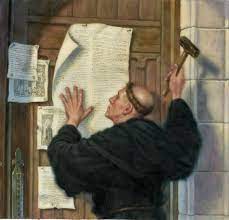
This is the time of year when people talk about the Reformation because of the “Reformation Day” celebration many Protestants observe on Oct. 31. Since I was trained as a Reformation scholar, I naturally have a lot to say about the Reformation. I’ve written a number of Reformation Day posts in the past, chronicling my own journey from disgruntled Catholic-leaning Protestant to disgruntled Protestant-hankering Catholic. Last year I defended Pope Francis against criticisms of his generous statements about atheists and argued that conservative Protestants actually believe in a form of “works righteousness.” This year I’m going to try for Internet click-bait and provide a list of five things I think people get wrong about the Reformation. (Originally I was going for ten but that would have made the post too long.) The list is in no particular order–just things I often hear people say which I find annoyingly wrong in one way or another. I’m happy to back up my opinions in more depth, of course. But here’s the list:
1. Luther just wanted to reform abuses, but the Church was too corrupt and wouldn’t listen.
Lots of people in Luther’s day recognized that the Church was corrupt. It was a common subject of satire. Germans in particular wrote complaints about the way the Roman hierarchy was oppressing the Church in Germany all the time. The “selling” of indulgences–giving people a reduction in the “temporal punishment” of their sins in purgatory in return for a financial contribution–was something lots of people could see was a cynical scam. Luther himself acknowledged that he had had many predecessors in the cause of moral reform. According to Luther, what made him different was that he addressed the theological causes of the corruption. He believed that conventional theology, canon law, and pastoral practice had gone wrong in ways that obscured the true Gospel. And he believed that even good and holy people within the Church, from early Church Fathers to late medieval reformers like Wyclif and Hus, had failed to grasp fully what the Gospel was all about and thus hadn’t touched the root problem. He even suggested at one point that God had allowed monasticism to become corrupt so that people would see that it was a bad idea in the first place.
2. The Reformation was really all about politics and theology was just an excuse.
Sometimes Catholics say this because they don’t want to have to take the theological challenges of the Reformers seriously. Sometimes secular people say it because they assume that theology of any kind doesn’t matter. Either way I don’t think it fits the evidence. Of course political and social factors were hugely important. They always are. But people on both sides genuinely cared about such questions as how human beings are declared righteous by God, or whether and how Christ is present in the Eucharist. I think they were right to do so. But whether or not they were, they did care, and thus these ideas affected people’s political decisions. The causality didn’t go all one way. (Obviously that also means that the Reformation wasn’t about “pure theology” unaffected by politics and economics and changes in social structures.) As my advisor in grad school, David Steinmetz, used to say, “human behavior is overdetermined.” People do what they do for a whole bunch of complex, interconnected factors. Any time someone tells you that any major historical event was “just” about anything, they should not be trusted.
3. The Reformation was about affirming individual freedom over against a tyrannical Church that controlled everything and forced everyone to practice the Christian faith in exactly the same way.
This one was really popular in the 19th century, but it still shows up today. Even as fine a scholar as Steven Ozment adopted a version of it in his The Reformation in the Cities. Ozment argued that the average sixteenth-century Christian found the spiritual as well as social and financial demands of the Church burdensome and overwhelming. Other scholars, though, have argued that most late medieval Christians seemed quite un-burdened by the sort of spiritual pressures that drove Luther to seek a new approach to the doctrines surrounding repentance and forgiveness. Far more commonly, reformers of all stripes complained that their fellow Christians were far too complacent about their spiritual state.
Similarly, most people serious about reform in the sixteenth century complained not about the uniformity of late medieval Catholicism but about its bewildering, chaotic diversity. Berndt Hamm has described the Reformation as a process of the “concentration of norms” or “normative centering.” Reformers, whether they stayed loyal to “Rome” or not, wanted Western Christianity to have a clearer and better defined set of norms that would express the core concerns of Christian faith, and they sought to compel, as much as possible, a fractious and worldly society to adhere to those norms. Protestants and Catholics argued with each other about which set of norms would do the job best. What modern Protestants often glory in–the chaotic energy of the first decade or so of the Reformation, in which Christians of many different backgrounds and theological views proclaimed confidently that they had found a new, liberating perspective on the Gospel–was terribly embarrassing and even terrifying to all but the most radical at the time. Luther’s horror at what was going on in Wittenberg while he was in the Wartburg, and his violent response to the working-class uprisings in Germany in 1525, were extreme but typical of the way the “magisterial” Reformers reacted to the “wild growth” of the 1520s.
The Reformers typically promised not to unleash new possibilities for freedom and spiritual innovation, but to give Western Christendom a new unity and a more secure basis of authority. Yes, they spoke of “Christian liberty” from purely human commands. But this was not the secular conception of liberty to follow one’s own choice, but rather the classic Augustinian understanding of liberty ordered toward the good. For the Protestants, this was found in the Word of God. Almost without exception, they believed that freedom from the complex structures of late medieval ecclesiastical authority would lead to a new unity around the things God had actually commanded. This did not happen. Many modern Protestants now see the unwanted results of the Reformation as the true and proper goal of the movement and celebrate them as such.
4. The Reformation was a basically conservative movement and did not break in any decisive way from what went before.
This one is of particular interest to me, because people who say this usually cite my doctoral advisor David Steinmetz as one of the scholars who has proved how traditional the Protestants really were. I decided to study with Steinmetz largely because he focused on the relationship between the Protestant Reformation and previous Christian tradition. A lot of people (prey to Error no. 3) have indeed spoken as if the Reformation was simply a break with the past and the affirmation of the primacy of the individual conscience. Many older interpreters of the Reformation saw it as the beginning of the modern world and defined it solely by how it was different from the Middle Ages.
Steinmetz and other scholars have pointed out, in rich detail, the many ways in which the Reformation stood in continuity with medieval and patristic Christianity. This is vitally important. But the more closely we trace the similarities, the more clearly we can see where the differences are. Steinmetz also said that if we focus on soteriology it was Luther, not the Anabaptists, who was the most “radical” reformer. And I think he was right about that. Luther’s doctrine of justification by faith alone, while rooted in Augustine’s theology, was a radical mutation of that theology. (Steinmetz’ earliest work, on Luther’s mentor Staupitz, traces the differences between even very early Luther and late medieval Augustinian theology. Though in that context I should acknowledge that Steinmetz also denied that there was anything like a coherent “Augustinian school” in late medieval theology.)
Steinmetz’ essay “Luther and Calvin on Church and Tradition,” printed in his book Luther in Context, makes it clear that Luther took a fairly cavalier approach to previous Christian tradition. Of course all the Reformers cited the Fathers and respected them, and all of them were deeply shaped by their “medieval” background–i.e., by the Christianity that existed up to and including their own times. But a lot of Protestants have, in my opinion, misused the work of Steinmetz and others to claim that there was no real break and that Protestantism is just as valid an heir to previous Christian tradition as Tridentine Catholicism is. While of course the question of validity is a theological judgment and not a historical one, there is a qualitative difference between the (very real) ways in which Tridentine Catholicism reshaped medieval Catholicism and the sharp (though always selective) rejection of important elements of traditional religion that the Protestants engaged in.
5. The Reformers fought to separate church and state.
At least if we’re talking about the “magisterial” Reformers, the opposite is true. The Protestant Reformation was in fact a kind of “counter-Reformation” against the Gregorian Reformation five hundred years earlier. In that earlier Reformation, the Popes had declared their independence from civil authorities and indeed their superiority over them. Pope Gregory VII and his heirs believed that the answer to corruption in the Church was to separate the Church hierarchy from the world of the laity and affirm its independent authority, deriving directly from Christ. Forcing all clergy into celibacy was one important key of this reform movement. Other typical–and controversial–elements of the medieval West such as the Crusades and the Inquisition also followed from the Gregorian reforms. While the Church never dominated medieval society entirely, it did have its own power base, so that late medieval people lived under two rival hierarchies often at odds with each other. (Actually there were far more than two, because both church and “secular” authorities each came in multiple flavors, often with parallel and overlapping jurisdictions.)
Part of the “concentration of norms” that took place in the Reformation was the reunification of these hierarchies into one authority structure. To some extent this was a pragmatic alliance–Protestant theologians offered their help to civil authorities in their long struggle against the Church’s claim to independence and even dominance. For instance, municipal authorities had long sought to force clergy to accept citizenship with all its duties and responsibilities. Catholic clergy functioned effectively as resident aliens with rights of extraterritoriality. If accused of a crime, they could ask to be tried by their own courts. They paid taxes to their ecclesiastical superiors, and many civil magistrates and monarchs saw this as a serious financial drain on their territories. The details of these arrangements could be negotiated through “concordats” between the papacy and civil rulers. But naturally the civil authorities preferred not to go through this process of negotiation, and argued that clergy should be treated as citizens and subjects just like the laity.
Martin Bucer, seeking refuge in Strasbourg in 1523 from pursuit by ecclesiastical and imperial authorities, offered to accept all the responsibilities of a citizen, declaring to the city magistrates that in his view this was what God expected of him. Over and over again this pattern was repeated. Protestants insisted that God had established one hierarchy with coercive authority, and that the Church’s job was to preach the Word and administer the sacraments under the protection and authority of the divinely appointed rulers and magistrates. They were thus able to “outbid” the authorities of the “old Church” in the competition for the religious allegiance of many local rulers, particularly in the cities of southern Germany, the cantons of Switzerland, and the peripheral monarchies of Scandinavia and Britain. They fared less well with the powerful rulers of France and the Holy Roman Empire, rulers who were already well able to hold their own in the continual renegotiation of the boundaries between civil and religious authority.
But it was more than a pragmatic alliance. It was a deep conviction for many of the Protestant leaders. Diarmaid MacCulloch has written movingly of the fundamental clash of convictions experienced by Thomas Cranmer when the divinely authorized ruler of his kingdom (Mary I) reversed all the reforms he had initiated and commanded him to abjure his actions and beliefs as heretical. MacCulloch argues that Cranmer’s temporary recantation wasn’t just an act of weakness–it was partly due to the implications of his own theology.
Among the more radical elements of the Reformed tradition, who followed the lead of Calvin in Geneva, a position emerged that was relatively closer to that of medieval Catholicism. But even Calvin insisted that “be subject to the higher authorities” referred only to civil, not to church authority. Calvin was only a “semi-Papist” on the question of church and state, and rejected the Gregorian reforms just as his colleagues did.
The Reformation did lead, in the long run, to the separation of church and state, But this was another of the Reformation’s many unintended consequences.
Previous Post

September 19, 2021
Conservatives and Corona: Why is the Pandemic Polarized?
Next Post
November 29, 2021 The Secret That Shouldn't Be
Browse Our Archives
Select a Category apologetics Bible Catholicism Christianity economics history Middle Ages personal Reformation Rodney Stark Uncategorized
Select a Month August 2026 June 2026 January 2026 December 2025 October 2025 June 2025 February 2025 December 2024 November 2024 June 2024 May 2024 January 2024 December 2023 April 2023 December 2022 November 2022 September 2022 July 2022 June 2022 April 2022 November 2021 September 2021 March 2021 February 2021 January 2021 December 2020 November 2020 October 2020 August 2020 July 2020 June 2020 May 2020 December 2018 October 2018 June 2018 March 2018 December 2017 November 2017 October 2017 September 2017 May 2017 April 2017 March 2017 February 2017 January 2017 December 2016 November 2016 October 2016 September 2016 August 2016 July 2016 June 2016 May 2016 April 2016 March 2016 January 2016 December 2015 November 2015 September 2015 June 2015 May 2015 April 2015 March 2015 February 2015 January 2015 December 2014 November 2014 October 2014 August 2014 June 2014 March 2014 January 2014 September 2013 August 2013 June 2013 August 2012 July 2012 October 2011 June 2011 March 2011 July 2010 March 2010 January 2008 May 2007 April 2007 February 2007 October 2006 August 2006 March 2006 January 2006 November 2005 October 2005 September 2005 August 2005 June 2005 May 2005 April 2005 March 2005 February 2005 January 2005 December 2004 November 2004 September 2004
Follow Us!
TAKE THE
Religious Wisdom Quiz
What did Job’s wife tell him to do after his suffering began?
Select your answer to see how you score.
Leave the city and start over Curse God and die Go to the priests for help Offer a sacrifice for healing
Related posts from Light in the West

What is "Christian Nationalism"? A Reply to Dennis...



TRENDING AT PATHEOS Catholic

Rejecting Doom: Christian Hope And Human Action
Christianity is a religion of hope. We are to have hope and...

It’s What Comes From Within Which Matters
One of the most difficult things for us to understand is why...

Why I Choose the Eucharist Over the Sermon
Choose the Eucharist, Not the Sermon What are we supposed to get...

5 Design Elements Found in Spiritually Rooted Homes
Putting Spirituality Into Home Decor Our homes are more than our living...

Credo: A Story of God Told with the...
About 10 years ago, I began to imagine a personal "Credo" that...

The Anatomy of Divine Revelation in Catholic Thought
The claim that God has made Himself known to human beings is...
view all Catholic blogs
Ad-Free & Subscriber Log-In Subscription Support
- About Us
- 2026 Calendar
- Videos
- Podcasts
- Library of World Religions
- Faith In Media Tracker
- Advertise With Us
- Write for Us
- Privacy Policy
- Terms of Service
- Do Not Sell My Data
- Contact Us
- Radiant Digital
- Manage Newsletter Subscriptions
- Unsubscribe From Notifications
- Sitemap
Copyright 2008-2026, Patheos. All rights reserved.
Subscription Support Ad-Free & Subscriber Log-In
Follow Patheos