
BuddhistCatholicContemplativeEvangelicalGeneral ChristianHinduJewishLatter-day SaintMuslimNew VisionsProgressive Christian
Beliefs
- Buddhist
- Catholic
- Contemplative
- Evangelical
- General Christian
- Hindu
- Jewish
- Latter-day Saint
- More Voices
- Muslim
- New Visions
- Pagan
- Progressive Christian
Topics
- Religion News
- Food and Religion
- Sports and Religion
- Religious Art
- Religious Music and Entertainment
- Religious Events
- History and Religion
- Style and Religion
- Politics and Religion
- Women in Religion
- Recreation Outdoors and Religion
- Business Finance and Religion
- Careers Workplace and Religion
- Education and Religion
- Family Parenting and Religion
- Health Fitness and Religion
- Home and Religion
- Relationships and Religion
- Technology and Religion
- Travel and Religion
Columnists
- Buddhist Columnists
- Business Finance and Religion Columnists
- Careers Workplace and Religion Columnists
- Catholic Columnists
- Contemplative Columnists
- Education and Religion Columnists
- Evangelists Columnists
- Family Parenting and Religion Columnists
- General Christian Columnists
- Health Fitness and Religion Columnists
- Hindu Columnists
- History and Religion Columnists
- Home and Religion Columnists
- Jewish Columnists
- More Voices Columnists
- Latter Day Columnists
- Muslim Columnists
- New Visions Columnists
- Nonreligious Columnists
- Pagan Columnists
- Politics and Religion Columnists
- Progressive Columnists
- Recreation Outdoors and Religion Columnists
- Relationships and Religion Columnists
- Religion News Columnists
- Religious Art Columnists
- Religious Events Columnists
- Religious Music and Entertainment Columnists
- Sports and Religion Columnists
- Style and Religion Columnists
- Technology and Religion Columnists
- Travel and Religion Columnists
- Women in Religion Columnists
Resource Library
- 2026 Calendar
- Library of World Religions
- The 100 Most Holy Places on Earth
- Patheos Answers
- Podcasts
- Videos
- Faith Leaders Database
- Anglican Episcopalian
- Bahai
- Baptist
- Buddhism
- Christianity
- Confucianism
- Eastern Orthodoxy
- Hinduism
- Holiness and Pentecostal
- ISKCON
- Islam
- Judaism
- Lutheran
- Methodist
- The Church of Jesus Christ of Latter-day Saints
- New Age
- Paganism
- Presbytarian and Reformed
- Protestantism
- Religion Behind the Scenes
- Roman Catholic
- Scientology
- Shia Islam
- Sikhism
- Sufism
- Sunni Islam
- Taoism
- Zen
- See all religions
Research Tools
 Ad-Free & Subscriber Log-In Subscription Support
Ad-Free & Subscriber Log-In Subscription Support
Follow Patheos 

- Trending:
- Forgiveness
- |
- Marriage
- |
- Consciousness
- |
- Death Penalty
- |
- Election
- |
- Halloween

- Home
- Catholic
- Unveiling the Virgin
Unveiling the Virgin
Last updated on: February 21, 2021 at 9:39 pm by Edwin Woodruff Tait
Unveiling the Virgin 2021-02-21T21:39:51-05:00 Edwin Woodruff Tait
Patheos Explore the world's faith through different perspectives on religion and spirituality! Patheos has the views of the prevalent religions and spiritualities of the world.
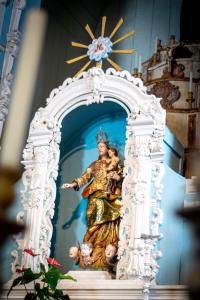
In grad school, I read a book called Veiled Threats by Michael Carroll, a Canadian scholar has written a number of books about popular/folk Catholicism in several different cultures. This book, like its predecessor Madonnas that Maim, focused on the role of the Virgin Mary in southern Italian Catholicism from the fifteenth century to the present. Carroll describes a common practice in southern Italy of covering statues of the Virgin Mary (and I believe sometimes other statues as well) with veils and only unveiling them for particular devotional purposes. People did this because they believed that such statues could harm or even kill if left permanently unveiled. They were sites of divine power and this power could be destructive as well as beneficent.
According to Carroll, the Catholic hierarchy after the Council of Trent sought to suppress this kind of Marian piety. It was not in line with the official Catholic understanding of Mary as someone whose power rests solely in her intercessory role, someone who is entirely subject to God and points us to her Son as the savior of the world. And at the time, as a Protestant who was worried that Catholics “worshiped Mary,” I was very much in sympathy with the authorities. Indeed, it was reassuring to know that the Catholic hierarchy was aware of the “dangers” of the “wrong” kind of Marian piety.
Now I think differently. I have a lot of difficulties with Catholicism, going on four years after finally swimming the Tiber in 2017. But devotion to Mary is not one of them. On the level of daily piety, I’m not hyper-Marian. I pray some form of the Liturgy of the Hours more often than the Rosary. A lot of traditional Marian piety just doesn’t do a lot for me emotionally, because it’s not the way I was brought up. And I do have a problem with forms of Marian piety that make her seem like the merciful one who can be counted on to restrain an angry Jesus. I also have questions about the dogmatizing of some of the Marian doctrines and about the way in which the concept of Mary’s virginity interacts with some troubling traditional ideas about sexuality and women’s bodies.
But can we have too much devotion to Mary? I think not. Is Mary a goddess in Catholicism? In my more heretical moments I think, “if only.”
In 2014, on the verge of moving to Kentucky after losing my teaching job in Indiana, I had a dream about Mary. She told me to move to Kentucky and she would be with me. I woke with a marvelous feeling of relief and hope that I had not had for several years. Of course it could well have been just my subconscious. But it mattered, and it still matters.
Gentle Mary, meek and mild
It also matters, I think, that the Mary of Catholic popular devotion has not always been the meek and obedient maiden of official piety. Today, feminist Catholics seek to reclaim Mary from the sentimentalism of “traditional” Catholic devotion. Contemporary Catholics point out, rightly, that the Magnificat is a song of the coming of the Kingdom and the overturning of the proud. Sometimes more conservative Catholics push back at this attempt to turn Mary into a kind of feminist “strong woman.”
But Carroll’s research shows that within popular Catholicism there is already a tradition of Mary as a being of terrifying power. It’s not simply an invention of modern feminism.
Of course, the Mary of Southern Italian folk piety (and other versions of Catholic folk piety in which Mary is a powerful and commanding presence) is not simply the “strong woman” of a feminist interpretation who stands up against the patriarchy. In the stories Carroll collected, Mary’s “victims” might themselves be women. Her vengeful actions could be seen as amoral, the actions of a supernatural being concerned with her own honor and dignity. The energy believed to emanate from some statues of the Virgin is a kind of magical force, a “mana” not necessarily connected to some kind of moral principle.
So we shouldn’t be too quick to take this “popular Mary” as a stand-in for modern feminist concerns. Nor should we dismiss the legitimate concerns with seeing Christian saints as akin to deities. Obviously it is basic Christian teaching that there is one true God and that saints derive their power from God. They act in ways that seem “godlike” because, as Orthodox teaching would put it, they have been “deified” through the action of the Holy Spirit. And the one in whom all things hold together is the Logos who became incarnate as Jesus of Nazareth. Mary and all the saints derive their spiritual importance from him and exercise their power by way of intercession, not as independent deities.
Divine electricity
And yet. . . . there’s plenty of Biblical language that speaks of God acting in “jealous” and “wrathful” ways. There are OT stories, like the story of Nadab and Abihu or Uzzah touching the Ark, in which divine power sees to act like a kind of “electricity” to “zap” people who treat sacred objects with disrespect. Certainly God is more than a kind of cosmic energy field. But also not less.
The same is true of the saints. The deifying power of the Spirit wraps them, so to speak, in the divine energy. To touch them is in some sense to touch God and come in contact with divine power. Hence the longstanding Christian tradition (with Biblical roots and contrasting with the Greco-Roman pagan horror of dead bodies) of venerating even their bones and other relics.
As a former Protestant, I get why modern American Catholics want to play down the “magical” elements of the Tradition and emphasize that saints are role models of faith and obedience and that all their power comes from their intercession. And all of that is true. But it’s not the whole truth. Catholicism is much wilder and more magical than that. God is not a tame lion. And the saints are not tame either.
The least tame of all
And least tame of all the saints is the Lady clothed with the sun, who tramples on the serpent. Catholic tradition, in fact, speaks of her as the Ark of the Covenant. (The allegorical interpretation of Scripture is another part of the tradition about which I think we should be a lot less reticent.) So the idea of divine power coming out from her images and smiting people isn’t as crazy, or as non-Biblical, as one might think.
I don’t, of course, think that the Blessed Virgin smites people capriciously or just to uphold her own importance. But I do think that we veil her too much.
We veil her under sentimental piety. We veil her under the fear of being thought idolatrous in a largely Protestant society. We veil her under patriarchal assumptions about what her virginity and her motherhood mean. We veil her under the projection of our own image of what a perfect woman is like. We veil her, most terribly of all, under the contempt that far too many of us male Catholics feel for real women.
Perhaps it’s time to unveil her and let her smite.
Previous Post
February 16, 2021
Homo factus est: Why Bishop Bode was right
Next Post

March 6, 2021 The Sacrifice of the Beloved Son
Browse Our Archives
Select a Category apologetics Bible Catholicism Christianity economics history Middle Ages personal Reformation Rodney Stark Uncategorized
Select a Month August 2026 June 2026 January 2026 December 2025 October 2025 June 2025 February 2025 December 2024 November 2024 June 2024 May 2024 January 2024 December 2023 April 2023 December 2022 November 2022 September 2022 July 2022 June 2022 April 2022 November 2021 September 2021 March 2021 February 2021 January 2021 December 2020 November 2020 October 2020 August 2020 July 2020 June 2020 May 2020 December 2018 October 2018 June 2018 March 2018 December 2017 November 2017 October 2017 September 2017 May 2017 April 2017 March 2017 February 2017 January 2017 December 2016 November 2016 October 2016 September 2016 August 2016 July 2016 June 2016 May 2016 April 2016 March 2016 January 2016 December 2015 November 2015 September 2015 June 2015 May 2015 April 2015 March 2015 February 2015 January 2015 December 2014 November 2014 October 2014 August 2014 June 2014 March 2014 January 2014 September 2013 August 2013 June 2013 August 2012 July 2012 October 2011 June 2011 March 2011 July 2010 March 2010 January 2008 May 2007 April 2007 February 2007 October 2006 August 2006 March 2006 January 2006 November 2005 October 2005 September 2005 August 2005 June 2005 May 2005 April 2005 March 2005 February 2005 January 2005 December 2004 November 2004 September 2004
Follow Us!
TAKE THE
Religious Wisdom Quiz
What happened when Jesus broke five loaves and two fish for a crowd?
Select your answer to see how you score.
A rainstorm started There were leftovers People went hungry Only five were fed
Related posts from Light in the West

What is "Christian Nationalism"? A Reply to Dennis...



TRENDING AT PATHEOS Catholic

Rejecting Doom: Christian Hope And Human Action
Christianity is a religion of hope. We are to have hope and...

It’s What Comes From Within Which Matters
One of the most difficult things for us to understand is why...

Why I Choose the Eucharist Over the Sermon
Choose the Eucharist, Not the Sermon What are we supposed to get...

5 Design Elements Found in Spiritually Rooted Homes
Putting Spirituality Into Home Decor Our homes are more than our living...

Credo: A Story of God Told with the...
About 10 years ago, I began to imagine a personal "Credo" that...

The Anatomy of Divine Revelation in Catholic Thought
The claim that God has made Himself known to human beings is...
view all Catholic blogs
Ad-Free & Subscriber Log-In Subscription Support
- About Us
- 2026 Calendar
- Videos
- Podcasts
- Library of World Religions
- Faith In Media Tracker
- Advertise With Us
- Write for Us
- Privacy Policy
- Terms of Service
- Do Not Sell My Data
- Contact Us
- Radiant Digital
- Manage Newsletter Subscriptions
- Unsubscribe From Notifications
- Sitemap
Copyright 2008-2026, Patheos. All rights reserved.
Subscription Support Ad-Free & Subscriber Log-In
Follow Patheos