
BuddhistCatholicContemplativeEvangelicalGeneral ChristianHinduJewishLatter-day SaintMuslimNew VisionsProgressive Christian
Beliefs
- Buddhist
- Catholic
- Contemplative
- Evangelical
- General Christian
- Hindu
- Jewish
- Latter-day Saint
- More Voices
- Muslim
- New Visions
- Pagan
- Progressive Christian
Topics
- Religion News
- Food and Religion
- Sports and Religion
- Religious Art
- Religious Music and Entertainment
- Religious Events
- History and Religion
- Style and Religion
- Politics and Religion
- Women in Religion
- Recreation Outdoors and Religion
- Business Finance and Religion
- Careers Workplace and Religion
- Education and Religion
- Family Parenting and Religion
- Health Fitness and Religion
- Home and Religion
- Relationships and Religion
- Technology and Religion
- Travel and Religion
Columnists
- Buddhist Columnists
- Business Finance and Religion Columnists
- Careers Workplace and Religion Columnists
- Catholic Columnists
- Contemplative Columnists
- Education and Religion Columnists
- Evangelists Columnists
- Family Parenting and Religion Columnists
- General Christian Columnists
- Health Fitness and Religion Columnists
- Hindu Columnists
- History and Religion Columnists
- Home and Religion Columnists
- Jewish Columnists
- More Voices Columnists
- Latter Day Columnists
- Muslim Columnists
- New Visions Columnists
- Nonreligious Columnists
- Pagan Columnists
- Politics and Religion Columnists
- Progressive Columnists
- Recreation Outdoors and Religion Columnists
- Relationships and Religion Columnists
- Religion News Columnists
- Religious Art Columnists
- Religious Events Columnists
- Religious Music and Entertainment Columnists
- Sports and Religion Columnists
- Style and Religion Columnists
- Technology and Religion Columnists
- Travel and Religion Columnists
- Women in Religion Columnists
Resource Library
- 2026 Calendar
- Library of World Religions
- The 100 Most Holy Places on Earth
- Patheos Answers
- Podcasts
- Videos
- Faith Leaders Database
- Anglican Episcopalian
- Bahai
- Baptist
- Buddhism
- Christianity
- Confucianism
- Eastern Orthodoxy
- Hinduism
- Holiness and Pentecostal
- ISKCON
- Islam
- Judaism
- Lutheran
- Methodist
- The Church of Jesus Christ of Latter-day Saints
- New Age
- Paganism
- Presbytarian and Reformed
- Protestantism
- Religion Behind the Scenes
- Roman Catholic
- Scientology
- Shia Islam
- Sikhism
- Sufism
- Sunni Islam
- Taoism
- Zen
- See all religions
Research Tools
 Ad-Free & Subscriber Log-In Subscription Support
Ad-Free & Subscriber Log-In Subscription Support
Follow Patheos 

- Trending:
- Forgiveness
- |
- Marriage
- |
- Consciousness
- |
- Death Penalty
- |
- Election
- |
- Halloween

- Home
- Catholic
- Homo factus est: Why Bishop Bode was right
Homo factus est: Why Bishop Bode was right
Last updated on: February 16, 2021 at 10:11 pm by Edwin Woodruff Tait
Homo factus est: Why Bishop Bode was right 2021-02-16T22:11:32-05:00 Edwin Woodruff Tait
Patheos Explore the world's faith through different perspectives on religion and spirituality! Patheos has the views of the prevalent religions and spiritualities of the world.
Did Christ become a human being or a man? According to the German bishop Franz-Josef Bode, the first answer is the correct one. At a forum he chaired on the role of women in the Church, Bishop Bode stated, about a year ago, that Christ became a “human being” rather than a “man” in the Incarnation. This shocked his episcopal colleague Bishop Strickland of Tyler, Texas, who called Bishop Bode to repent of his heresy. Due to the way Facebook brings things back on the date they were originally posted, this debate (ancient by social media standards) resurfaced in my feed this past week.
Perhaps a mere church historian such as myself should not get involved in a clash between bishops, especially one a year old. But bloggers know no shame. And the issue Bishop Bode raised remains one Catholics need to think clearly about.
What did Bishop Bode mean by this statement? Did he intend to say that Jesus of Nazareth was not a man? And is that what Bishop Strickland understood him to mean? Or was Bishop Bode saying rather that Jesus’ humanity, not his maleness, is significant for our salvation? And if that’s what he meant, is Bishop Strickland right in accusing him of falling away from the Catholic Faith?
For us men and for our salvation
The first question is easy to answer, I think. There’s no reason to think that Bishop Bode was claiming that Jesus, as a human being, was female or what we would now call intersexed. He appears to have been speaking of the Creed’s affirmation that the eternal Son of God “became man” for “us men and for our salvation.” If I understand Bishop Bode correctly, he was claiming that Jesus’ humanity, not his maleness, brings about our salvation. I’m less sure whether Bishop Strickland understood Bishop Bode’s view in this way. But the question I want to address in this post is whether Bishop Bode was, in fact, right, assuming this second interpretation of what he meant.
The first point in Bishop Bode’s favor is that the Creed says, quite explicitly, that the Son became “man” “for us men.” Nobody thinks that Jesus only saves male human beings. “Men” in that context clearly means “human beings.” It seems to make sense that “became man” has the same meaning as “for us men,” since the point is precisely that Jesus saves us by taking on our nature.
Linguistic confusion
A source of confusion here is the fact that English has historically used the same word “man” to mean “male human being” and “human being in general.” In recent decades, many people have moved away from this usage, so that to many people “man” now means “a male human being.” Typically, conservatives insist that this is unnecessary because “man” can carry both meanings. Bishop Strickland appears to be a good feminist, since he seems to agree with the view that “man” is a gender-exclusive rather than inclusive term wherever it occurs. Or perhaps the feminists have just won this particular fight. But surely Bishop Strickland realizes that the official documents of the Church, in English, are not as feminist as he is, and often use the term “man” in a gender-inclusive way.
In Latin and Greek, of course, there are separate words for the two concepts. And in both Latin and Greek versions of the Creed, the word used is “anthropos/homo” not “aner/vir.” “Human being,” not “man” in a gender-specific sense, just as Bishop Bode claimed. Furthermore, German also has this distinction, using “Mensch” for “human being” and “Mann” for male human being. (Though I believe German feminists find even “Mensch” too male-centered a term, and I’ve sometimes seen German texts say “Mannern und Frauen” rather than “Menschen” to indicate gender-inclusiveness. To me this seems unnecessary, but it’s not my language.)
In German, Bishop Bode said that Christ became for us “Mensch” not “Mann.” In saying this, he affirmed exactly what the Creed says, only adding the negative qualification. But this negative qualification follows from the use of a gender-inclusive term (anthropos/homo/Mensch) where Latin and Greek, like German, have a gender-specific one available.
Unresolved theological business
The historic English use of “man” in both senses, and the insistence of the Church’s hierarchy on using “man” in a gender-inclusive sense even as many English-speakers move away from that usage, seems to have misled Bishop Strickland into thinking that Bishop Bode was saying something heretical when he was literally quoting the Creed. But the theological issue behind the linguistic one remains unresolved.
What is the significance of the maleness of Jesus? How is the historical fact of Jesus’ maleness related to the salvific (as well as historical) fact of his humanity? Does Jesus save us by his maleness as well as by his humanity?
These questions boil away under all the debates over the role of women in the Church. And yes, that includes the debate over the ordination of women that St. John Paul II declared closed a quarter of a century ago.
In persona Christi
JPII’s Ordinatio Sacerdotalis does not address most of the substantive theological issues surrounding the question of the ordination of women. JPII cites Jesus’ choice of twelve men and the historic practice of the Church as justifications for continuing the restriction of ordination to men, and declares that the Church has no authority to ordain women. The earlier document Inter Insignores, written by Franjo Cardinal Seper and approved by Paul VI, offers more theological arguments.
Cardinal Seper acknowledges that Jesus took on our common human nature: “Christ is of course the firstborn of all humanity, of women as well as men: the unity which he re-established after sin is such that there are no more distinctions between Jew and Greek, slave and free, male and female, but all are one in Christ Jesus (Gal.3:28).” Nonetheless, he finds it significant that the Incarnation took place “according to the male sex.” Because of the “nuptial mystery” under which the Biblical narrative of salvation is presented, Jesus’ maleness is significant for purposes of sacramental representation. Hence, though Jesus saves everyone, only men can represent him sacramentally.
Unfinished business
Ordinatio Sacerdotalis implicitly affirms this line of reasoning and declares the debate closed. But as many previous controversies could have shown us, authority never solves a debate all by itself. The theological issues have to be addressed.
When we don’t do that, we wind up with one bishop accusing another of heresy for affirming the language of the Nicene Creed.
We wind up with comfortable caricatures of the arguments for women’s ordination as merely “secular” and “political,” when in fact the fundamental question is a Christological and soteriological one.
And we also wind up with a radicalization of the pro-WO position, because people with more generally orthodox views are going to respect the Magisterium’s ruling that the debate is closed. That further confirms conservative Catholics in their belief that there are no serious theological arguments to be considered.
This is a personal issue for me, because my wife is an Episcopal priest. In becoming Catholic, I committed to accepting the authority of the Magisterium. But as Bishop Strickland’s tweet demonstrated, there’s a lot of unfinished business here. And if we don’t occasionally point this out, the business will remain unfinished.
The key debates of our time seem to concern anthropology: what does it mean to be human. For Christians, those debates are fundamentally about Christology: what does it mean that God became human? We will never come to an end of exploring the mystery in those words “homo factus est.”
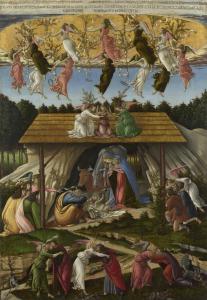
Image: “Mystical Nativity,” by Sandro Botticelli, National Gallery, London
Previous Post

January 23, 2021
If this isn't a prolife issue, then nothing is
Next Post
February 21, 2021 Unveiling the Virgin
Browse Our Archives
Select a Category apologetics Bible Catholicism Christianity economics history Middle Ages personal Reformation Rodney Stark Uncategorized
Select a Month August 2026 June 2026 January 2026 December 2025 October 2025 June 2025 February 2025 December 2024 November 2024 June 2024 May 2024 January 2024 December 2023 April 2023 December 2022 November 2022 September 2022 July 2022 June 2022 April 2022 November 2021 September 2021 March 2021 February 2021 January 2021 December 2020 November 2020 October 2020 August 2020 July 2020 June 2020 May 2020 December 2018 October 2018 June 2018 March 2018 December 2017 November 2017 October 2017 September 2017 May 2017 April 2017 March 2017 February 2017 January 2017 December 2016 November 2016 October 2016 September 2016 August 2016 July 2016 June 2016 May 2016 April 2016 March 2016 January 2016 December 2015 November 2015 September 2015 June 2015 May 2015 April 2015 March 2015 February 2015 January 2015 December 2014 November 2014 October 2014 August 2014 June 2014 March 2014 January 2014 September 2013 August 2013 June 2013 August 2012 July 2012 October 2011 June 2011 March 2011 July 2010 March 2010 January 2008 May 2007 April 2007 February 2007 October 2006 August 2006 March 2006 January 2006 November 2005 October 2005 September 2005 August 2005 June 2005 May 2005 April 2005 March 2005 February 2005 January 2005 December 2004 November 2004 September 2004
Follow Us!
TAKE THE
Religious Wisdom Quiz
Who was Abraham's wife?
Select your answer to see how you score.
Sarah Leah Rebekah Rachel
Related posts from Light in the West

What is "Christian Nationalism"? A Reply to Dennis...



TRENDING AT PATHEOS Catholic

Rejecting Doom: Christian Hope And Human Action
Christianity is a religion of hope. We are to have hope and...

It’s What Comes From Within Which Matters
One of the most difficult things for us to understand is why...

Why I Choose the Eucharist Over the Sermon
Choose the Eucharist, Not the Sermon What are we supposed to get...

5 Design Elements Found in Spiritually Rooted Homes
Putting Spirituality Into Home Decor Our homes are more than our living...

Credo: A Story of God Told with the...
About 10 years ago, I began to imagine a personal "Credo" that...

The Anatomy of Divine Revelation in Catholic Thought
The claim that God has made Himself known to human beings is...
view all Catholic blogs
Ad-Free & Subscriber Log-In Subscription Support
- About Us
- 2026 Calendar
- Videos
- Podcasts
- Library of World Religions
- Faith In Media Tracker
- Advertise With Us
- Write for Us
- Privacy Policy
- Terms of Service
- Do Not Sell My Data
- Contact Us
- Radiant Digital
- Manage Newsletter Subscriptions
- Unsubscribe From Notifications
- Sitemap
Copyright 2008-2026, Patheos. All rights reserved.
Subscription Support Ad-Free & Subscriber Log-In
Follow Patheos