
BuddhistCatholicContemplativeEvangelicalGeneral ChristianHinduJewishLatter-day SaintMuslimNew VisionsProgressive Christian
Beliefs
- Buddhist
- Catholic
- Contemplative
- Evangelical
- General Christian
- Hindu
- Jewish
- Latter-day Saint
- More Voices
- Muslim
- New Visions
- Pagan
- Progressive Christian
Topics
- Religion News
- Food and Religion
- Sports and Religion
- Religious Art
- Religious Music and Entertainment
- Religious Events
- History and Religion
- Style and Religion
- Politics and Religion
- Women in Religion
- Recreation Outdoors and Religion
- Business Finance and Religion
- Careers Workplace and Religion
- Education and Religion
- Family Parenting and Religion
- Health Fitness and Religion
- Home and Religion
- Relationships and Religion
- Technology and Religion
- Travel and Religion
Columnists
- Buddhist Columnists
- Business Finance and Religion Columnists
- Careers Workplace and Religion Columnists
- Catholic Columnists
- Contemplative Columnists
- Education and Religion Columnists
- Evangelists Columnists
- Family Parenting and Religion Columnists
- General Christian Columnists
- Health Fitness and Religion Columnists
- Hindu Columnists
- History and Religion Columnists
- Home and Religion Columnists
- Jewish Columnists
- More Voices Columnists
- Latter Day Columnists
- Muslim Columnists
- New Visions Columnists
- Nonreligious Columnists
- Pagan Columnists
- Politics and Religion Columnists
- Progressive Columnists
- Recreation Outdoors and Religion Columnists
- Relationships and Religion Columnists
- Religion News Columnists
- Religious Art Columnists
- Religious Events Columnists
- Religious Music and Entertainment Columnists
- Sports and Religion Columnists
- Style and Religion Columnists
- Technology and Religion Columnists
- Travel and Religion Columnists
- Women in Religion Columnists
Resource Library
- 2026 Calendar
- Library of World Religions
- The 100 Most Holy Places on Earth
- Patheos Answers
- Podcasts
- Videos
- Faith Leaders Database
- Anglican Episcopalian
- Bahai
- Baptist
- Buddhism
- Christianity
- Confucianism
- Eastern Orthodoxy
- Hinduism
- Holiness and Pentecostal
- ISKCON
- Islam
- Judaism
- Lutheran
- Methodist
- The Church of Jesus Christ of Latter-day Saints
- New Age
- Paganism
- Presbytarian and Reformed
- Protestantism
- Religion Behind the Scenes
- Roman Catholic
- Scientology
- Shia Islam
- Sikhism
- Sufism
- Sunni Islam
- Taoism
- Zen
- See all religions
Research Tools
 Ad-Free & Subscriber Log-In Subscription Support
Ad-Free & Subscriber Log-In Subscription Support
Follow Patheos 

- Trending:
- Forgiveness
- |
- Marriage
- |
- Consciousness
- |
- Death Penalty
- |
- Election
- |
- Halloween

- Home
- Catholic
- Allegory gone wild?
Allegory gone wild?
Last updated on: June 17, 2024 at 12:17 pm by Edwin Woodruff Tait
Allegory gone wild? 2024-06-17T12:17:21-05:00 Edwin Woodruff Tait
Patheos Explore the world's faith through different perspectives on religion and spirituality! Patheos has the views of the prevalent religions and spiritualities of the world.
My trusty colleague and sparring partner in matters of Biblical interpretation, “Fellow Dying Inmate,” wrote a post back in August on the book of Revelation that upset a number of readers.
Of course, writing on Revelation is bound to upset a lot of people. I would have thought that Catholics would be less inclined to go ballistic on these subjects than evangelical Protestants, but alas, I’m no longer sure that’s true.
Four Gospels or four constellations?
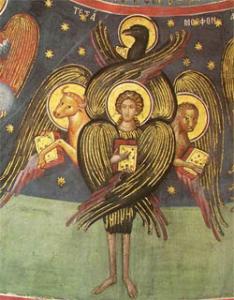
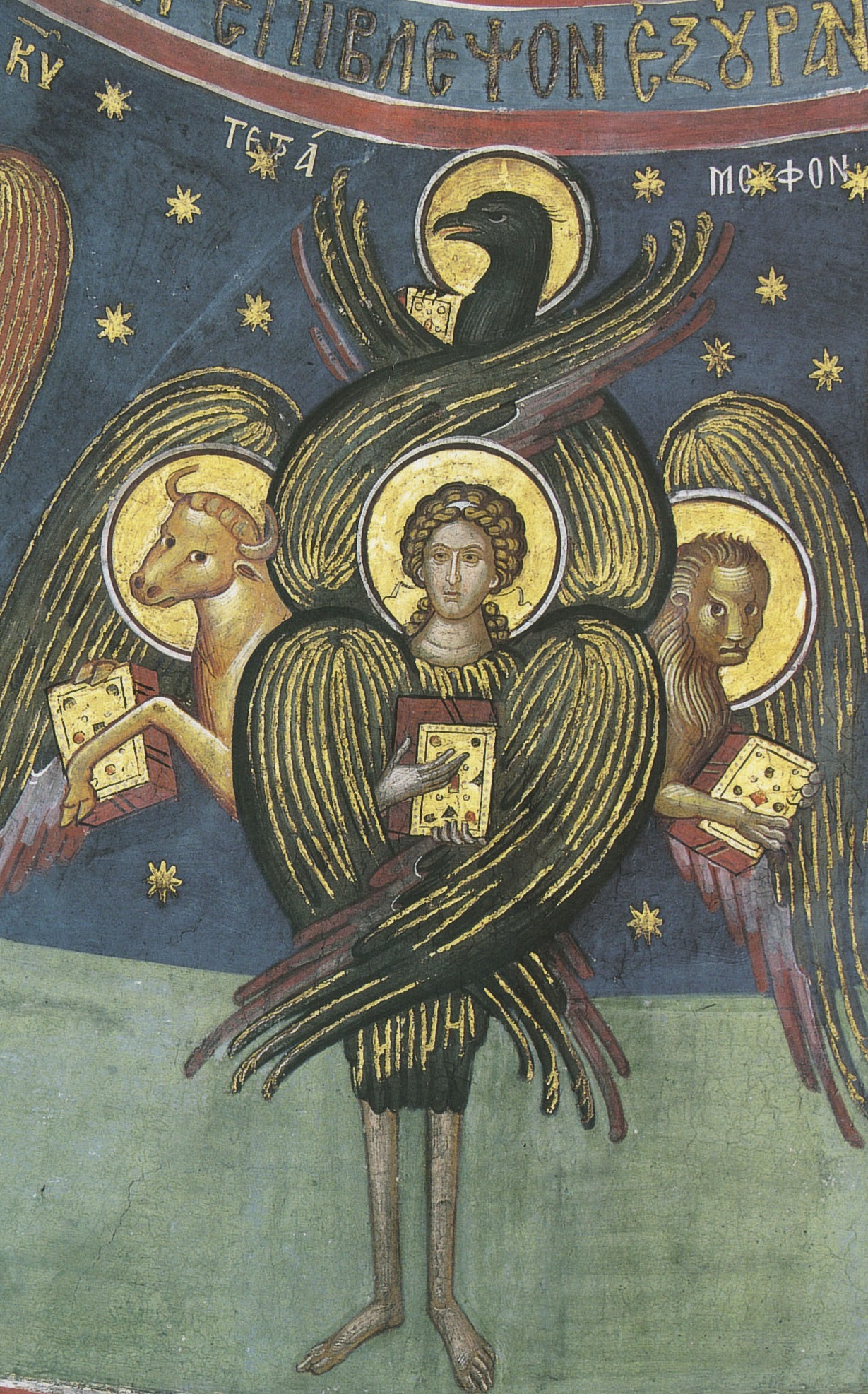
FDI argued, in particular, that the “four living creatures” of Revelation do not represent the four Gospels, as widespread Christian tradition holds, but rather four constellations in the sky, heavenly servants of God. The lion would be Leo and the ox/bull Taurus. (He doesn’t explain what the other two are.) He disparaged the traditional interpretation as “allegory gone wild” and particularly criticized Scott Hahn for making this kind of interpretation popular once more. Instead, FDI argued, we must base our interpretations on the literal sense of Scripture: what the original author intended.
On the Patheos Catholic Facebook page, one reader claimed that this post was further proof that the Patheos Catholic channel isn’t really Catholic. Another suggested trying to get bishops to intervene (presumably to declare us all heretics). As FDI pointed out in some bemusement, this is a pretty extreme reaction to the claim that a particular pious interpretation of weird imagery in a notoriously obscure Biblical book is not in fact justified by the literal sense of the text.
Literary forms vs. living tradition
On the other hand, I think FDI’s post does raise a lot of significant questions about how Catholics should interpret Scripture. FDI rightly points out that Vatican II calls us pay attention to the sense intended by the human authors and to the “literary forms” they used in the context of their own time :
However, since God speaks in Sacred Scripture through men in human fashion, (6) the interpreter of Sacred Scripture, in order to see clearly what God wanted to communicate to us, should carefully investigate what meaning the sacred writers really intended, and what God wanted to manifest by means of their words.
To search out the intention of the sacred writers, attention should be given, among other things, to “literary forms.” For truth is set forth and expressed differently in texts which are variously historical, prophetic, poetic, or of other forms of discourse. The interpreter must investigate what meaning the sacred writer intended to express and actually expressed in particular circumstances by using contemporary literary forms in accordance with the situation of his own time and culture. (7) For the correct understanding of what the sacred author wanted to assert, due attention must be paid to the customary and characteristic styles of feeling, speaking and narrating which prevailed at the time of the sacred writer, and to the patterns men normally employed at that period in their everyday dealings with one another. (DV 3.12)
Having established the importance of careful literary/historical reading of the text, however, the Constitution on Divine Revelation goes on to say this:
But, since Holy Scripture must be read and interpreted in the sacred spirit in which it was written, (9) no less serious attention must be given to the content and unity of the whole of Scripture if the meaning of the sacred texts is to be correctly worked out. The living tradition of the whole Church must be taken into account along with the harmony which exists between elements of the faith. It is the task of exegetes to work according to these rules toward a better understanding and explanation of the meaning of Sacred Scripture, so that through preparatory study the judgment of the Church may mature. For all of what has been said about the way of interpreting Scripture is subject finally to the judgment of the Church, which carries out the divine commission and ministry of guarding and interpreting the word of God.
Widening the gap
In the years following Vatican II, the Council’s approval of historical-critical interpretation led to an explosion of Catholic Biblical scholarship. This has greatly enriched our understanding of Scripture. But conventional historical-critical scholarship is not well adapted to fulfilling the second aspect of Biblical interpretation called for by the Council: attention to the whole meaning of Scripture and particularly to the function of Scripture within the “living tradition of the Church.” The “canonical criticism” of the Old Testament pioneered by Brevard Childs is a really healthy and welcome development within Biblical scholarship. But for the New Testament–and indeed for the Christian Bible as a complete canonical collection–canonical criticism must include attention to the interpretations of the Church Fathers and the way the canon of Scripture functioned for them.
Unfortunately, a lot of Catholic Biblical scholarship seems quite content with a “literal” sense of Scripture that does not support the teaching of the Church. Many scholars seem to see this as totally fine. After all, Catholics don’t believe in sola scriptura. It’s possible for us to say “this doctrine is not taught by the literal sense of Scripture but we believe in it based on Tradition.”
Ironically, this common post-Vatican II approach widens the gap between Scripture and Catholic theology which Vatican II endeavored to close. It’s no secret (though many apologists try to explain it away) that for centuries (from the late Middle Ages until the 19th century) the Church tended to take a rather dim view of laypeople reading Scripture. Catholic theology and devotion was, of course, always deeply rooted in Scripture, but often in a rather indirect way. And for laypeople it was mediated by layers of interpretation and selection, more often than not.
Vatican II reaffirmed that Scripture should be accessible to the whole people of God. It stressed the Scriptural roots of Catholic theology. And yet, ironically, by opening the door to historical criticism it also provided a new way in which Scripture became inaccessible to ordinary laypeople.
It is a noble thing to take the original context of Scripture seriously. But the line between the most probable meaning of Scripture to its original authors/readers and a meaning that is relevant to us in our very different contest is not always a direct or easy one.
From alienation to application
FDI’s posts dramatize this repeatedly. He’s a big fan of the “Context Group” of Biblical scholars who have very specific ideas about just how our understanding of ancient Mediterranean culture should shape our interpretation of Scripture. These scholars’ interpretations are not always shared by other historical critics, so shouldn’t be taken as identical with historical criticism as a whole. But the issues they raise are certainly issues that anyone who takes the historical study of Scripture must face.
FDI is fond of translations of NT terms that create a kind of “alienation effect” reminding us how alien the world of Jesus was: “sky vault” instead of “heaven” and so on. The question is: where does this go for us theologically and spiritually? Does it lead to an enriched understanding of our faith or does it simply lead us to feel that the New Testament world is so alien that it has nothing to say to us?
Obviously FDI doesn’t think the latter. But I confess that reading his posts I find it hard to tell at times just how he goes about reconciling his understanding of Scripture with Catholic faith. At times he seems to be saying that our faith has gone in a different direction than the Scriptural text would indicate and that’s fine. At other times, as in his most recent post on holiness, he’s clearly calling us to take the ancient understanding more seriously and allow our modern Western perspective to be modified. (In this case, to be more open to the possibility of “altered states of consciousness.”) I find FDI’s posts challenging and often illuminating, and I don’t question his deep Catholic faith for an instant. But I’d like to see a more sustained account of how theology and Biblical interpretation (as he understands it) are connected.
Reviving the fourfold method
My own view has been for many years that we need a revived appreciation of the traditional “fourfold method” of Biblical interpretation. What FDI disdains as “allegory gone wild” I see as, on the whole, a fruitful and appropriate method of interpreting Scripture, into which the insights of modern historical scholarship need to be integrated.
But that’s a subject for a separate post. Possibly many separate posts.
Image from Wikipedia
Previous Post
August 23, 2020
Standing on the Promises: Why Catholics believe Peter is the Rock
Next Post

October 27, 2020 Loud Live the Dogma: Amy Coney Barrett and the Secular Fallacy
Browse Our Archives
Select a Category apologetics Bible Catholicism Christianity economics history Middle Ages personal Reformation Rodney Stark Uncategorized
Select a Month August 2026 June 2026 January 2026 December 2025 October 2025 June 2025 February 2025 December 2024 November 2024 June 2024 May 2024 January 2024 December 2023 April 2023 December 2022 November 2022 September 2022 July 2022 June 2022 April 2022 November 2021 September 2021 March 2021 February 2021 January 2021 December 2020 November 2020 October 2020 August 2020 July 2020 June 2020 May 2020 December 2018 October 2018 June 2018 March 2018 December 2017 November 2017 October 2017 September 2017 May 2017 April 2017 March 2017 February 2017 January 2017 December 2016 November 2016 October 2016 September 2016 August 2016 July 2016 June 2016 May 2016 April 2016 March 2016 January 2016 December 2015 November 2015 September 2015 June 2015 May 2015 April 2015 March 2015 February 2015 January 2015 December 2014 November 2014 October 2014 August 2014 June 2014 March 2014 January 2014 September 2013 August 2013 June 2013 August 2012 July 2012 October 2011 June 2011 March 2011 July 2010 March 2010 January 2008 May 2007 April 2007 February 2007 October 2006 August 2006 March 2006 January 2006 November 2005 October 2005 September 2005 August 2005 June 2005 May 2005 April 2005 March 2005 February 2005 January 2005 December 2004 November 2004 September 2004
Follow Us!
TAKE THE
Religious Wisdom Quiz
The sun will be turned to darkness and the moon to blood before the coming of what great and dreadful event?
Select your answer to see how you score.
The end of the world The final judgment The day of the Lord Christ's return
Related posts from Light in the West

Thoughts on Isaiah, ISIS, and the Peaceable Kingdom

Greg Boyd's warfare theology part 2--God at war...

Canon and authority--a common Catholic argument analyzed

Progressive revelation in the OT: A response to...
TRENDING AT PATHEOS Catholic

Rejecting Doom: Christian Hope And Human Action
Christianity is a religion of hope. We are to have hope and...

It’s What Comes From Within Which Matters
One of the most difficult things for us to understand is why...

Why I Choose the Eucharist Over the Sermon
Choose the Eucharist, Not the Sermon What are we supposed to get...

5 Design Elements Found in Spiritually Rooted Homes
Putting Spirituality Into Home Decor Our homes are more than our living...

Credo: A Story of God Told with the...
About 10 years ago, I began to imagine a personal "Credo" that...

The Anatomy of Divine Revelation in Catholic Thought
The claim that God has made Himself known to human beings is...
view all Catholic blogs
Ad-Free & Subscriber Log-In Subscription Support
- About Us
- 2026 Calendar
- Videos
- Podcasts
- Library of World Religions
- Faith In Media Tracker
- Advertise With Us
- Write for Us
- Privacy Policy
- Terms of Service
- Do Not Sell My Data
- Contact Us
- Radiant Digital
- Manage Newsletter Subscriptions
- Unsubscribe From Notifications
- Sitemap
Copyright 2008-2026, Patheos. All rights reserved.
Subscription Support Ad-Free & Subscriber Log-In
Follow Patheos