
BuddhistCatholicContemplativeEvangelicalGeneral ChristianHinduJewishLatter-day SaintMuslimNew VisionsProgressive Christian
Beliefs
- Buddhist
- Catholic
- Contemplative
- Evangelical
- General Christian
- Hindu
- Jewish
- Latter-day Saint
- More Voices
- Muslim
- New Visions
- Pagan
- Progressive Christian
Topics
- Religion News
- Food and Religion
- Sports and Religion
- Religious Art
- Religious Music and Entertainment
- Religious Events
- History and Religion
- Style and Religion
- Politics and Religion
- Women in Religion
- Recreation Outdoors and Religion
- Business Finance and Religion
- Careers Workplace and Religion
- Education and Religion
- Family Parenting and Religion
- Health Fitness and Religion
- Home and Religion
- Relationships and Religion
- Technology and Religion
- Travel and Religion
Columnists
- Buddhist Columnists
- Business Finance and Religion Columnists
- Careers Workplace and Religion Columnists
- Catholic Columnists
- Contemplative Columnists
- Education and Religion Columnists
- Evangelists Columnists
- Family Parenting and Religion Columnists
- General Christian Columnists
- Health Fitness and Religion Columnists
- Hindu Columnists
- History and Religion Columnists
- Home and Religion Columnists
- Jewish Columnists
- More Voices Columnists
- Latter Day Columnists
- Muslim Columnists
- New Visions Columnists
- Nonreligious Columnists
- Pagan Columnists
- Politics and Religion Columnists
- Progressive Columnists
- Recreation Outdoors and Religion Columnists
- Relationships and Religion Columnists
- Religion News Columnists
- Religious Art Columnists
- Religious Events Columnists
- Religious Music and Entertainment Columnists
- Sports and Religion Columnists
- Style and Religion Columnists
- Technology and Religion Columnists
- Travel and Religion Columnists
- Women in Religion Columnists
Resource Library
- 2026 Calendar
- Library of World Religions
- The 100 Most Holy Places on Earth
- Patheos Answers
- Podcasts
- Videos
- Faith Leaders Database
- Anglican Episcopalian
- Bahai
- Baptist
- Buddhism
- Christianity
- Confucianism
- Eastern Orthodoxy
- Hinduism
- Holiness and Pentecostal
- ISKCON
- Islam
- Judaism
- Lutheran
- Methodist
- The Church of Jesus Christ of Latter-day Saints
- New Age
- Paganism
- Presbytarian and Reformed
- Protestantism
- Religion Behind the Scenes
- Roman Catholic
- Scientology
- Shia Islam
- Sikhism
- Sufism
- Sunni Islam
- Taoism
- Zen
- See all religions
Research Tools
 Ad-Free & Subscriber Log-In Subscription Support
Ad-Free & Subscriber Log-In Subscription Support
Follow Patheos 

- Trending:
- Forgiveness
- |
- Marriage
- |
- Consciousness
- |
- Death Penalty
- |
- Election
- |
- Halloween

- Home
- Catholic
- Standing on the Promises: Why Catholics believe Peter is the Rock
Standing on the Promises: Why Catholics believe Peter is the Rock
Last updated on: August 23, 2020 at 2:33 pm by Edwin Woodruff Tait
Standing on the Promises: Why Catholics believe Peter is the Rock 2020-08-23T14:33:43-05:00 Edwin Woodruff Tait
Patheos Explore the world's faith through different perspectives on religion and spirituality! Patheos has the views of the prevalent religions and spiritualities of the world.
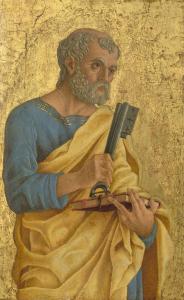
During my 19 years of being an Episcopalian, this particular Sunday in the church year was always uncomfortable for me. Every three years Matthew 16 would roll around and the priest would explain why “we” didn’t read this passage the way the “Roman Catholics” did. And almost invariably, the explanation would strike me as rather feeble. It was part of my general sense that as an Episcopalian (and as a Protestant generally) I wasn’t signing on to full-throated, unequivocal Christianity but to a somewhat watered-down, cautious version.
I’m speaking specifically of my experience as a mainline, ecumenical Protestant. While obviously I have my disagreements with conservative Protestant interpretations of this passage too, my objection to those versions is not so much that they are watered down (though in some ways they are) but that they are too narrow. It’s a different conversation.
The many possibilities of Matthew 16
Also, I’m not arguing that exegetically the “Rock” must be Peter. And still less am I arguing that the passage must mean that Peter (if he is the “Rock”) must have successors and that the bishops of Rome are, uniquely, those successors. Like much of Scripture, this passage can mean a lot of things. Catholic apologetic arguments claiming that Protestants must believe that “Jesus lied” are, like most apologetic arguments, pretty silly.
Indeed, many of the Fathers commenting on this passage interpret the “Rock” as Peter’s faith, or as Christ. And furthermore, many of them speak of all bishops, not just the bishop of Rome, as successors of Peter.
Furthermore, the entire “You are Peter” speech is unique to Matthew. In Mark–probably the earliest version of the story–Jesus simply warns the disciples not to tell other people about him and the story moves on.
Of course it’s possible that Matthew had additional information Mark didn’t record. (And it is possible that Matthew was actually written first. That’s a minority view among scholars but there are some arguments for it.) But Matthew on the whole seems more interested in theological meaning than in historical detail. He often seems to add theological “glosses” to the story.
So it seems more likely, on the whole, that the entire passage on which Catholics build so much is a theological “midrash” by the author of the First Gospel. Matthew is telling us how the significance of Peter’s confession was understood by his community. That is one of the many reasons why the “spiral argument” popularized by Karl Keating doesn’t work. We can’t be sure, by purely historical means, that the historical Jesus said these words or intended to “found a Church.” (Many people would confidently assert that Jesus intended no such thing, but I think that’s going too far on the other side.)
Seeing this passage as a later first-century theological “gloss” rather than a direct account of something the historical Jesus said actually strengthens the Catholic case. It would seem that Christians began to see Peter’s confession as the basis for some kind of institutional leadership position very early indeed.
A hermeneutic of plenitude
But the key principle for me is what could be called the exegetical “principle of plenitude,” which is foundational to traditional Catholic (i.e., traditional Christian) exegesis. Modern exegetical methods seek to determine the one correct meaning and treat various alternatives as mutually exclusive. A good exegete is expected to approach a proposed interpretation with a hermeneutic of suspicion. One needs to have a good reason to believe that this particular interpretation is in fact the one intended by the author and/or understood by the original audience.
Traditional Christian Biblical interpretation and theology, on the other hand, proceed on the assumption that divine revelation is manifold and reveals greater depth and richness the more we explore it. The “development of doctrine” is a never-ending journey into those depths. (For a succinct Protestant defense of the traditional approach to Scripture, see my doctoral advisor David Steinmetz’ essay “On the Superiority of Pre-critical Exegesis,” unfortunately not freely available online.)
Or, to use an apologetics cliche that I actually like, the Catholic approach is both/and, not either/or. Once one has begun to think about the Bible and theology in this way, the either/or approach is going to seem like very thin porridge indeed.
Several rocks or one?
Thus, the varying possible interpretations of Jesus’ statement “on this rock I will build my church” are not necessarily mutually incompatible.
Jesus is, of course, the Rock. That’s an obvious starting point, given passages such as 1 Cor. 3:11, 1 Cor. 10:4, Ephesians 2:20, Romans 9:33, and 1 Peter 2:6, drawing on Old Testament references to “cornerstones” and “stumbling stones” in Psalms and Isaiah.
And Peter’s faith and confession, by resting on that rock, become part of it, so that the Church can be said to rest on the confession of faith first made by Peter.
But in a traditional method of interpretation that doesn’t rule out the possibility that Peter is also, in some personal and covenantal sense, the Rock. The pun on Peter’s name is almost certainly not a contrast (“pebble” vs. “rock”) as some Protestants claim, but an identification. Peter is called “Rocky” because of his faith and confession in Christ the Rock.
St. Augustine, drawing on the work of the Donatist Tychonius, articulated the exegetical principle “head/body/members.” That is to say, often what Scripture says about Christ may also be said about the Church and about individual members of the Church. Again, this is an approach to interpretation that looks for plenitude and harmony rather than exclusion and sharp alternatives.
Protestants understandably worry that this kind of interpretation deifies Peter and his alleged successors, equating them with Christ. But the point is precisely that it’s Christ’s promise that makes Peter the Rock, based on Peter’s confession of faith. The three “rocks” are three aspects of the same thing–what Karl Adam would call Jesus’ “redeeming might” at work in the Church. Jesus, who is the one foundation of our faith, builds his Church on his sovereign and gracious promise received by faith, and received by a particular person. This person receives a new name, as the key figures in earlier stages of the covenant (such as Abraham) had done. The consistent Biblical pattern is that God works in the world through specific people who then become the foundation for the new stage of God’s revelation and the new manifestation of the people of God in the world. This to my mind is the most satisfying and reasonable interpretation of Matthew 16, one that accounts for all the possibilities instead of setting them against each other.
And the same is true of the further question of whether Peter has successors and who they are. All of us who share his confession are, fundamentally, his successors. But in a more specific way, those who have been entrusted with the pastoral care of the Church–the bishops standing in succession from the apostles–exercise Peter’s ministry with regard to the rest of us (as the Fathers said). And most specifically, the bishop of Rome, the city where both Peter and Paul were martyred, exercises this ministry with regard to other bishops, to the rest of the Church, and to the world. Again, the principle is “both/and”: concentric circles rather than mutually exclusive alternatives.
None of this is proof. I’m not trying to prove the Catholic view. I’m trying to explain its coherence and imaginative appeal.
Papal probabilities
The most powerful objection is not an exegetical one but a historical and experiential one. If the Popes are successors of Peter, why haven’t they acted like it more often? Why has the office of the Papacy often been a source of division? Why have so many Popes used their office to claim power and control over both Church and society rather than truly acting as the “servants of the servants of God” they claim to be?
Catholics are wrong, I think, to dismiss this objection. Yes, it’s true that we don’t claim that the office of the Papacy will always be held by holy people. But why don’t we? If what we claim is true, wouldn’t we expect that the Popes would on the whole have set a better example?
Jerry Walls, a Protestant philosopher and a friend of mine, has made this argument in his co-authored book Roman but not Catholic. I’m going to address Walls’ argument–and the book as a whole–in more detail in later posts. The basic argument from probability is that one would expect that if Catholicism were true, Popes would be better than they have been. I think that’s clearly true.
It’s also true that we would expect that if God were real, then there would be no evil in the world, or at least less than there is. We would expect that if Christianity were true, then Christians as a whole (not just Popes and not just Catholics for that matter) would be better examples than they are. In other words, as Newman pointed out (though I confess I don’t remember exactly where), this kind of argument against Catholicism is a subset of the problem of evil.
That doesn’t make it negligible. The problem of evil is the strongest reason to disbelieve in God. And its analogs are the strongest reasons to disbelieve both in Christianity as a whole and in Catholicism in particular. Nor is it necessarily true that each more specific version of this argument is no stronger than the preceding one. But in each case we have to look at the other reasons we have for believing in God/Christianity/Catholicism and whether we can make a reasonable case for why, in fact, God might allow evil that we would have expected He would prevent.
The promise of God
Fundamentally, to believe in Catholicism is to believe in Christ’s unequivocal and unalterable promise. That doesn’t mean that Protestants think “Jesus lied,” as silly apologists claim. But it does mean that they hold to a somewhat weaker version of the promise. They hold to a view in which we must sort through various Christian communities to see which of them best matches our vision of the true Church. (Or, which I find much more defensible, we must just stick with the one we started in and work for unity with the others.)
Catholics believe in the Papacy not because we think the Papacy is so awesome but because it is the most concrete and personal embodiment of Christ’s faithfulness.
As was the case last week, the Epistle reading strengthens the message of the Gospel reading. It’s the end of Paul’s complex discussion of divine election and the relationship between Israel and the emerging Christian church. Paul has affirmed that “the gifts and calling of God are without repentance.” God is, in some sense, “stuck” with Israel even if Israel is not always faithful. God will always find a way to overcome our unfaithfulness with His faithfulness. And as the great closing doxology says, God does this in ways that are unfathomable to us.
As Catholics, we believe that God expresses His faithfulness to the Church in tying Himself to a particular flawed human being (Peter) and his even more flawed successors, and being faithful to the community gathered around them. He shows this faithfulness by not allowing us to reject the Faith even as, through our own sinful use of free will, we so often fail to live up to it.
Is this the only way God could have acted? No. Is it how we might expect, in the abstract, God to act? Quite possibly not.
But is it in keeping with God’s constant pattern of action revealed in Scripture? Yes, I think it clearly is.
Does it make richer and fuller sense of the available Scriptural (and patristic) evidence than the alternatives? Yes, I believe it does.
We believe not so much in the Pope, whether person or office, as in the promise of God. The Pope is the living sign of that promise. The Papacy exists not to draw attention to itself but to hold together a community that rests on the death and resurrection of Jesus and Jesus’ promise that he would never abandon those who believe in him.
Previous Post
August 21, 2020
Remembering St. Bernard: Theologian of love
Next Post
October 6, 2020 Allegory gone wild?
Browse Our Archives
Select a Category apologetics Bible Catholicism Christianity economics history Middle Ages personal Reformation Rodney Stark Uncategorized
Select a Month August 2026 June 2026 January 2026 December 2025 October 2025 June 2025 February 2025 December 2024 November 2024 June 2024 May 2024 January 2024 December 2023 April 2023 December 2022 November 2022 September 2022 July 2022 June 2022 April 2022 November 2021 September 2021 March 2021 February 2021 January 2021 December 2020 November 2020 October 2020 August 2020 July 2020 June 2020 May 2020 December 2018 October 2018 June 2018 March 2018 December 2017 November 2017 October 2017 September 2017 May 2017 April 2017 March 2017 February 2017 January 2017 December 2016 November 2016 October 2016 September 2016 August 2016 July 2016 June 2016 May 2016 April 2016 March 2016 January 2016 December 2015 November 2015 September 2015 June 2015 May 2015 April 2015 March 2015 February 2015 January 2015 December 2014 November 2014 October 2014 August 2014 June 2014 March 2014 January 2014 September 2013 August 2013 June 2013 August 2012 July 2012 October 2011 June 2011 March 2011 July 2010 March 2010 January 2008 May 2007 April 2007 February 2007 October 2006 August 2006 March 2006 January 2006 November 2005 October 2005 September 2005 August 2005 June 2005 May 2005 April 2005 March 2005 February 2005 January 2005 December 2004 November 2004 September 2004
Follow Us!
TAKE THE
Religious Wisdom Quiz
Who was Solomon's mother?
Select your answer to see how you score.
Bathsheba Ruth Rahab Tamar
Related posts from Light in the West

What is "Christian Nationalism"? A Reply to Dennis...



TRENDING AT PATHEOS Catholic

Rejecting Doom: Christian Hope And Human Action
Christianity is a religion of hope. We are to have hope and...

It’s What Comes From Within Which Matters
One of the most difficult things for us to understand is why...

Why I Choose the Eucharist Over the Sermon
Choose the Eucharist, Not the Sermon What are we supposed to get...

5 Design Elements Found in Spiritually Rooted Homes
Putting Spirituality Into Home Decor Our homes are more than our living...

Credo: A Story of God Told with the...
About 10 years ago, I began to imagine a personal "Credo" that...

The Anatomy of Divine Revelation in Catholic Thought
The claim that God has made Himself known to human beings is...
view all Catholic blogs
Ad-Free & Subscriber Log-In Subscription Support
- About Us
- 2026 Calendar
- Videos
- Podcasts
- Library of World Religions
- Faith In Media Tracker
- Advertise With Us
- Write for Us
- Privacy Policy
- Terms of Service
- Do Not Sell My Data
- Contact Us
- Radiant Digital
- Manage Newsletter Subscriptions
- Unsubscribe From Notifications
- Sitemap
Copyright 2008-2026, Patheos. All rights reserved.
Subscription Support Ad-Free & Subscriber Log-In
Follow Patheos